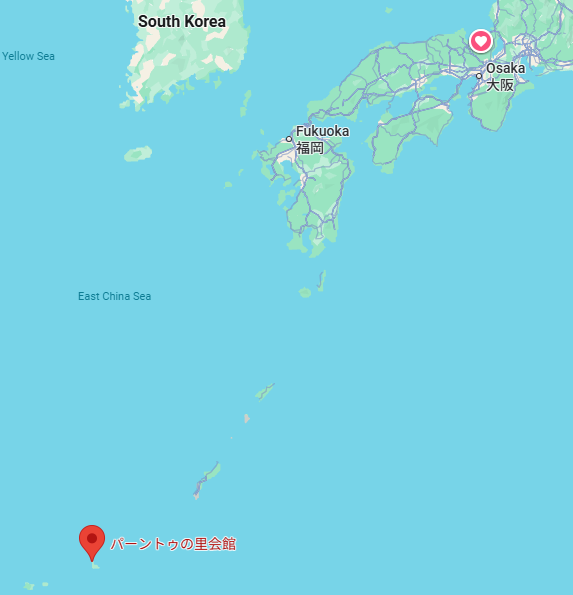
In 2018, UNESCO listed 10 Japanese Visiting Deity events on its World Heritage List (official name: ritual visits of deities in masks and costumes). In fact, there are more than 10 Japanese Visiting Deity events. Since these 10 were selected from among them, each has its own unique characteristics. Among them, this Paantoo is probably the best in that you have to be prepared to participate in it. What on earth does this mean? Let’s take a closer look.
in Ueno-nobaru
Date: Last Ox (ushi) Day* of the 12th lunar month (Late January of the new calendar) Location: Ueno-nobaru, Miyakojima City, Okinawa Prefecture Access: The Ueno-nobaru district is about 6 kilometers (14 minutes) from Miyakojima Airport. Take Prefectural Route 190 from the airport. *In Japan, there has long been a tradition of using a cycle of 12 animals to represent years, months, and days. For example, “What year is it?” might be answered, “It’s the Year of the Tiger.” These are simply symbols; they do not carry any specific meaning associated with the animals themselves.
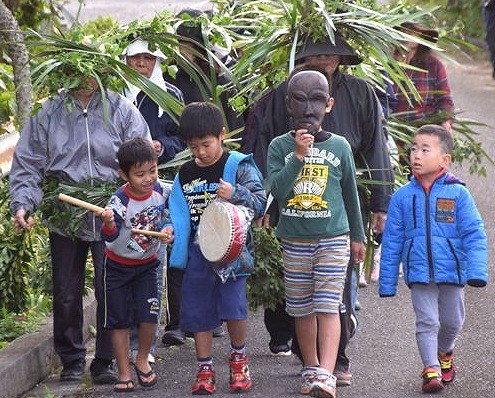
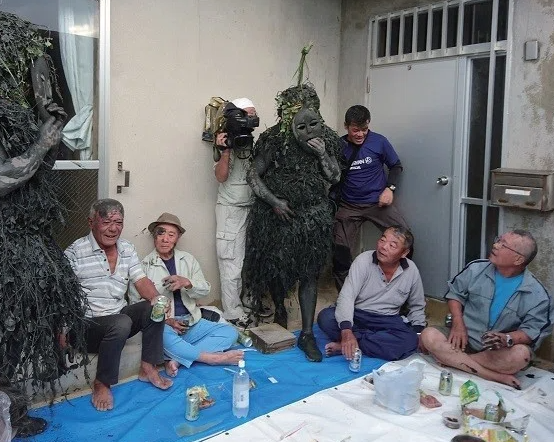
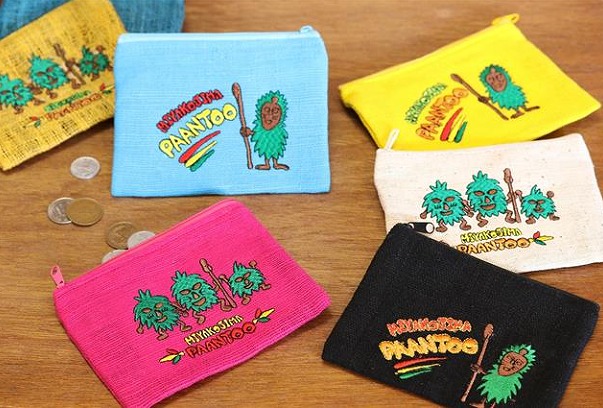
Now, this is what Parntoo looks like. What’s so scary about it? It certainly doesn’t look scary anywhere. Actually, there are two events called Pārntoo, and both are held on Miyako Island. However, the dates and contents are completely different, and it is not clear how they are related. This is a scene from a parntoo held in the Ueno-nobaru上野野原 area. The event is called Satiparou, which means to purify the village. The masks are worn by a boy in the district. Behind him are women decorated with plants that are meant to ward off evil. They go around the district exorcising demons while shouting “Hoi, hoi”. The tour begins after 5:00 p.m., and the sun is setting by the time it comes to the outskirts of the village after the tour. There, all the bad luck is removed and the event comes to an end.
in Shimajiri
Date: Early September of lunar calendar (Around October in the new calendar) Location: Hirara Shimajiri, Miyakojima City, Okinawa Prefecture Access: The Shimajiri district is about 14 kilometers (30 minutes) from Miyakojima Airport. From the airport, take Prefectural Route 78, then Prefectural Route 83 and Prefectural Route 230, and turn right at the Shimajiri Iriguchi bus stop.
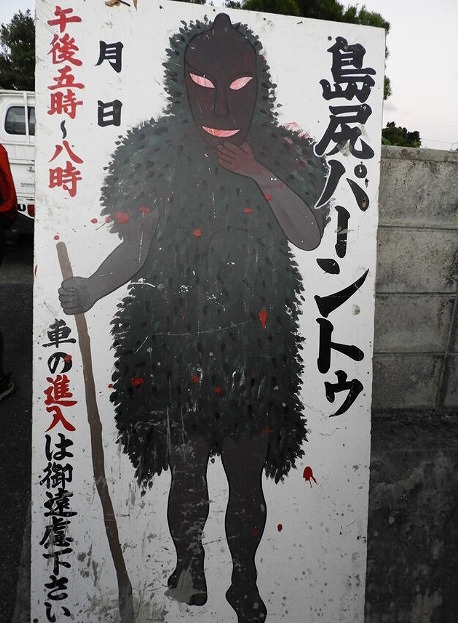
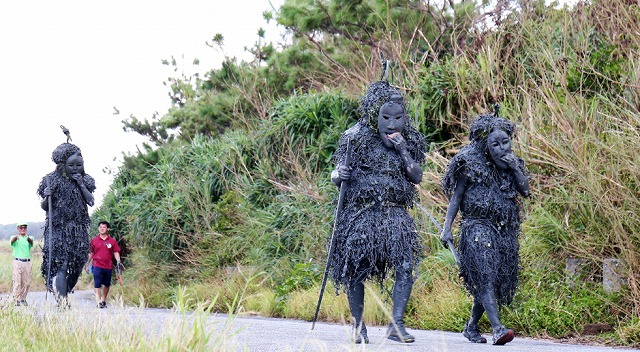
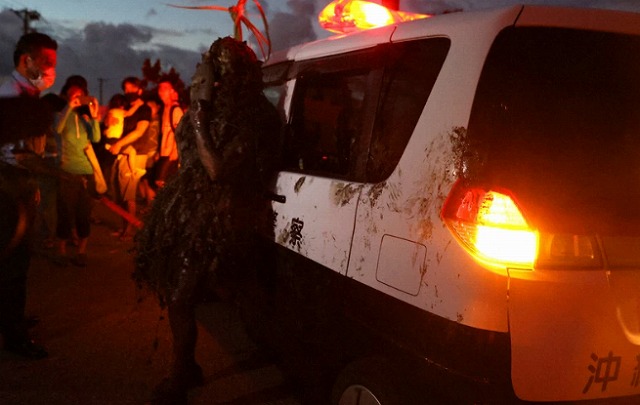
And here is a Pantoo from the Shimajiri 島尻 area. Generally speaking, this is the most famous Parntoo. And in a way, it is the scariest god. There could be any number of deities that are scarier just by their appearance, but it is hard to tell from the images alone why this one is so scary. In fact, this god has mud all over his body that emits a strong odor. And they are the god who rubs it on anyone and everyone. It does not matter if it is a police officer or a tourist. Cars, houses, and people don’t matter at all to them. Especially easy targets are children, women, and newly built homes. They will enter a newly built house and sling mud at you with impunity. Yet people welcome this with a smile. So what is this stinky mud?
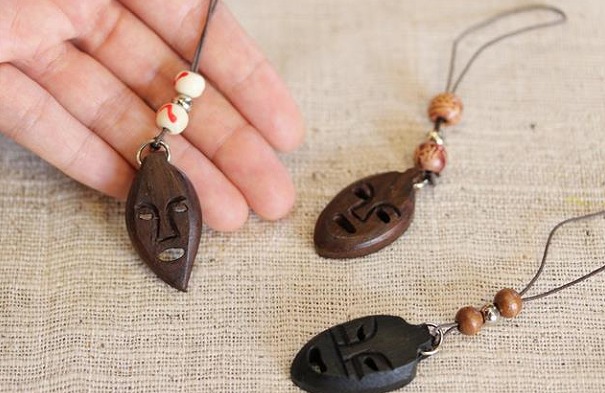
Three parntoos, all men under the age of 40, will serve in that role. On the day of the event, they wear a specific costume and go to the well. The costume consists of vines all over the body, a special rope tied around the waist, and a walking stick. They also wear grass on their heads to ward off evil spirits. The rope is a special rope used to prevent evil spirits from entering the village in another event. And a wooden mask. They smear mud from the bottom of a well called ” Nmarigar” all over their bodies. This completes their transformation into gods. This well is a sacred well where, until recently, when a new child was born, the parents would draw water from this well to keep it out of sight. It is a well that is associated with life and death.
However, it stinks. And near Nmarigar, people are already waiting for Parntoo to come. Finally, around 5:00 in the evening, Parntoo slowly appears in front of the people. Slowly at first, as if nothing is happening, then suddenly they start running and catching people. It is said that being covered in mud will make you happy for a year, but it is still human nature to run away. This is where the mad rush begins.
Mud everywhere for everyone. People running away, laughing, crying children. But the really scary part comes after dark. This event lasts until eight o’clock at night. It is not easy to find Pārntoo once he is hidden in the darkness. This goes on for two days. If you rent a car, you need to park it far away. It is said that once the scent of Prāntoo gets on your car, it will remain there for three days. Also, if you are wearing black clothes, there is a possibility that you will be attacked again and again.
When the parnto will take place will not be announced until just prior to the parnto. This is because there have been problems in the past with tourists who were unfamiliar with the area, and people want only those who understand the purpose of the event to be able to visit. In addition, the parntoo is always accompanied by an escort. However, this is a sacred festival. If you go, please be careful, and if you happen to run into someone, be thankful that you were lucky enough to see him or her.
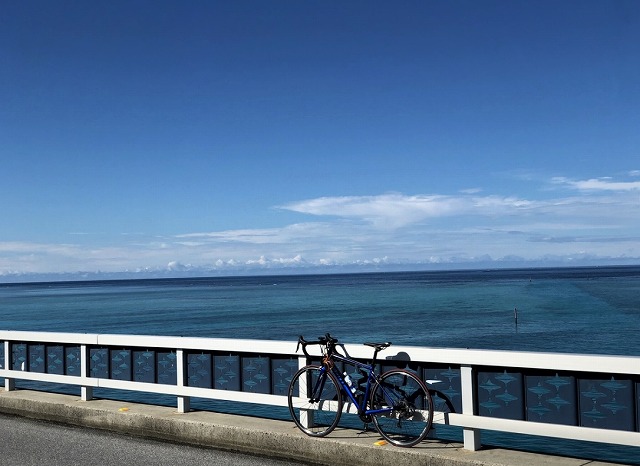
Okinawa is one of the most famous resort areas in Japan. Miyako Island is considered one of the most beautiful of them all. Sea, hot springs, and activities. It is a place that makes you happy just by being there.
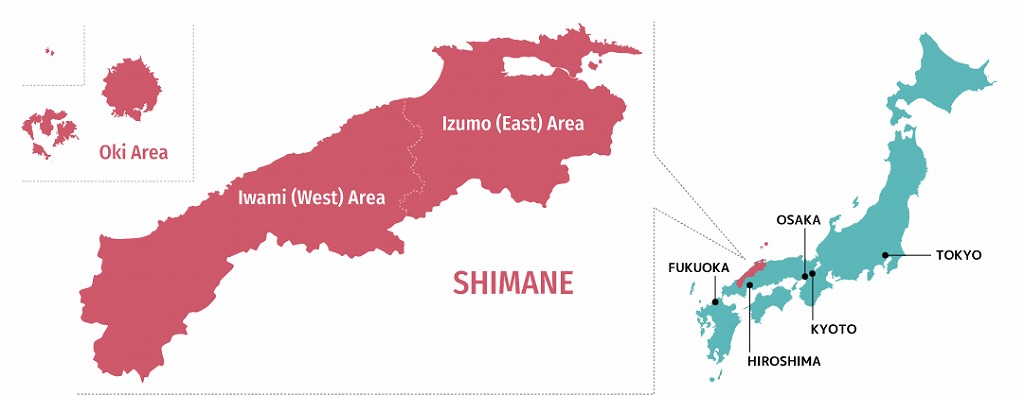
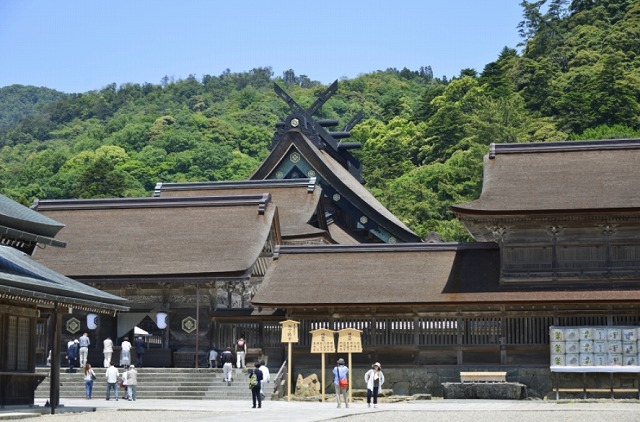
Japan has 47 prefectures, but the most populous is of course the capital, Tokyo. Then what is the least populated? It is Shimane Prefecture. But once you look at the ancient world, it was in a sense the most important region. The oldest historical book, Kojiki (Records of Ancient Matters), records a group of mythological worlds set in this region. The Ise Jingu shrine enshrines the ancestral deities of the current imperial family. The Izumo Grand Shrine continues to receive worship comparable to that of the Ise Shrine. Why are there shrines of this size in this region? Why did the Kojiki specially record the mythology of this region? Two thousand years on, the region remains a mystery to us all.
In fact, the region has long existed as a separate country from the east and west. The eastern side was called “Izumo 出雲” and the western side “Iwami 石見”. The eastern region (Izumo) is home to Matsue, the prefectural capital, and Izumo Taisha shrine, and has a large population. It is said that the “Sada Shin Noh” was the first kagura to be arranged to the narrative style of today’s kagura.
While the Izumo region has preserved this tradition, the Iwami region has followed a very different path. There are six reasons why Iwami Kagura has become so prosperous.
6 Features
1 Jadou
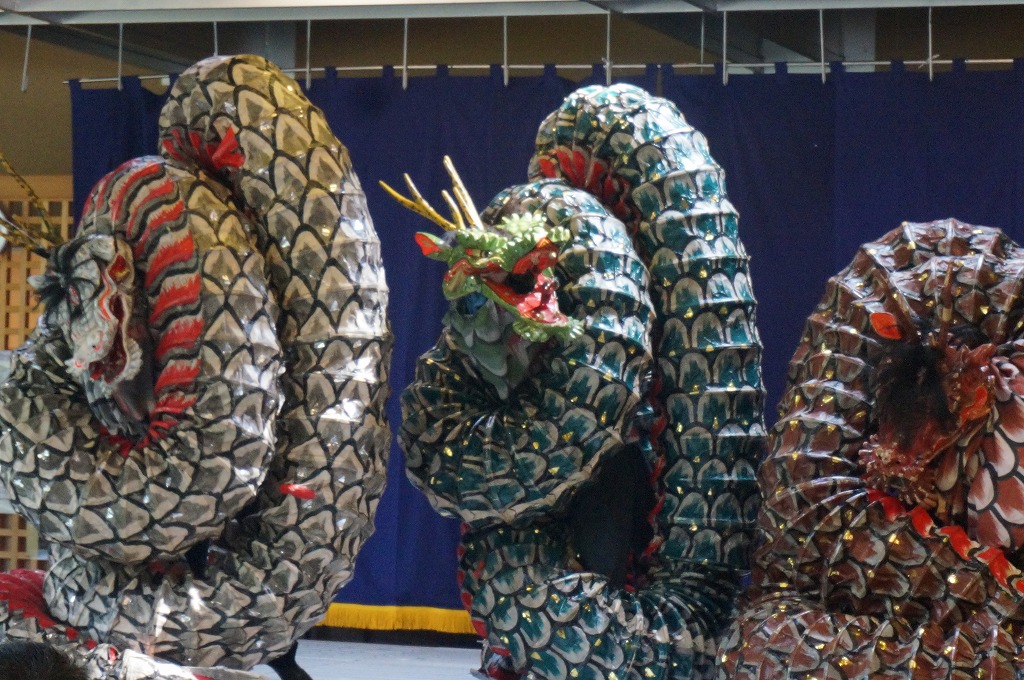
Iwami Kagura is synonymous with the story of the extermination of an eight-headed monster called Orochi. Originally, Orochi were performed using masks with 16 eyes. This is because the first Sada Shinno did so. But a craftsman named Kikuichi Ueda had a question. Orochi is the most monstrous of mythology with the eight-headed. Kikuichi thought, “The 16-eyed mask is not a good look. There must be another way to describe it”. He came up with the idea of a jadou 蛇胴 (snake body), an idea based on a lantern. Jadou is a device to create Orochi’s original snake-like appearance. He made of bamboo rings connected with Japanese paper, as we know it today, that bends freely, does not tear, and is lightweight and easy to move around. He devised a new way of performing. This quickly became so popular that it has spread not only to the Iwami region, but now to western Japan in general.
Orochi
2 rhythm
The second is a modification of the rhythm. Originally, there was a form of kagura called Oomoto kagura, which developed from this form. Omoto Kagura had a slow rhythm of 6 choshis 調子(beat), but people changed to a fast rhythm of 8 choshis. This made the entire stage faster.
3 mask
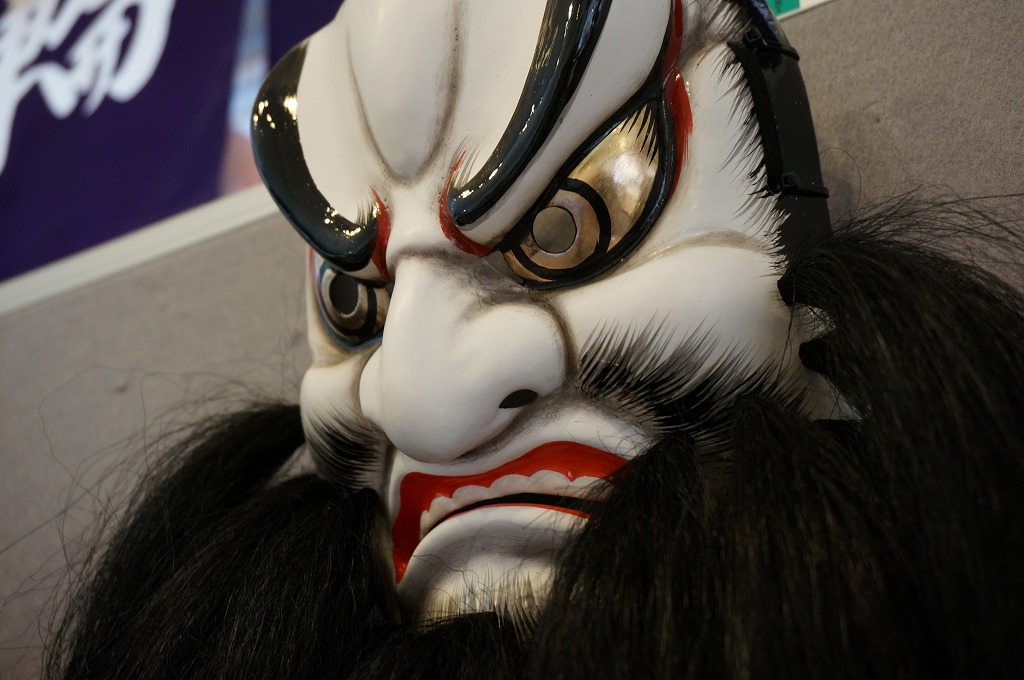
Third, They changed the mask from wood carving to Japanese paper. This Iwami region also inherited traditional paper making. Japanese washi is stronger than ordinary paper. Taking advantage of this feature, they came up with a new method of making masks. This made it possible to produce lightweight, large masks, which were more dynamic.
4 costume
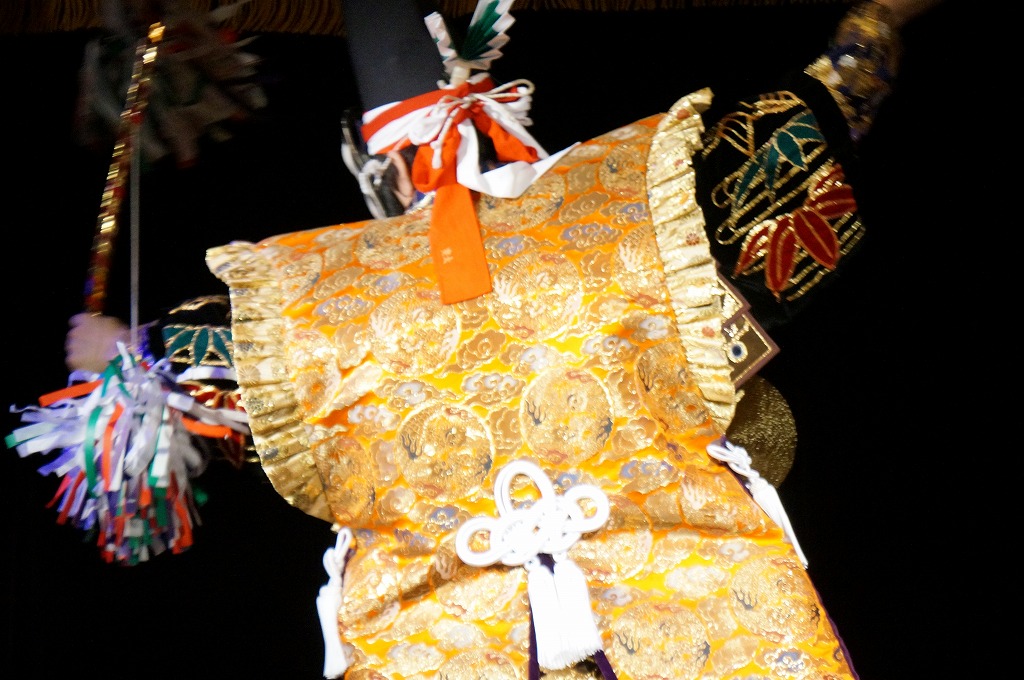
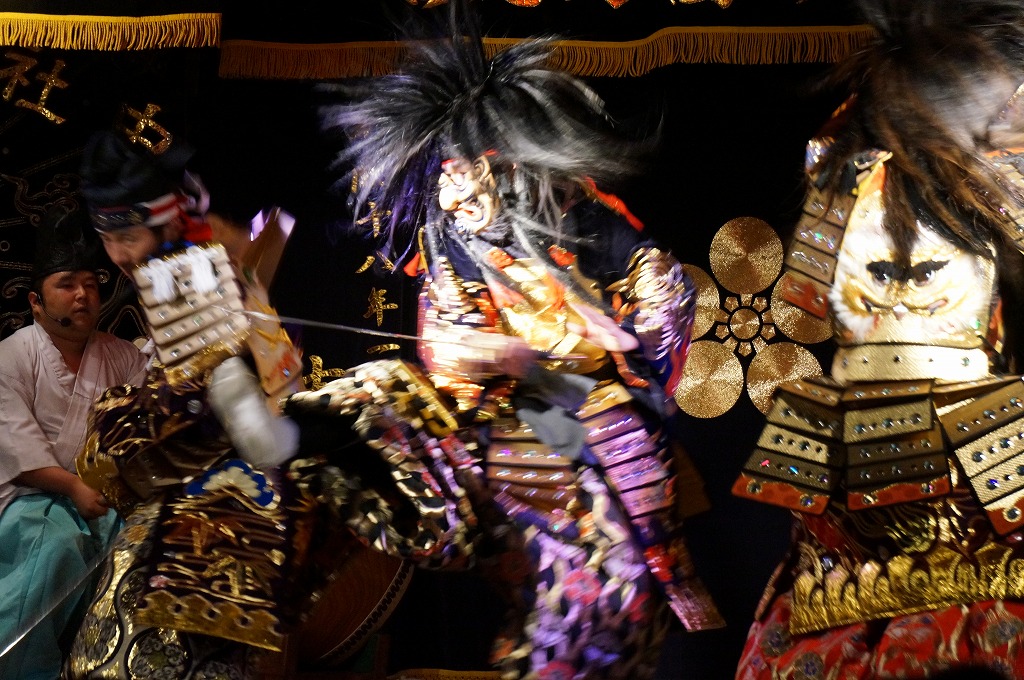
Fourth, there is the flamboyance of the costumes. The costumes, which embody the word “gorgeous” with their abundant use of gold and silver threads and sometimes even glass beads sewn into the fabric, are illuminated by the lighting, inviting the audience into a world of fantasy. All the work is done by hand, and it takes several months to half a year to complete. Sometimes it amounts to over a million.
5 script
Fifth, there is a revision of the script. Originally in the Edo period (the age of the samurai), kagura was performed by a specialized priesthood. However, the people who overthrew the Shogun and created the new Meiji era forbade the Shinto priests to perform kagura in order to promote modernization. They ordered that the priests should perform only Shinto rituals. Therefore, the people in the private sector took over it freely. As a result, it became much more secularized. Concerned about this, the people revised the script. They tried to correct the abusive language, to make it more dignified, and to convey their intentions more clearly. The scripts from this time are still in use today, and they add dignity to the kagura.
666
6 fireworks
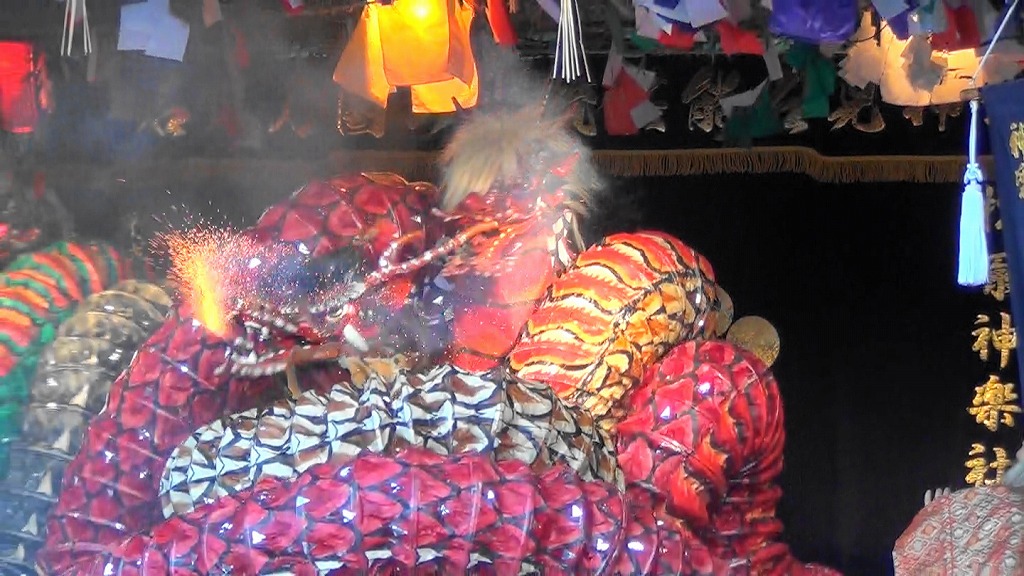
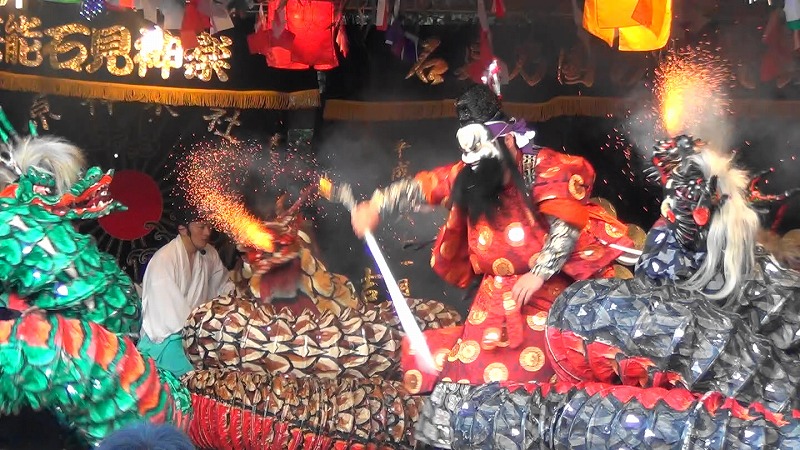
And last but not least is the use of fireworks. Fireworks launchers were attached to the lightened surface. This allowed the villains to breathe fire. It was especially spectacular to see Orochi, whose numbers had increased, all breathing fire together. In this way, kagura has become more entertaining over time.
The kagura stage direction further increased the entertainment factor by trying to create smoke.
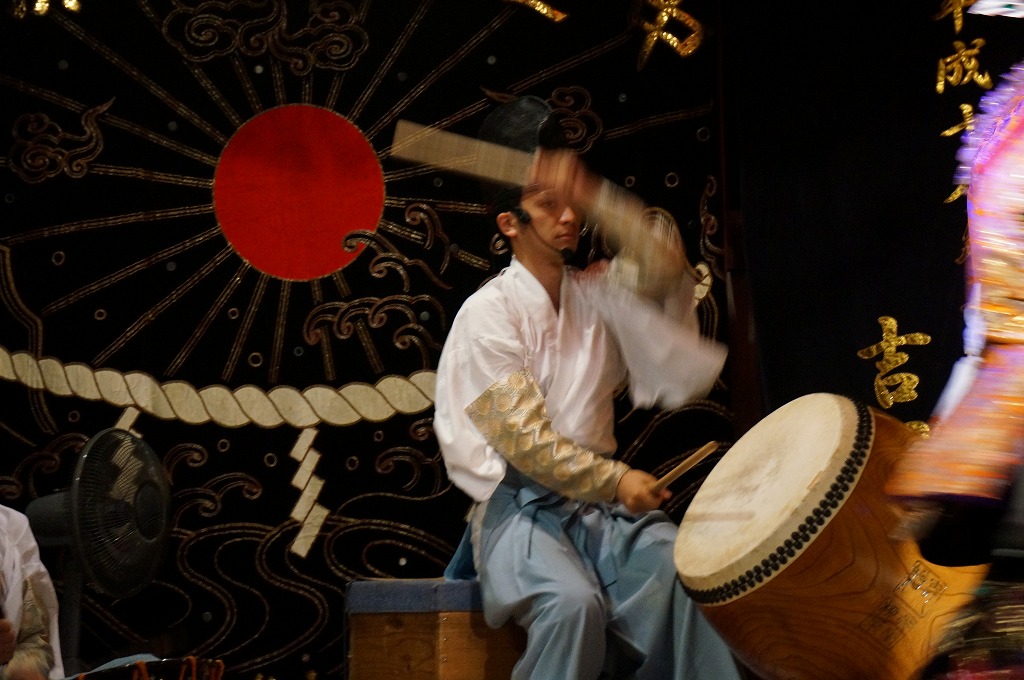
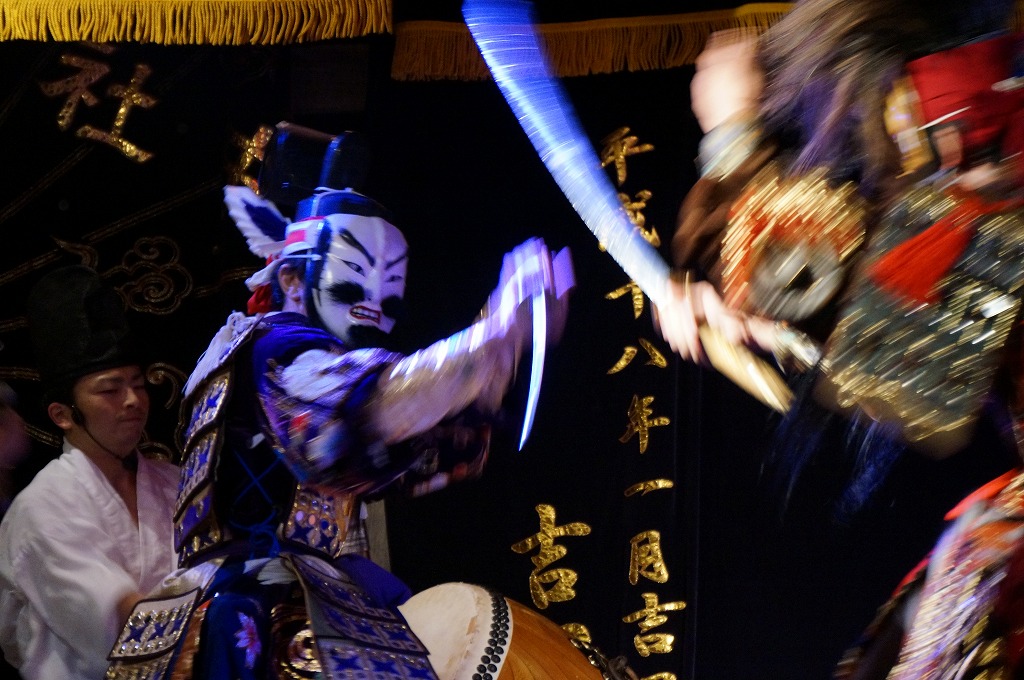
As a result, more than 100 kagura troupes are active in this modestly populated area, and they perform throughout the year. Not only that, but usually the adults take the children, but here the children want to go and take the adults out. Thus, the audience is all ages and both men and women. The audience supports their favorite group and sometimes throws themselves into the performance. It is common in the local community for children to recite the difficult scripts and imitate the kagura effortlessly. The attractiveness of Iwami Kagura is, above all, its easy-to-understand storyline. Basically, it is a story of good and evil, so even if you do not understand the language well, you can fully understand the content. As can be inferred from the large masks and flashy costumes, there is almost no detailed staging, as is the case with Noh, another traditional art form. It is more like kabuki with mask.
representative program
Orochi 大蛇
After all, it is all about “exterminating Orochi. It could be said that Orochi is the equal of Iwami Kagura, which has evolved dramatically since the invention of Jadou. The story is a famous mythological anecdote. One day, a fierce god named Susanoo was walking through the area. He was so violent that he was banished from the heavenly realm. Then he met an old couple in tears. When Susanoo asked them what was going on, they said, ” The old man told Susano’o that there was a monster with eight heads and eight tails called “Yamata-no-orochi” in the area, and that every year it demanded sacrifices. He told Susanoo that they had eight daughters, and that they would have to sacrifice every year they were devoured by Orochi, and that this time the last daughter would be sacrificed. Hearing this, Susanoo offered to exterminate the orochi if he would give the girl to me as my wife. Susanoo then gave Orochi sake to drink, and when it was drunk, he attacked it and successfully vanquished it. The jadou, which consists of 100 bamboo skeletons with a length of 40 centimeters and a length of about 17 meters, is operated by one person. The key to his skill is how he manages to keep people out of sight at this time. As the number of jadous has increased, the way of displaying them vertically and horizontally has evolved, and more and more efforts are being made every day to make them more appealing to the audience.
Jinnrin 塵輪
Iwami Kagura is basically a tale of good and evil. The most representative of these is Jinrinrin. Two demons come from a foreign country to overrun Japan. They spread evil in Japan, spread plague, and boast that they will destroy the country. Emperor Chuai and his followers rise up to meet this crisis. The stage is set for a confrontation between two gods and two demons, which makes the story even more exciting. It is a ridiculous story, but there is not much historical fact involved. There is no such story left as a myth. To begin with, history books record Emperor Chuai as the 14th emperor, but it is not clear what he actually did. Some people suggested that the dynasty may have changed at this point, since the later people used the character for “god” for his wife and children. Some say that this is the reason why the dynasty changed here. In other words, it is a completely invented story. There is also this one.
Yorimasa 頼政
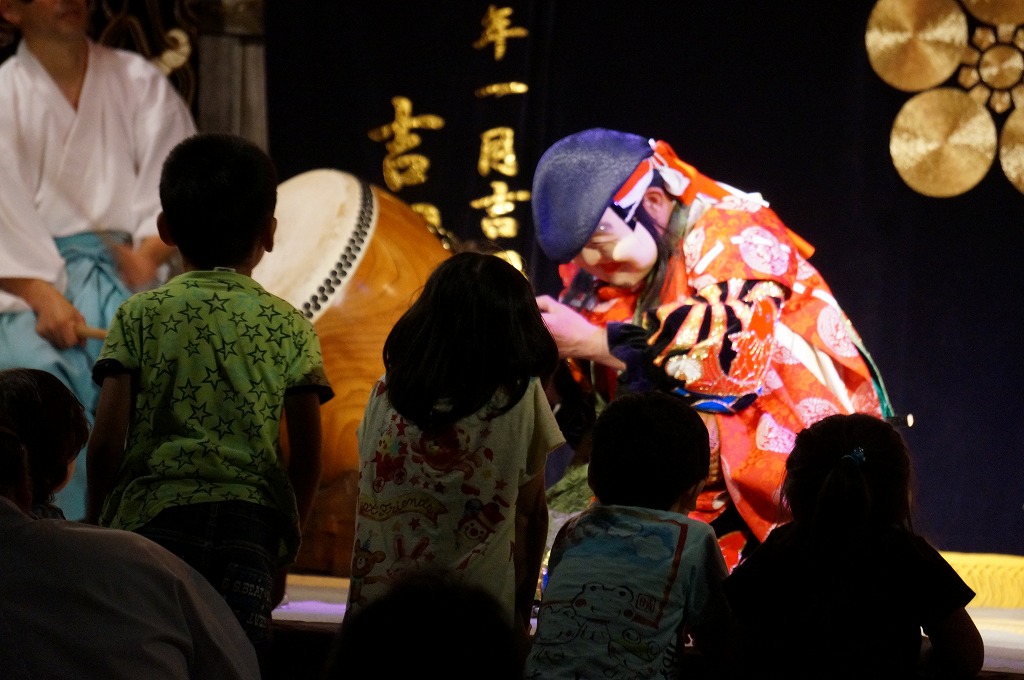
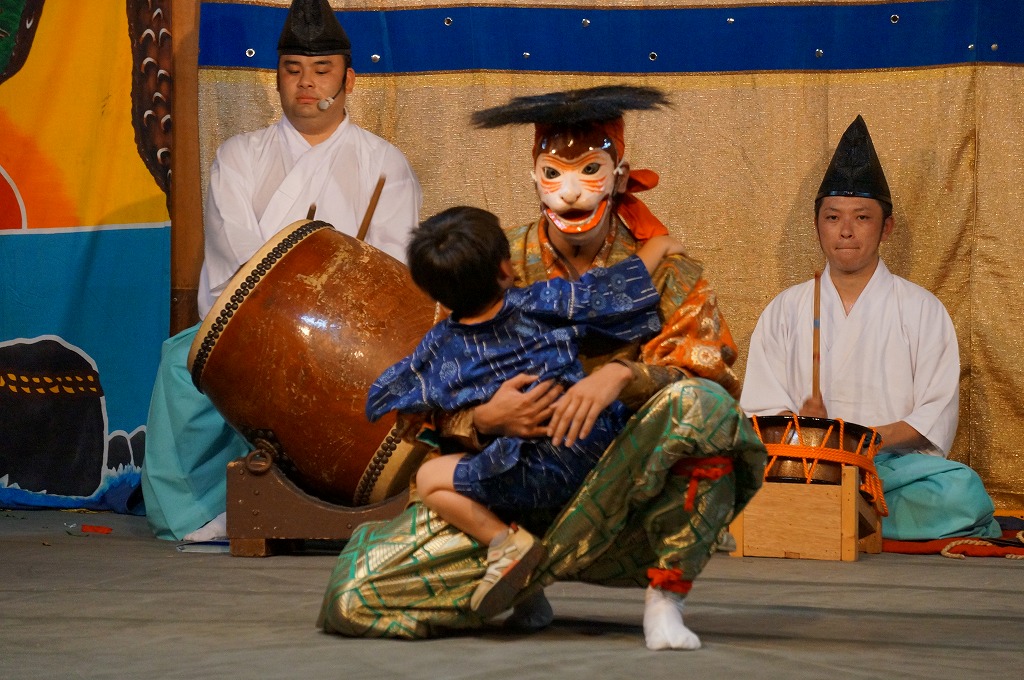
The main character is a real-life military commander from the 12th century during the Heian period, who had a legend of exterminating Nue. Night after night after night, a suspicious smoke rises in the capital. Then the emperor always complains of suffering. No one could discover the cause of this. The emperor’s close advisors then selected Minamoto no Yorimasa as the person to do the work. The story is that Yorimasa successfully exterminated the yokai and saved the emperor. In the middle of the story, there is a scene in which the yokai wrestle with each other. There was a fun scene where children and others went up on the stage and wrestled with them, which is a fun scene and adds a touch of humor to the monotonous flow of the program.
The most prosperous place~ Hamada City
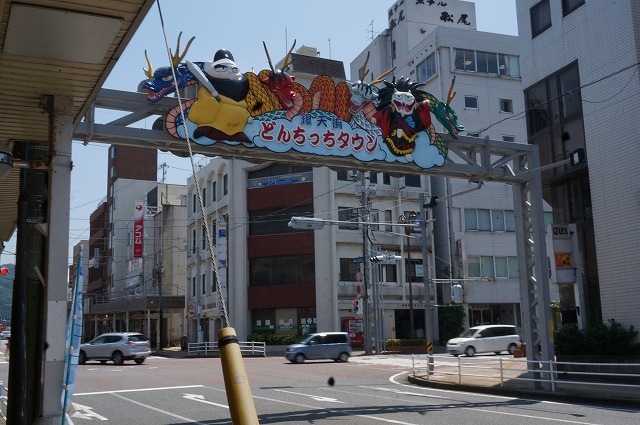
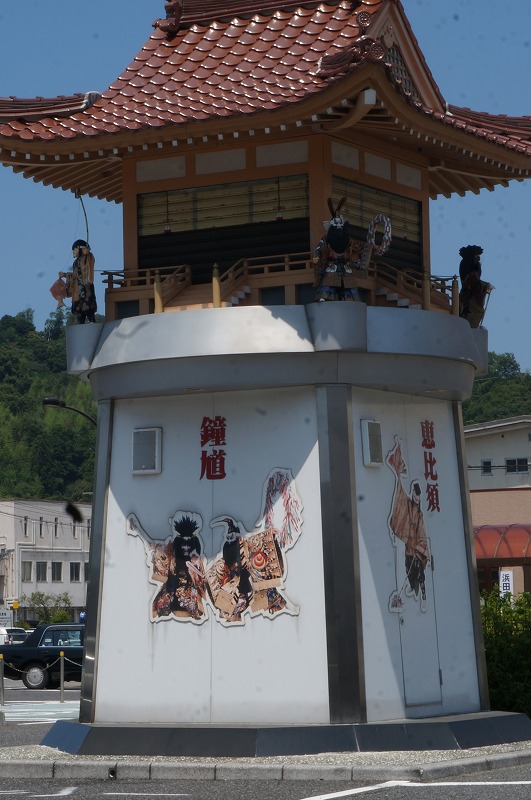
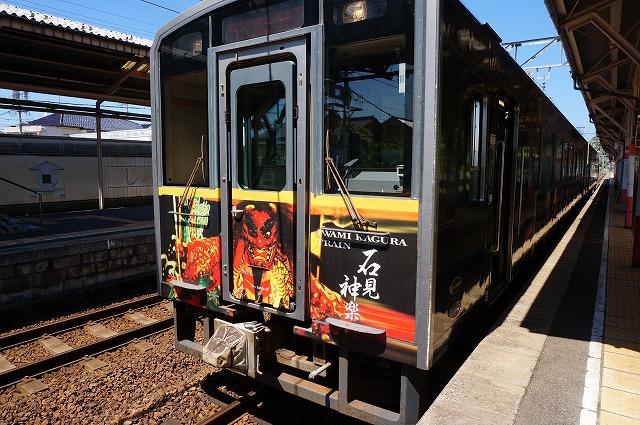
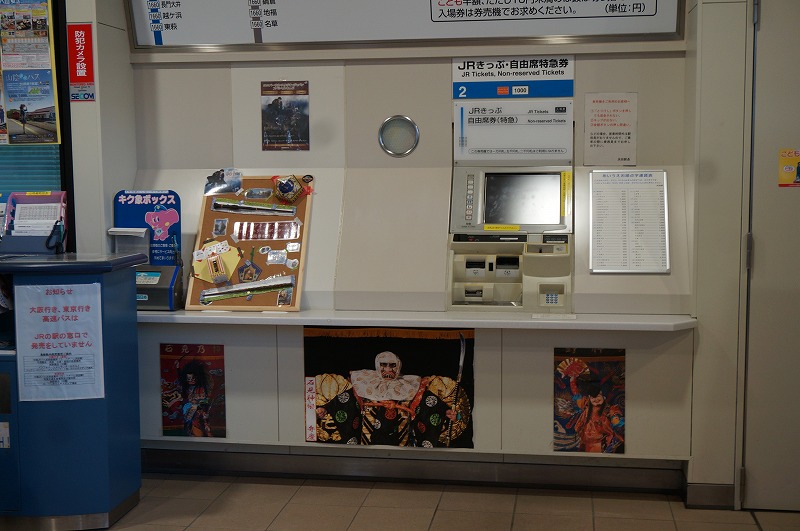
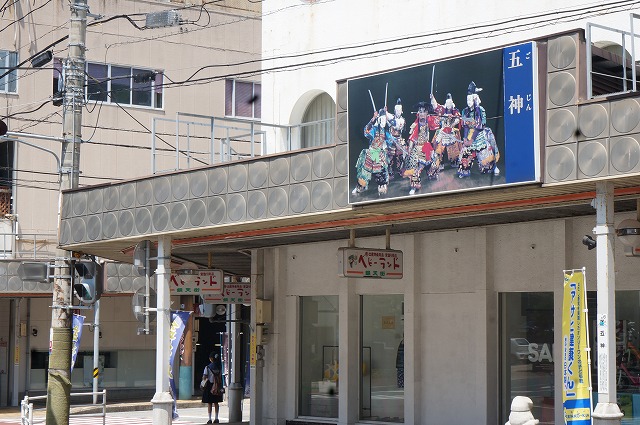
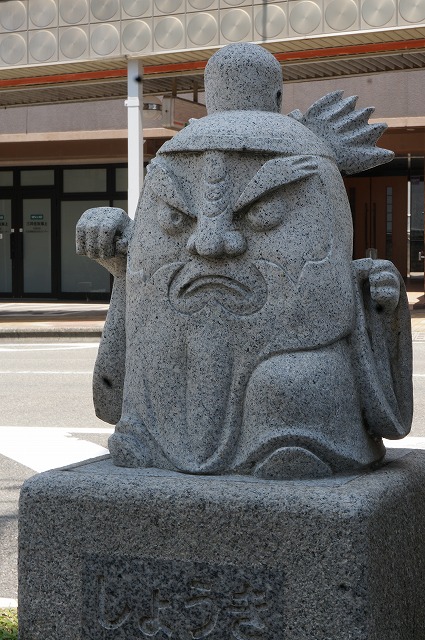
The core city of Iwami region is Hamada 浜田 City. It is also the most active place for Iwami Kagura. When you get off the train with Iwami Kagura printed on it, you are already in a kagura world from the ticket gate. As you exit the ticket gate, a large kagura tower stands in front of the station. Every hour on the hour, a kagura puppet appears and shows a kagura scene. The main street is lined with kagura signboards, and statues of kagura characters line the street. There is also a workshop for making kagura costumes and masks at a leisure facility a short distance away.
Where to watch it?
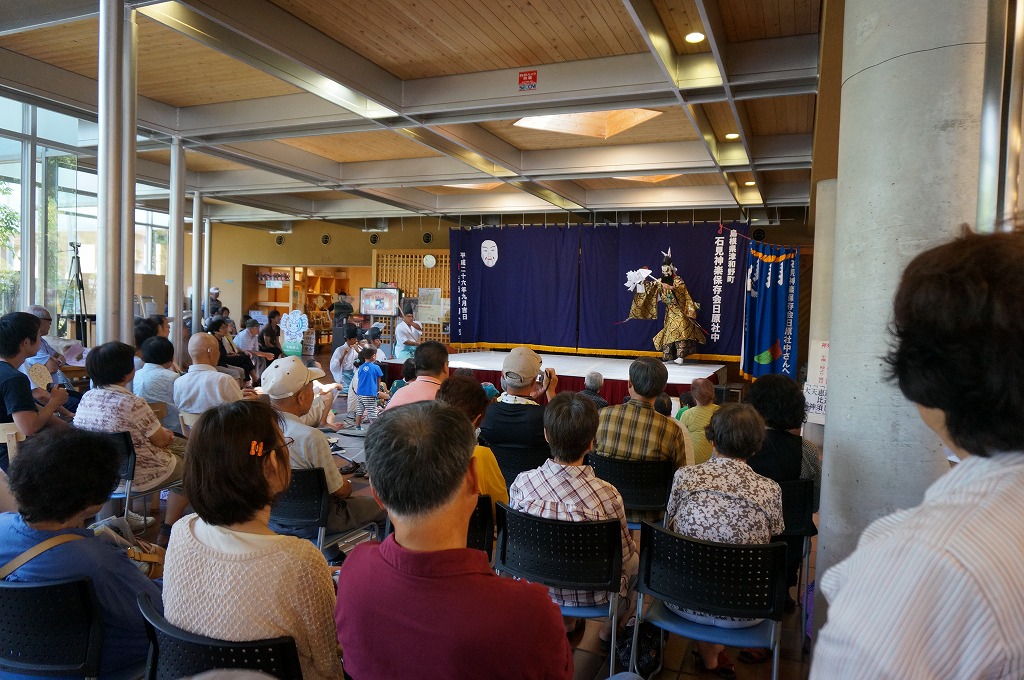
Basically, if you go to this region, you can watch it anywhere and anytime, especially on weekends. There are two main types: festivals at shrines and regular performances. Shrines are basically free of charge, while regular performances are often charged. In addition, there are performances in major cities such as Tokyo and Osaka. There is also a joint performance competition several times a year where kagura groups compete their skills. There are too many to list here, so if you are interested, I will provide links so you can watch them there. Incidentally, when the author of this article went to cover the festival, it was held at a shrine near Masuda City from 8 pm to 6 am the next morning. The next day, I had the experience of seeing a performance at a roadside station in the town of Tsuwano, which is also a tourist spot, during the daytime, and then a festival at another shrine at night from 7:00 p.m. to past 9:00 a.m. All of these events are free of charge.
Key words when viewing the calendar
Unfortunately, the calendar is mostly in Japanese, so the following is a list of Japanese and English translations to keep in mind. Please refer to these for confirmation. 有料 fee 無料 Free of charge 公演 Events & Performances 定期公演 Regular Show 祭り(祭) Festival 神社 Shrine 大会(競演大会) Tournaments (competitive tournaments) 予約 Reservations 電話 phone 1月、2月 ~月(以下同様表記)Jan, Feb ~ (same below) ~日(1日)~Day ( Day 1 ) 日曜日(日)Sunday (Sun.) 月曜日(月) Monday (Mon) 毎 every →毎月 every month 毎土曜日 every Saturday
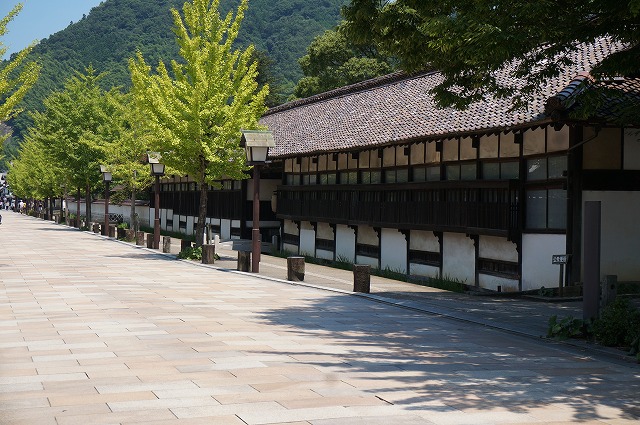
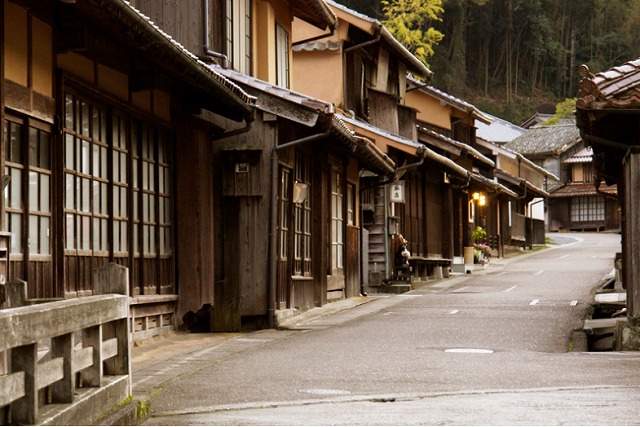
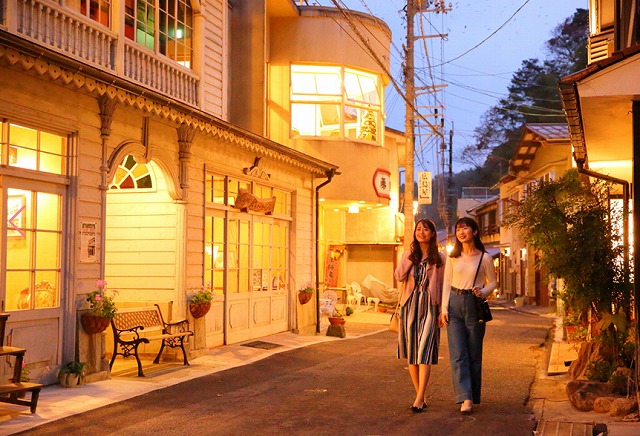
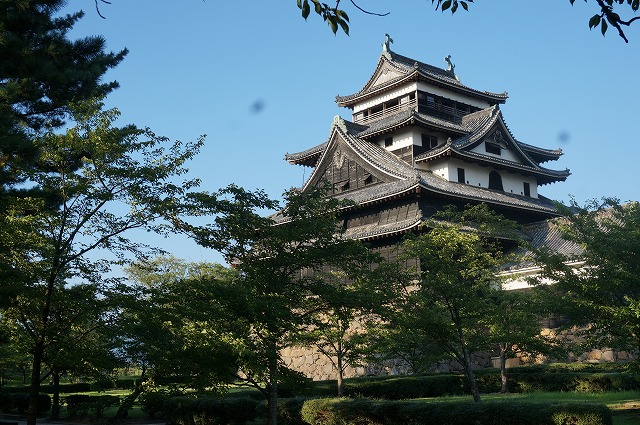
If you want a taste of rural Japan, Shimane Prefecture is exactly what you are looking for. The Iwami region has it all: old townscapes, world heritage sites, and hot springs. The neighboring Izumo region has castles and some of the largest shrines in Japan.
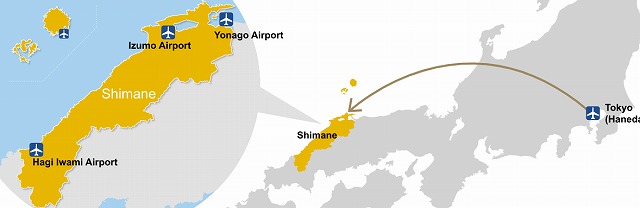
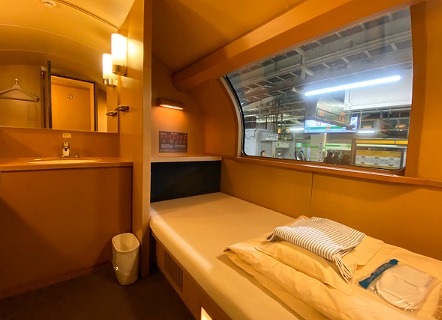
From the major cities of Tokyo and Osaka, there are various options: airplanes, trains (Shinkansen, sleeper express), and buses. However, the Shinkansen runs south from Okayama, so it is necessary to transfer to a local express train. Also, the number of trains in Okayama is limited and access to the area is inconvenient in some places, so please do your research in advance.