Report; Simple, powerful Oni dance~at Hata Choukoji-temple
Date; Every year on May 5

Location; Hata Chokouji-temple 畑朝光寺、 609 Hata 畑, Kato City, Hyogo Prefecture

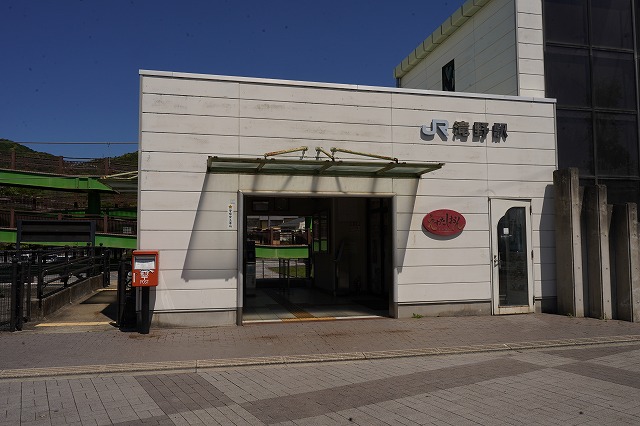
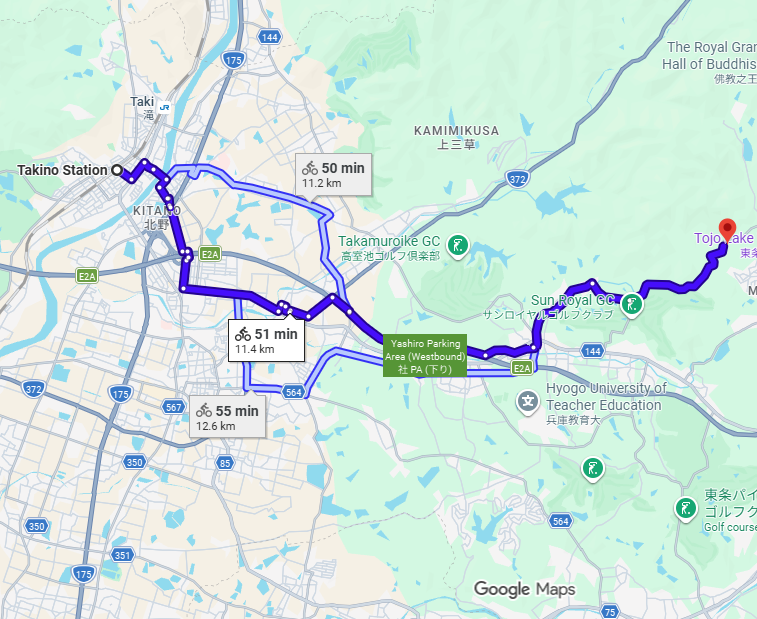
Access; The nearest stations are Takino or Yashiro. It is about 12 kilometers from there.
There is a tourist information center at Yashiro Station, and bike-sharing services are available at both Yashiro 社 and Takino 滝野 stations (Next to Yashiro Station), which anyone can use.

It takes about 40 minutes (one train per hour) from Kakogawa to Yashiro or Takino Station via the Kakogawa Line. It takes about 1 hour to get to Kakogawa from Osaka.

*visited on May 5, 2026

Prologue

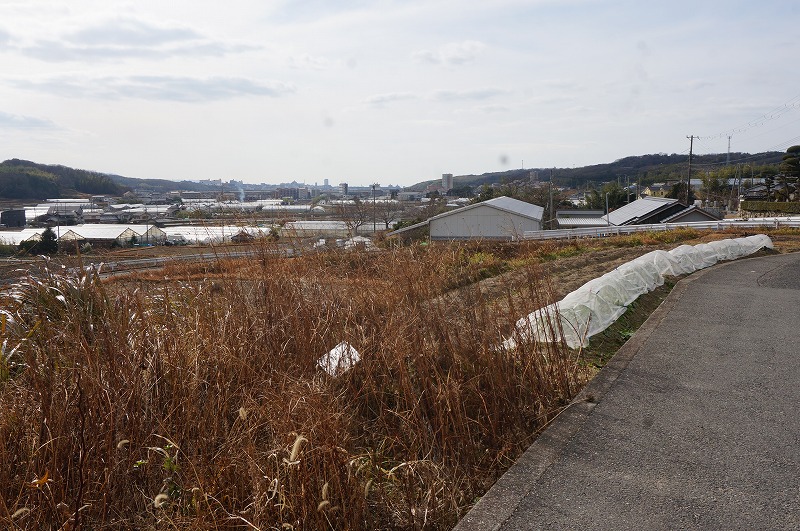
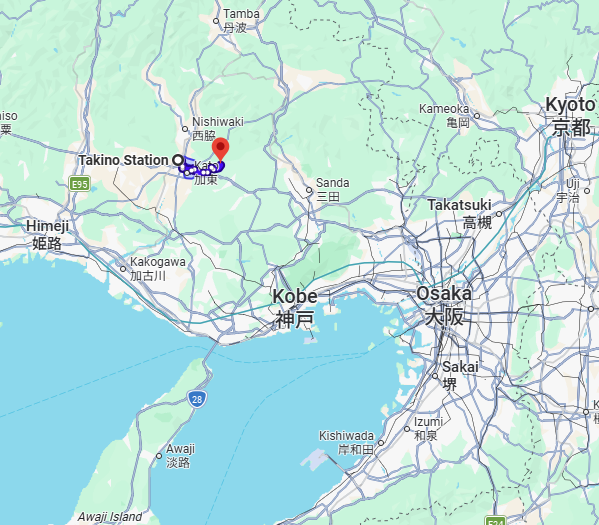
Kato City in Hyogo Prefecture isn’t exactly a well-known town. When people think of Hyogo, they usually think of the port city of Kobe in the east, or Himeji in the west, home to the World Heritage Site Himeji Castle. Kato City is an inland town located roughly halfway between the two. In a rather remote part of that town stands a temple designated as a National Treasure, where a “Demon Oni Dance” is said to gather many people. What’s more, they still use “Oni” masks that were crafted over 400 years ago. I wondered exactly what kind of dance it was. I felt I had to go and see for myself, so I set out on a trip.

Let’s watch the “Oni” dance

The monks will enter at 1:00 p.m., and the Oni dance will begin at 1:30 p.m.

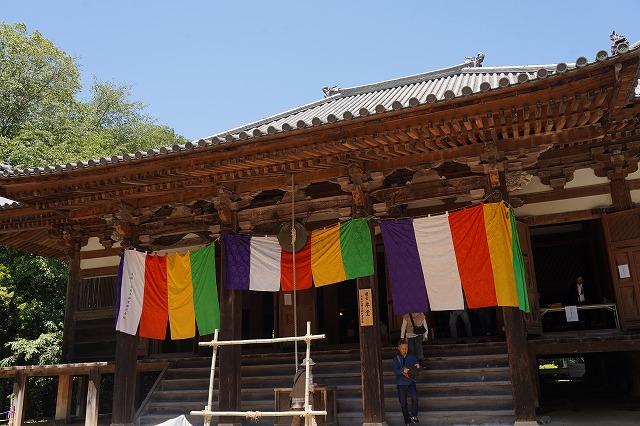
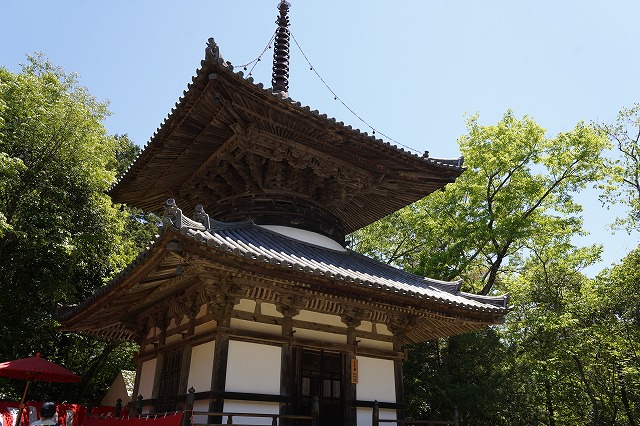
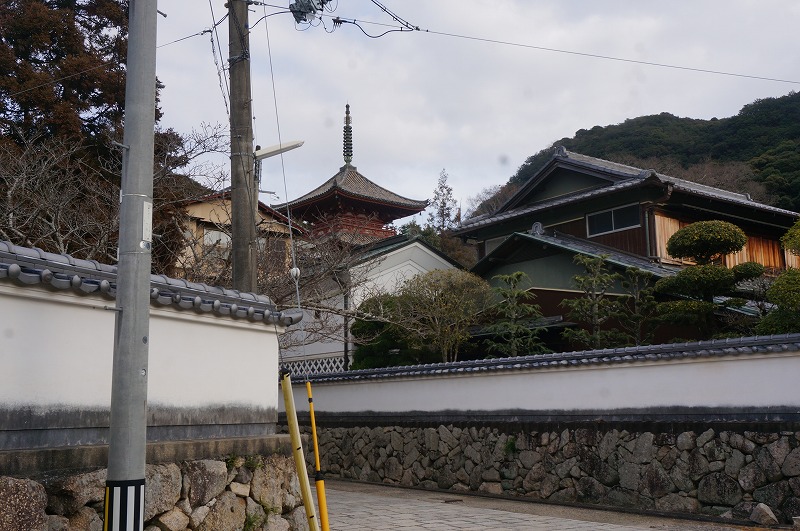
According to tradition, Chōkō-ji Temple was relocated to this site in the 12th century. The main hall, which records indicate was built in the early 15th century, is designated a National Treasure, and the bell tower is an Important Cultural Property.
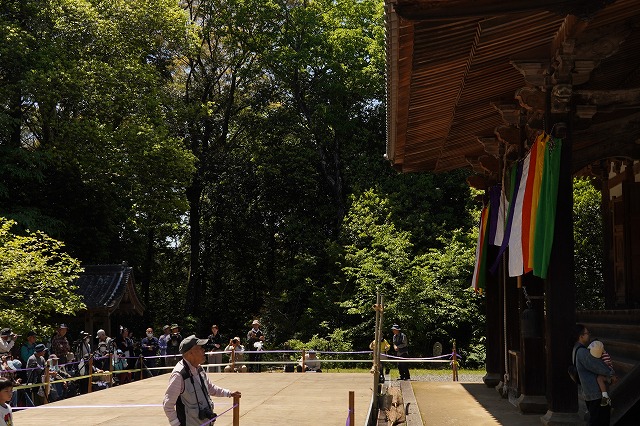
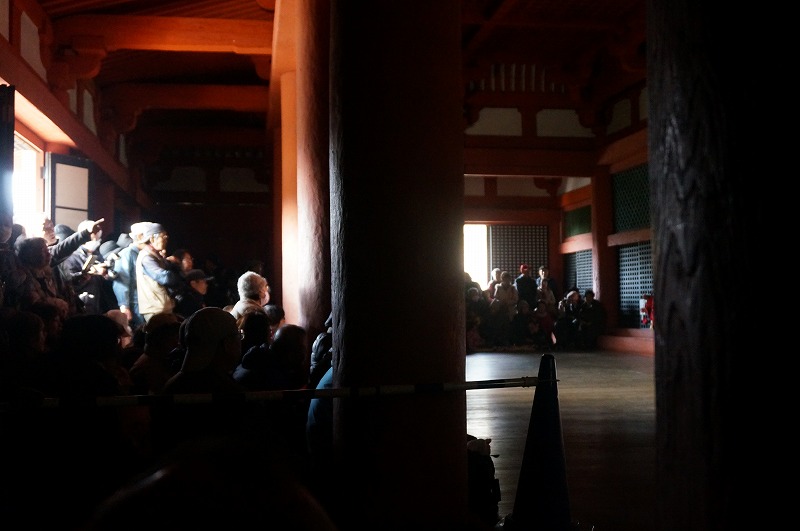
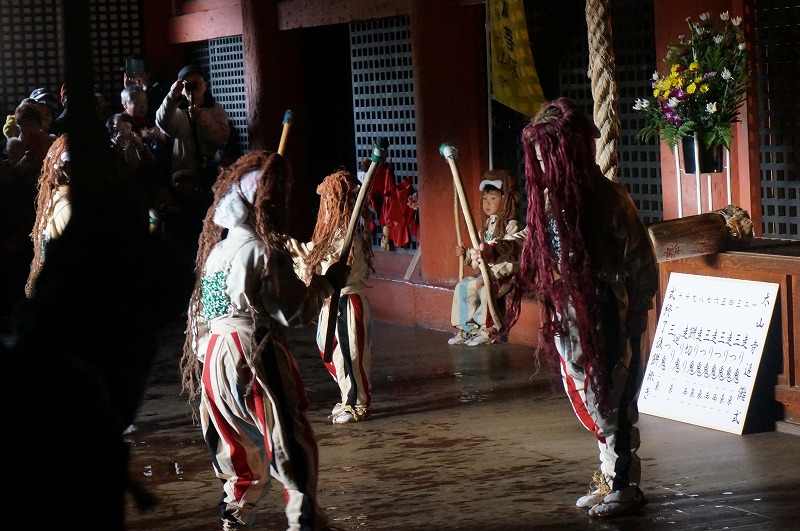
A large crowd has been eagerly waiting for over an hour, as if every moment counts. Most of them appeared to be locals.
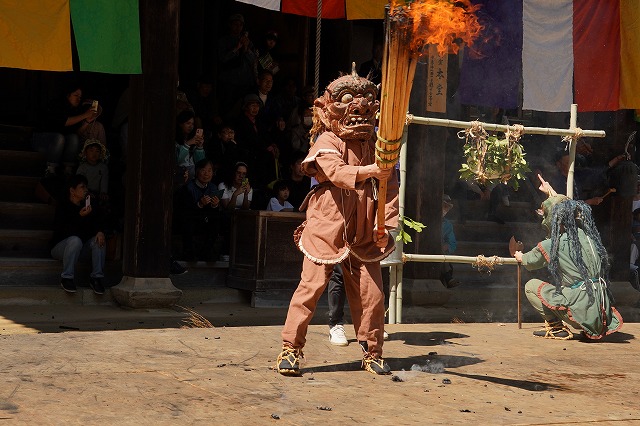
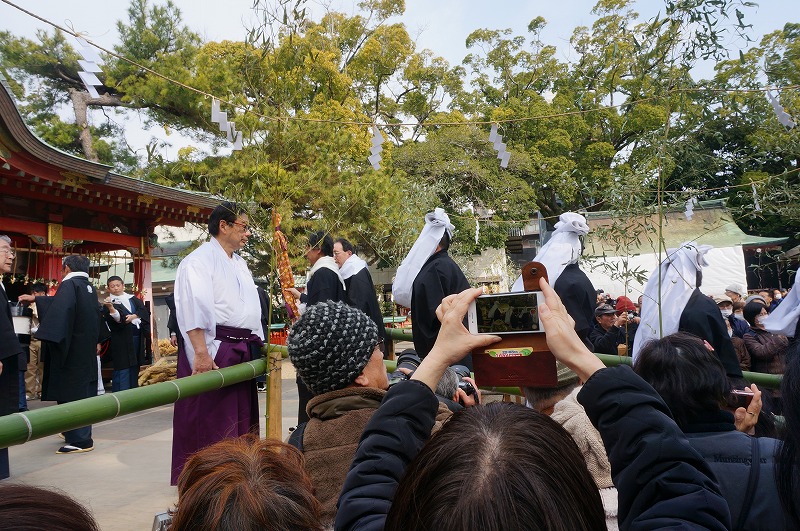
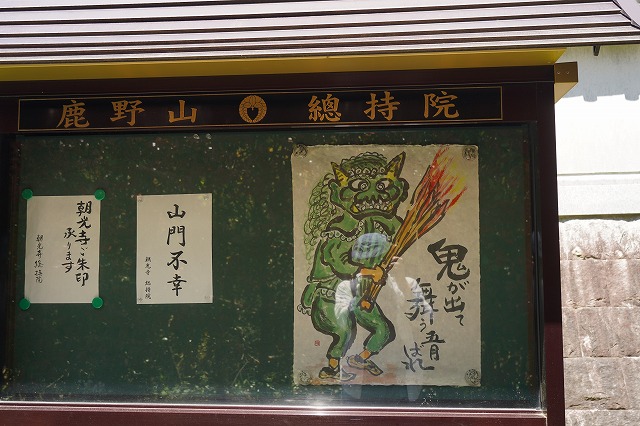
A stage has been set up in front of the main hall, and the audience is waiting, surrounding it on all sides. The poster of the “Oni” on the bulletin board also gets crowd exited.

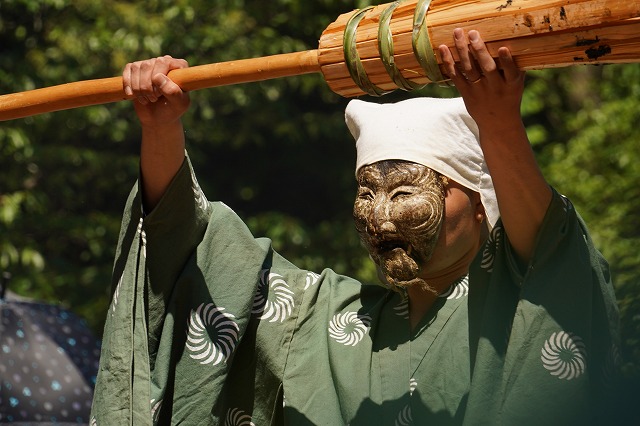
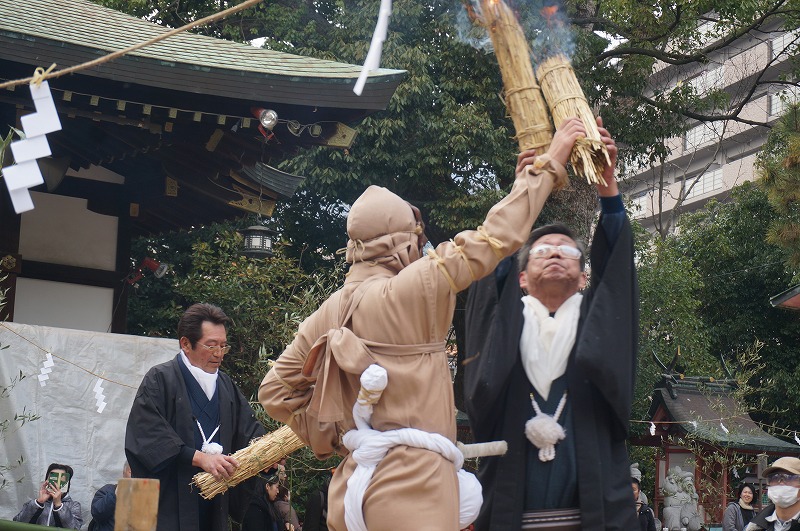
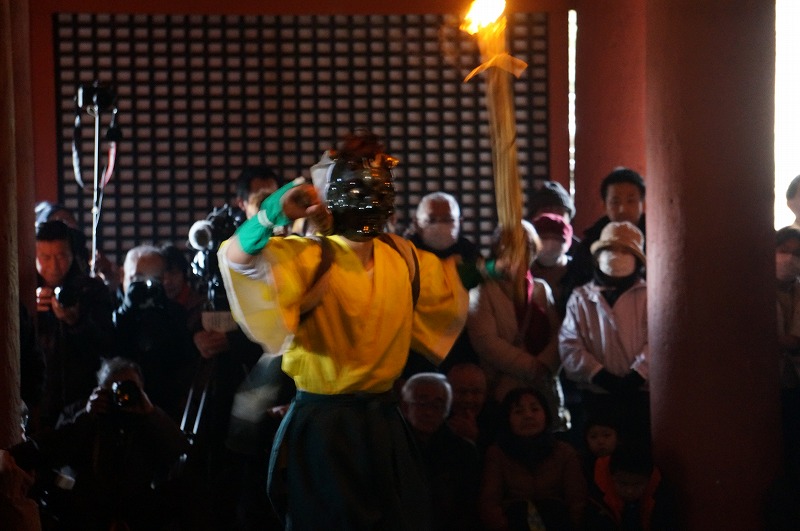
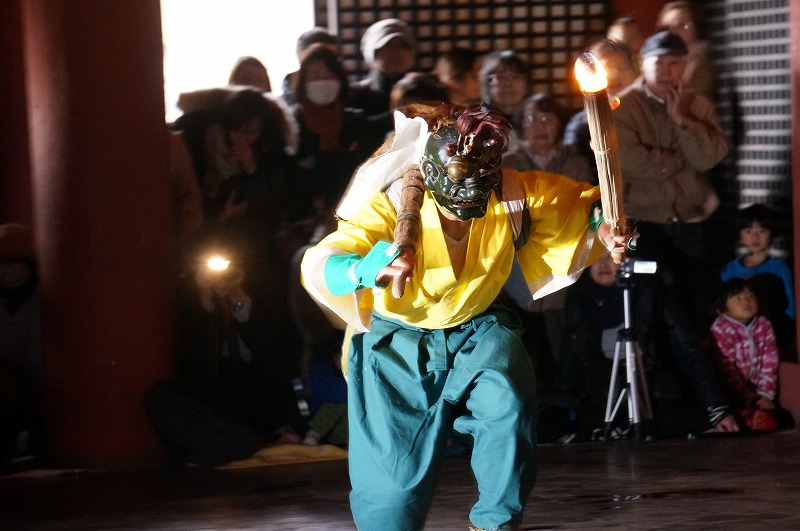
The dull, distinctive sound of a temple gong rings out. The first character to appear is “Okina.” While ‘Okina’ literally means “old man,” here he serves as a sort of harbinger of things to come. He comes out twice, holding a torch.
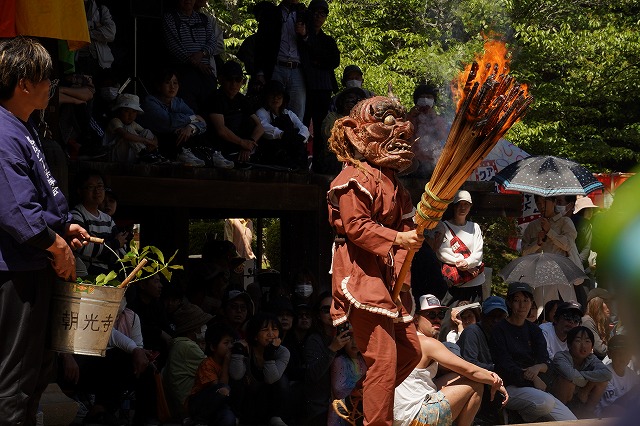
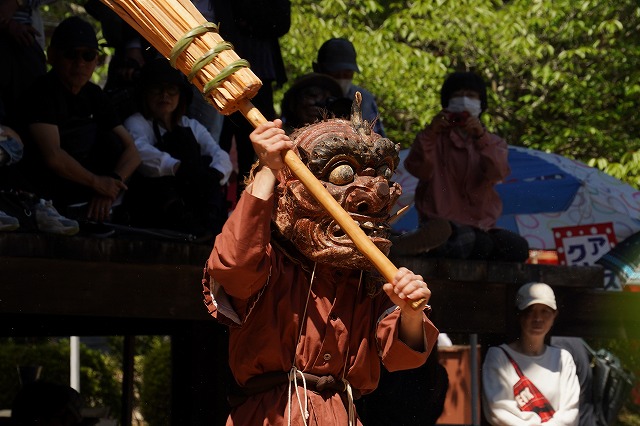
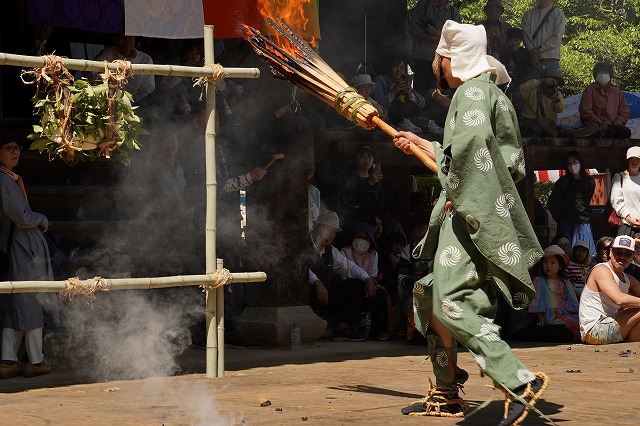
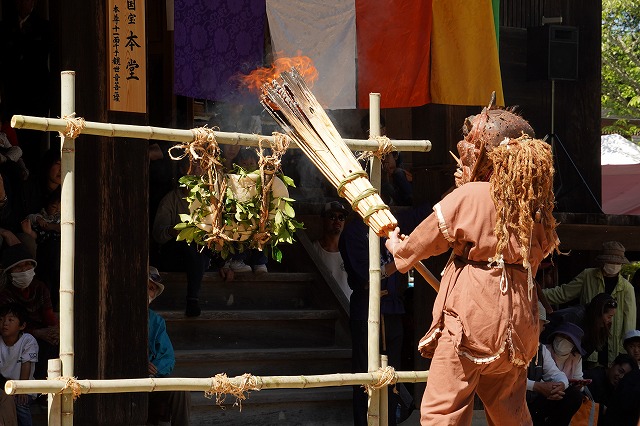
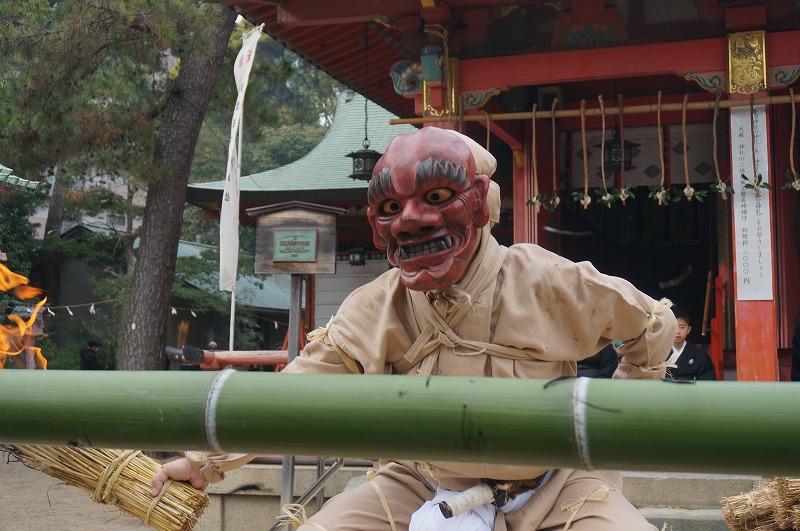
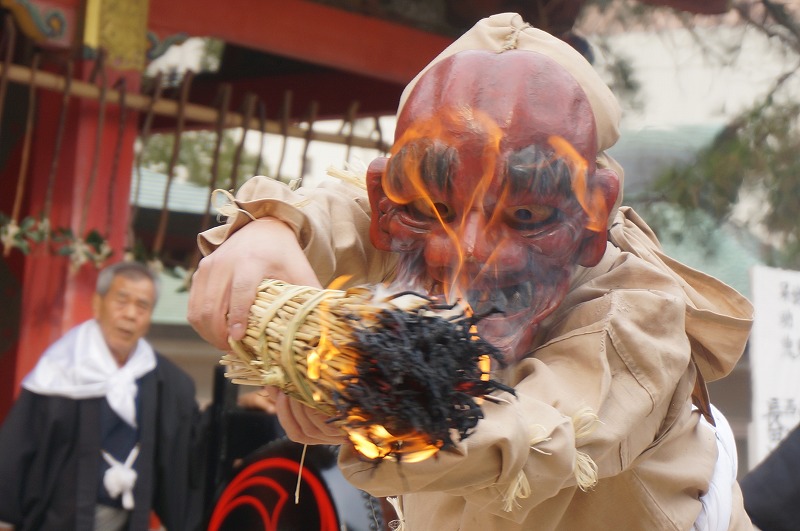
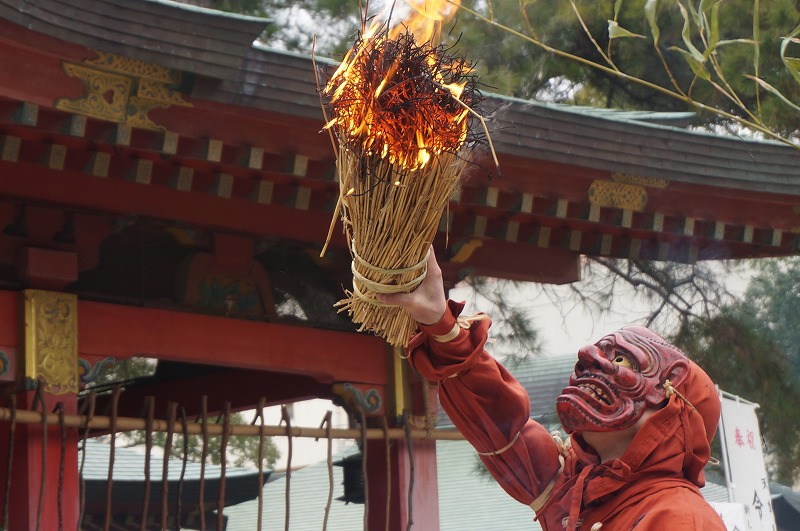
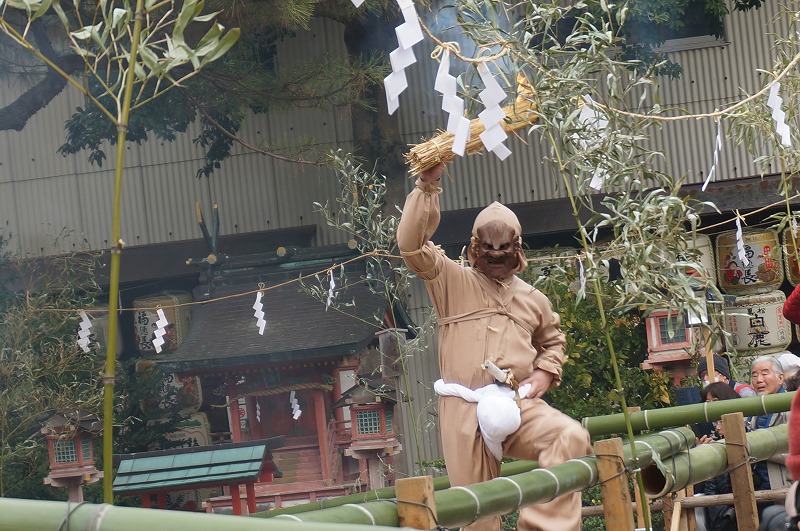
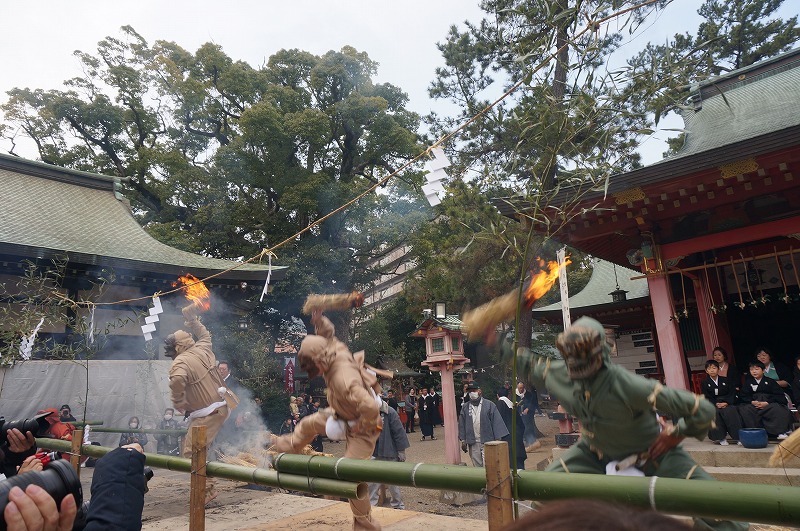
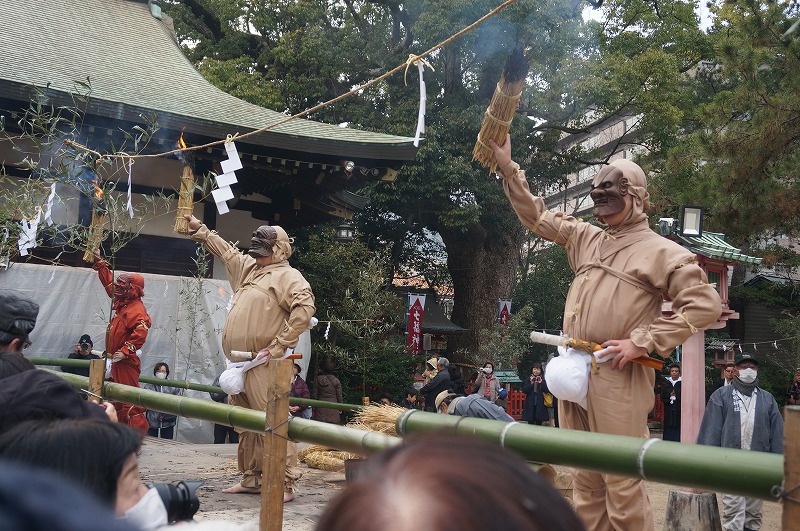
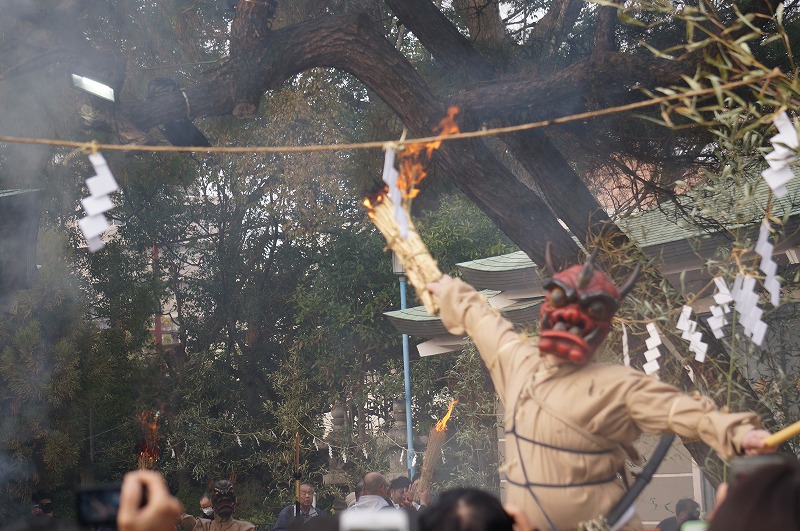
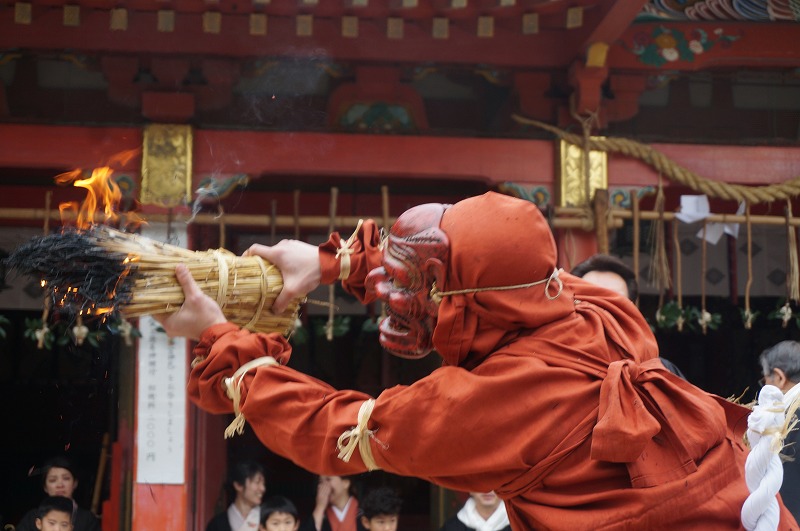
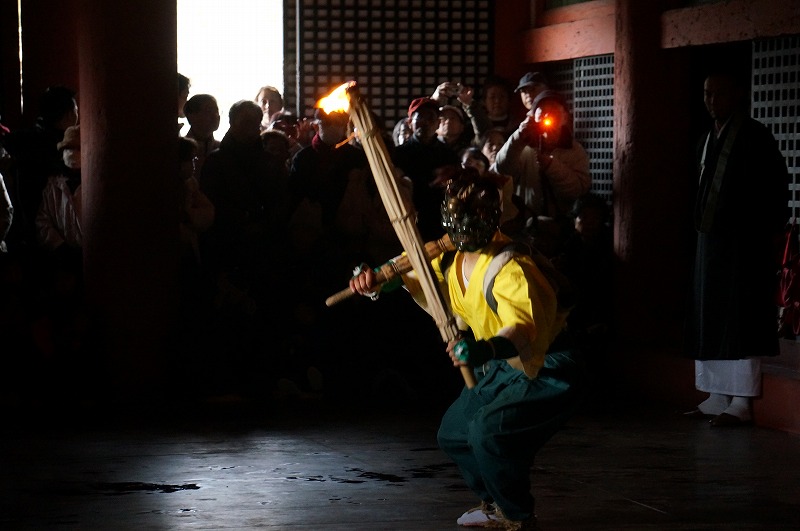
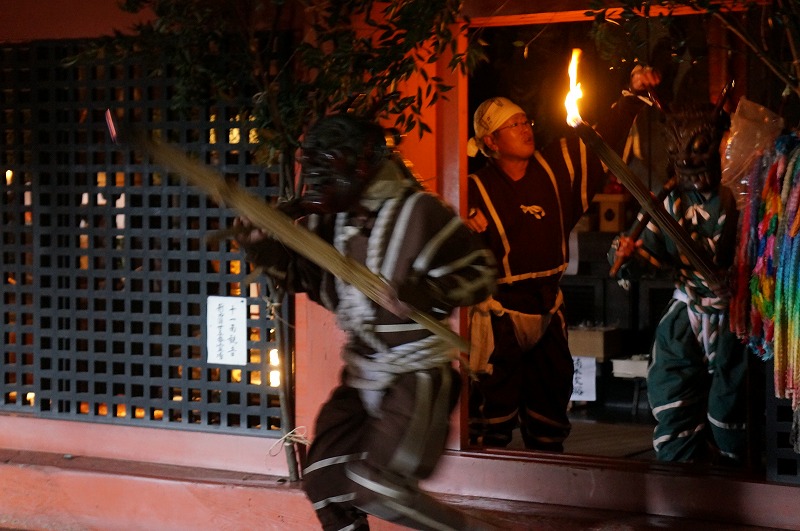
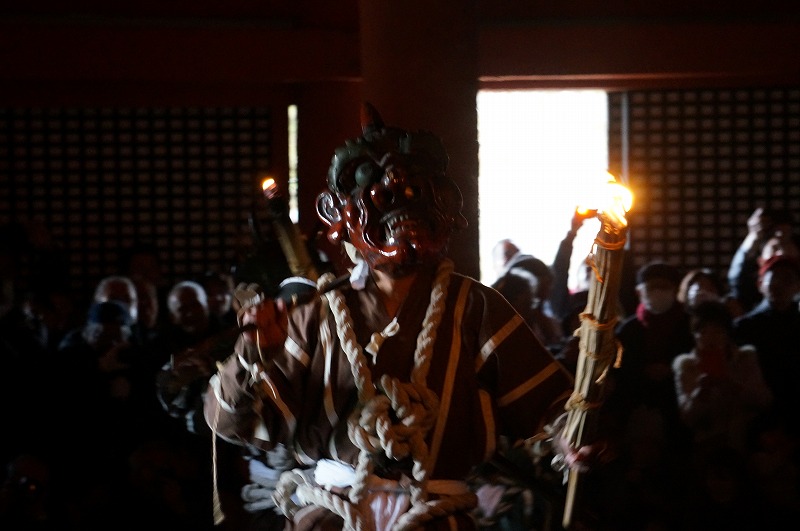
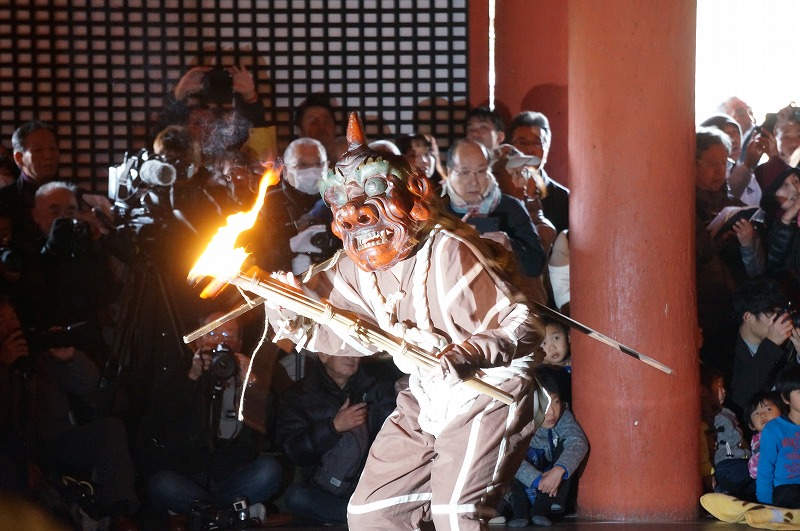
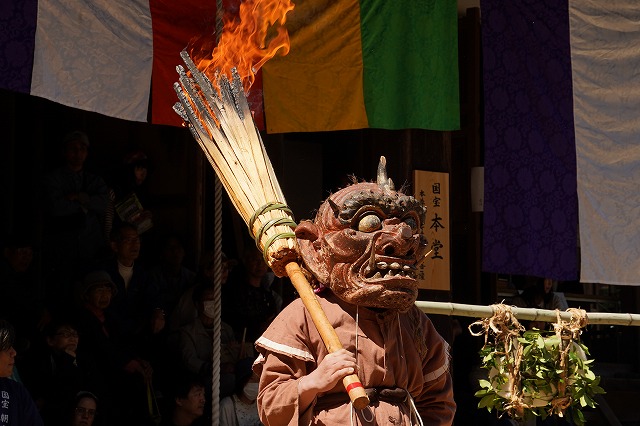
And then, finally, the “Oni” appear. At first, they come one by one. First, a red Oni holding a torch.
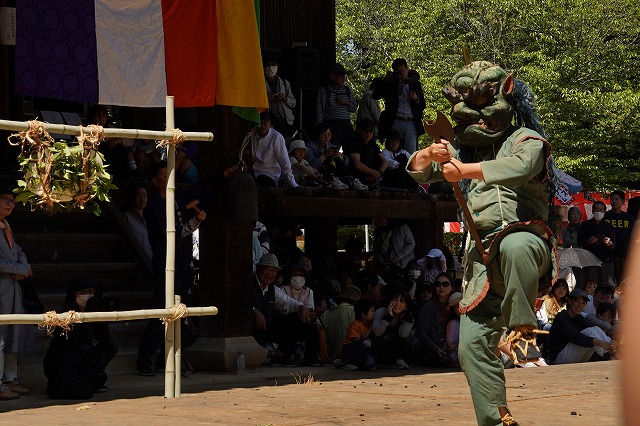
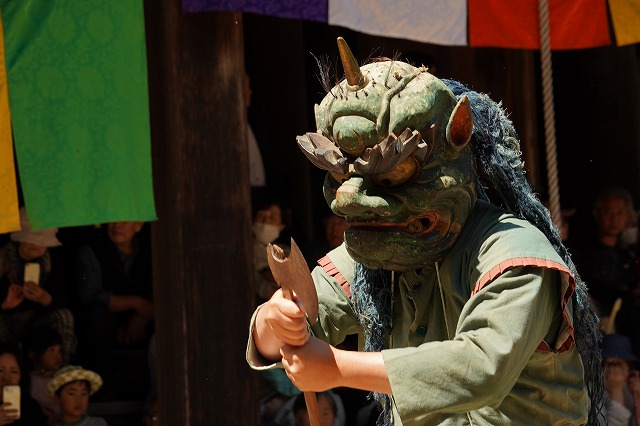
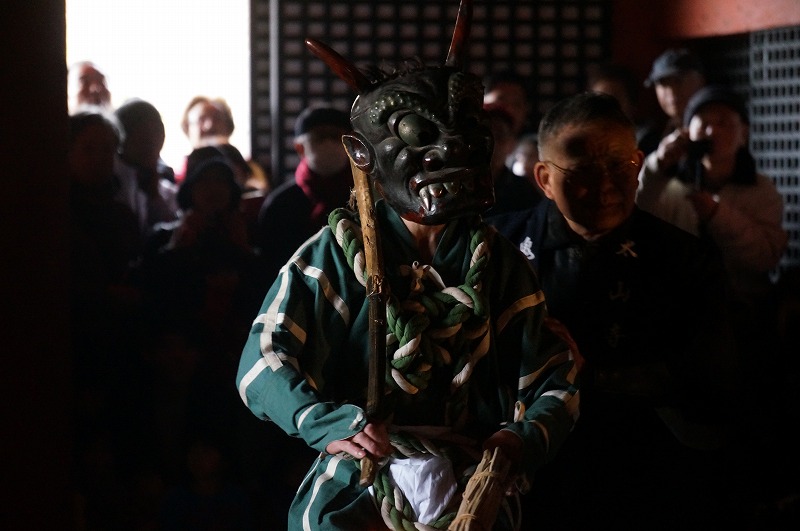
Next up is the blue Oni wielding an axe. All the Oni stomp their feet powerfully on the ground as they approach.
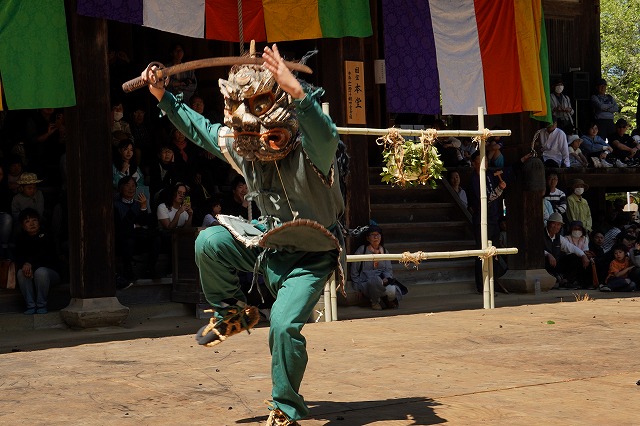
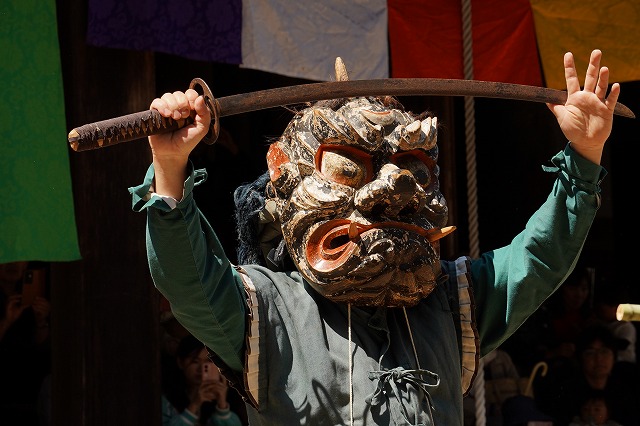
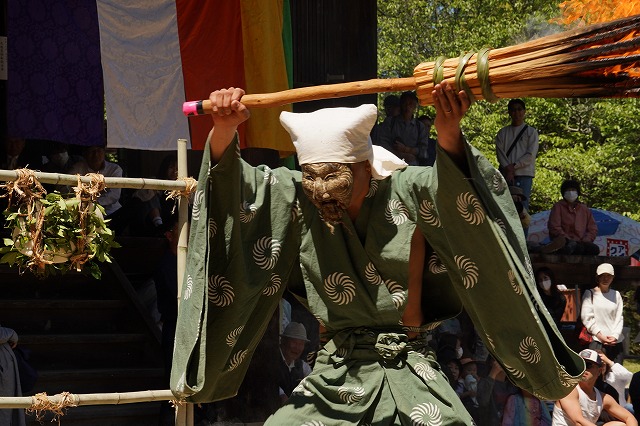
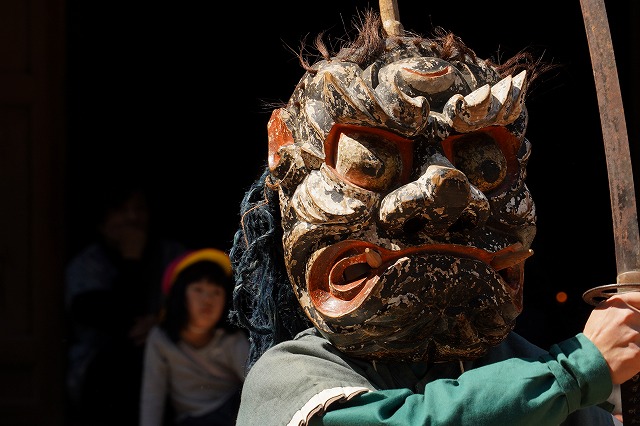
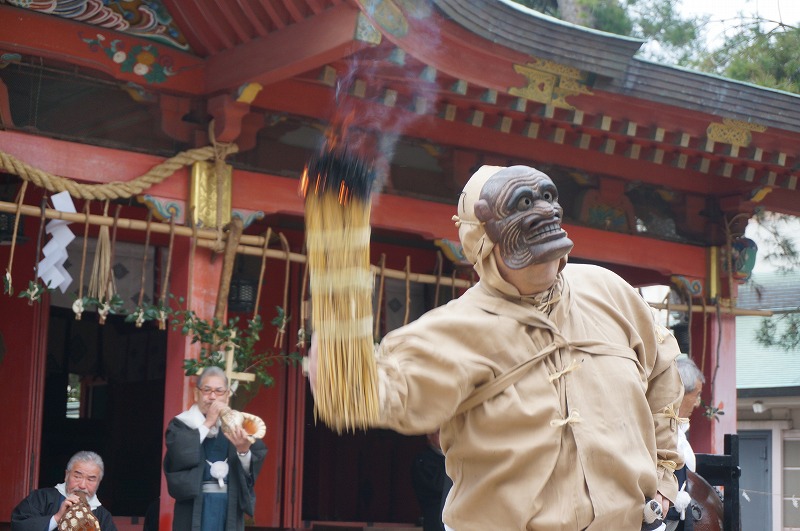
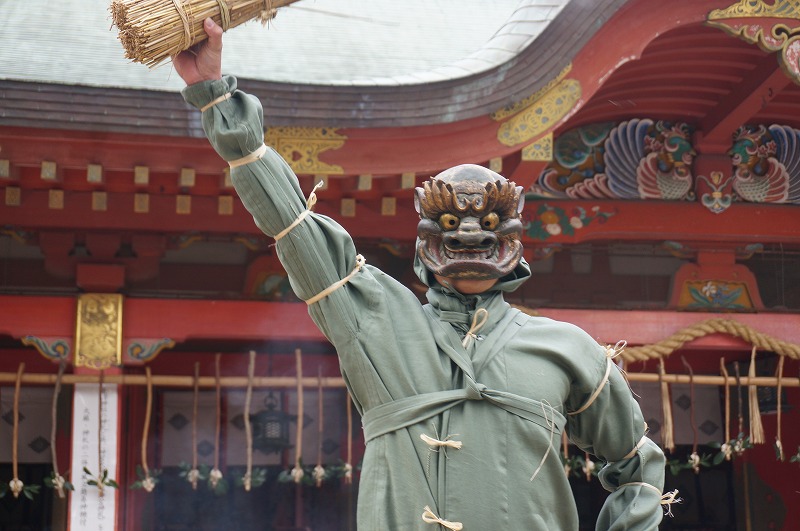
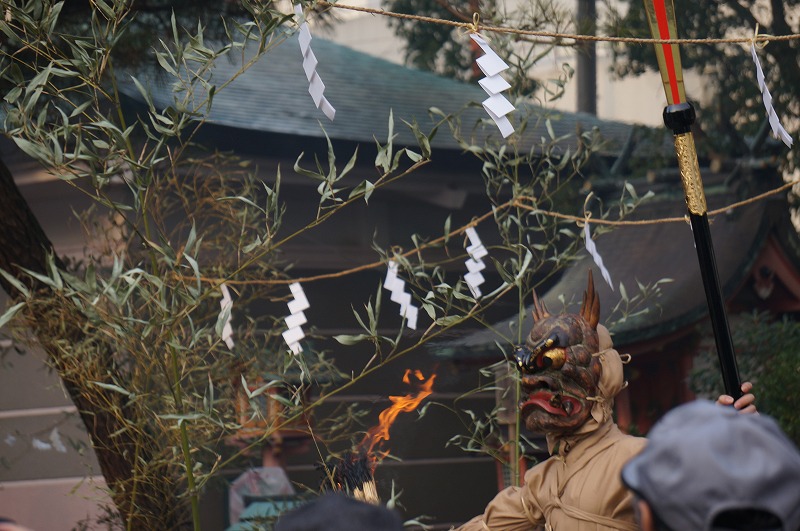
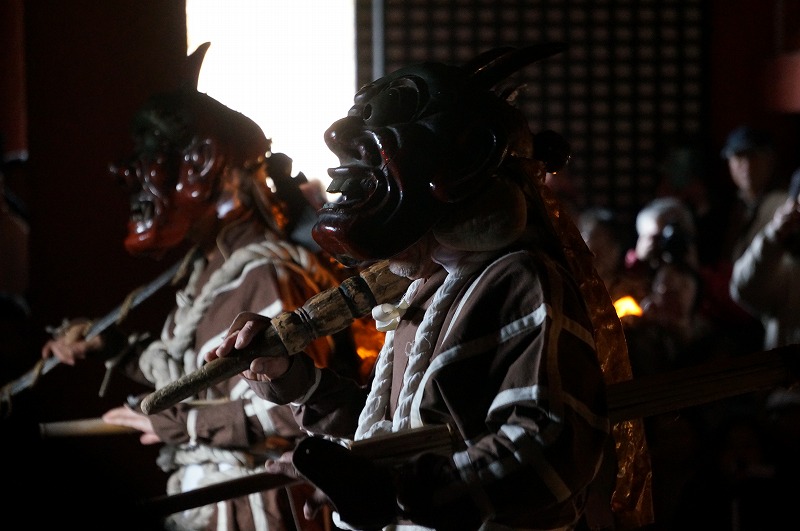
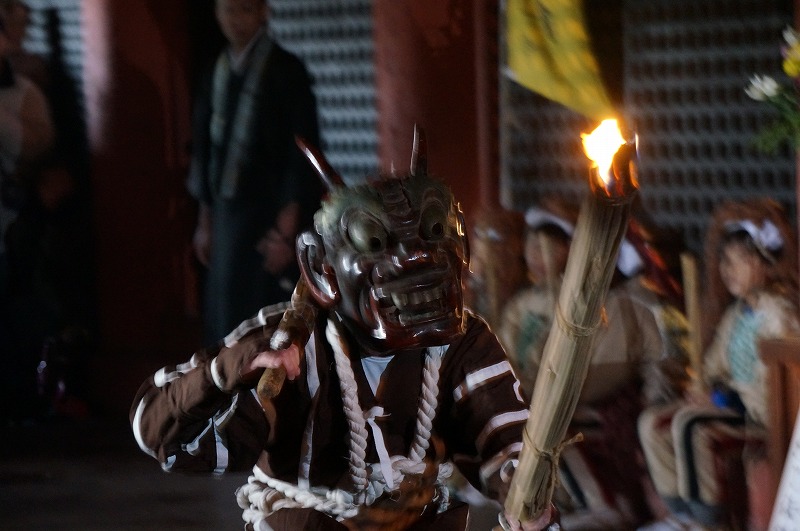
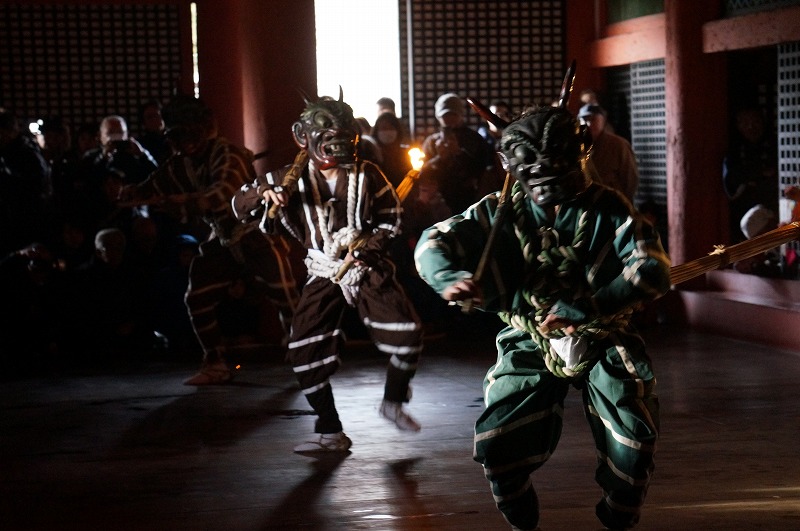
Finally, Oni wielding a long sword appears. All of the masks look quite old. That’s because they are still using the original masks, which were made around the 14th century. Although they would ideally like to create replicas, those involved say it would be far too costly.

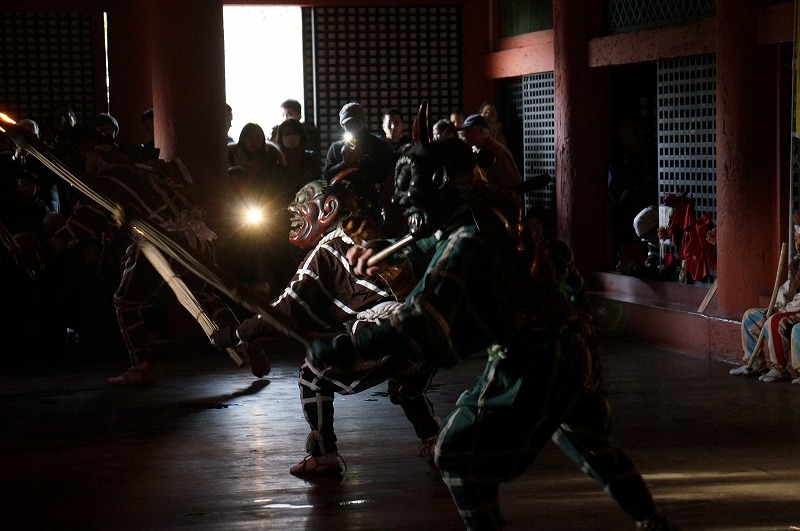
One’s movements are simple. They just walk, jump, and leap while changing direction. They simply stomp the ground powerfully, thud, thud. This originally had the meaning of driving away evil spirits from the land by stamping one’s feet firmly on the ground.
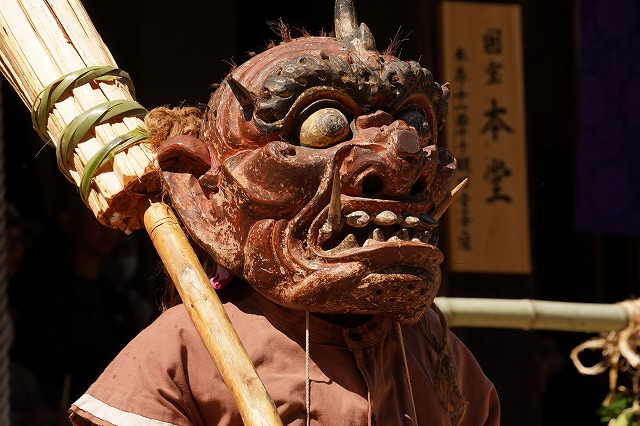
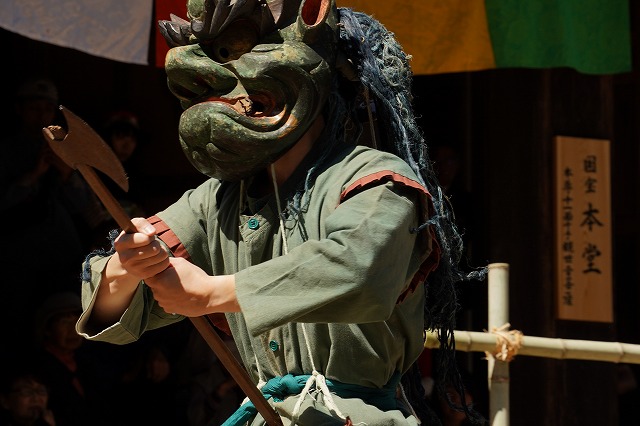
Unfortunately, although there are supposed to be four characters, only three appear this time. That said, each one exudes the distinctive aura of a traditional mask.
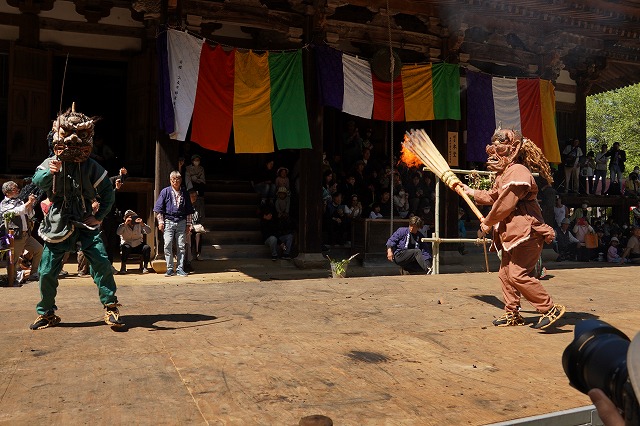
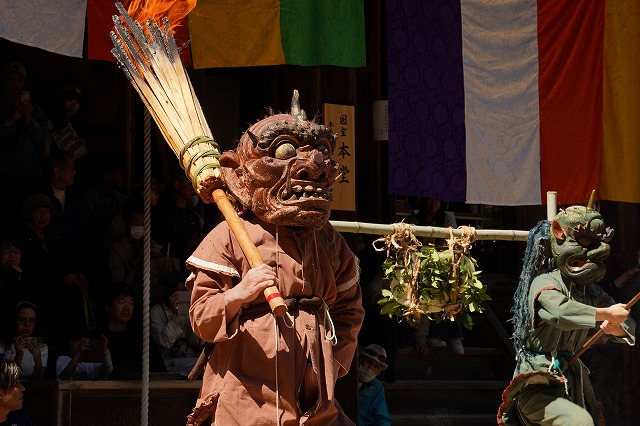
Next, the three of them appear together and cast curses on the rice cake displayed in the center. This lasts about 40 minutes and ends around 2:10 p.m.
Afterward, the rice cake is cut into small pieces and distributed to anyone who wants some.
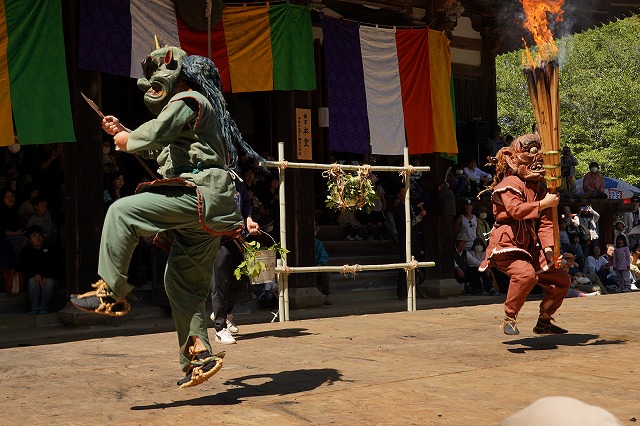
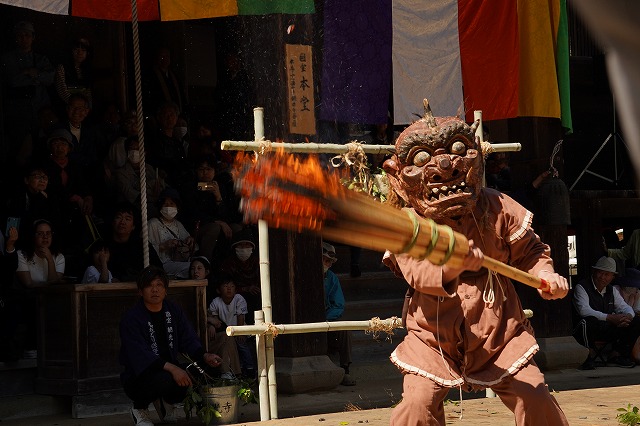
As for sound, there is nothing but the monotonous clang of a gong. The movements are equally simple: walking, stomping, and leaping. Yet despite this simplicity, the space has a mysterious quality that seems to be imbued with a divine presence. Perhaps this is due in part to the power of the ancient masks, or perhaps it stems from the weight of a tradition that has been passed down for hundreds of years. How one evaluates this experience can only be left to the impressions of those who have actually been there.

Incidentally, among the spectators surrounding the area, none of those seated on the steps of the main hall had set up tripods. Perhaps there is some unspoken rule.

Heading to Hata Chōkōji Temple

The only public transportation option for getting to the nearest station is the Kakogawa Line. However, the Kakogawa Line is a single-track local line with only one train per hour. Therefore, to make it on time, you need to leave Osaka shortly after 8:00 a.m. and transfer from the Kobe Line to the Kakogawa Line at Kakogawa Station. It’s quite inconvenient. The main event is scheduled to start just after 1:00 p.m., but just in case something comes up, you can safely assume that the 9:00 p.m. Osaka time is the latest you’ll need to be there. Additionally, even though it’s more than 10 kilometers from the station, there’s no public transportation. Tourists would have to go by bike or on foot, but since walking isn’t a realistic option, a bike is the only choice. Fortunately, however, there are bike-sharing services available at Takino Station and Yashiro Station. The bikes can be rented cheaply with a simple registration process. Yashiro Station also has a tourist information center, so while it’s a bit farther from the temple, it’s convenient for tourists who aren’t familiar with the area.

This time, I brought my folding bike. I set off from Takino Station around 10:30 a.m. For a while, I rode along busy city streets, but…
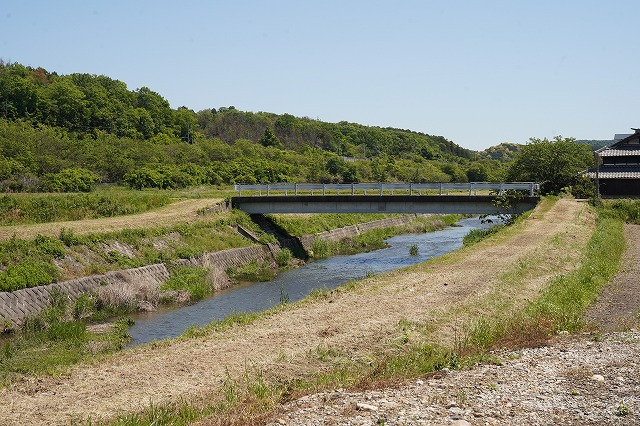
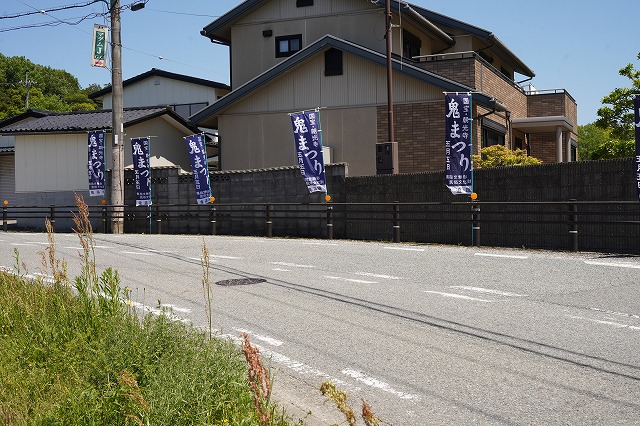
Soon the road turns into a peaceful country lane, and once you see the banners, the temple is just around the corner. The path is mostly flat, so it’s not tough going.

There are convenience stores dotted along the road for about 5 kilometers, and there’s one near the temple as well, so you can pick up just about anything there. Even taking it easy, I arrived just after 11:30. It took a little over an hour.

Report; Seven Oni bring happiness~ Setubun at Kobe


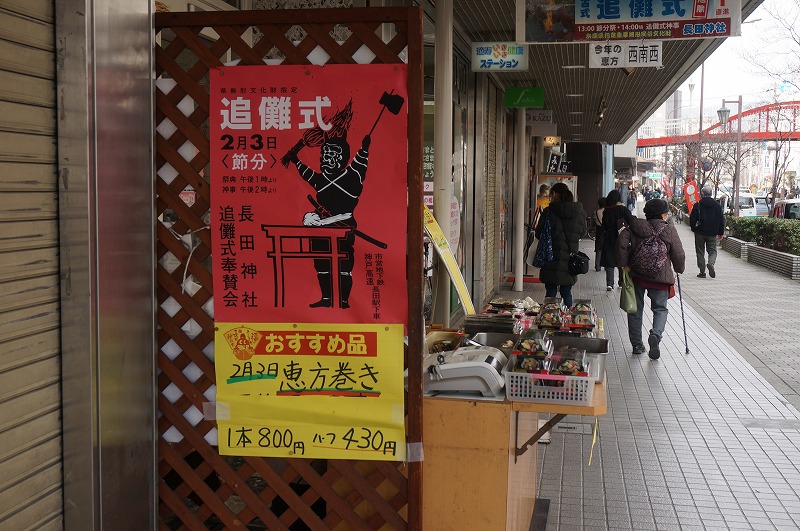
Date: 3 February
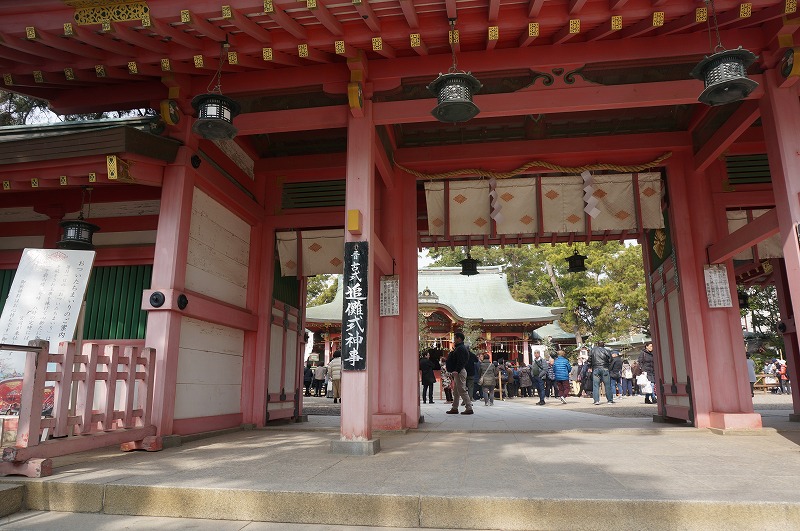
Location: Nagata Shrine 長田神社 3-1-1 Nagata-cho 長田町, Nagata-ku 長田区, Kobe, Hyogo prefecture
Access: For City Subway, Hankyu 阪急, Hanshi阪神 and Sanyo 山陽 trains, get off at Nagata (Nagata-jinja-mae) Station and walk 5 minutes northwards from Nagata-jinja-mae Shopping Street.
For JR, change at Sannomiya 三宮/Kobe 神戸/Shinnagata 新長田 Station to City Subway, Hankyu, Hanshin or Sanyo and get off at Nagata (Nagata-jinja-mae) Station.
City buses, routes 3, 4 (JR Kobe/Hyogo Stn.) and 17 (JR Shin-Nagata Stn.), get off at Nagata-jinja-mae, respectively.

prologue~ 3 points I recommend

“Since I am in Japan during Setsubun, I want to see the japanese Oni. But I can’t go around a lot at once. So where is it good? I want to see many good things efficiently if possible. “
In such a case, this site recommend *Setsubun at Nagata Shrine. The first point I recommend. It’s easy to get to. It can’t be helped, but there are many inconvenient places where traditional events remain. This shrine is about 30 minutes by train from central Kobe. Kobe is close to Osaka and Kyoto, and as a port city, Kobe itself attracts many tourists.
The second point. There are many Onis. It’s not bad to watch only one Oni carefully, but you want to see many if possible. On that point, in this shrine, as many as seven appear at once.
The third point is that the mask is well made. There are many Oni events in Hyogo prefecture, and all of which are of good workmanship. This is probably due to the fact that a lot of skilled craftsmen came from Kyoto and Nara. Also, the technique was easy to convey. Kyoto and Nara are both ancient capitals and the birthplace of many Buddhist sculptures.

*Setsubun originally meant a day to divide the seasons. And Tsuina Ceremony is an event to exorcise the bad luck of the year. These two were combined someday, and the current Setsubun event was born. Therefore, many people recognize February 3 as Setsubun, the day on which people throw beans at ogres to drive them away.

program of a ceremony

On the day of the event, early in the morning, those who play the role of Oni purify themselves on the beach. This is an important ritual that is performed from the day before. From around noon, the Oni actors and others involved parade through the town and arrive at the shrine. At 1 o’clock in the afternoon, the Onis’ performance finally begins. A long podium on which the Oni walk is set up in the hall, and the audience is waiting in front of a bamboo fence. Taro Oni appears first, alone. Then the five Onis, including Taro Oni, appear in full force. Finally, the Mochi-Wari Oni and Shirikujiri Oni, regarded as the strongest Oni, appear. This is repeated twice. So by the end of the performance, the sun has completely set and a fantastic scene appears with torches blazing in the night sky.

Oni and the Stage

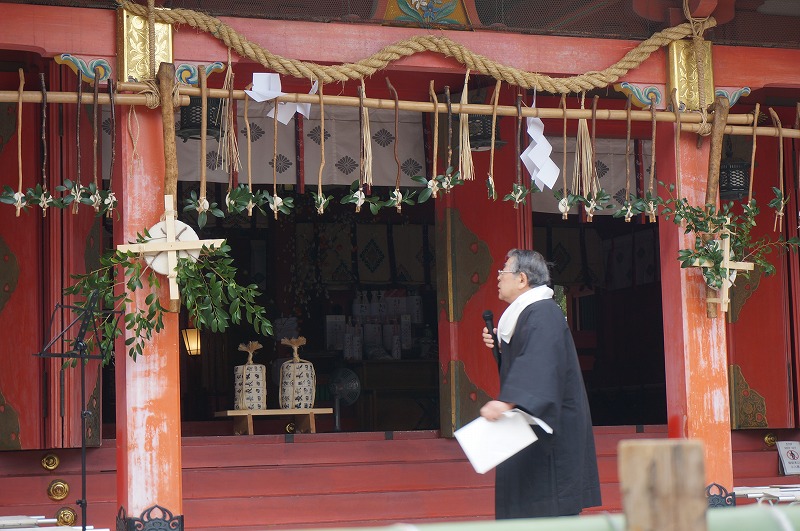
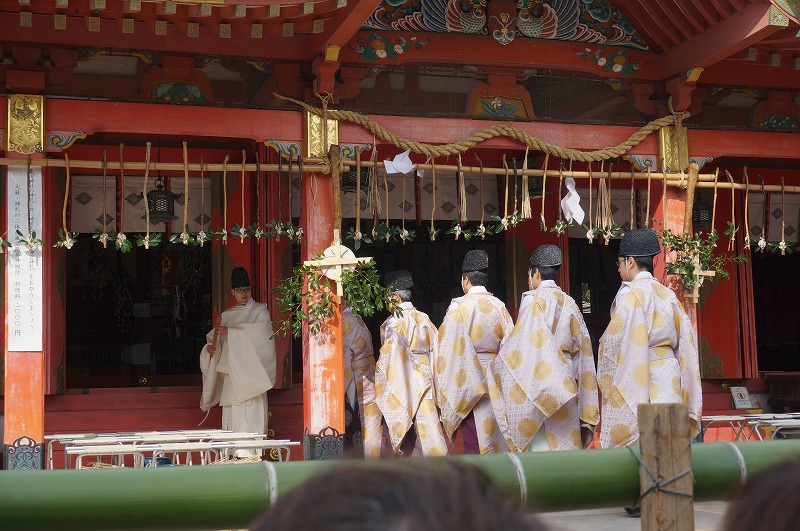
Two large rice cakes are hung in the shrine. These are the symbol of the sun and the moon, and thus heaven and earth. Alongside them hang 64 rice cakes and sakaki (cleyera japonica) leaves. This represents the whole country, as Japan was called 64 provinces in the past. In addition, rice cakes and tangerines adorn the center of the worship hall. These represent the universe and the stars.

In this shrine, the Oni are not daemons. They are messengers who bring happiness to people instead of God. Therefore, there are no bean-throwing ceremonies, and there is no chanting of ‘Oni wa soto’ (meaning to drive out the ogres, the symbol of misfortune)

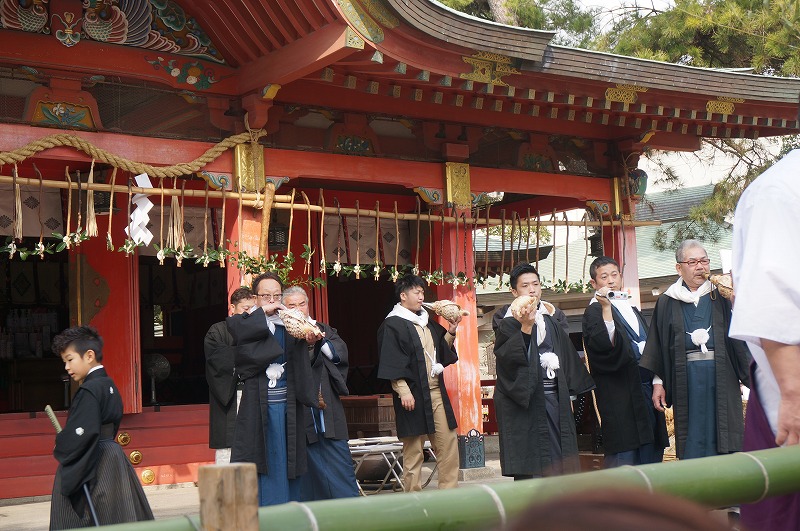
After the 30-minute ritual that begins at 1:30, it is time for the Onis to appear.

Taro oni appear

At 2 pm, finally, the Oni appear. At first, the Taro oni appeared alone. Wielding a torch, he performs a vigorous preliminaries. He appears repeatedly three times. He will appear after this. He is the most frequent on this day.

Five Oni on the stage

Aka oni 赤鬼

Uba oni 姥鬼

This time, five Onis continue to appear on the stage. Besides Taro, they are Aka Oni, Uba Oni, Housuke Oni, Ao Oni. The scene of the five Oni lined up on stage is a spectacle. The presenter then adds witty commentary. For example, such as “This Oni is too good-looking to be wearing a mask” or “He is a veteran who has already played the role of the Oni ten times this year”. It is also said that if the Ao oni pats you on the head, your eyesight will improve.

Housuke oni 呆助鬼

Ao oni 青鬼

Aka and Ao mean the color, red and blue. The uba means an old woman. The Housuke represents a stupid man, but he has the most fearsome face that does not look very like that.

Mochiwari Oni and Shirikujiri Oni

Mochiwari oni 餅割り鬼

Shirikujiri oni 尻くじり鬼

And last but not least, Mochiwari Oni and Shirikujiri Oni. These are the strongest Oni, holding swords and spears and wielding torches to shake off the evils of the world. The meaning of the Shikujiri Oni is unknown, but the Mochiwari Oni means the Oni that breaks rice cakes (mochi). And as the name suggests, to smash the rice cakes with an axe is the climax of the event. By then, it was already nearly 6 pm.

The baton is passed on

Thus, the event, which continued during the day, comes to an end with the year’s prayers.
To be a Mochiwari Oni, one must have played the role of Oni at least seven times. In addition, the various people involved, including the Oni, must basically be born in the area. Despite these restrictions, fortunately, people who have played the role of oni once want to do it again and again, so there seems to be no need to worry about successors. The event has continued for more than 600 years, and I am not the only one who hopes that it will continue in the future.

Kobe is a major city along with Osaka and Kyoto. Its centre is Sannomiya 三宮. There is no shortage of sightseeing. Be sure to visit once when you visit the port city.

cf. https://www.feel-kobe.jp/en/


Explore Japan’s Oni Legends at Taizanji Temple


Date: 7 January every year
Location: Taizanji-temple 太山寺, Zenkai-224 Ikawadani-cho, Nishi Ward, Kobe, Hyogo
Access: 10 minutes by Shinki 神姫 bus from Ikawadani 伊川谷, from where it is a 5-minute walk. However, there is only one bus every hour.
    Or a 30-minute walk from Gakuen-toshi 学園都市.
    Both stations are about 30 minutes from Sannomiya 三宮 (Central shopping district of Kobe) by the Seishin 西神 Subway.

based on a visit on 7 January 2018

Nationally, Setsubun 節分, or Oniyarai 鬼遣らい (To drive away bad evil spirits represented by Oni demons), is a fixed date of 3 February. On this day, Oni demons appear in many parts of the country and beans are scattered to scare them away. Although it seems to have become less common these days, it is sometimes held in ordinary households with children, and you can find Oni masks in supermarkets.
Here in Hyogo Prefecture, however, events already start in January in various parts of the prefecture. There is a record that Oni yarai events were originally held at court on New Year’s Eve in the old days, so there is nothing wrong with going in January. Around 20 or more locations throughout Hyogo Prefecture. The latest is in May. This website reports on one of them today.
cf. http://kobe.travel.coocan.jp/shrine_temple/tuinashiki.htm

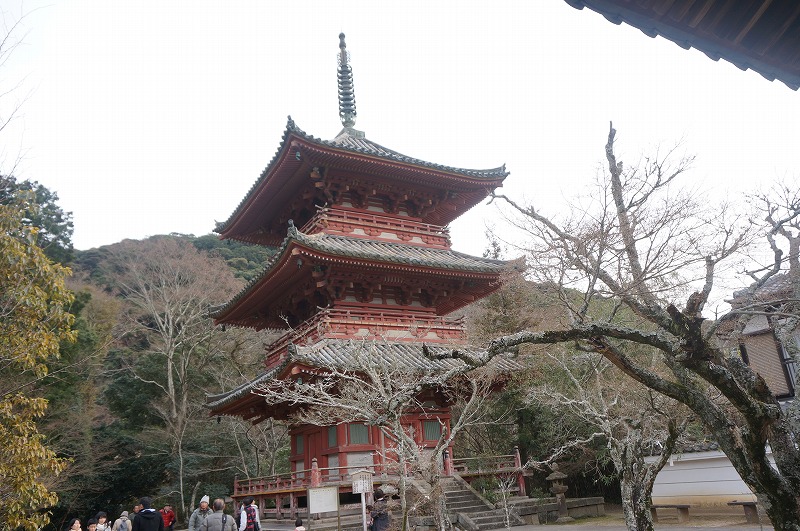
The venue, Taizanji Temple, is located in a mountain village far from the station. It is a 30-minute walk along a winter-dried road. The temple can be seen standing quietly. Although the temple has a quiet atmosphere now, it used to be a large temple with about 40 temples and halls. Founded in 973. It was later damaged by fire, but reconstruction began in 1293. For this reason, the main hall is the only one in Hyogo Prefecture to be designated a national treasure. Its main hall is filled with the enthusiasm of people on 7 January. The festival starts at 2pm, but by 1.30pm it is already full of people. Incidentally, there is no admission fee on this day. Conscientious management means that on days when there are events, it is free.

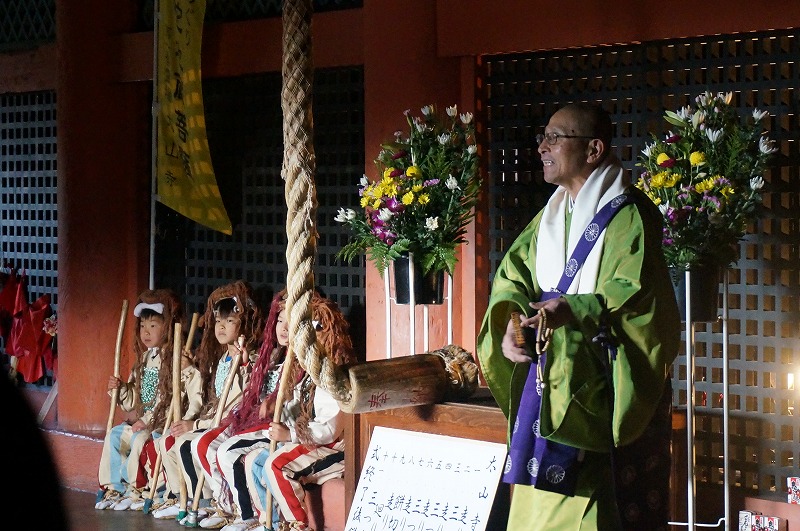
Starts at 2 pm. Before that, there will be a brief explanation by the resident priest. Then the people concerned will sprinkle water on the floor. The ceremony uses torches, so it would be a big problem if the fire spread. It is astonishing that this kind of event has been carried on for so long in such a situation.
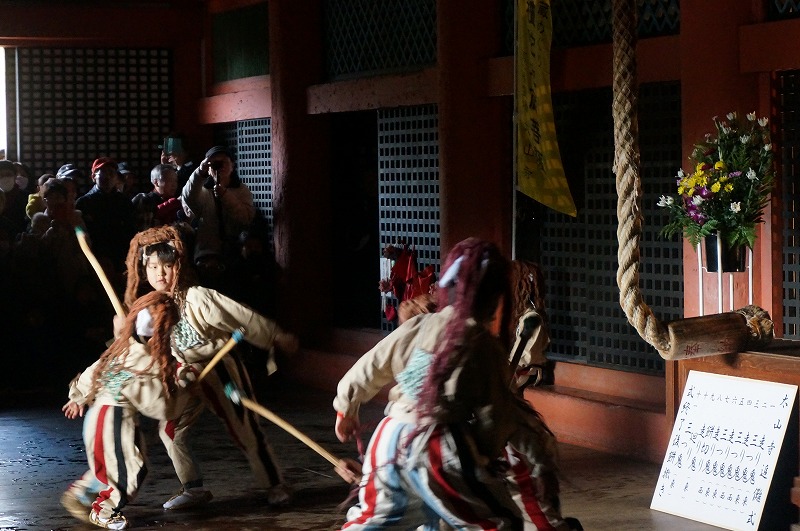
There will be a total of four Oni demons. They are the Hashiri-Oni (Running Oni), the Taro Oni, the Jiro Oni and the Baba Oni. Of these, Taro and below appear in groups of three. Each one lasts about five minutes. This is repeated about 10 times in total. The only background music is the sound of Japanese drum. The doors of the main hall are closed when the performance begins, so it is pitch-dark inside. When the heavy bass drumbeats begin to resonate in the stomach, the Oni finally make their appearance.

hashiri Oni 走り鬼

Running Oni appear alone. The person chosen to play the role of the Oni purifying themselves a one-day and performs water purification.

Three Onis, Taro, jiro, and Baba

When the running Oni is finished, three Onis appear. They are named Taro 太郎, Jiro 次郎 and Baba 婆. Taro and Jiro are (or perhaps it is more correct to say were…) typical Japanese male names. They seem to have lost much of their popularity nowadays). The first son is named Taro and the second son is named Jiro. The word ‘ro’ means man. Even so, Taro is still often used as the name of a shop or a robot.

Taro oni

Jiro oni

Baba oni

The masks are said to have been made by Unkei 運慶 (early 13th century), the most famous Japanese Buddhist master. In fact, it was not certain, and the resident explained that it was only an oral tradition with smile. The carving of the face is so superb that we can nod our heads in agreement when we are told so. The area is close to Kyoto and Nara, so there must have been many skilled craftsmen. On New Year’s Eve, the great religious city of Hieizan 比叡山 also holds a ritual to drive away demons, and the Oni masks that appear there are said to be modelled on those from here.

Ko-oni 子鬼

In between there are also child Onis by children. A moment’s peace of mind among the terrifying Onis. Their serious expressions are adorable.
The explanation is late, but the Oni here are not bad demons, but Oni that bring happiness to people.

The direction in which the Onis appear changes each time, and they are called mountains and villages respectively.

The audience stands in the pitch-dark hall, lit only by the light of torches. All that can be heard is the deep, resonant sound of the Japanese drums and the stomping of the onis’ feet on the floor.

An hour and a half later, a rice cake throwing ceremony takes place at the temple, which has been opened to the public, and the visitors disperse in their own directions.

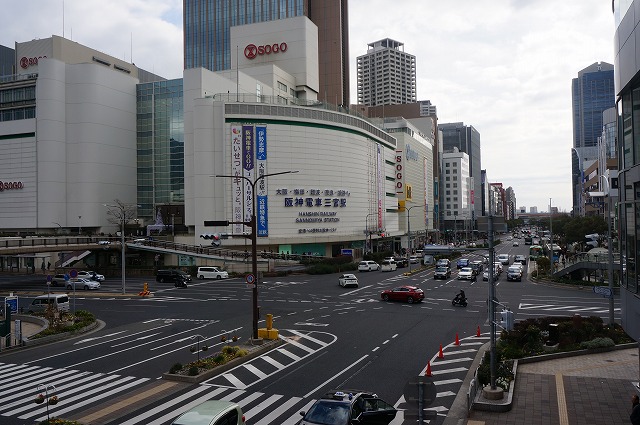
On the way back, one of the biggest cities in the Kansai region, Kobe, awaits.

https://www.feel-kobe.jp/column/taisanji/