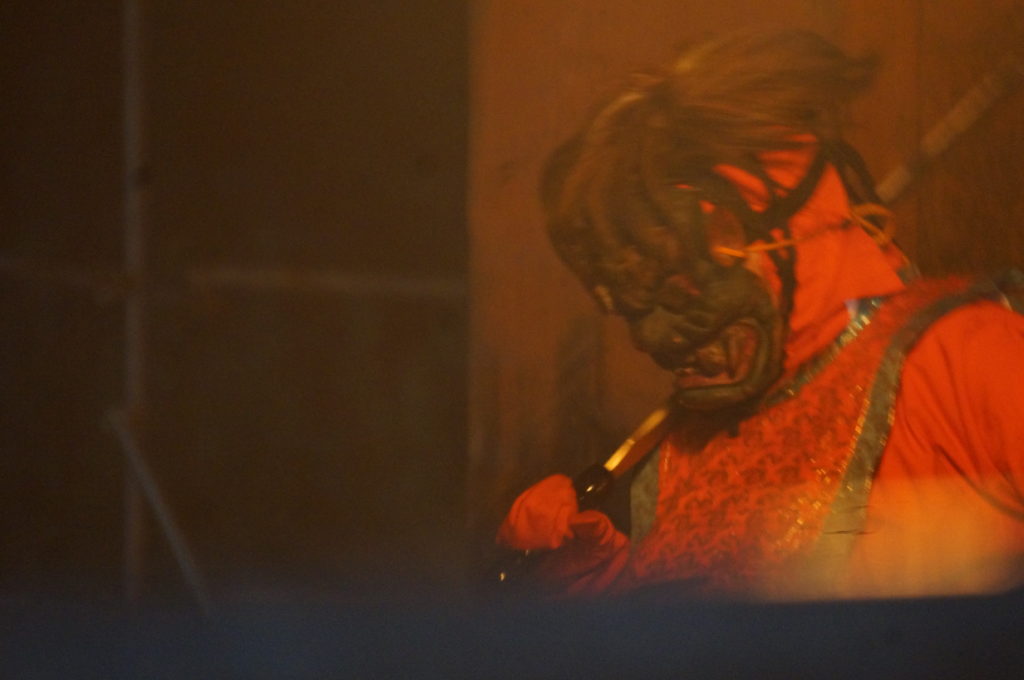
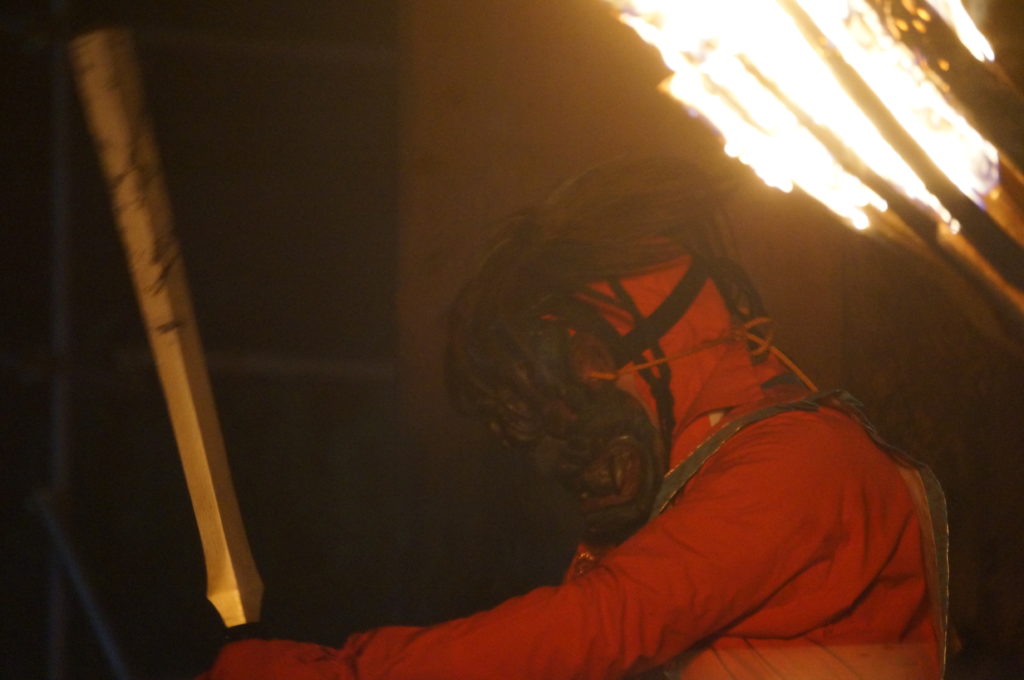
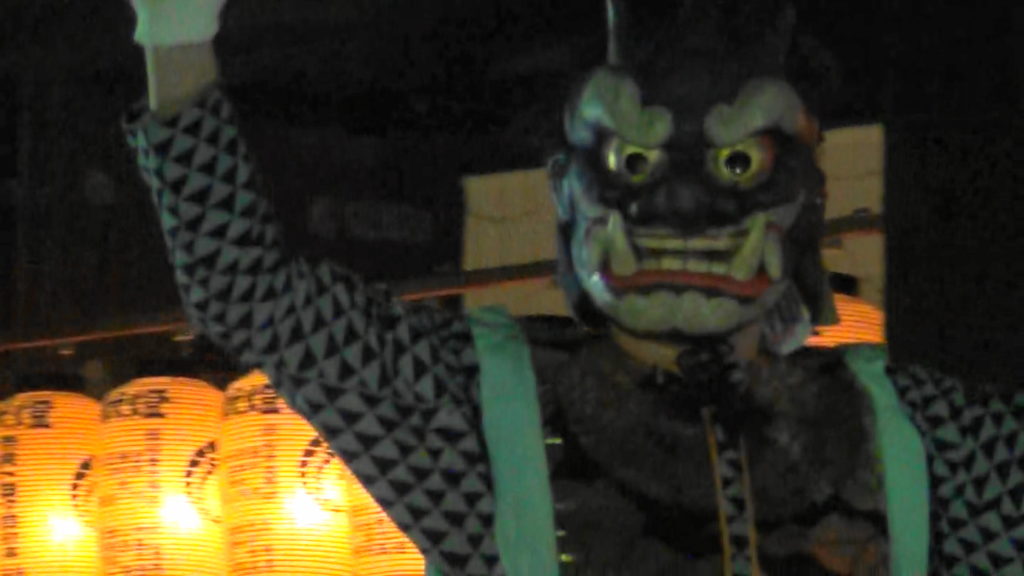
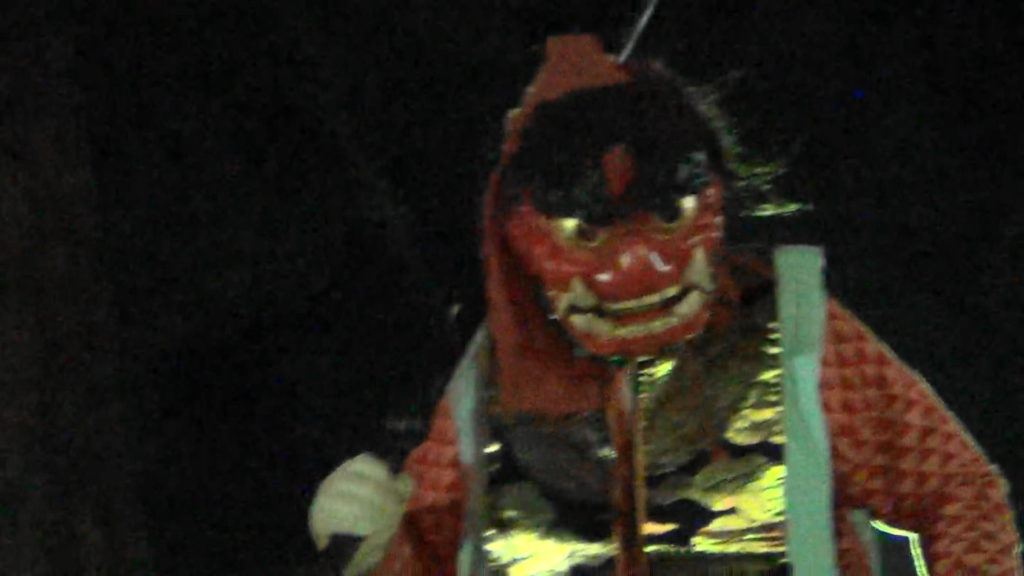
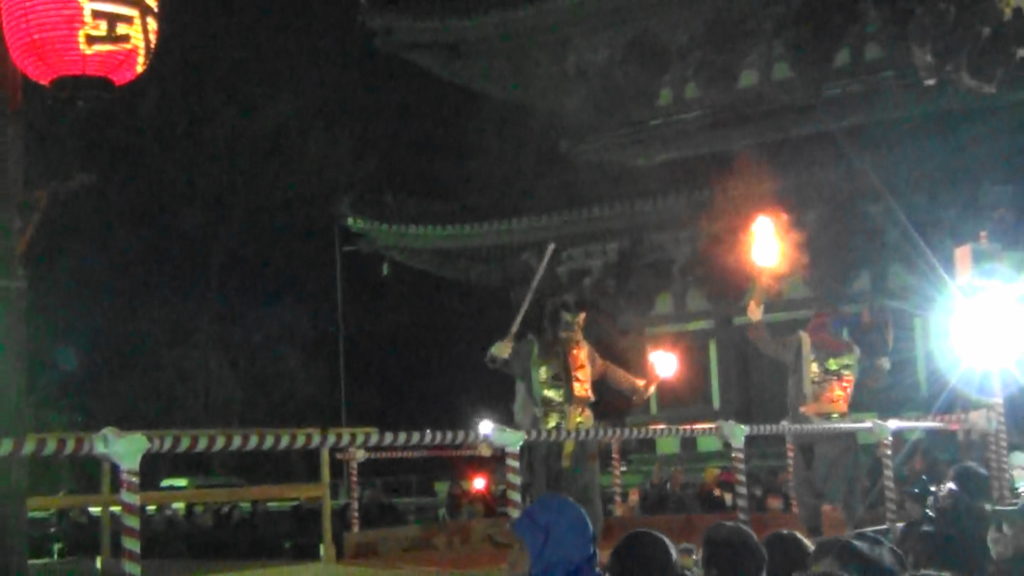
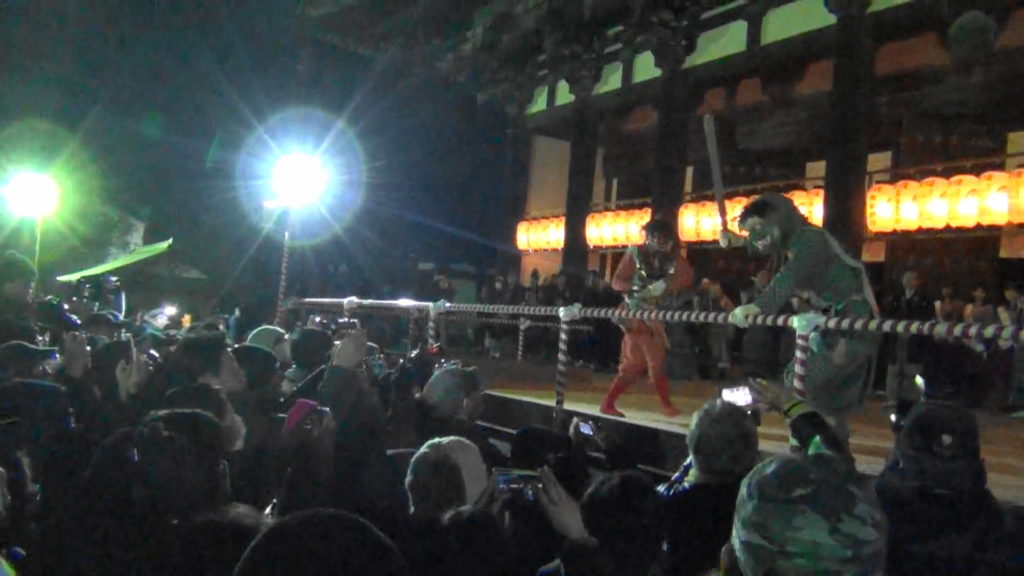
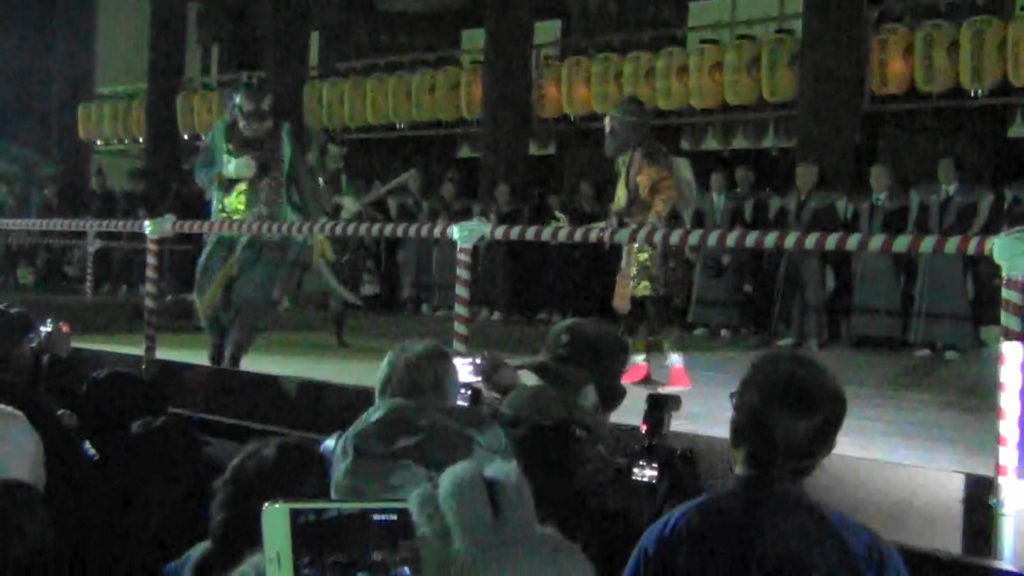
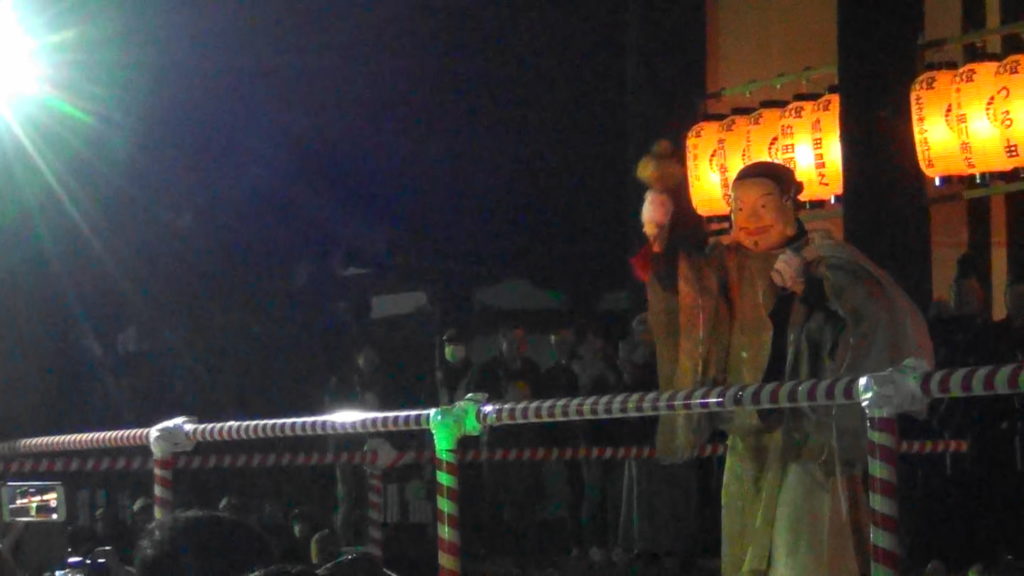
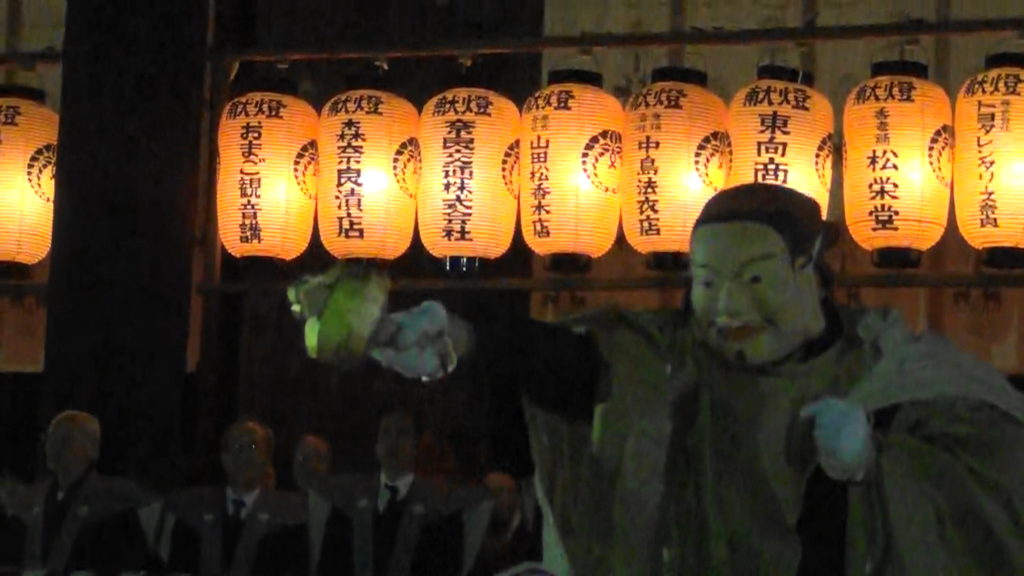
Ogre runs with fire ~at Dada-do

Date: January 14th every year
Location: Otsu town 177, Gojo city, Nara prefecture
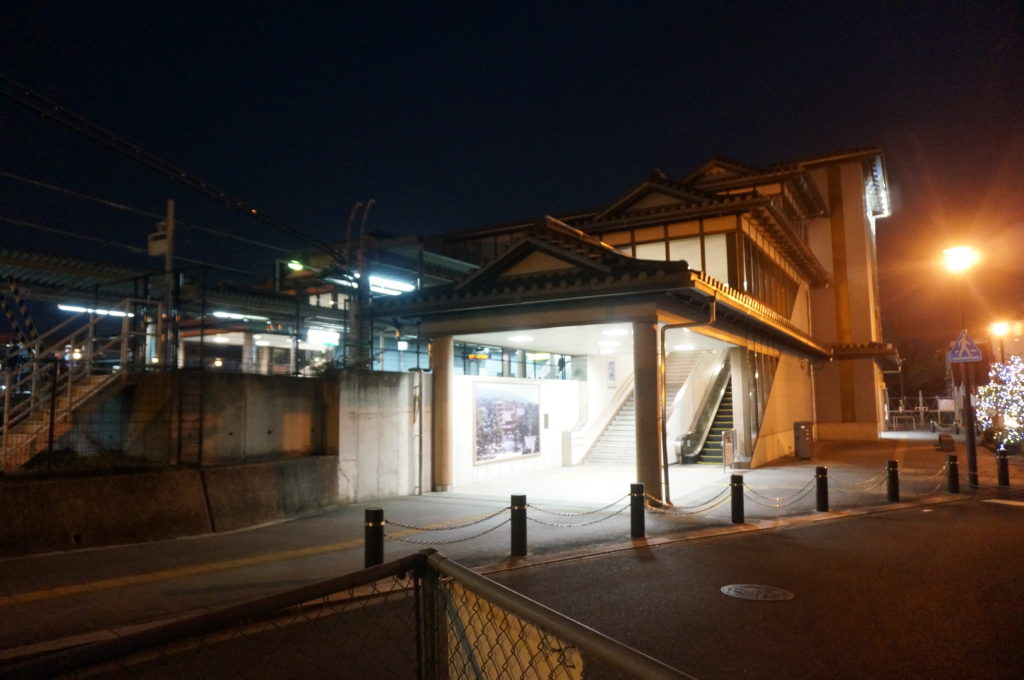
Access: 10 minutes by car from JR Yamato Futami Station, or 30 minutes on foot.

What is the purpose of doing this?

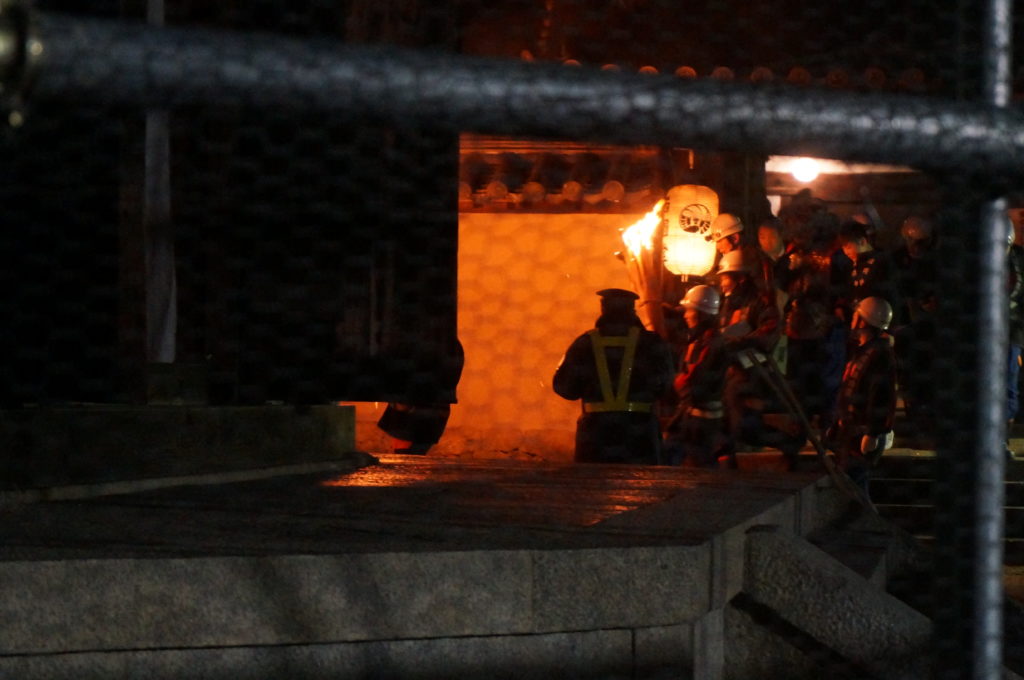
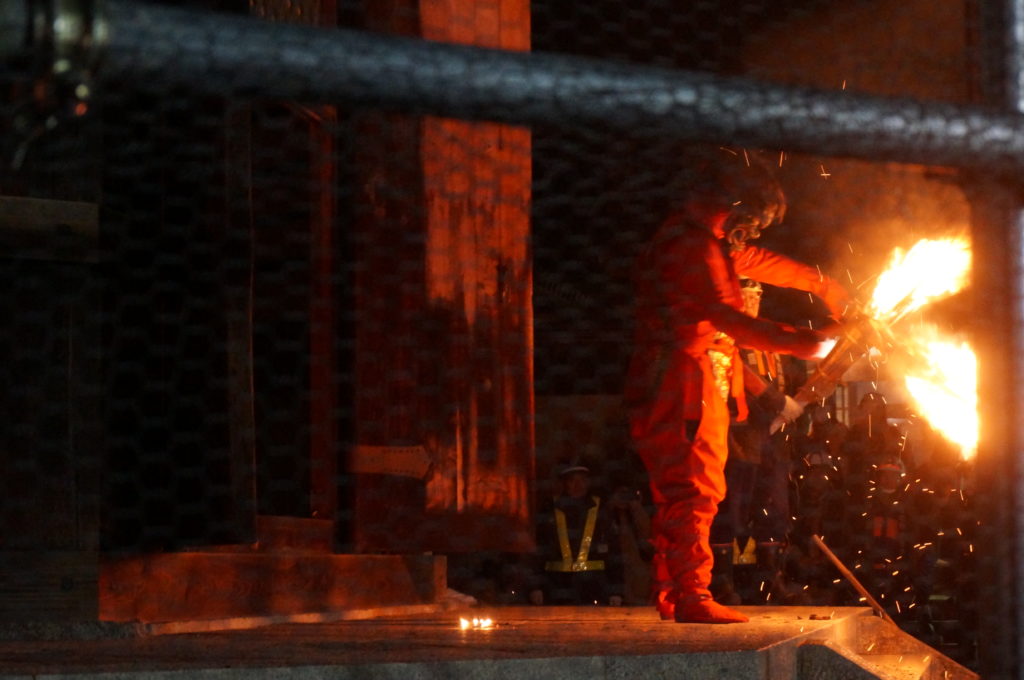
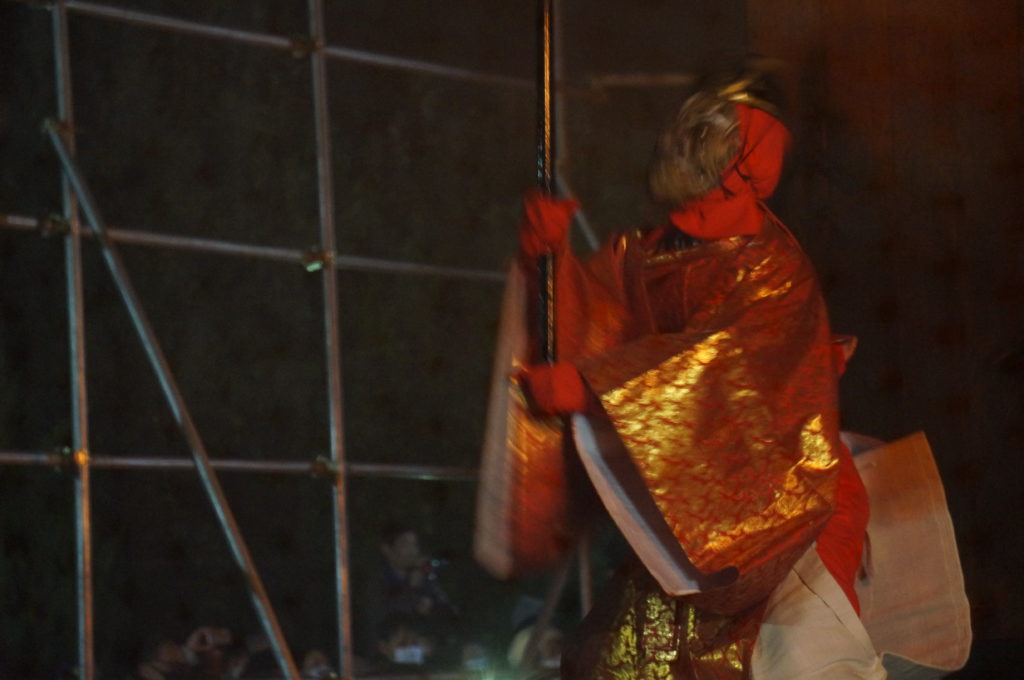
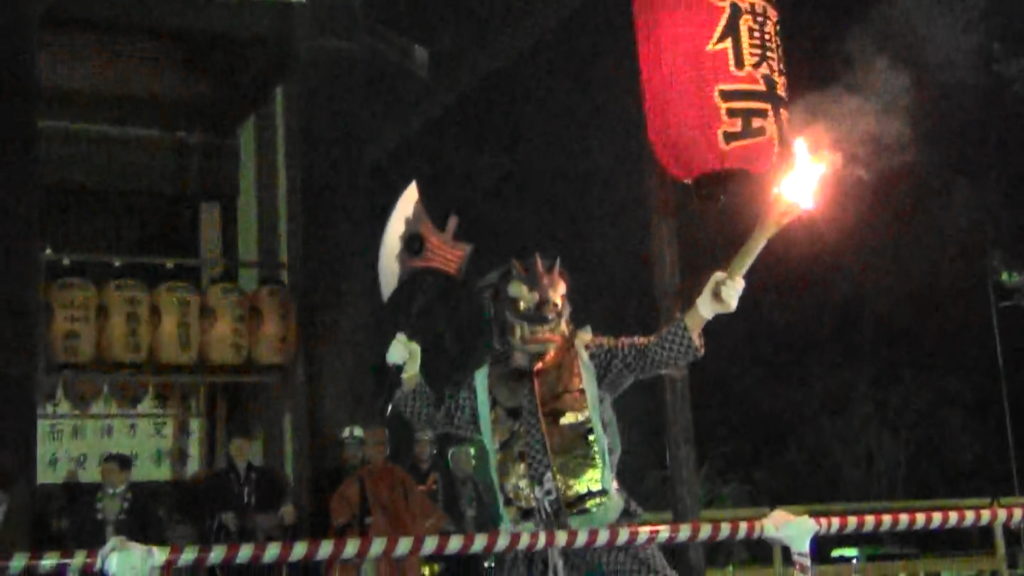
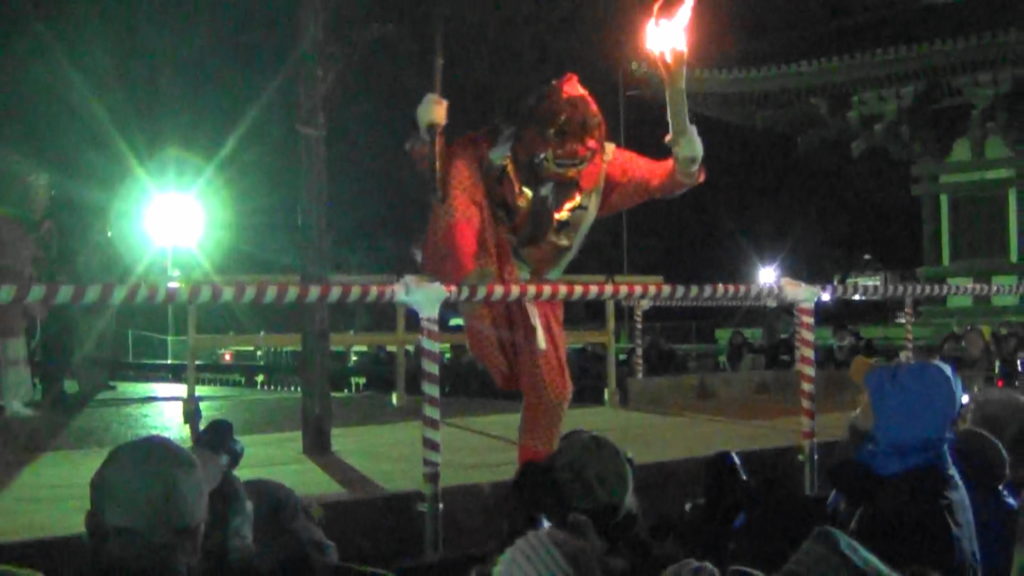
Ogres with huge torches wielding fire. Such events are held at a place called Nenbutsuji Temple 念仏寺. It is a very inconvenient place. The official website even lists the last train schedule. Every year, they hold an event where ogres run with torches in the temple.
Part of an event called Shusho-e 修正会. Shusho-e is a Buddhist event held at New Year’s to pray for a good harvest and to ward off bad luck. Here at Nenbutsuji Temple, we regard it as an event to rid ourselves of past sins and pray for happiness in the new year. The final day is Kechigan 結願. Kechigan means “consummation of a vow period”.
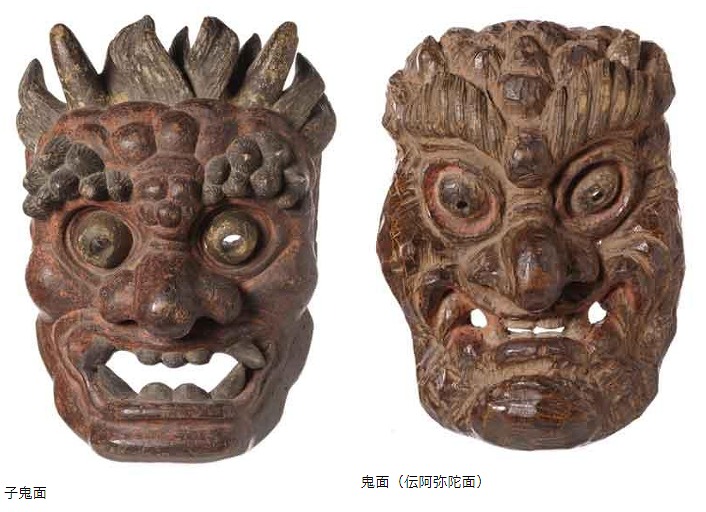
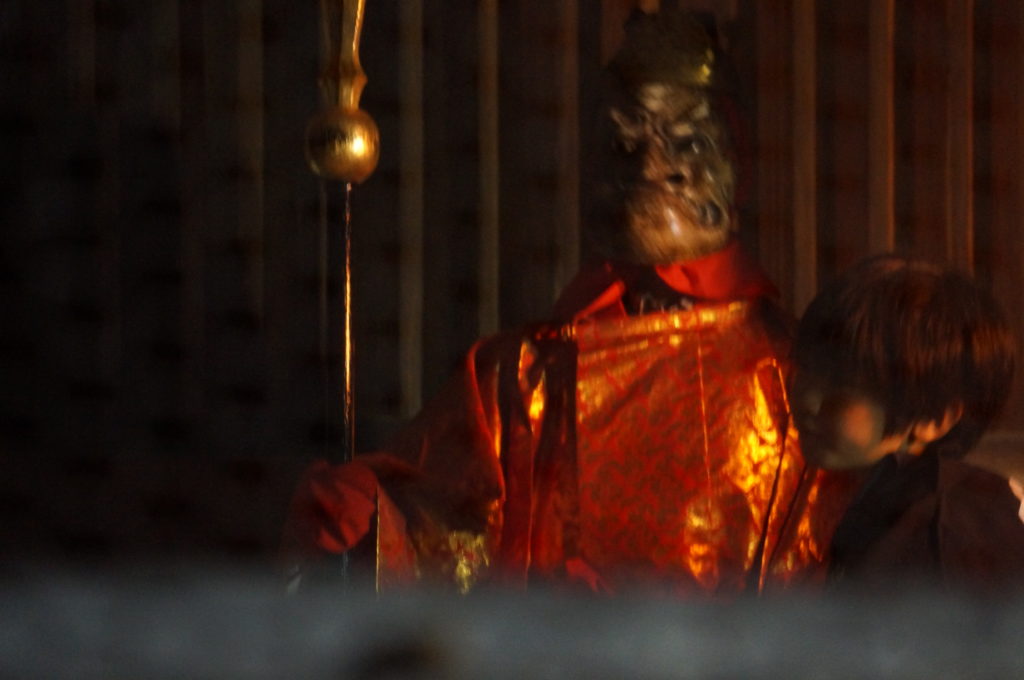
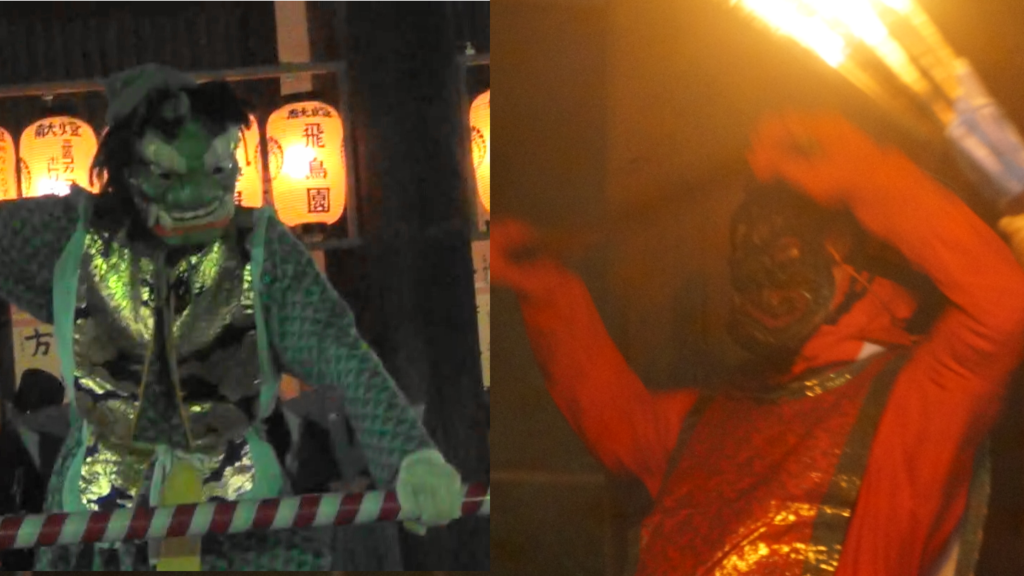
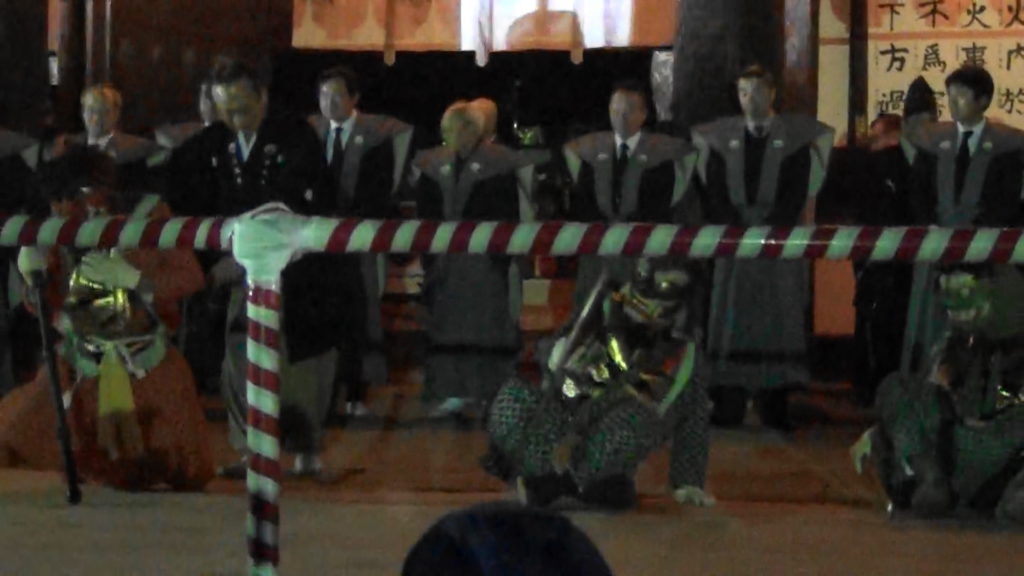
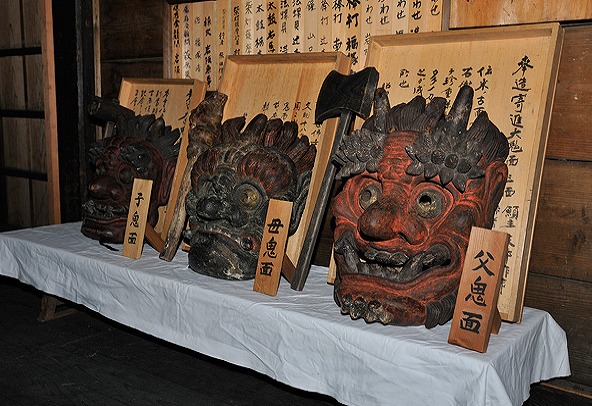
father and mother ogre

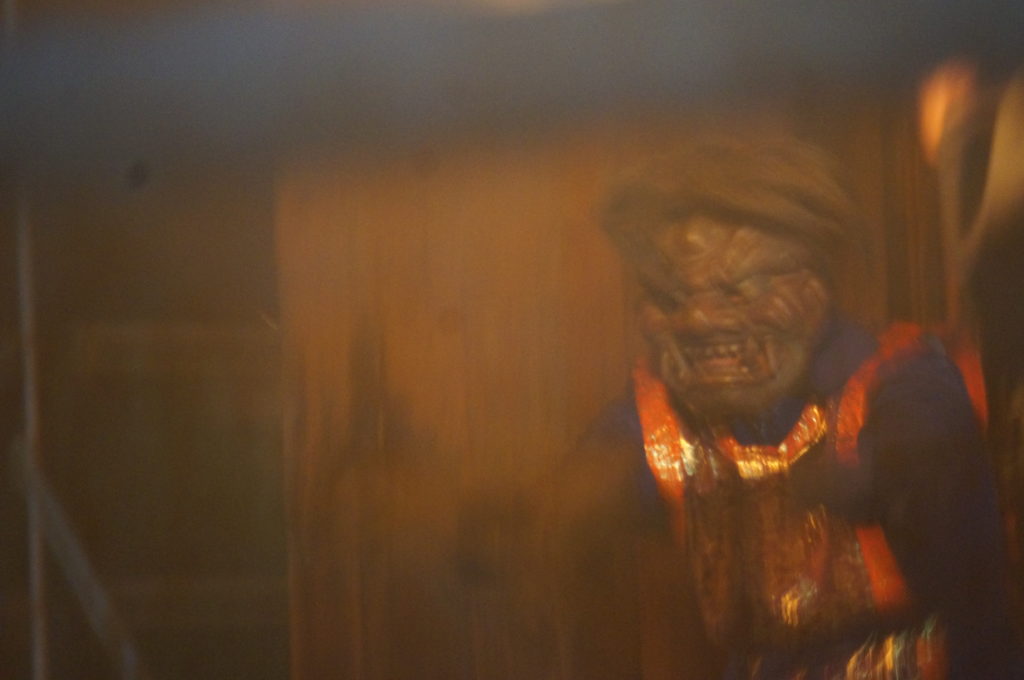
kid and Amida

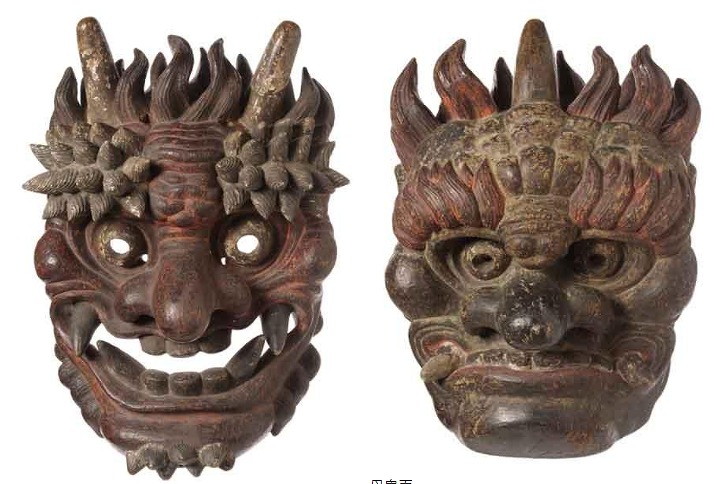
The masks used in the current event were made of cypress in 1961. However, the older masks were made in 1468, so we can assume that this event started at least around that time.

Schedule of Events

4:00 pm. the event daytime
4:30 pm. throwing rice cakes

7:00 pm. Monks begin reading sutras
9:00 pm. main event starts
Why don’t we go to Dada-do? There are no foxes or raccoons there. If there are, we can go back. But then ogres appeared!

This time, the stage was the Dada-do 陀々堂 in Nenbutsu-ji Temple 念仏寺 where such a children’s song is handed down. It is roughly divided into daytime and nighttime sessions. In the daytime, ogres appear and run around with torches as in the nighttime, but they do not set fire to the torches. It’s like a kind of rehearsal. But it has the advantage that there are not as many people as at night. Also, since it is bright, you can see the gestures and masks clearly. In the past, people used to make the masks from a single tree made of Japanese cypress, which weighed about 4.5 kg, but now they use masks made of a single tree made of thatch.
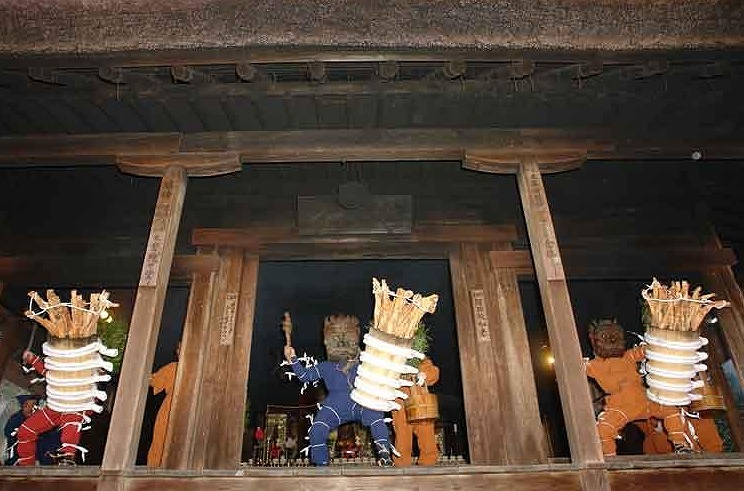
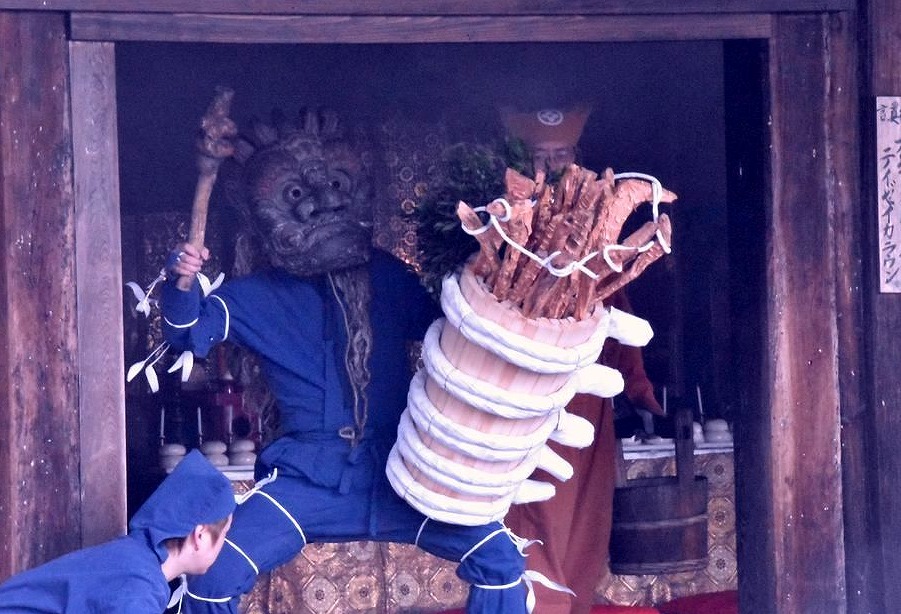
However, the main attraction is still at night. Fire seems to have something that makes people’s hearts flutter. Whether or not you’ve prepared well for the daytime session, the main event is the evening session.
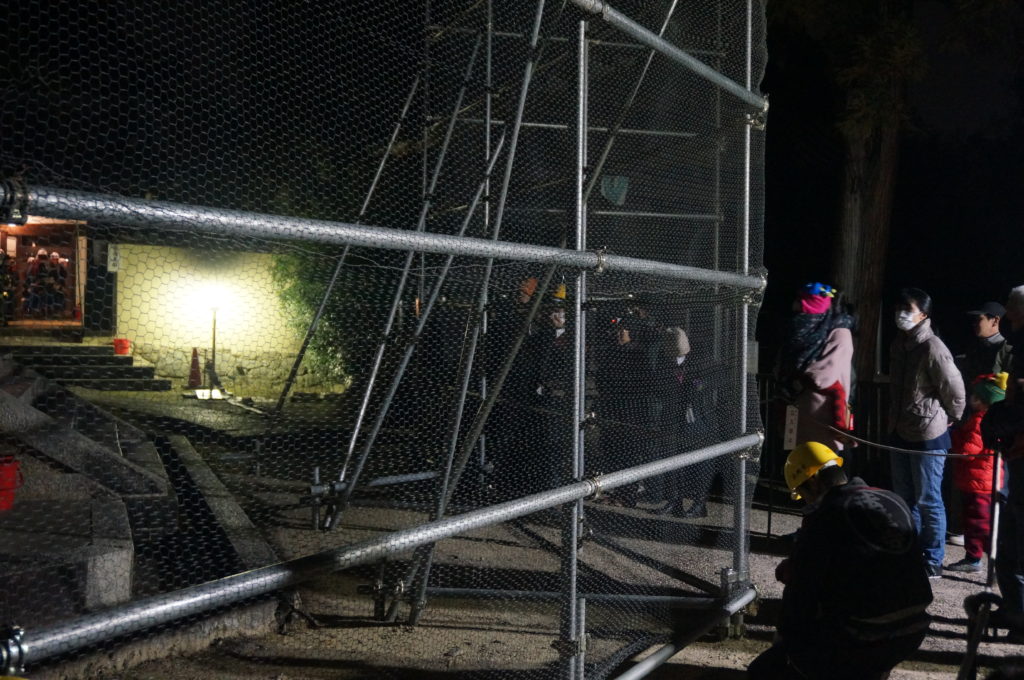
The evening session begins at 9 p.m.
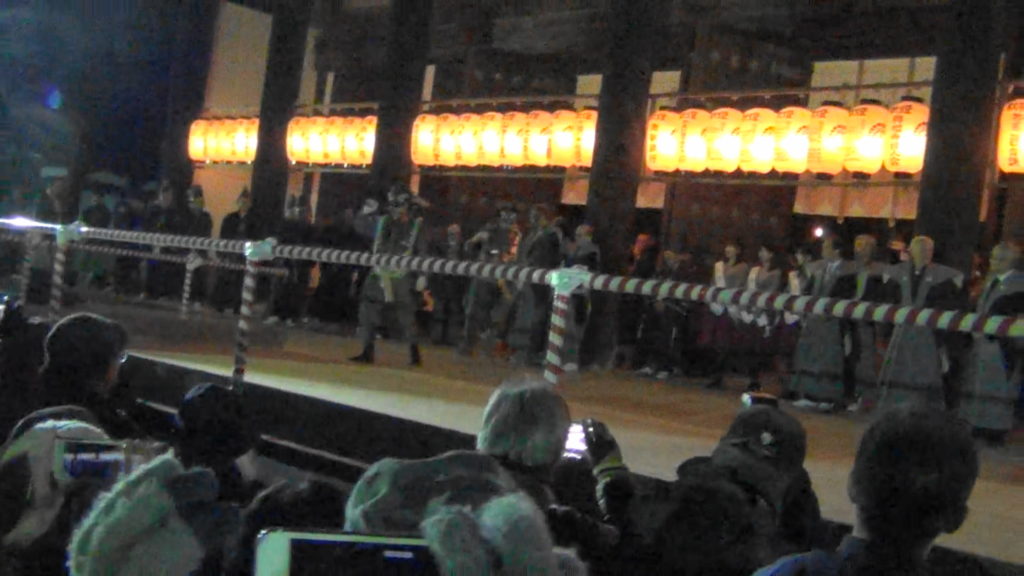
As the sound of sticks tapping on the wall rang out, the monks entered first, blowing hollow shells. Behind them are the ogres. The monks began to shout, and the sound of sticks and more bells rang out. It’s time to begin. The sound of the bells was and still is used to warn people of fire. The sound of the bells quickens people’s heartbeats and heightens their sense of danger. People also call tapping on the wall with a stick “Amitabha’s shoulder tapping,” a unique name. In Buddhism, Amitabha is the Buddha who saves all people.
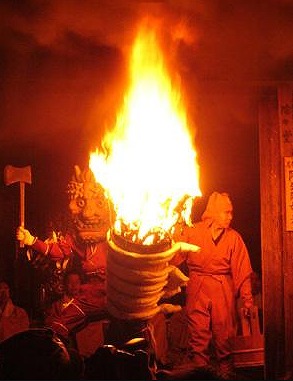
In the meantime, the first person to handle the fire in the hall (called katte) appeared with a large torch. He draws the Chinese character for water 水 in the hollow to prevent the fire from raging. Right behind him was a waterman named Kawase with a bucket of water to put out the fire and clear away the sparks. When it was over, the demons finally made their appearance.

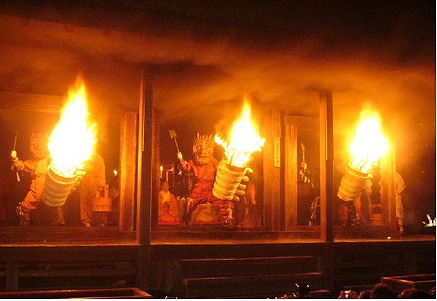
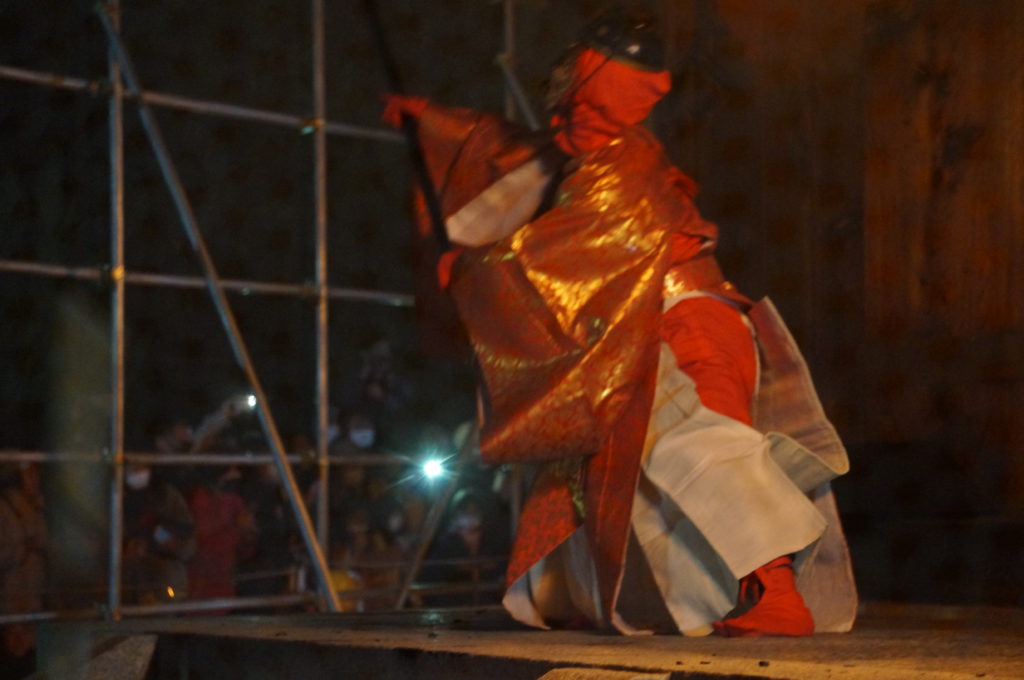
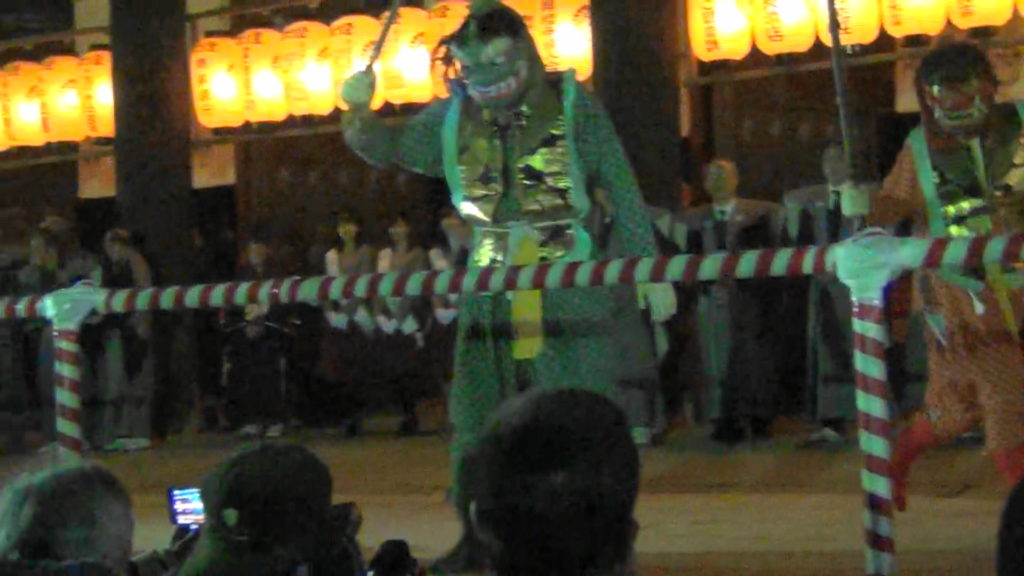
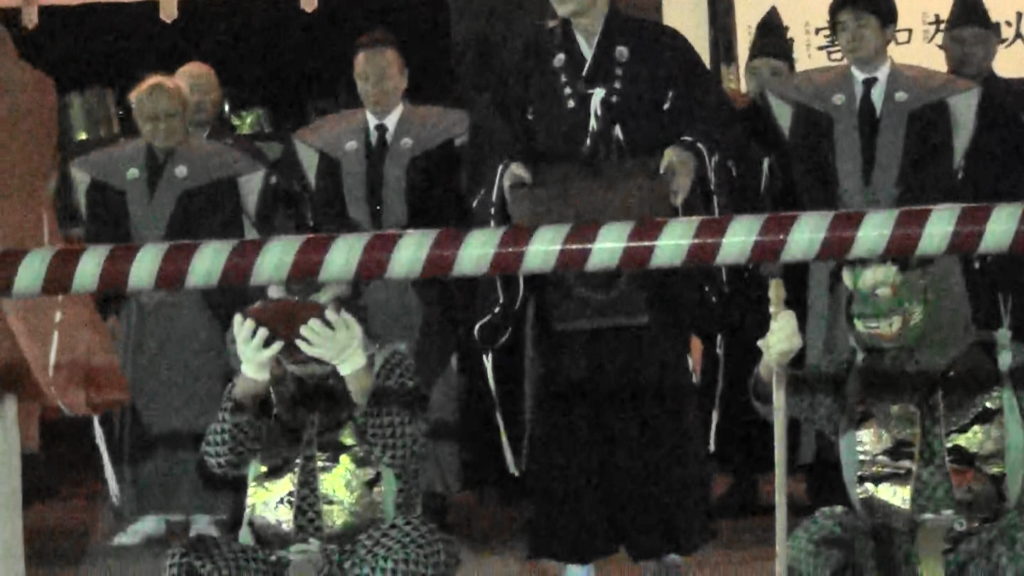
A father ogre, a mother ogre, and a child ogre: there are three ogres in total:. It is said that the ogres here are not bad, but good, bringing good fortune to the people. That’s why they have quite charming faces.
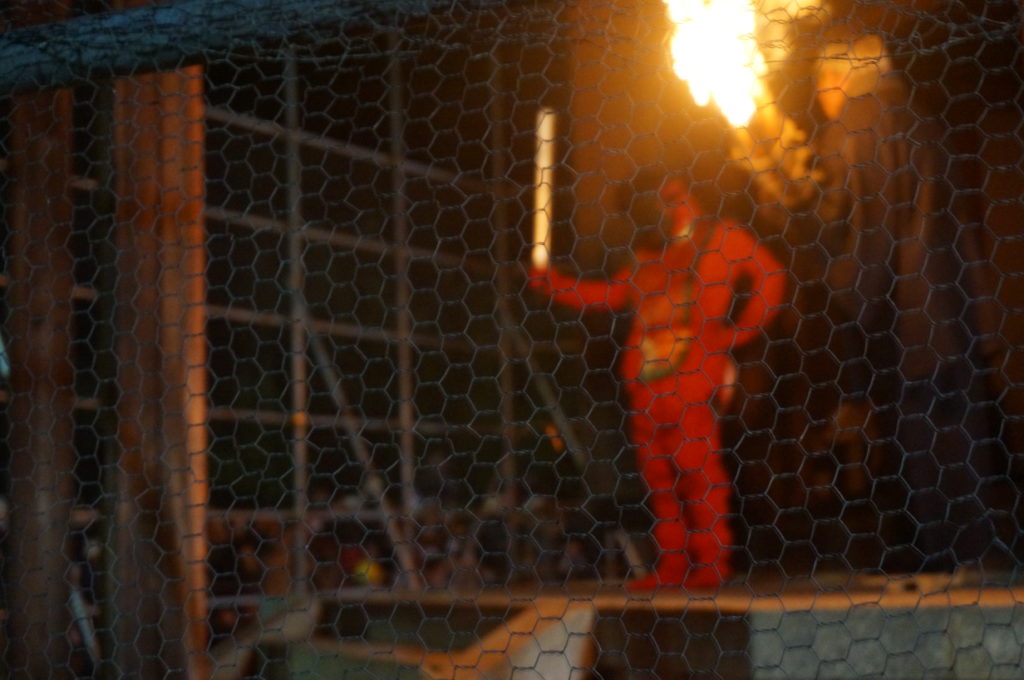
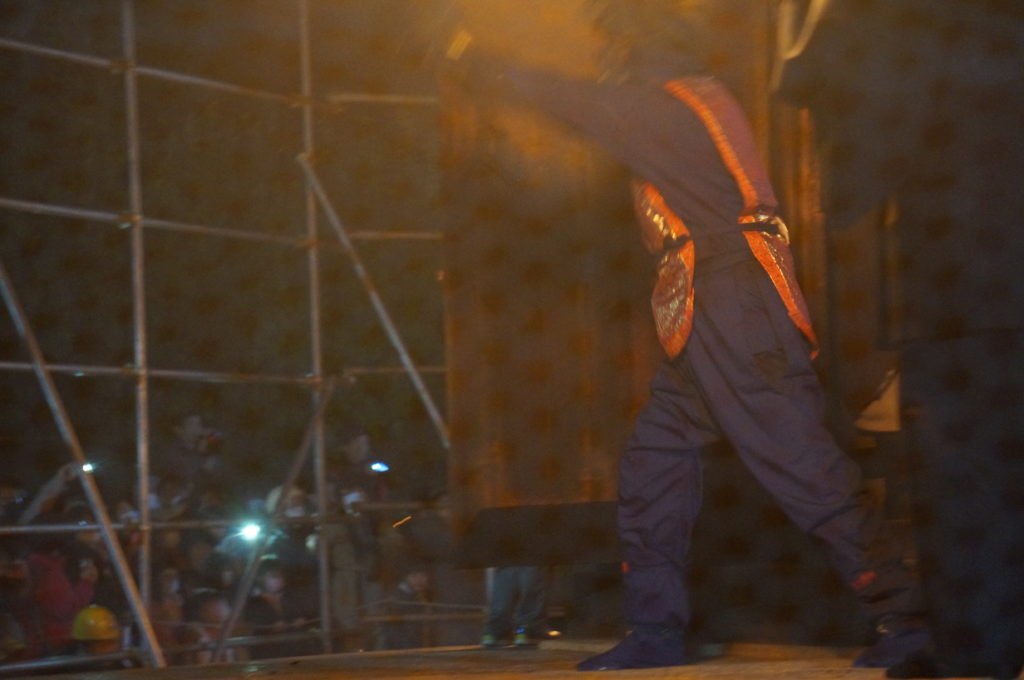
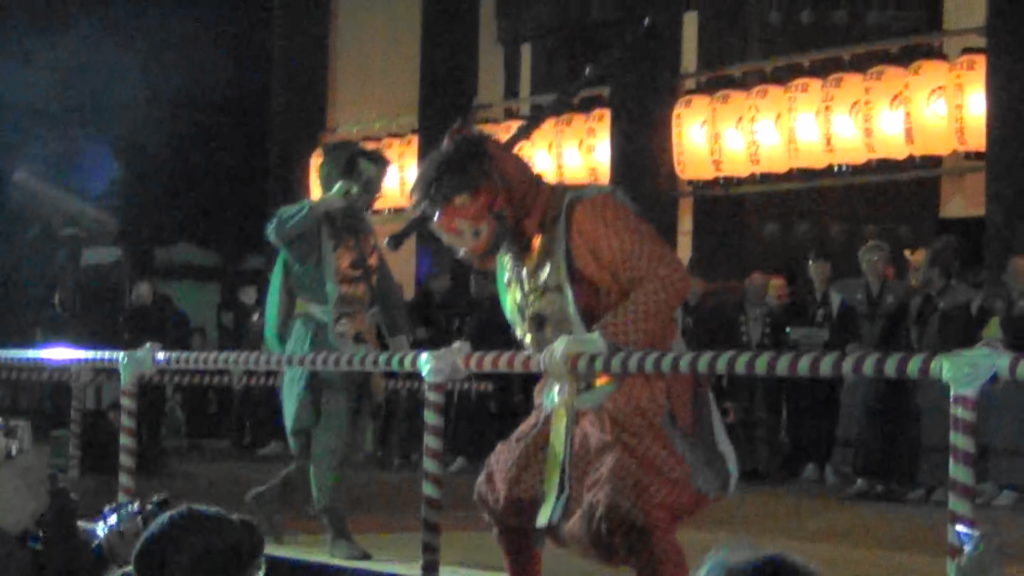
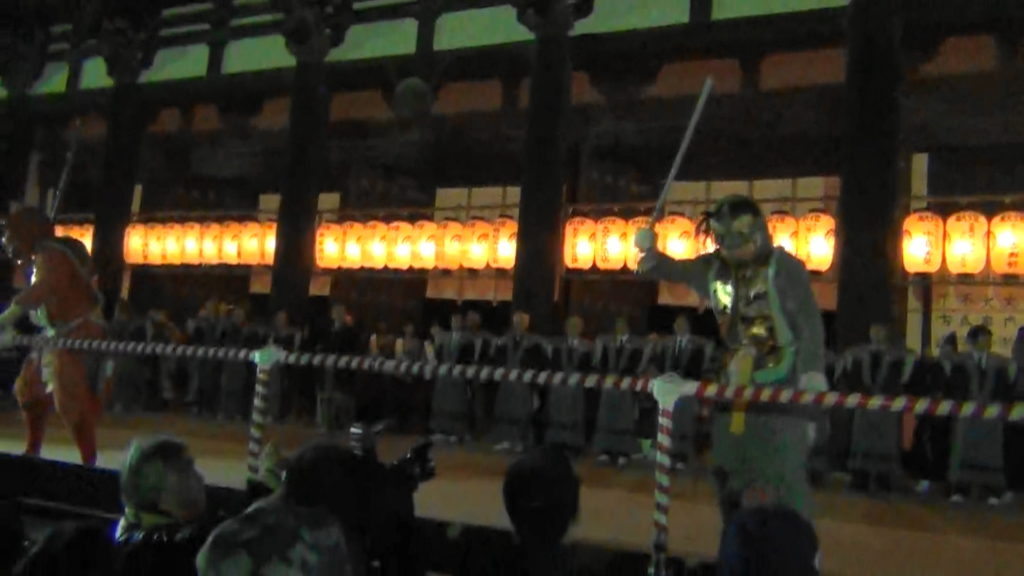
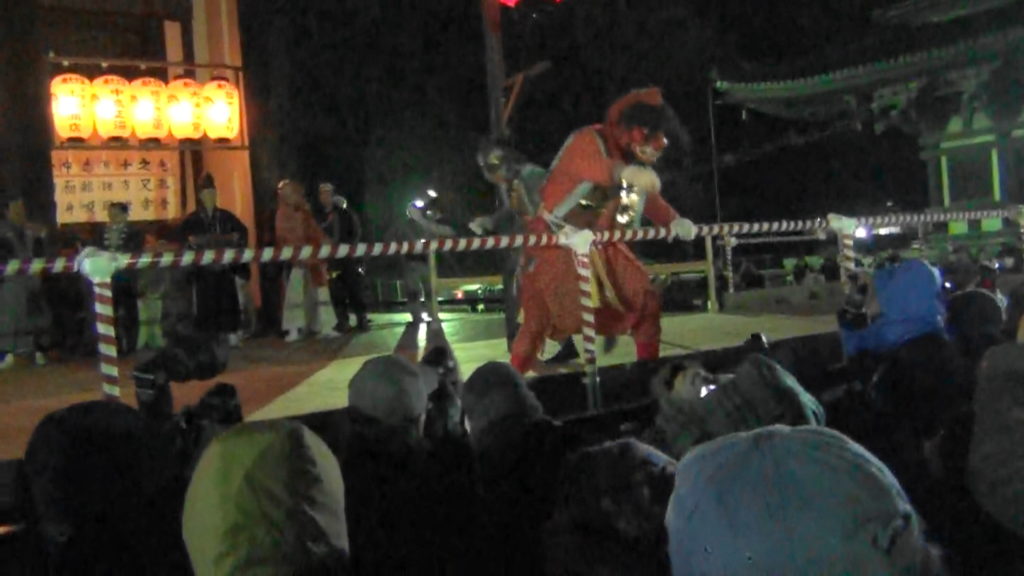
The assistants pass the burning torches to the ogres. The ogre puts it on his crotch and supports it with one hand. The torch is 70 centimeters in diameter and weighs about 60 kilograms. There are two pillars in the center of the hall, so when the ogres appear, they move one by one to the next. When the child ogre appears, the three ogres are all together, creating a breathtaking sight. In this way, the demon circled the hall three times before finally leaving the hall.
Anyone can play the role of an ogre, but once they do, they often continue to do so. They bathe in water for a week and avoid fire. It takes a lot of strength and energy to be an ogre, so when they become weak, they are passed on to the next person. The event ends with people trying to steal the paper strings from the ogres, as the paper strings that the ogres wear on their bodies is said to ward off evil.
Ends around 9:30 p.m.

The nearest town, Gojo, is a traditional building preservation district where the streets of olden times remain intact. If you have time, you should definitely take a stroll.
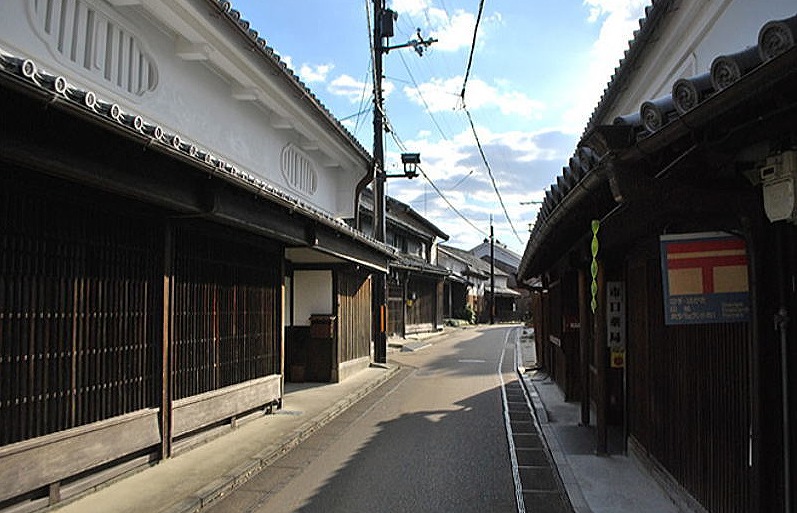
http://yamatoji.nara-kankou.or.jp/03history/02old_house/04south_area/shimmachidori-gojoshi/


Dadaoshi at the Hasedera temple

Date: February 14th, every year
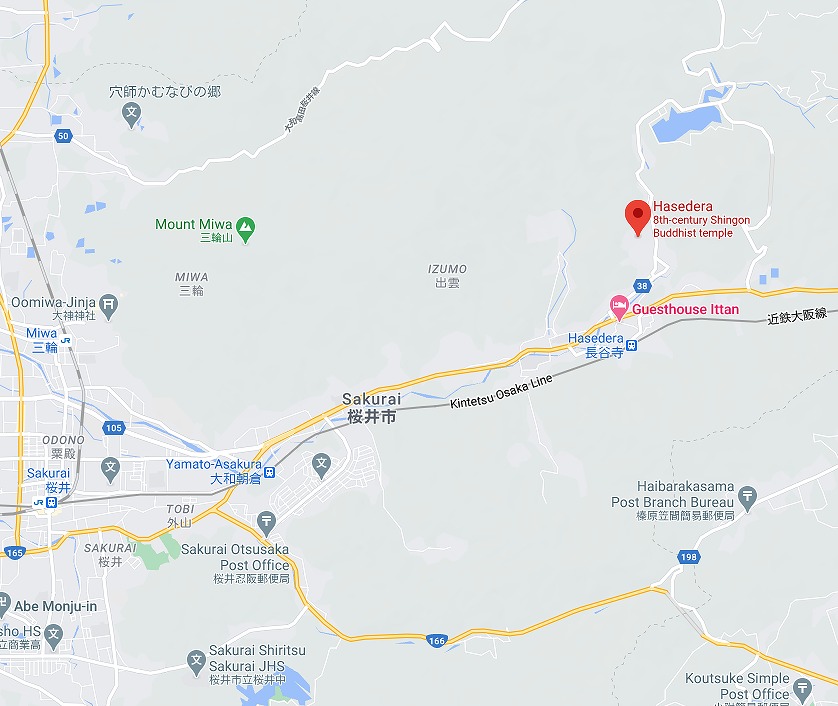
Location: Hatsuse 731-1, Sakurai city, Nara prefecture
Access: A 15-minute walk from Kintetsu Hasedera Station. Or take the JR Manyo Mahoroba Line to Sakurai Station. From there, take the Nara Kotsu bus to Hasedera Sando-guchi. It is a 10-minute walk from the bus stop.

奈良から長谷寺へ
from Nara

桜井から長谷寺へ
around Sakurai city

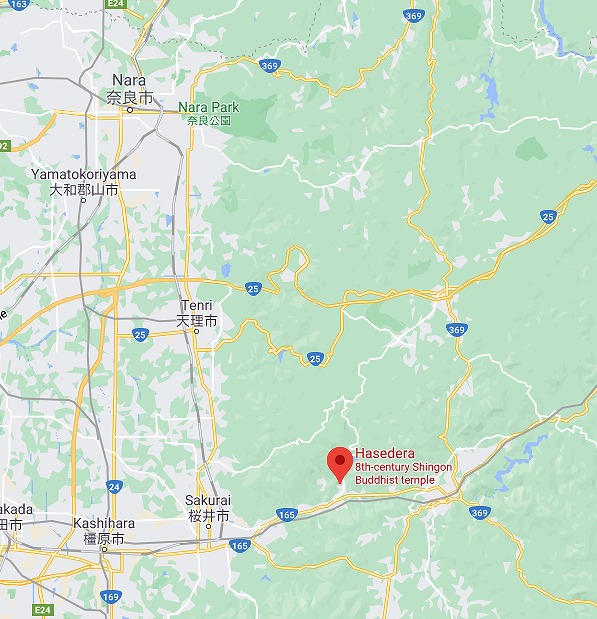
Hasedera temple is located in a slightly out-of-the-way place in Nara. The temple was founded in 686. It is a very old temple. There are many temples and shrines like this in Nara. Todaiji temple, famous for the Great Buddha, was built in 741, so it is older than that. If Todaiji Temple is famous for the Great Buddha, Hasedera temple is famous for the Kannon (Goddess of Mercy), which is said to have been created in 727, but was destroyed by fire several times, and the current statue was rebuilt in 1538.

だだおし 長谷寺公式サイト
https://www.hasedera.or.jp/free/?id=531

Dadaoshi” is the final stage of the annual event, called “Shunie 修二会” hel-d at this temple in February to drive out demons.

Shuni-e is a Buddhist ritual that began in the Nara period (710-794), where people repent before the Buddha for the sins they have committed during the year without knowing. It is held in various places, but the most famous one is at Todaiji Temple. The ceremony, commonly called “Omizutori,” is held for two weeks from the first day of March, the most famous being the 13th. The most famous ceremony is held on the 13th, which usually lasts about 10 minutes, but lasts 45 minutes on this day. Because of the large number of spectators, admission is sometimes restricted. I won’t go into detail about it here, so please confer another site.
Cf.→https://www.japan-guide.com/e/e4110.html
Now, even though it’s not that big, the most famous one is “Dadaoshi”.

The Shuni-e at this temple started about a week ago, and the last day will be on the 14th. Around 3:00 p.m., monks bring the seven treasures in the main hall and the ceremony begins. The monks run around the hall and so on. This does not mean they are being idle, nor are they pressed for time. This ritual is supposed to take place in the virtual world of the Buddha, called “tosotsuten,” where things move hundreds of times faster than in the human world, so they are trying to catch up as much as possible. After four o’clock in the afternoon, the last treasure, called “Gofuda,” is taken out. This is the most powerful talisman that the founder of the temple received from Enma, the king of hell, a long time ago. When it appears , the demons (ogres), who have finally lost their patience, come running out.

There are a total of three types of ogre masks. The blue and green masks are relatively recent, but only the red mask was made in the Edo period. The red mask is different from the other masks in terms of power. The red mask represents this event, so it is often seen on the posters. It is not only different in size, but also in carving technique and outstanding expressiveness.

Then, the Buddhist monk presses something called a “danda-in” on the forehead of the attendant. At this point, the demons, unable to take it anymore, run out toward the cloister. This Danda stamp is said to be the origin of the word “Dadaoshi.

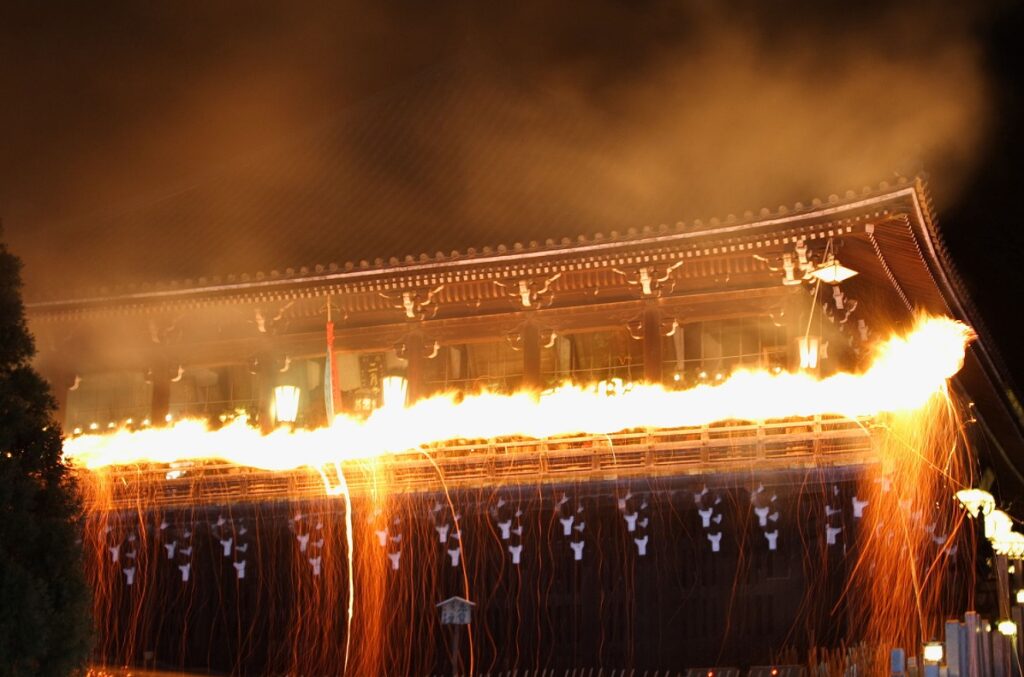
The most powerful part is the big torch that follows behind the ogres. A large torch is said to weigh more than 150 kg, and it takes four people to carry it. As a result, the torches swing left and right, and fire sparks fall on the audience each time. It is said that being exposed to these fire sparks will keep people healthy, but it is necessary to be very careful about how you dress. So, a firefighter sprinkles water right behind torches and chases after them. These can be viewed outside the hall, on the cloister side, for an entrance fee only, or you can watch the ceremony inside the hall by applying for a paid Goufuda.

And finally, the red ogre, the last boss, comes out. The people playing the role of the demons are said to have drunk sake to cheer themselves up before appearing on stage, so they wander around the corridors, scaring people.
The rhapsody lasts about 15 minutes. By 5:00 p.m., it was all over. After that, everything goes back to normal in an instant. People take the burnt-out torches home as a souvenir. When this ceremony is over, spring will soon arrive in the area.

Surprisingly, this main hall is actually a national treasure. Hase Temple is also dotted with various other facilities such as a five-story pagoda, and it is also a temple of flowers where seasonal flowers bloom all year round. The long staircase leading to the main hall is the most beautiful part of the temple. It’s worth taking a short walk to see. A different kind of Nara. A different kind of Japan. That’s what you’ll find here.


Report: ~ceremony to drive out evil sprits in Nara~In the case of Kofukuji-temple and Horyuji-temple Part 2

   Horyuji-temple ‘s case

2. Horyuji-temple’s case

Introduction

 Horyuji-temple is in a slightly remote place from the center of Nara. The nearest station is “Horyuji station” (JR line). It takes about 10 minutes from Nara by train. From Osaka, it takes about one hour. But, unfortunately, this station is for away from the temple (about 1.5 kilometers. It takes eight minutes by bus, over 20 minutes on foot), besides, the bus does not run after about 5 pm. The event begin at 7:30 pm every year. If you want to watch only this event, you should use the next station “Ouji” and you should take a bus.

Horyuji station
Horyuji station

a town around Horyuji-temple
around the temple

 In this season, when it passes 5:00 pm, the sun goes down. When you arrive at this temple, you will stand in deep darkness without many people. There are several Buddhist monasteries and long wall.
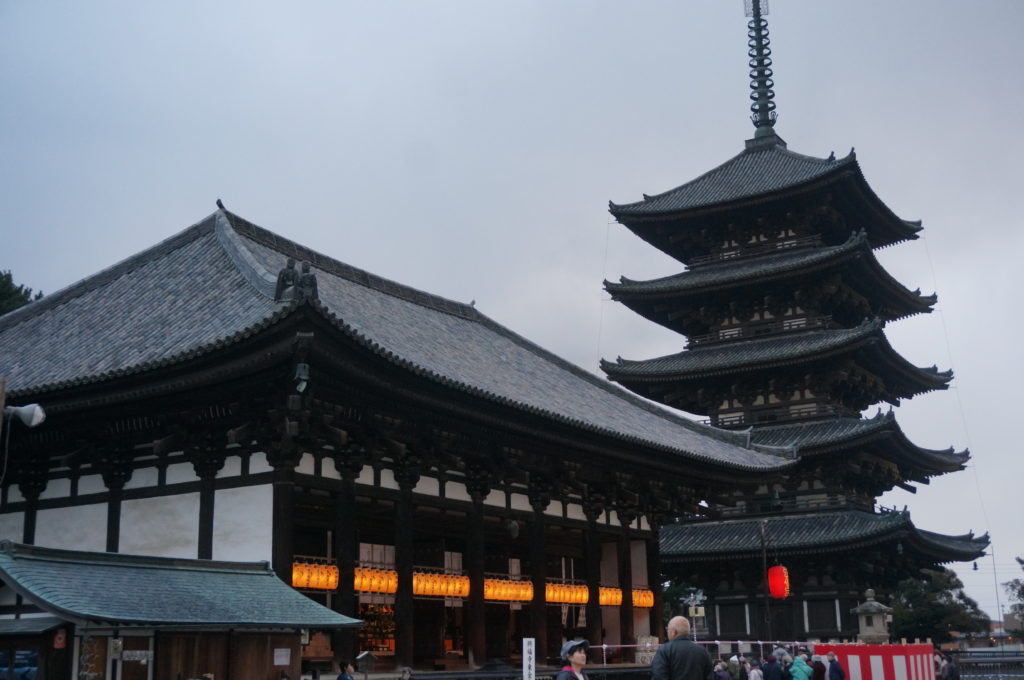
 When I arrived there past 6:30, I saw that scene. I felt lonely, I thought I had better returm. Because I guessed that probably the ceremony would not to be performed for some reason that day. When I decided to return, I saw that several people came there. They seemed a family. So, I turned back and walked little and then several more people came in sight. They seemed to be waiting for somebody. It seemed there was a misunderstanding. This temple looked very quiet. The state was greatly different from Kofukuji-temple. I presumed the reason there was no ceremony. Of course, nobody got gifts. Perhaps this temple in a remote place. I didn’t know whether this was right or not.

Horyuji-temple

Horyuji-temple

Ogres and Bishamonten come out

 The event was held in front of “Seien-do hall 西円堂”. This hall is on the left side of the main hall and Five Storeyed Pagoda.
 After 7:00, it was not crowded. A fence was built sorounding the hall, people had been waiting in front of it. Just before it start, people finally gathered. There were fewer it than I expected. At 7:30 pm, it started.

ogre holds fire

ogre holds fire

ogre in Horyuji-temple
Ogre

bishamonten drops out evil
Bishamonten

 Three ogres and Bishamonten got on the stage. This style was the same as Kofukuji-temple’s. A defferent is that the ogres and Bishamonten did not fight each other. Basically, nothing much happened. Ogres came out one by one from the right side of the hall and took torches. An ogre swung the torch and it powerfully to the fence. He did this three times. The next ogre did the same action.

ogre's face

ogre's face

ogre in Horyuji-temple

ogre throws fire

 After the third ogre, Bishamonten came on a stage, he stuck a long sword out powerfully seversl times, shouting “Yah, Yah, Yah”. This action meant throw out evil spirits. They went around 3 times.

bishamonten dop out evil

beity in Horyuji-temple

ogre's face

ogre is walking

 When the sparks spread, people cheered. Sometimes, a torch flew over the fence. However, generally it was silent without the voices of cheering and Bishamonten. No announce, no commentary, no noise. There was only some cheering and the sound of fire sparking.
 Before 8:00, the event was over. As soon as the ogres and Bishamonten left, several fireman got on stage.

end of ceremony

five storeyed pagota

Horyuji-temple

Horyuji-temple

 When I turned back on my way to the gate, only the Five Storeyed Pagoda soared high in the soundless night like an illusion.


Report: ceremony to drive out evil spirits in Nara~In the case of Kofukuji-temple 興福寺 and Horyuji-temple 法隆寺

about two famous temples

 In Japan, there is a ceremony called “Tsuina-shiki 追儺式” or “Oni-yarai 鬼やらい”. This is the ceremony to drive out evil spirits. In many cases, it is performed by throwing to send ogres away. People had originally performed this ceremony at the end of the year, it gradually changed to a day “Setsubun”. Setsubun’s “Setsu” means seasons, and “bun” means separate in Japanese, so a day of Setsubu originally came four times in a year. But today, “Setsubun” is the beginning of spring. It is on February 3rd. On this day, we can see many ceremonies all over Japan. In these events, ogres often appear. People throw beans at ogres to drive out evil spirits, shouting “in with fortune! out the demon!”. This time, I will introduce two temples’ ceremonies of Setsubun in Nara. These are “Kofukuji-temple 興福寺”and “Horyuji-temple 法隆寺”.

ogres in Kofukuji-temple and Horyuji-temple

 These temple are the most famous sightseeing sots and represent the old building of Nara. Of you open some guide books about Japan, you will see these names by all means. These two temples seem to similar, but their characteristics are considerably different.

Five Storeyed Pagoda in Kofukuji-temple
Kofukuji-temple 興福寺

Kofukuji-temple
Horyuji-temple 法隆寺

 The Kofukuji-temple was built over 1,300 years ago by the Fujiwara clan. The Fujiwara clan had monopolized an aide of the Emperor from generation to generation, and had continued ruling this country for 1,000 years. This temple was to protect the Fujiwara clan. So, it had very large territory and vast property for a long time. They sometimes refused the demands of the goverment. KOfukuji-temple is such a temple.

 On the other hand, Horyuji-temple is about 100 years older than Kofukuji-temple. The Buddhism is ardent, without a Buddhist transmission interval, it was built for the intention of believing in “Shotoku-taishi 聖徳太子 (he was a cousin of the Emperor and assisted her. At that time, the Emperor was a woman). Even if there was a fire afterwards, it was reconstructed by stubborn faith and continued up to the present day. Above all, it’s story Five pagoda is said to be the world’s oldest wooden building.
 These temples each have the ceremony of “Tsuinashiki”, that styles are quite different. One is flamboyant and noisy, the orher is calm and quiet. I have seen both, Kofukuji-temple in 2018, Horyuji-temple in 2020. I will report about these based on those, but each program is the same year.

Kofukuji-temple’s case

 The ceremony starts at 6:00 pm every year.
 Kofukuji-temple is located near Near Nara station. It takes five minutes from Kintetsu Nara 近鉄奈良 station (20 minutes from JR Nara station). Nara is about one hour from Kyoto by train. If you want to watch the ceremony from start to finish , you must arrive at least one hour before at least. In my cas, when I arrived at 5:00, there were already approximately 3 lines of people nearby the center, and approximately one line on right and left. Many people came early because they wanted to get lucky beans or rice cakes. At the end of the ceremony, the chosen people threw many beans and ricecakes with lucky numbers. If you are lucky, you can get a ticket for the gorgeous hotel and so on. When you arrive in front of main hall, you get a ticket for entrance int o the area partitioned ropes. An area is proved for the prevention of danger. The main hall is big. If you are behind ropes, you can watch the ceremony.

the stage

ogres on the stage

 When it is 6 o’clock, priests entered the hall and the ceremony started. However, the audience only heard the voices of the sutra-chanting. A person came out before long and explained the flow of the event. He made the audience laugh using witty talk. H said, for example, “some people are laud to cheer up ogres, but don’t cheer for ogres please. You will support a bad in yourself because ogres represent evil spirits. The audience laughed. Yes, he was right.

ogres on the stage

ogres on the stage

ogre's face

ogre's face

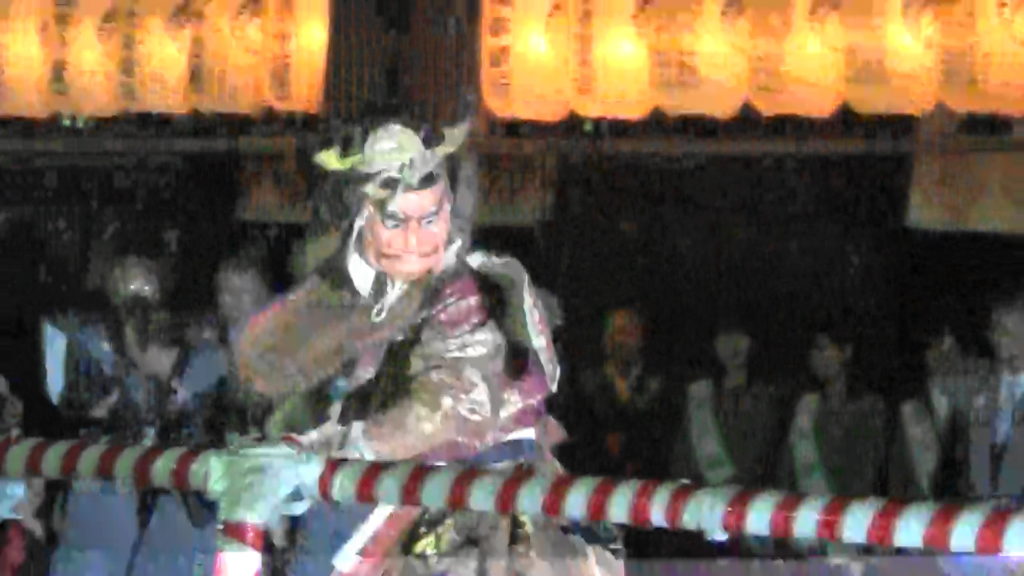
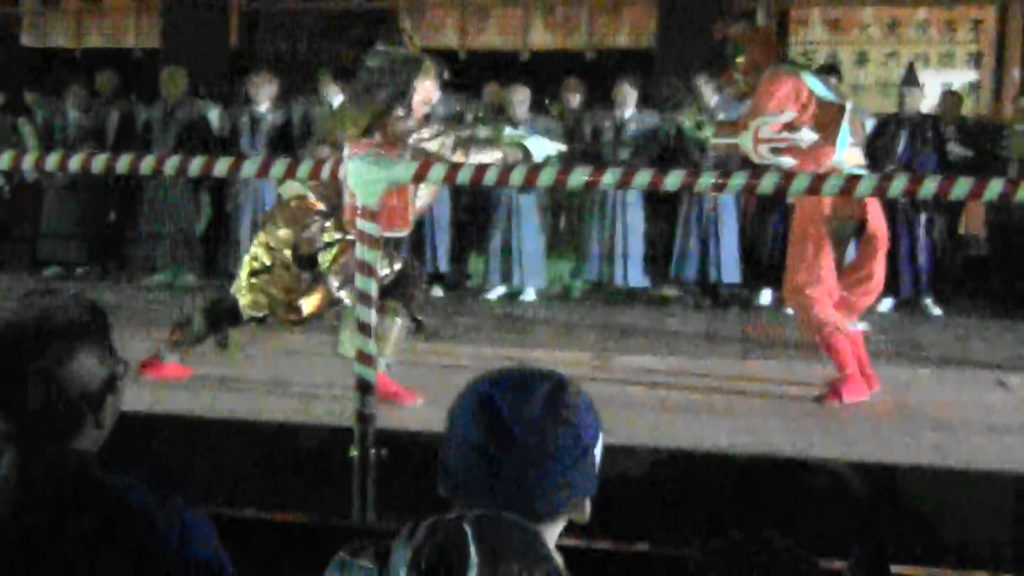
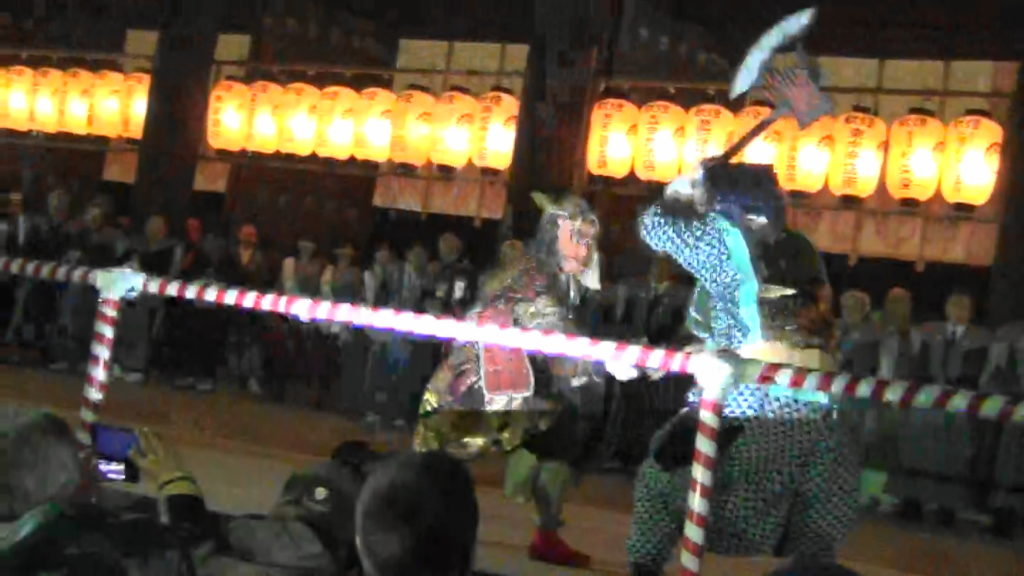
 At 7:00, three ogres got on the stage holding long sticks. It seemed their mask were rather new looking. They walked around the stage crying loudly and sometimes threatened the audience with by leaning over the banister.

ogres on the stage and Five Storeyed Pagoda

ogres on the stage~Japanese culture  Setsubun

 It was a very attractive scene of ogres rushing wildly against the backdrop of the Five Story Pagoda.

ogres on the stage~Japanese culture  Setsubun

ogres drink sake~Japanese culture Setsubun

 They sat down when they acted violently and they were tired. It was here, a commentary explained without interval. “They required some liquor.” Three people carried sake bottles. The ogres drank with joy, and walked around the stage again.
ogres on the stage~Japanese culture Setsubun

ogres are walking ~Japanese culture Setsubun

ogre holding a torch~Japanese culture Setsubun

ogre holding a torch

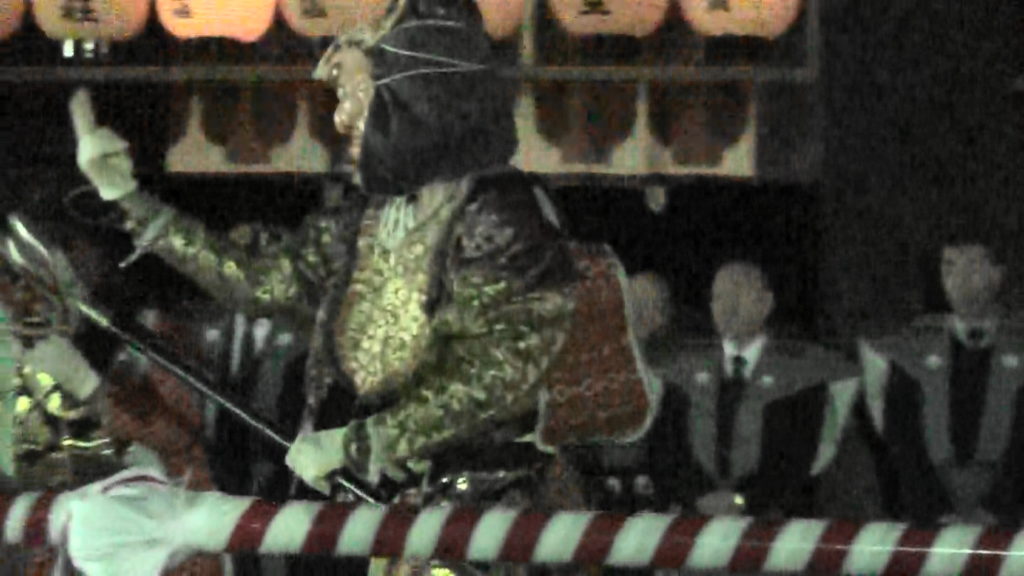
 This time, a commentator talked to the audience to call a “Bishamonten 毘沙門天”. And people joined in, so he got on the stage. Bishamonten is a deity of battle who protects Buddha. He wears armor and holds a long sword.

bishamonten (masked character)

bishamonten's face (Japanese masked character)

bishamonten vs ogre

bishamonten vs ogre

 On the stage, the fight began with Bishamonten and the ogres.

bishamonten vs ogre

bishamonten (Japanese masked character)

 I felt it was like a stunt show for adults. They seemed like children’s popular characters on TV. Bishamonten was overwhelmingly strong. If the ogres attacked all at once, Bishamonten pushed back them lightly. Still the ogres challenged to fight many times without being discouraged. I understood the feeling that people wanted to cheer up the ogres in this situation.

bishamonten vs ogres

bishamonten's victory

Ending (Daikokuten) of Kofukuji-temple’s ceremony

 After about 10 minutes, the ogres gave up finally and they prostrated themselves before Bishamonten. So, Bishamonten drove them away and they left.

daikokuten~Japanese deity of fortune

daikokuten~Japanese deity of fortune

 Then, Daikokuten 大黒天 (he is a deity giving fortune) got on the stage. He held a mallet. People know this mallet will bring fortune good. So, the audience called for him to give a fortune. Daikokuten walk around the stage, he swang a mallet everywhere to give a fortune.

 After Daikokuten left, people began to throw-beans at the stage. These people were born in a year with the same sign of the Chinese zodiac as the current year*.After this portion, you can choose to stay or leave. Me ? I left quickly.

 This is all of the state of the ceremony at Kofukuji-temple.

*The twelve zodiac signs of Chinese astrology make a circuit by 12 years. The 12 zodiac signs are represented by 12 animals. The order is as follows, the Rat, the Ox, the Tiger, the Rabbit, the Dragon, the Snake, the Horse, the Ram, the Monkey, the Rooster, the Dog, and the Boar. 2020 is the year of the Rat.

    This article continues with Part 2 Horyuji-temple case