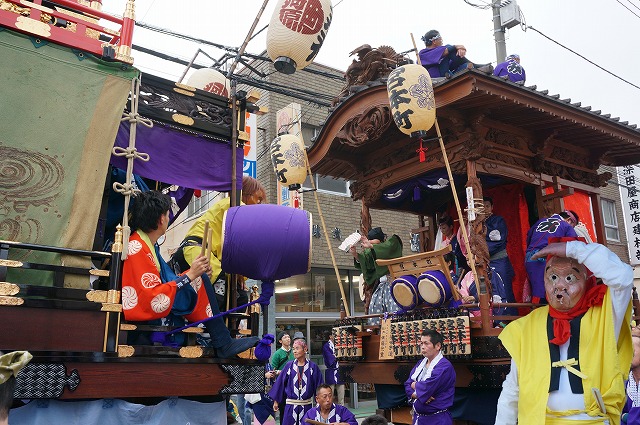
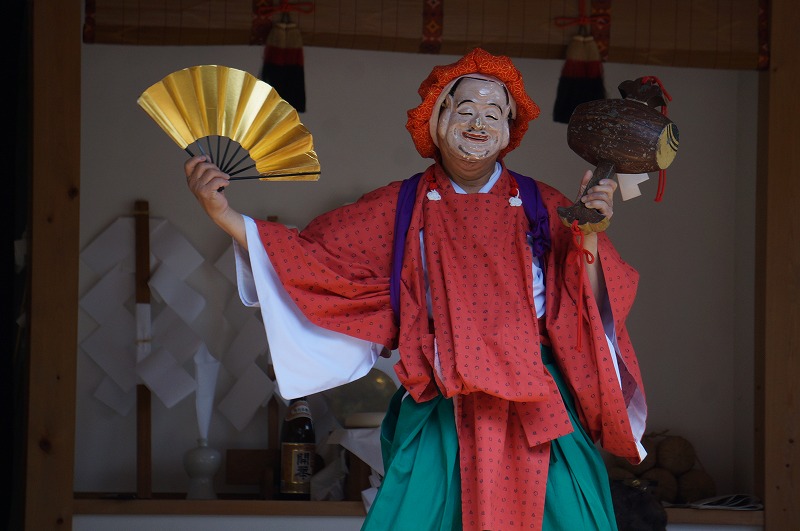
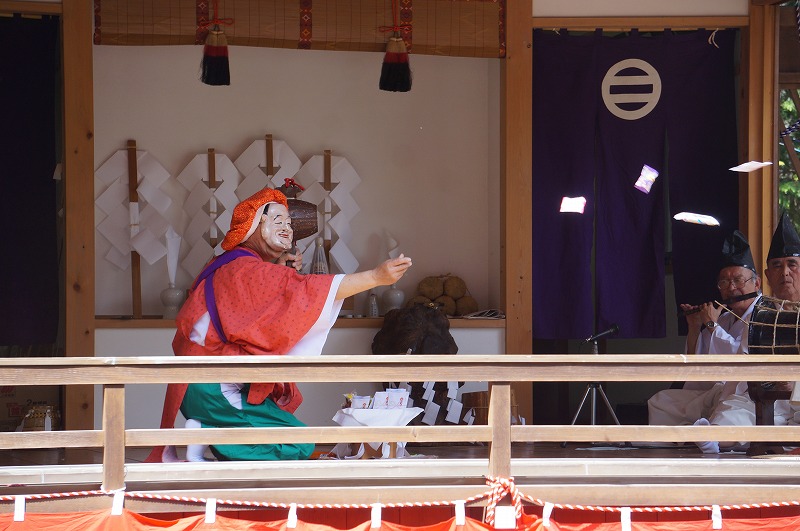
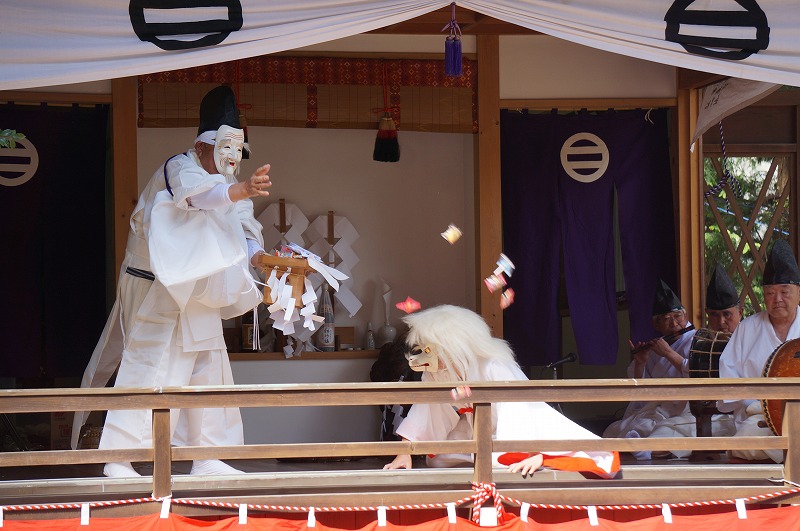
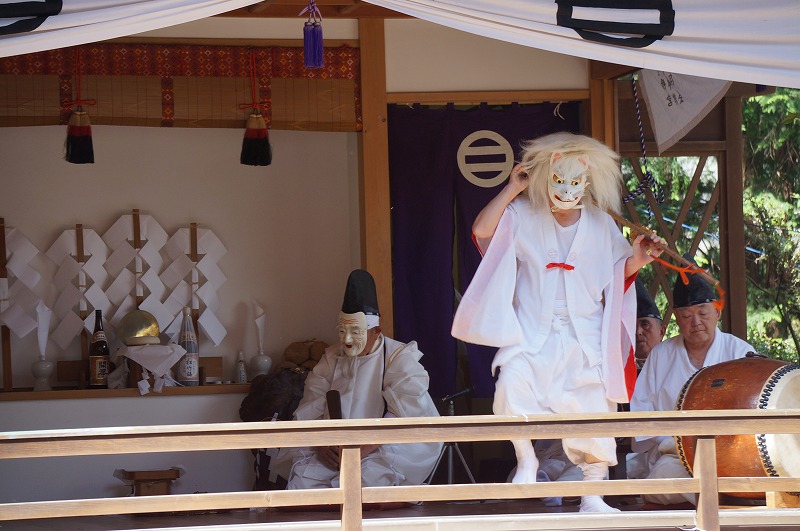
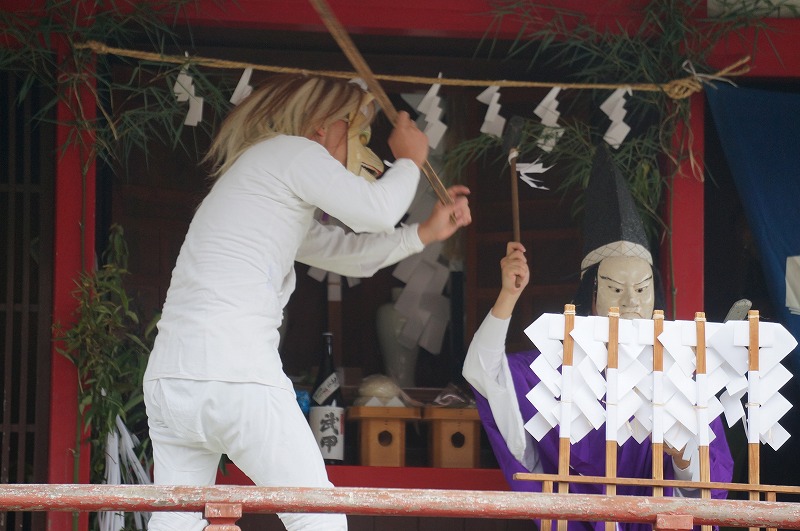
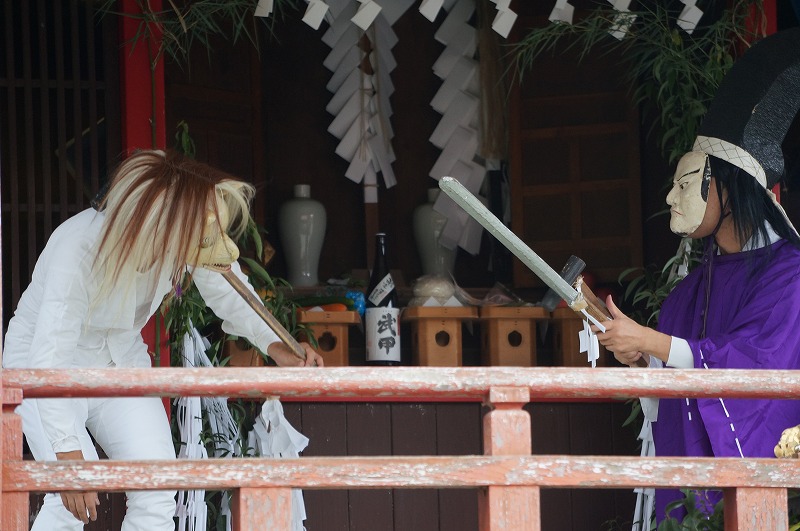
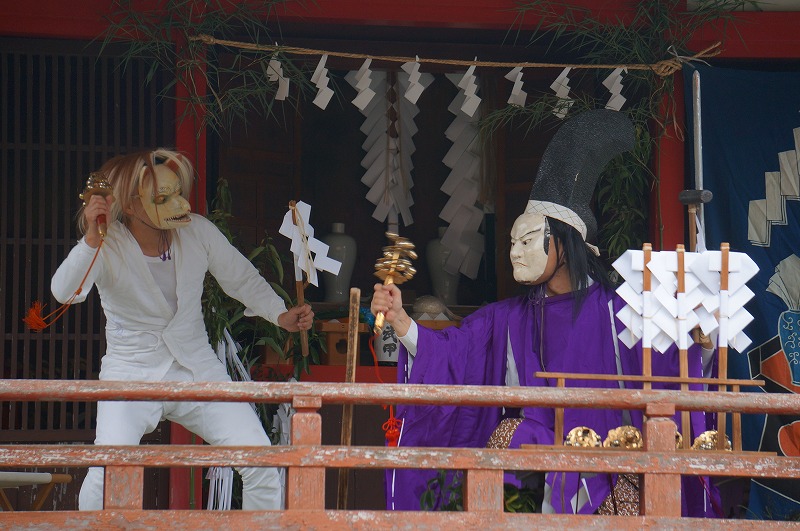
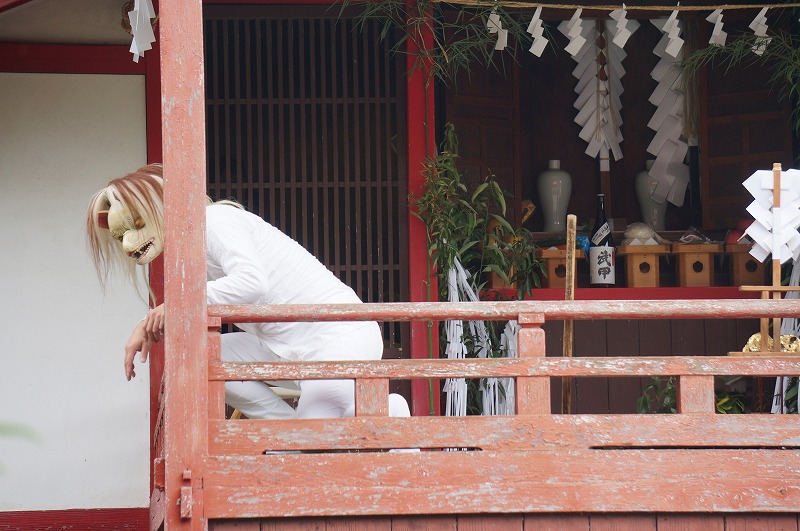
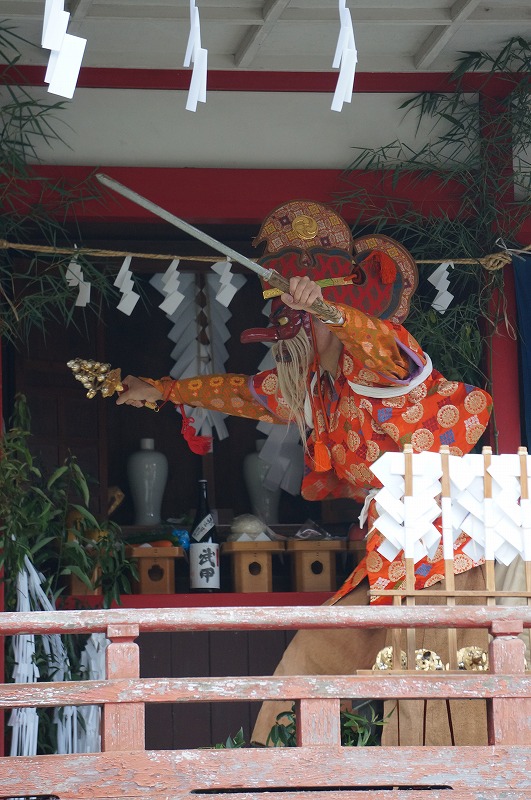
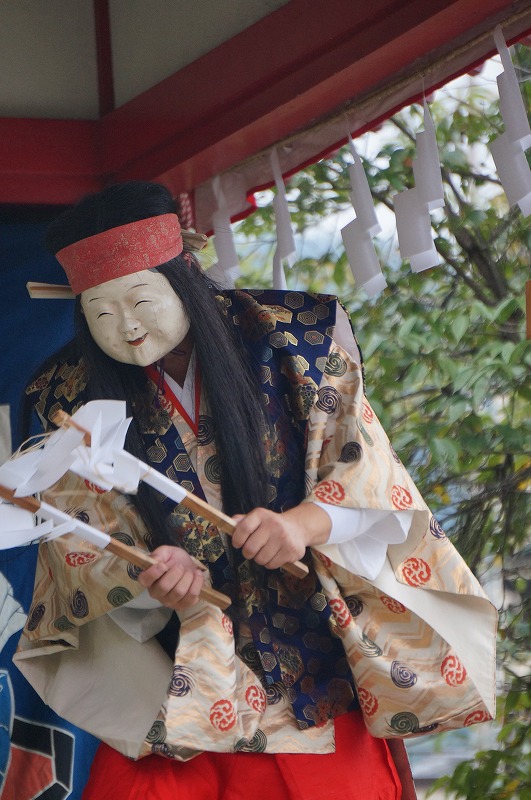
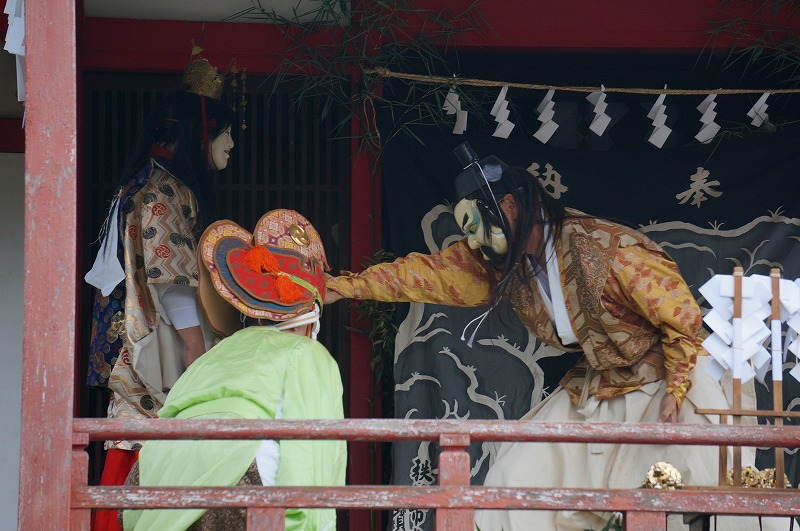
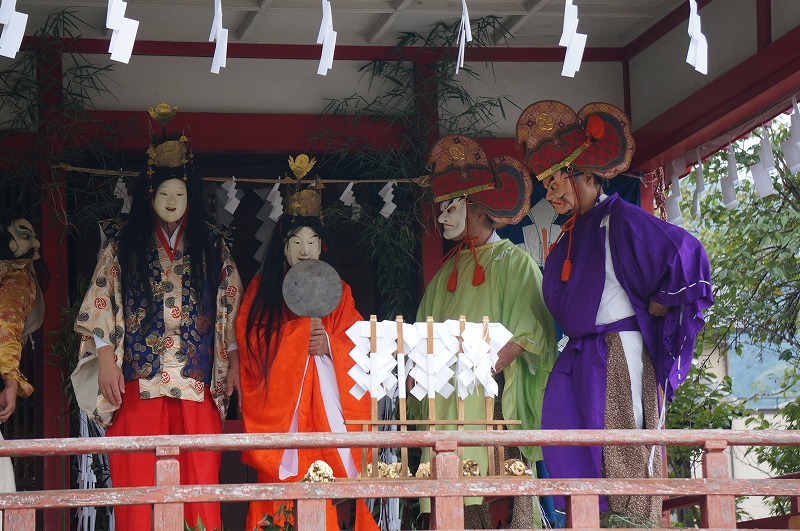
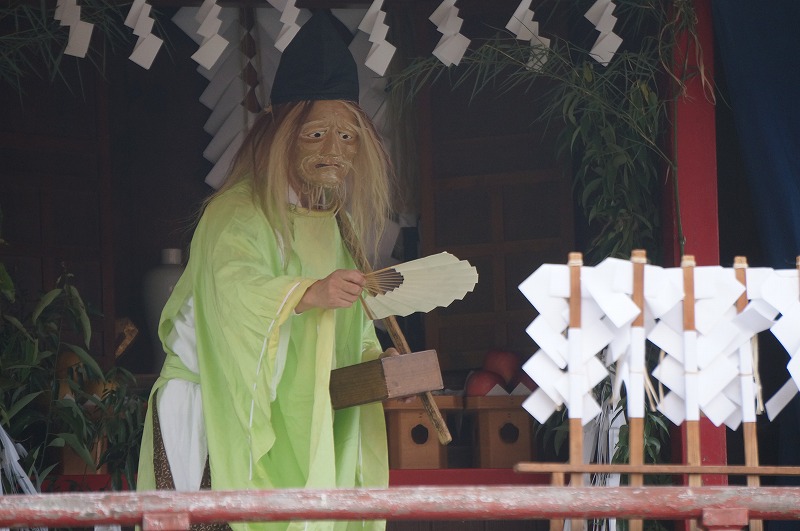
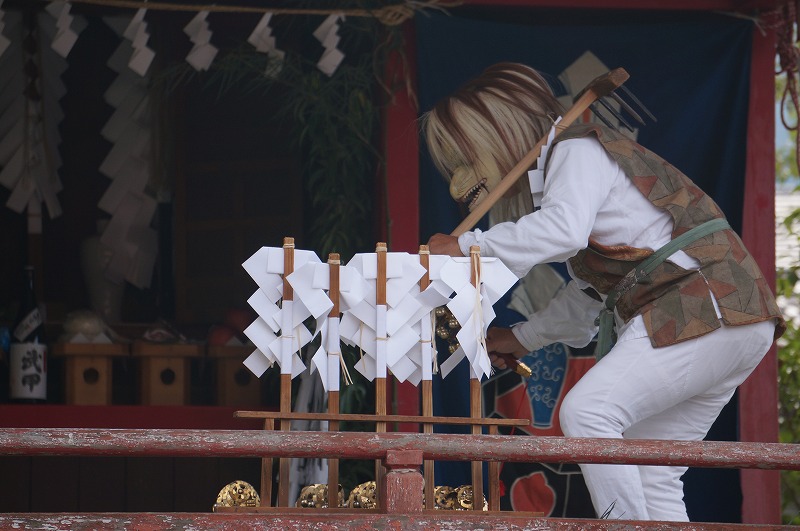
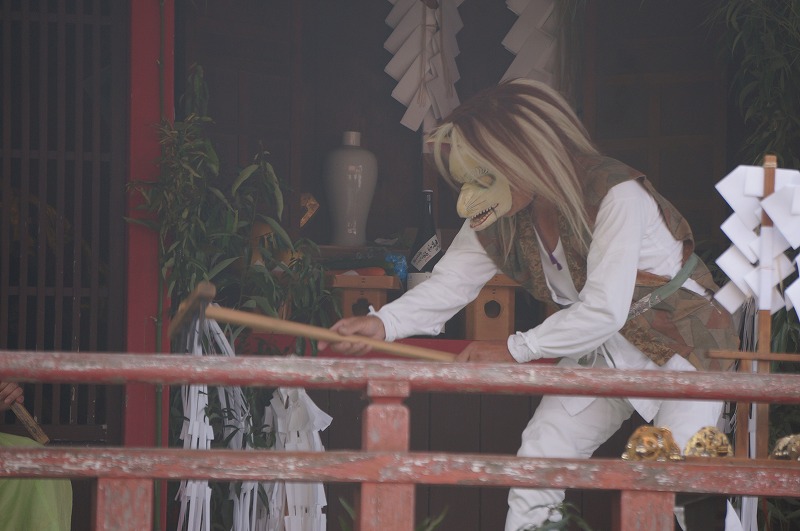
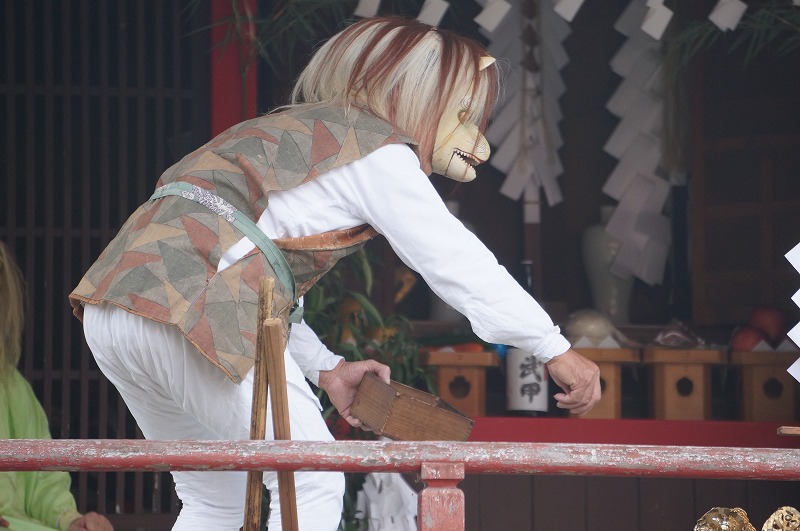
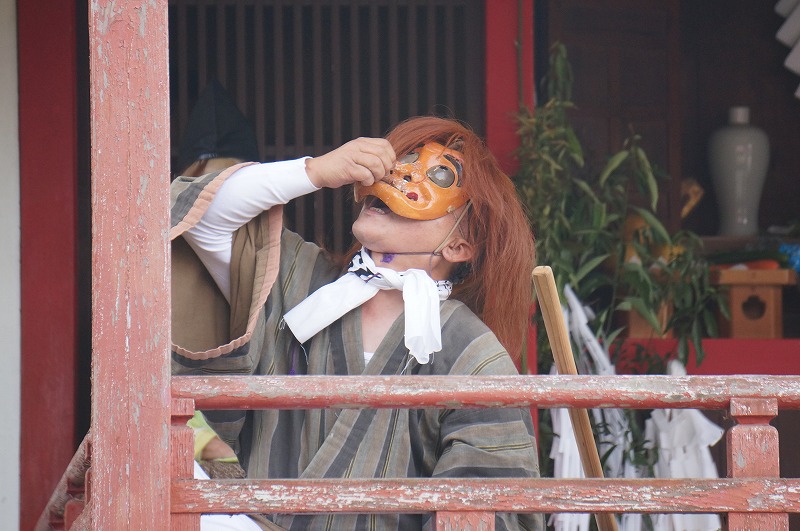
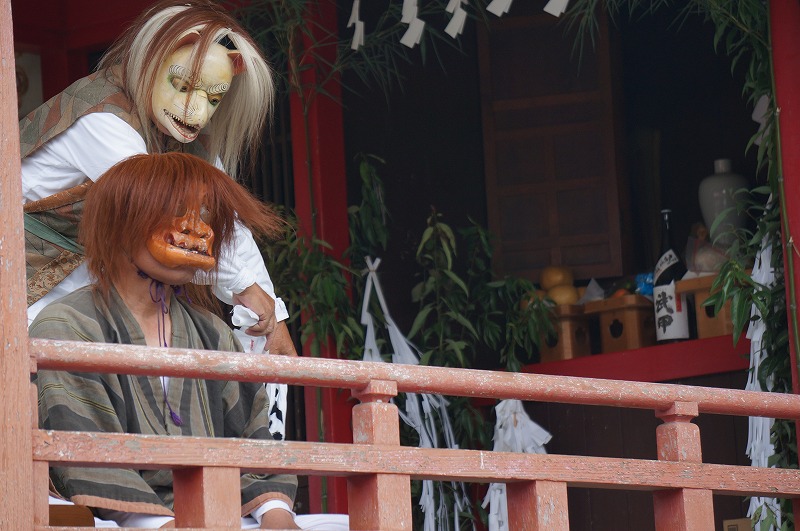
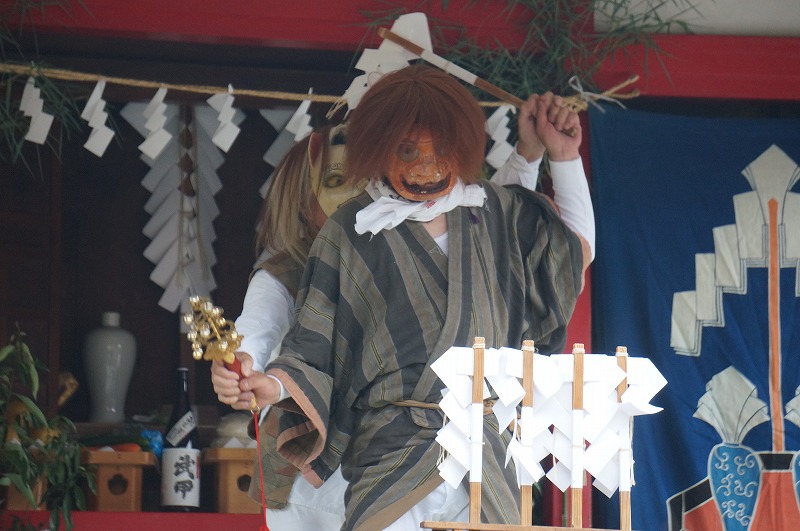
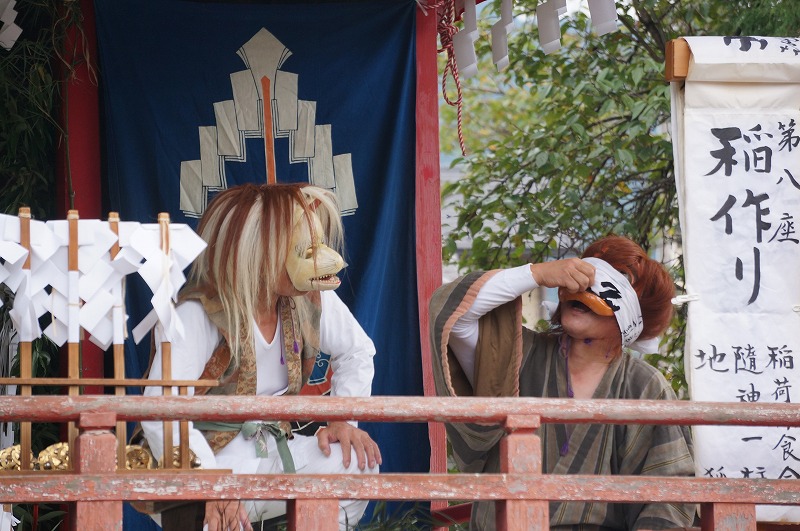
Lion Dance Entertainment: A Strength Contest with the Lion ~The Hanahata Lion Dance 花畑の獅子舞
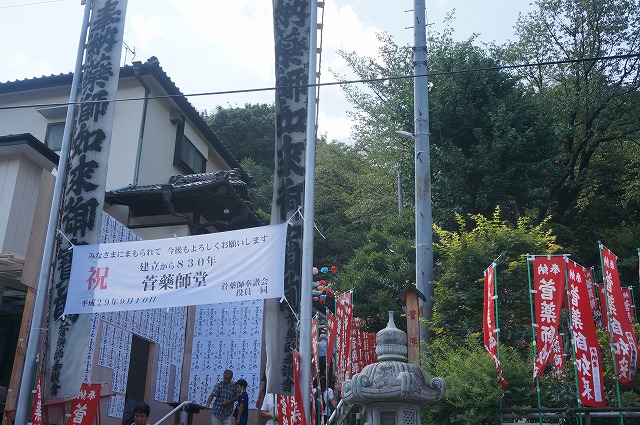
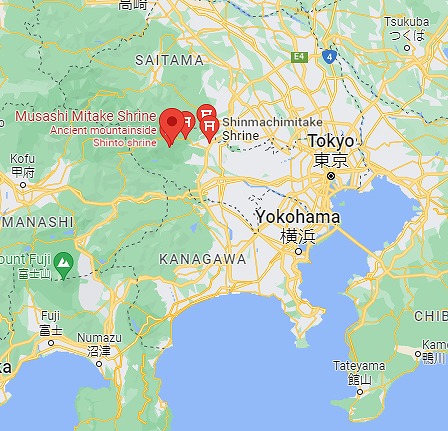
Date; Every year on the Sunday before Marine Day—Marine Day is a public holiday falling on the third Monday in July Location; Hanahata Otori shrine 7-16-8 Hanahata, Adachi Ward, Tokyo Access; Take the bus from Tobu Bus Platform 1 at Tsukuba Express ‘Rokucho Station’ Take the Bunkyo University Circular bus and alight at ‘Hanahata 6-chome’; it is an 8-minute walk from there or From ‘Yatsuka Station’ on the Tobu Skytree Line, take the Tobu Bus bound for Hanabata-Kuwabukuro Housing Estate, alight at ‘Soka Memorial Gymnasium’, then walk for 8 minutes.
Both the Tobu Line and the JR Tsukuba Express take around 10 to 20 minutes from Asakusa
This article is based on visits of 19th, July, 2015 and 17th, July, 2017
A rare lion dance that can be seen in the wards of Tokyo
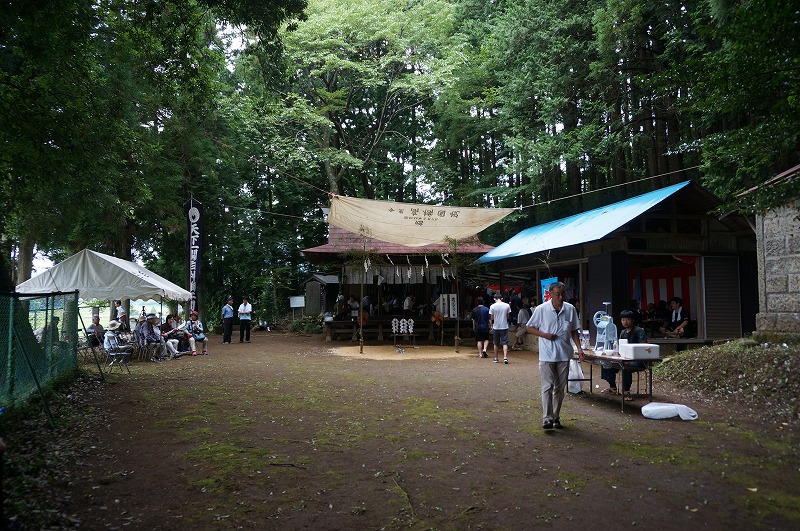
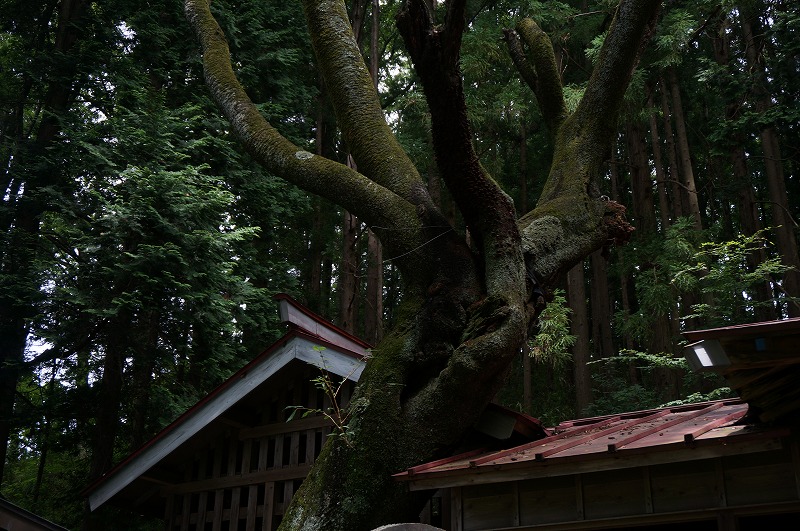
To put it bluntly, traditional folk arts can only be seen in remote areas. They are not passed down in the heart of the city. This is only to be expected, as it is virtually impossible to pass on such arts across generations in places where the population turns over so rapidly. In that sense, this lion dance can be said to be extremely valuable. Conversely, it shows that although this area is now a city, it used to be a rural area. That said, the shrine now stands right in the heart of a residential area.
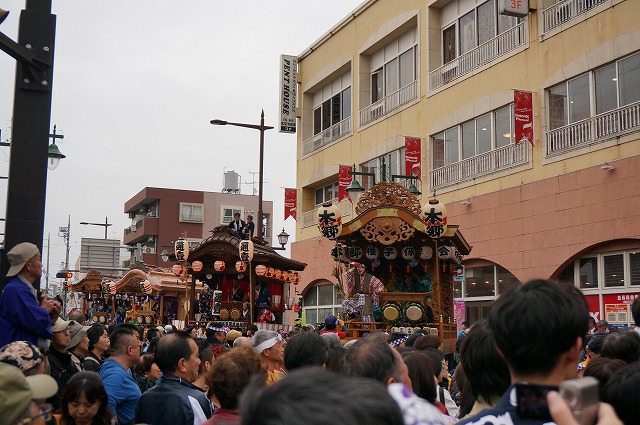
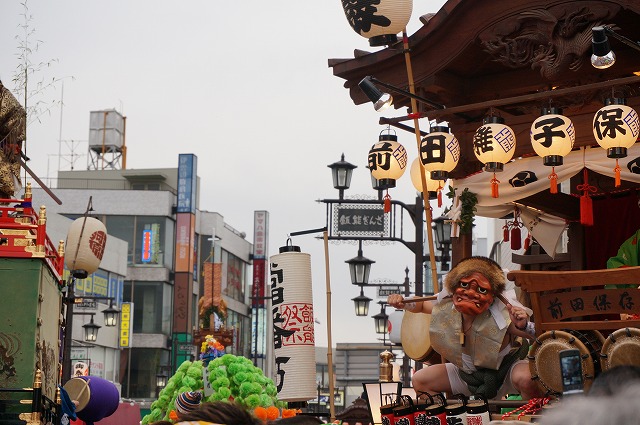
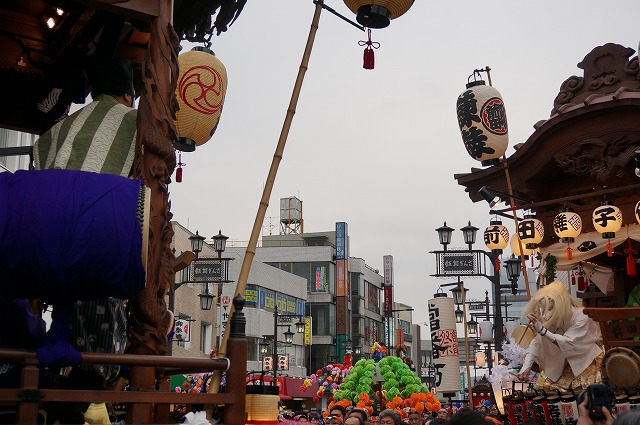
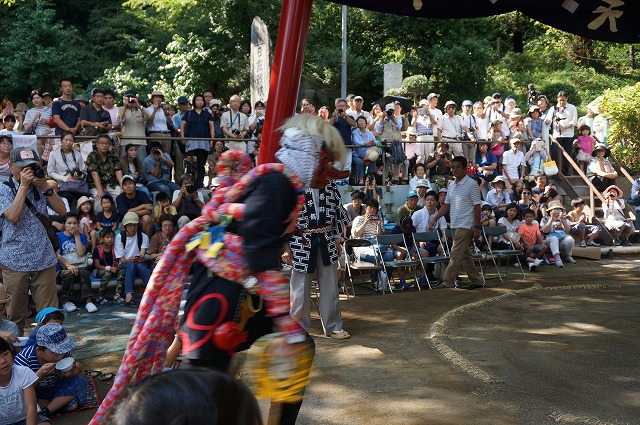
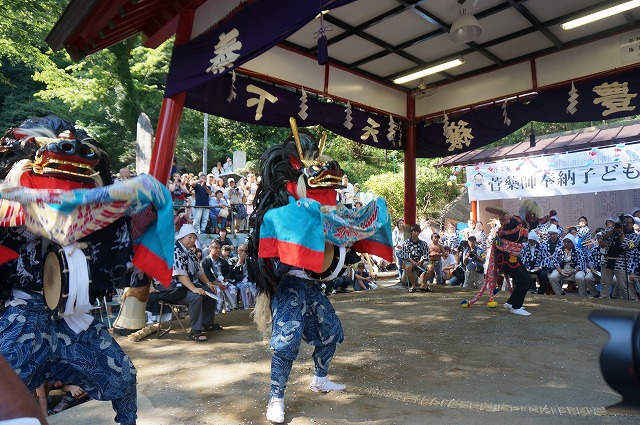
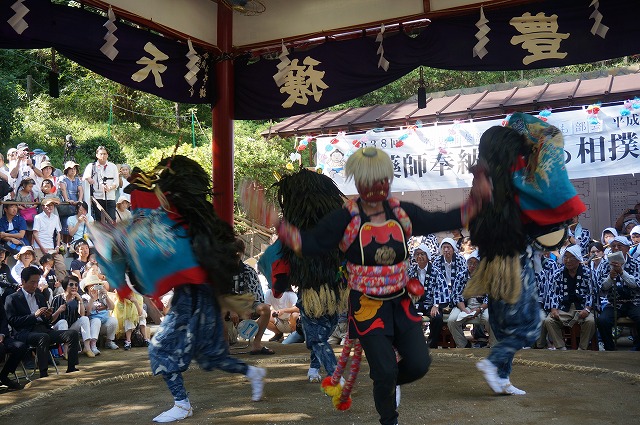
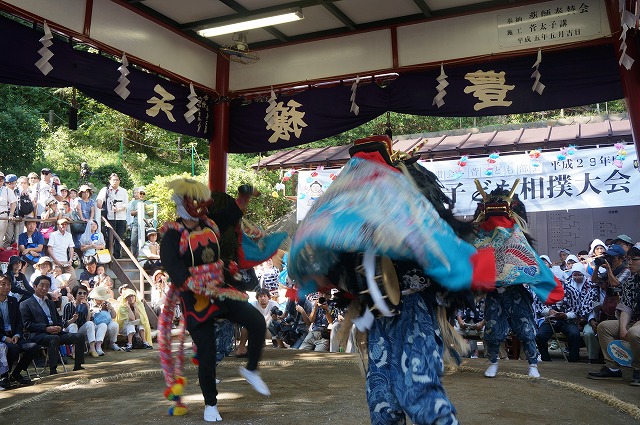
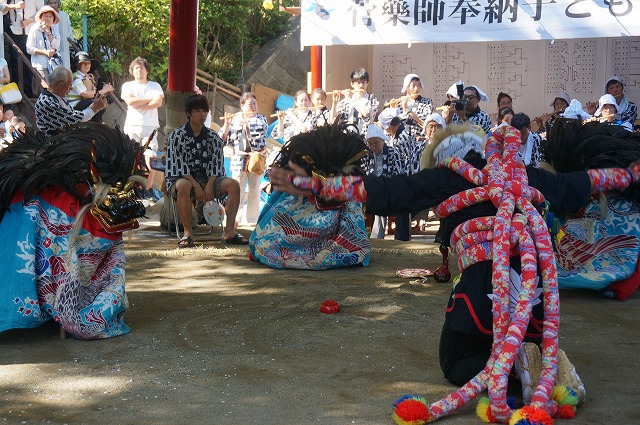
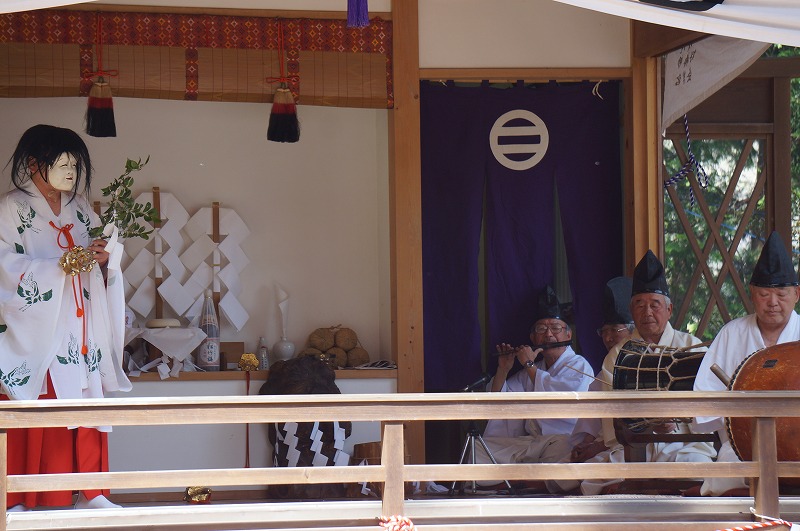
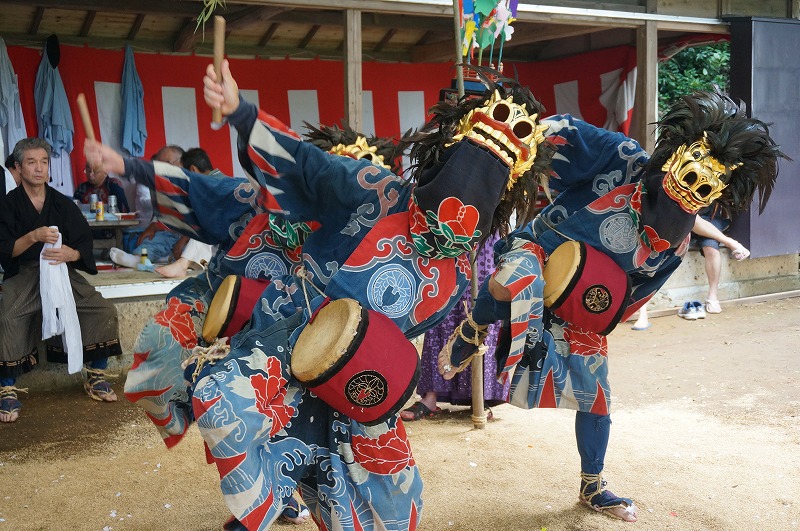
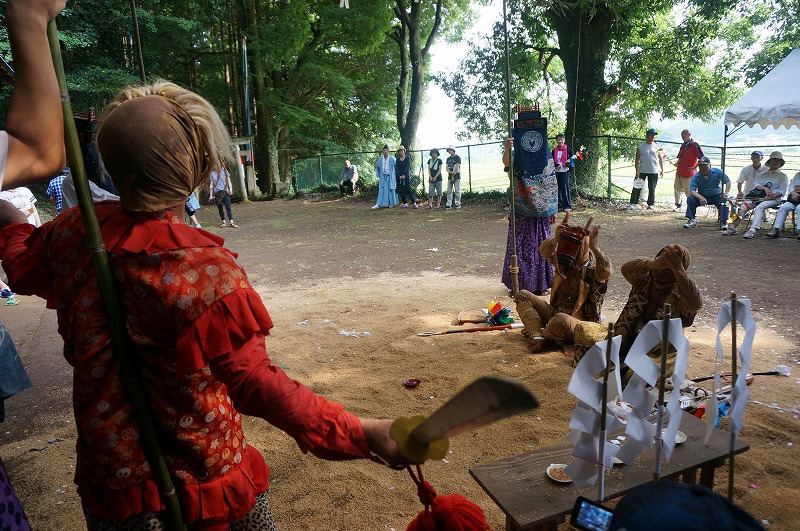
The lion dance finished one performance this morning, and the afternoon session is about to begin. Apart from the central stage, you can watch from anywhere.
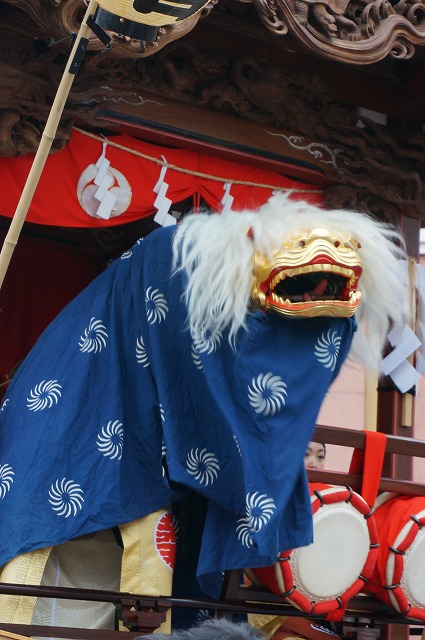
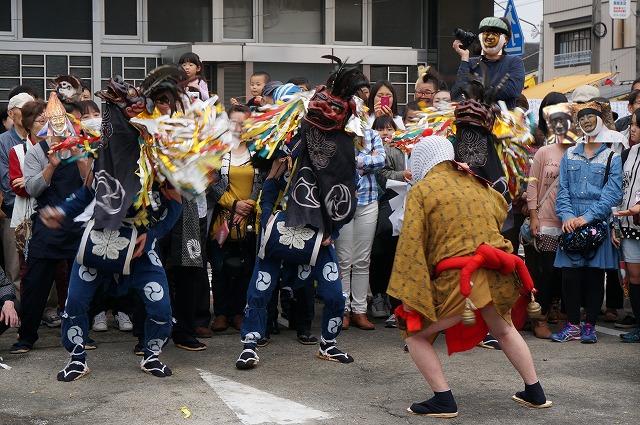
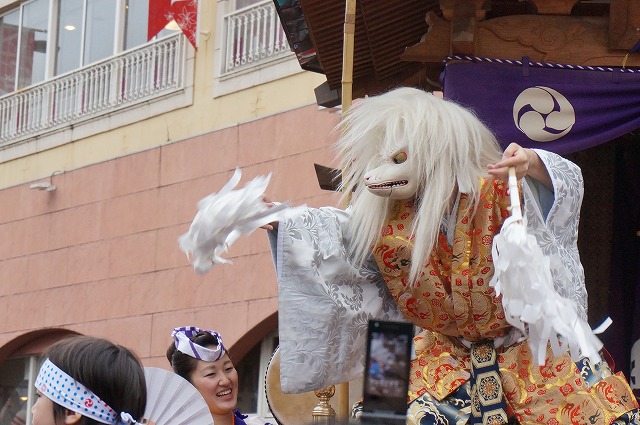
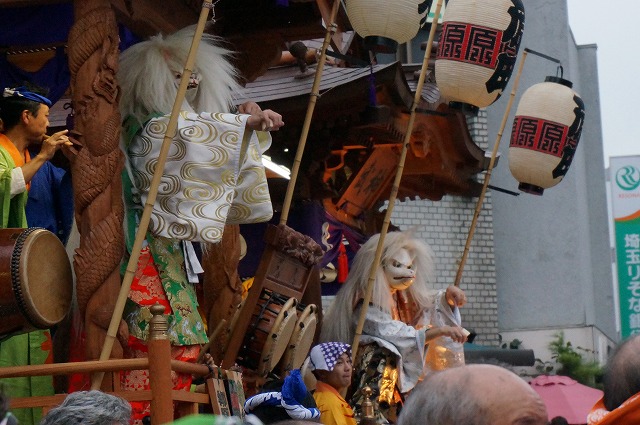
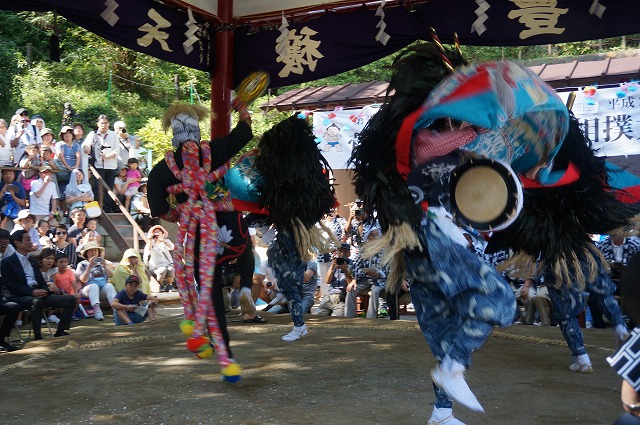
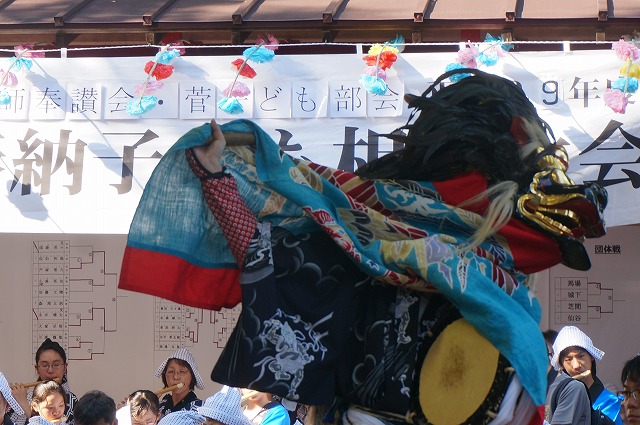
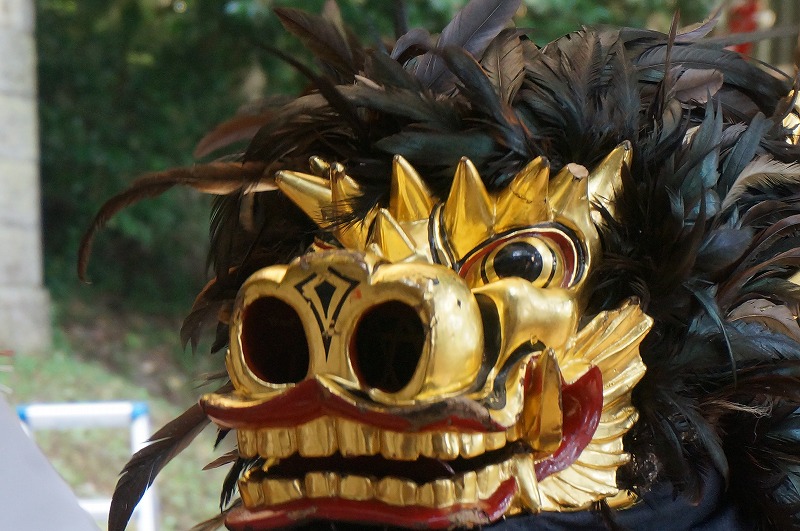
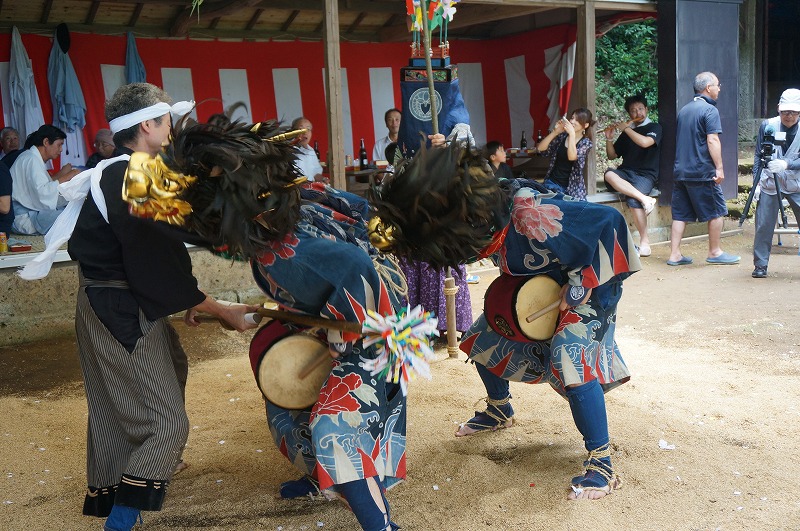
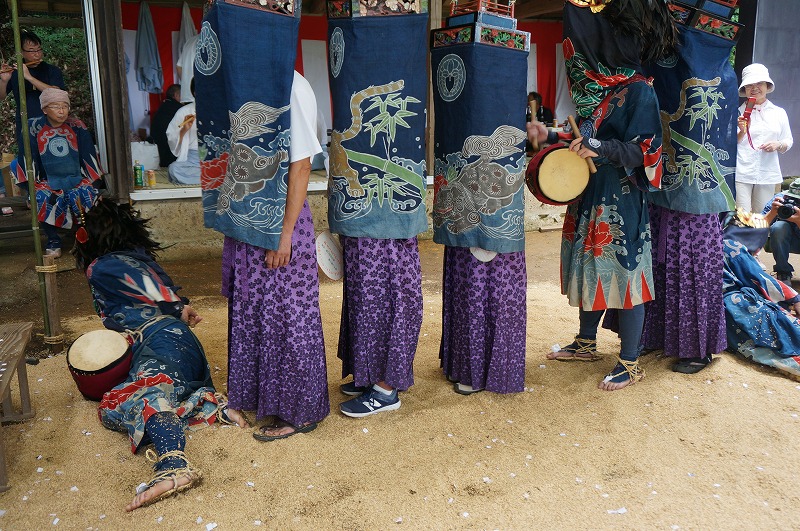
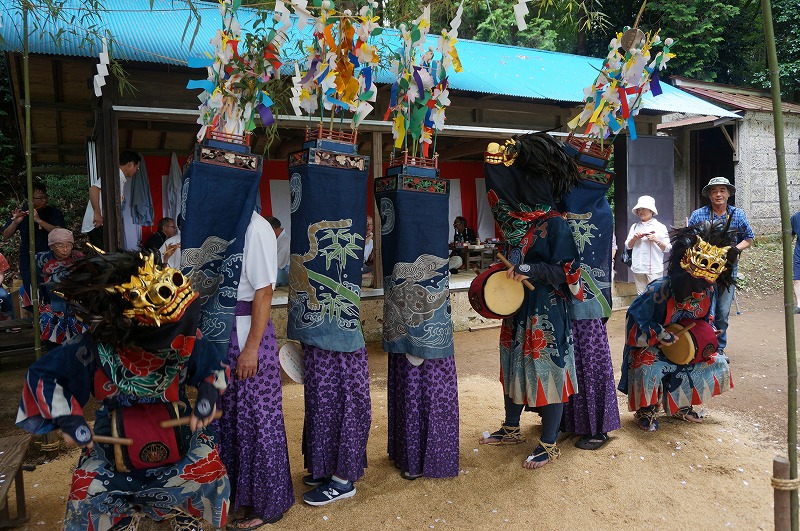
This is the form of the ‘three-lion dance’ commonly seen in the Kanto region and further east.
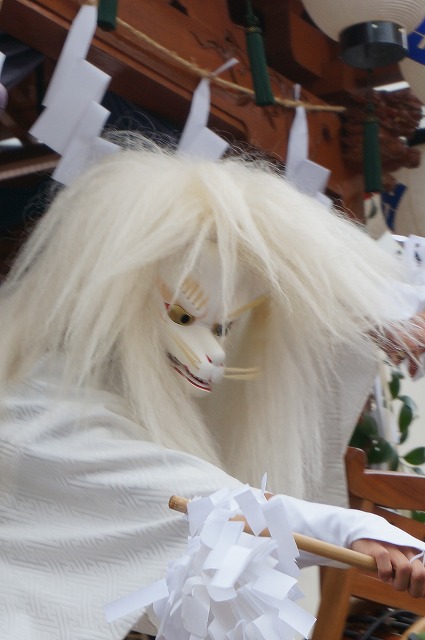
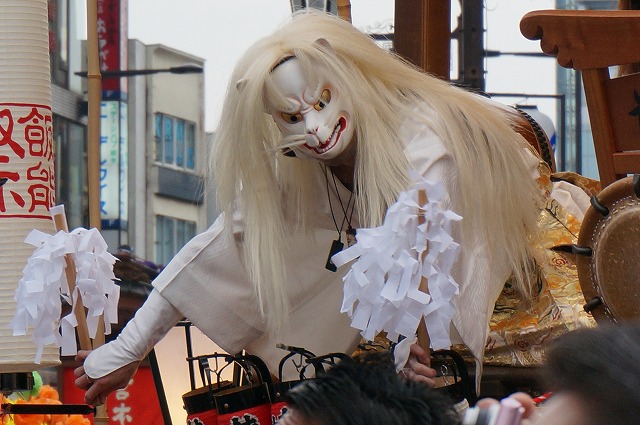
Whatever happened to the lioness?
Where has the lioness gone?
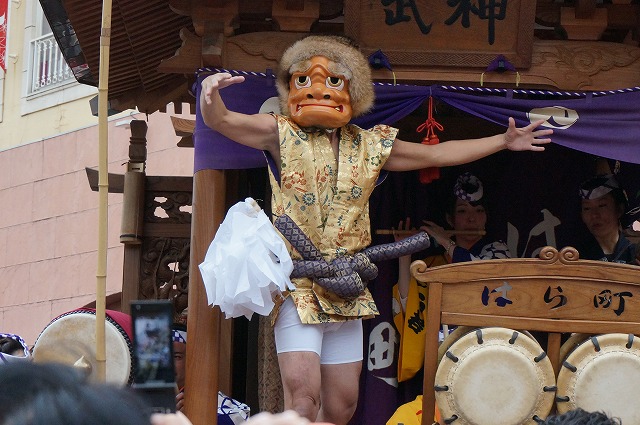
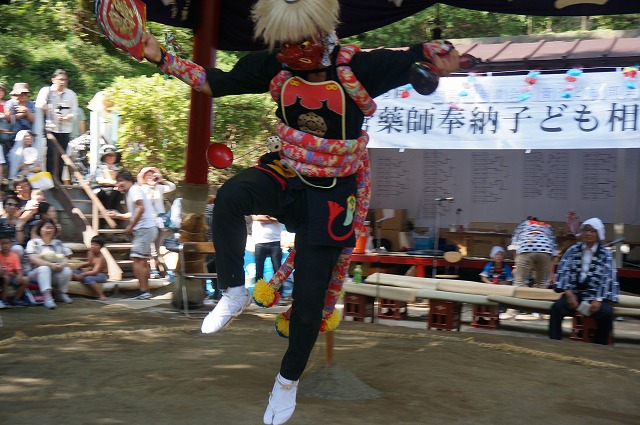
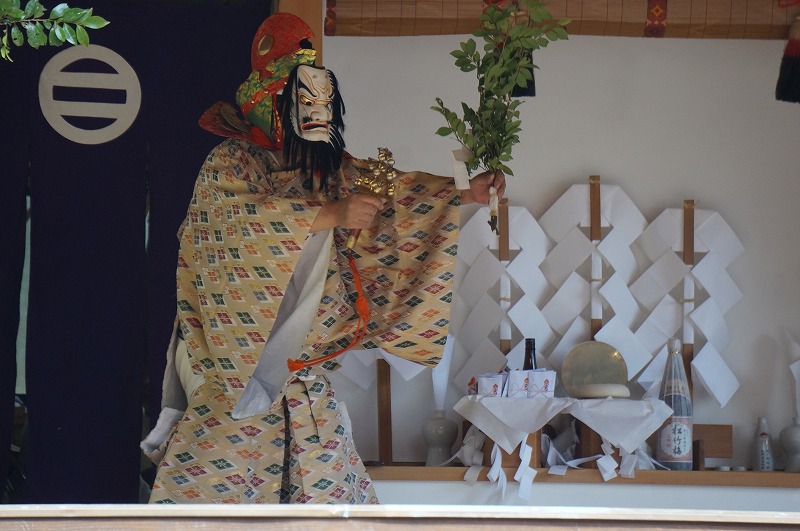
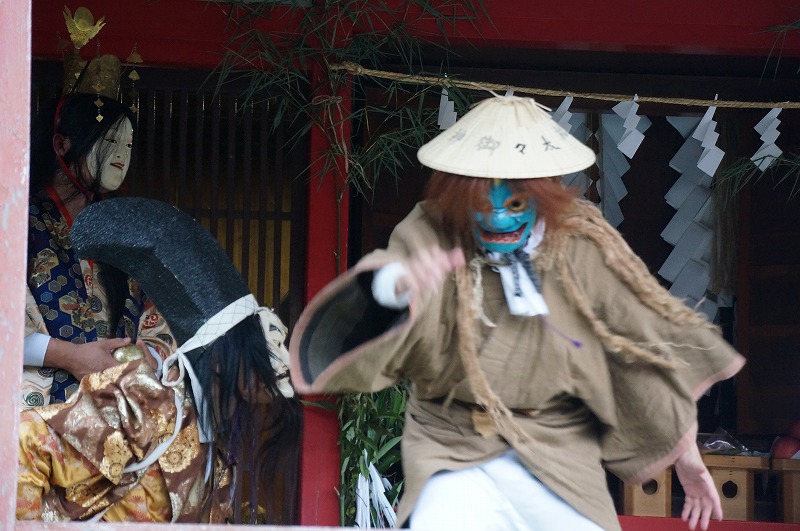
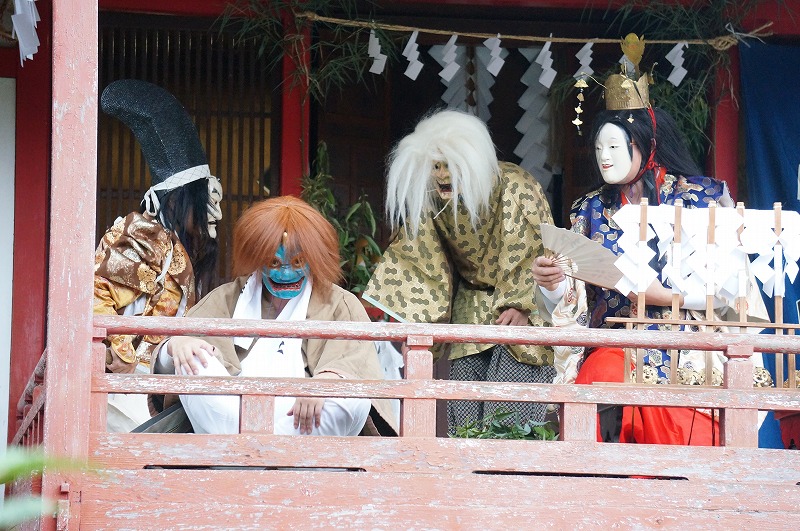
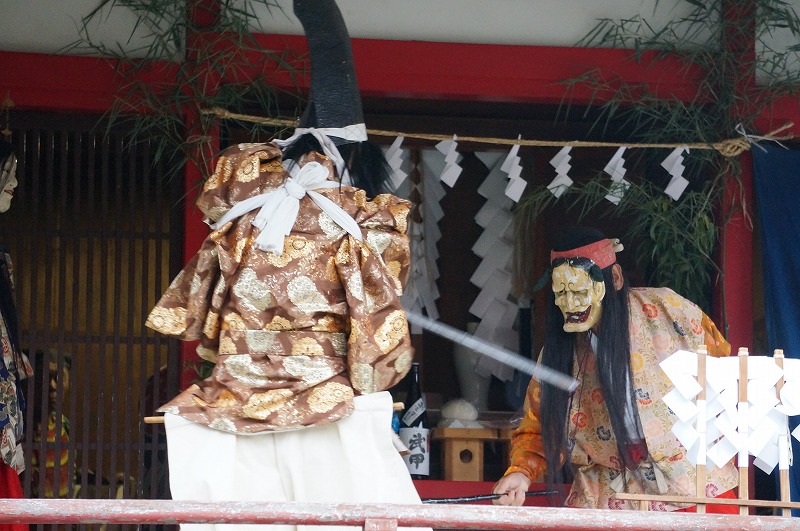
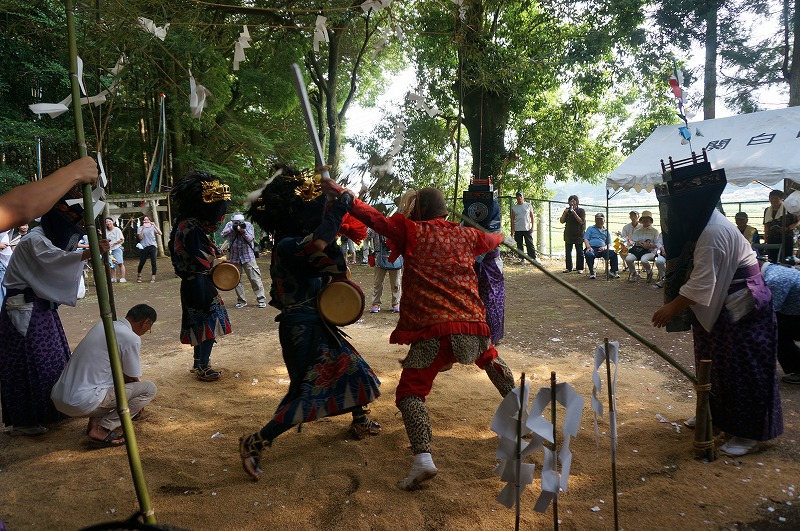
The performance known as ‘The Hidden Female Lion’ is a classic lion dance piece. Although there were originally three lions, for some reason only the female lion disappears. The remaining two work together to start looking for her, but…
How dare you steal a march on me!
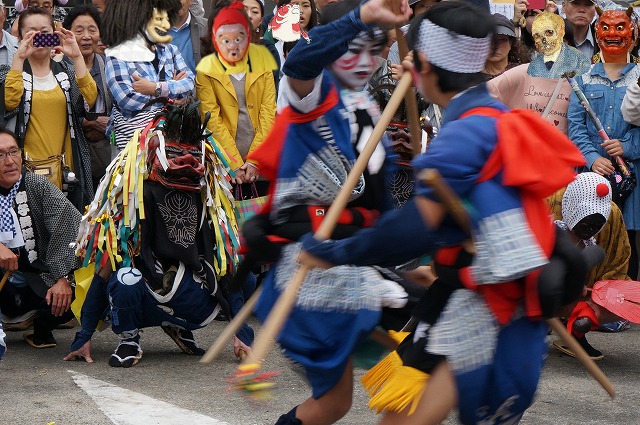
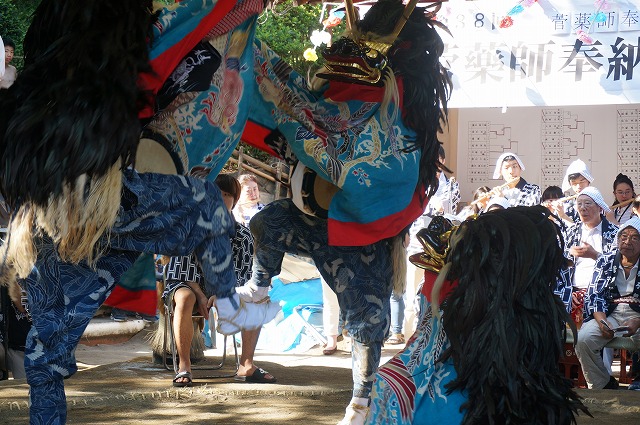
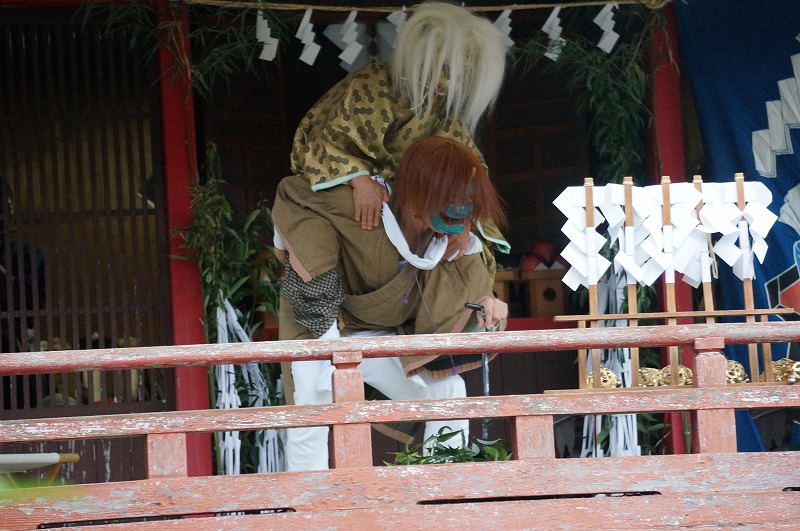
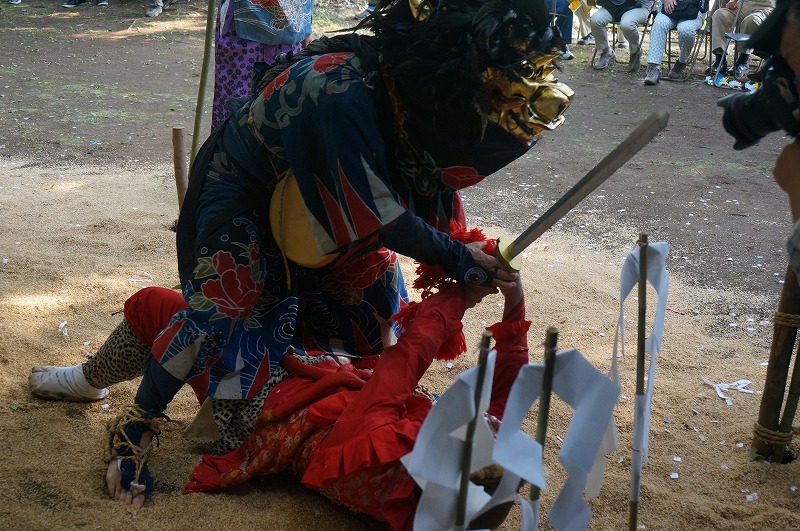
The lion who spotted the other first should have reported it straight away, but instead tries to play it down. He tries to play it down. It’s soon obvious. And so the battle between the two begins.
Whilst all this was going on, the lioness disappeared again… The same thing happened twice, and in the end, everything ended happily.
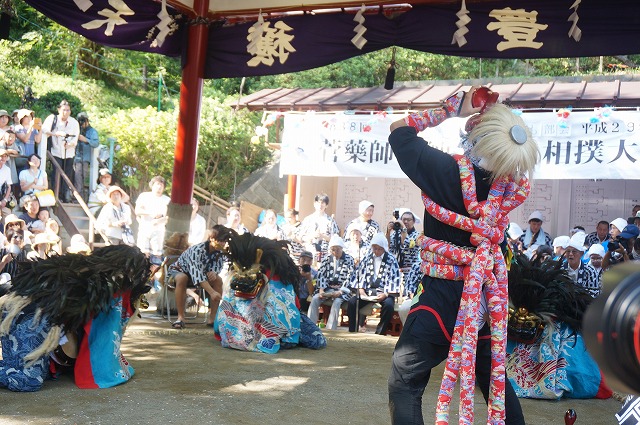
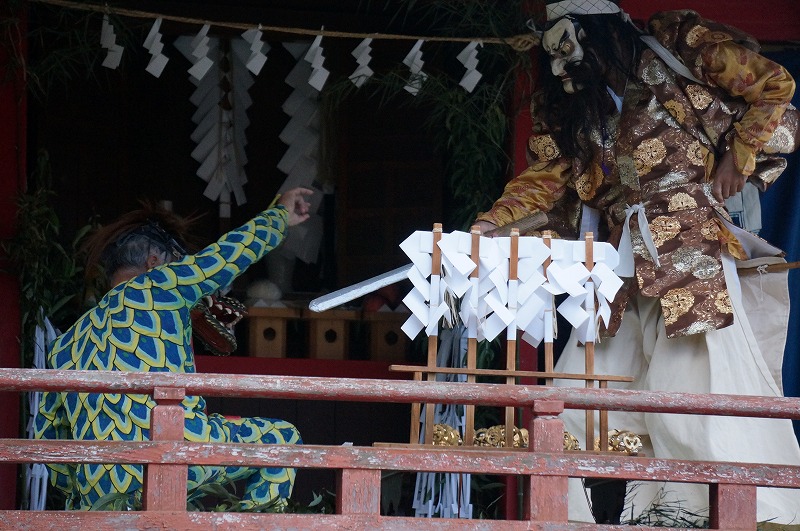
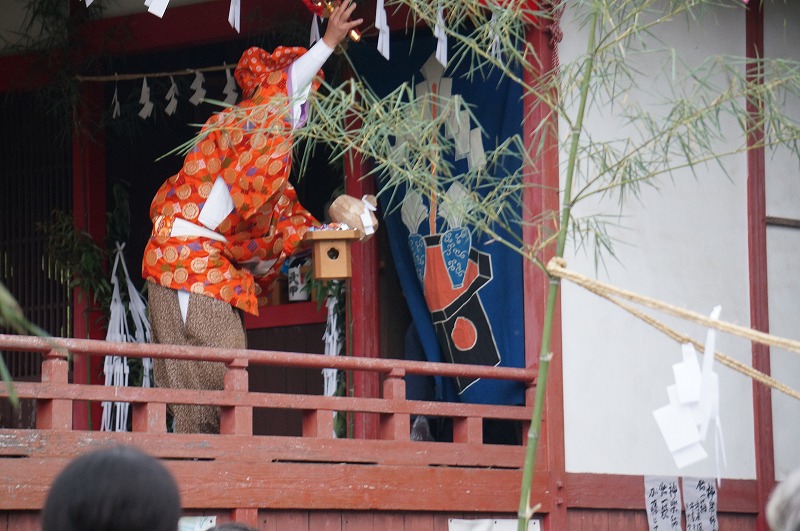
Hei gakari
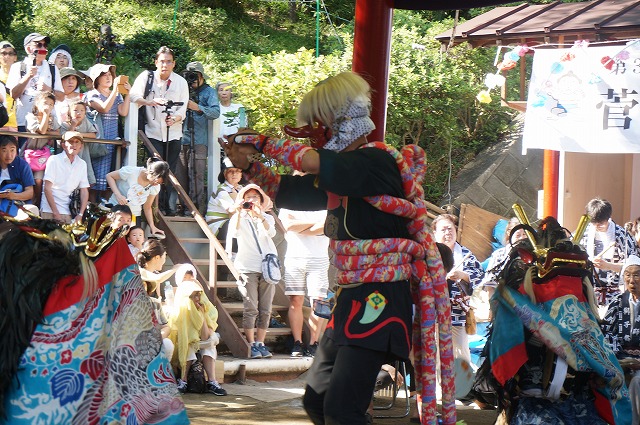
A performance in which the performers become connected to something is called a ‘kakari’. This is a performance in which the performers become connected to Gohei (sacred objects).
Tuna (rope) gakari
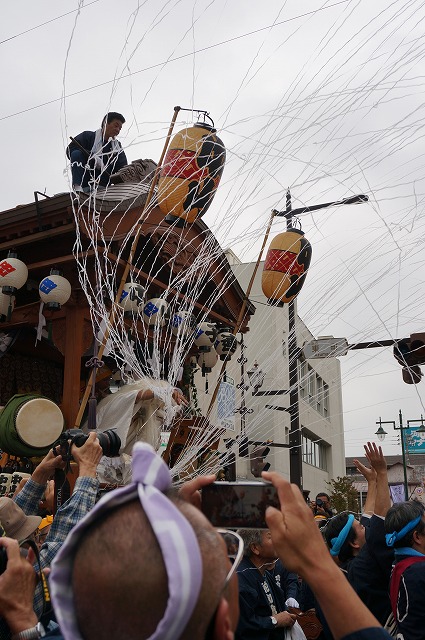
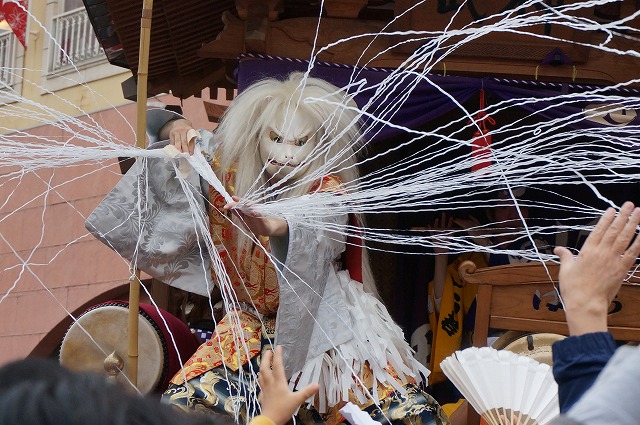
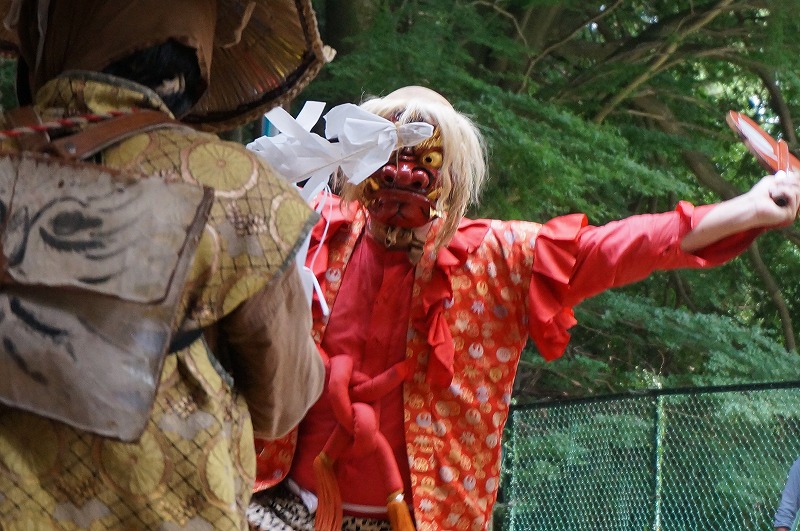
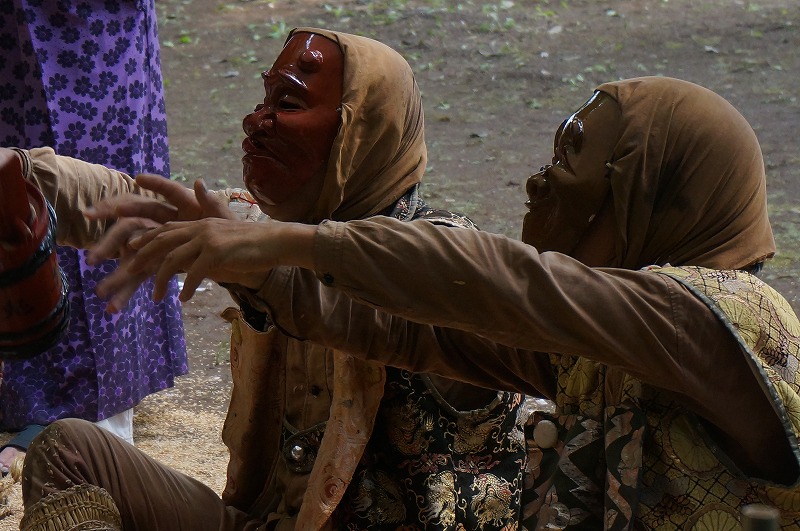
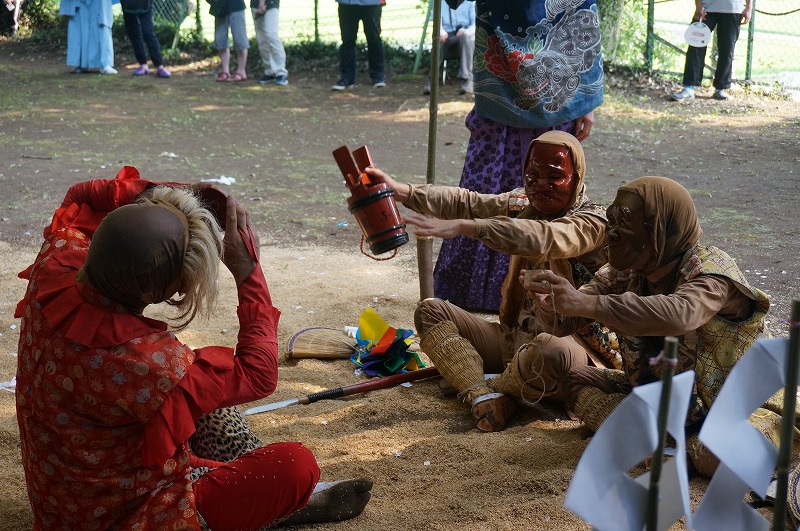
Suddenly appearing, a mysterious rope. ‘What on earth is this?’ wondered the lions.
‘I’m off then.’ ‘Right.’ ‘It’s no use trying to stop me.’ ‘Right, I won’t.’
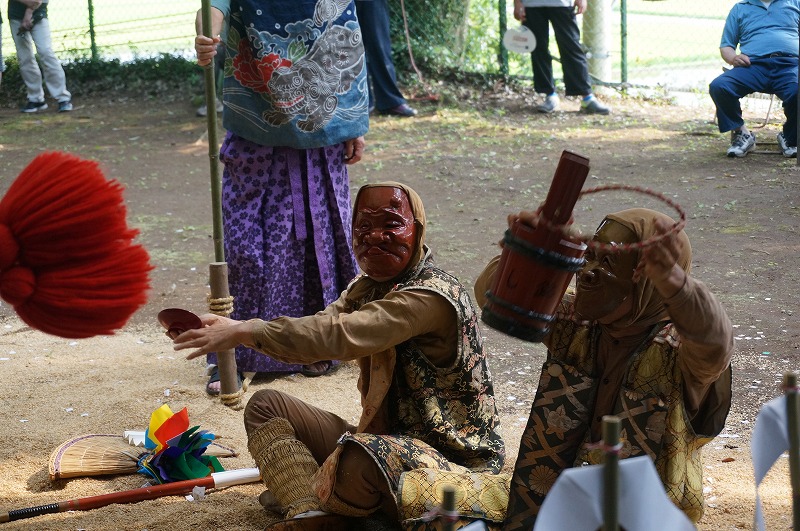
Shall we have a go at it?
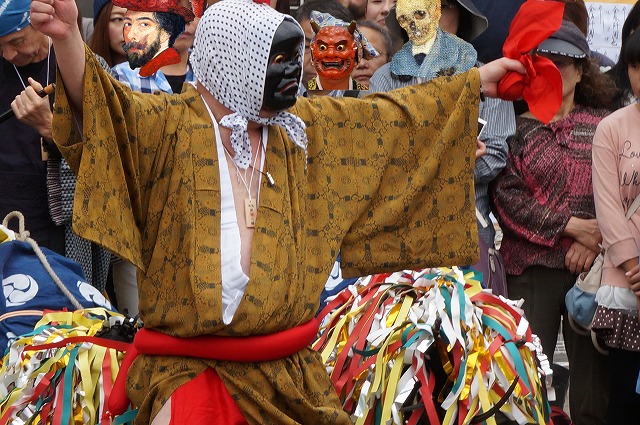
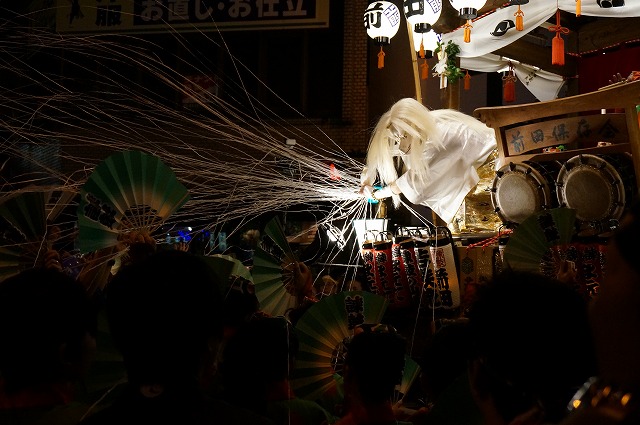
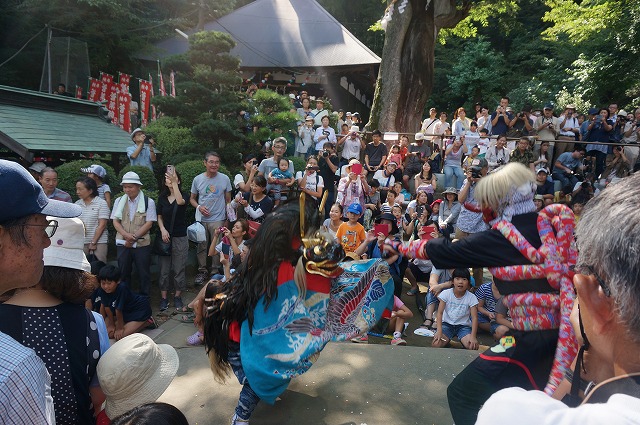
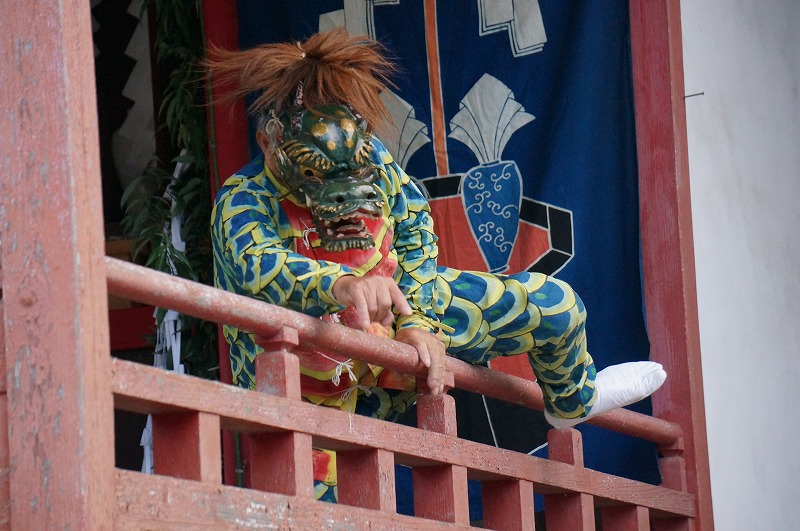
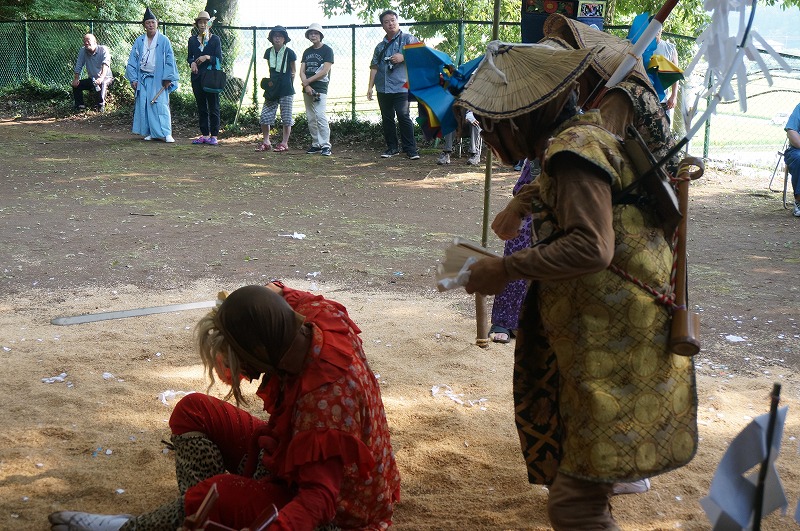
The Hanahata Lion Dance is about to begin—arguably the highlight of the performance.
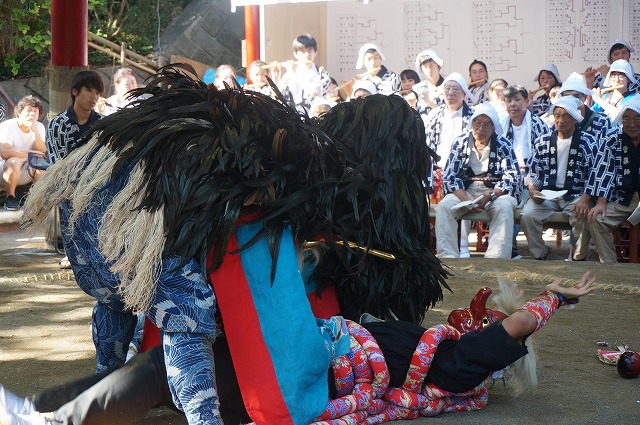
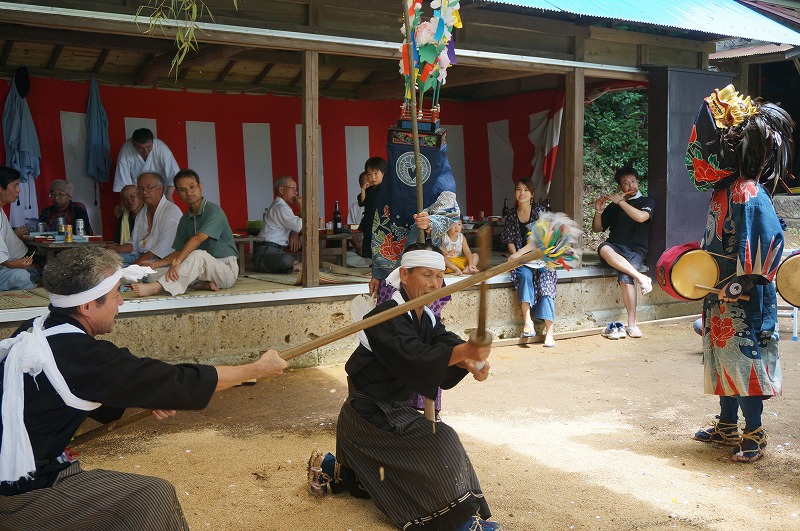
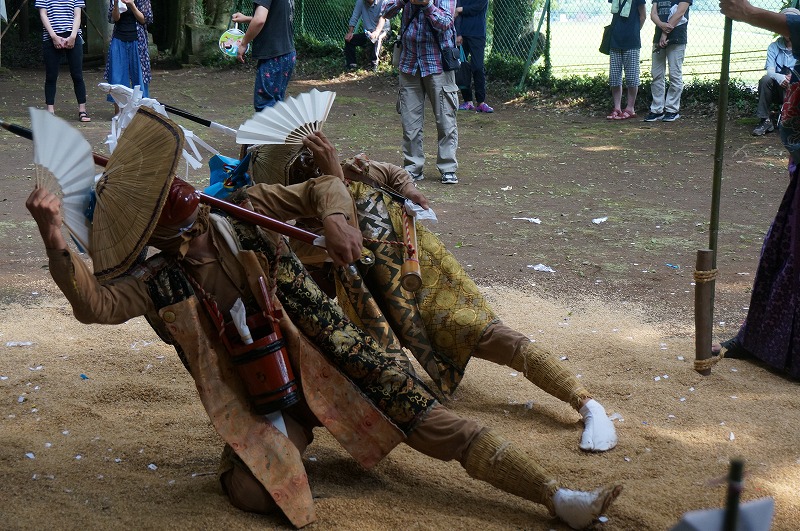
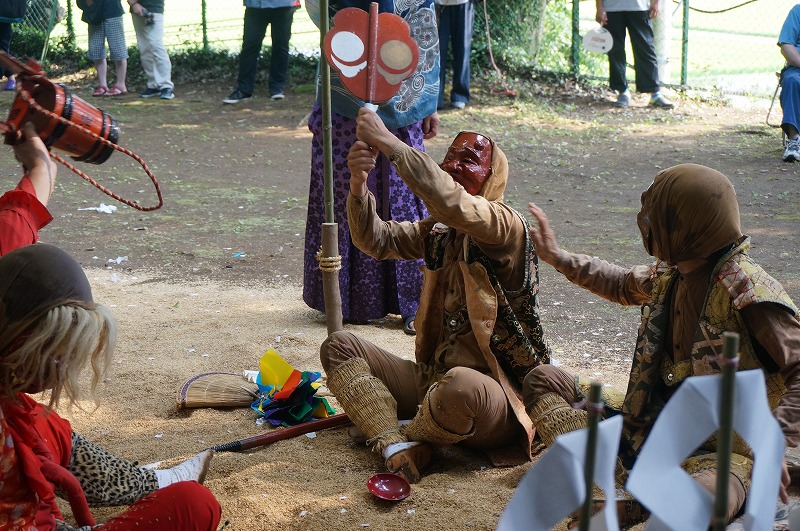
And so, the lion pulled and pushed the rope with all his might. On either side, the men stood by, determined not to be outdone.
‘The next lion is still young, so he’s got plenty of strength,’ said the compère, whipping the crowd into a frenzy. ‘Come on! There’s more to come!’
Even the security guard finds himself putting his all into it
Even the security guard finds himself putting his all into it
at the end
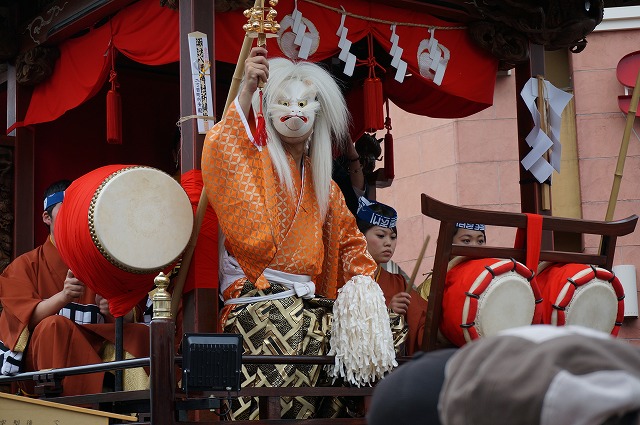
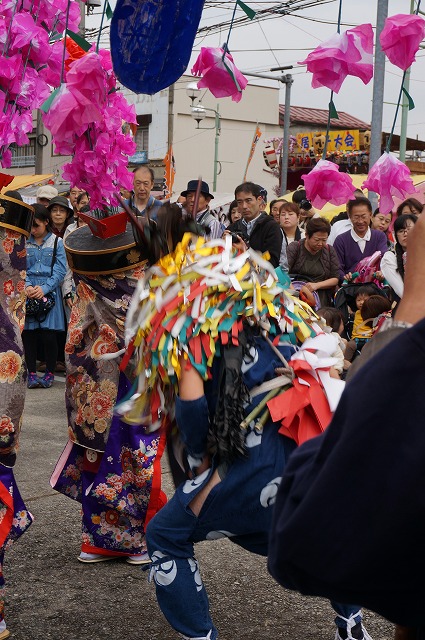
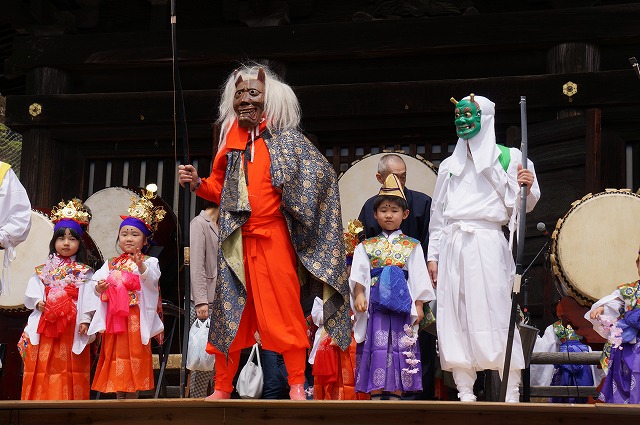
Once the lion dancers have finished their dedication ceremony at Ōtori Shrine, they head to a temple called Fukuju-in, where they perform their final dance to bring the event to a close. According to legend, a long time ago, during a flood, a complete set of lion dance tools was washed ashore and kept by Fukuju-in. It is said that this lion dance was eventually created using those very tools. It was already half past three in the afternoon. The heat was starting to ease off. The lion dance was over, but summer was far from over. So, where are the next masked characters?
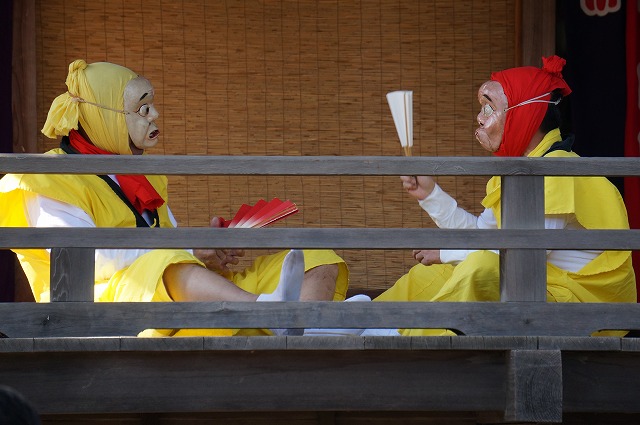
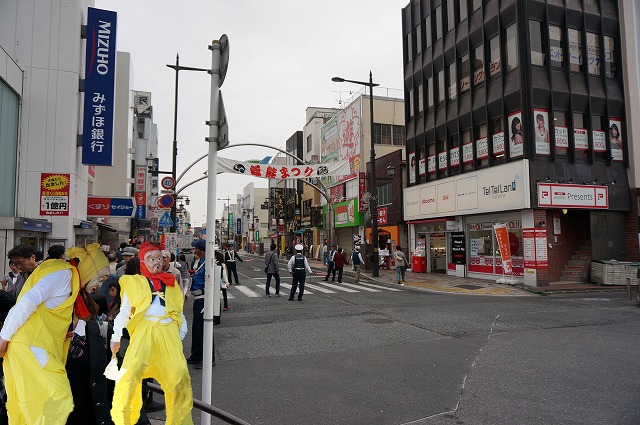
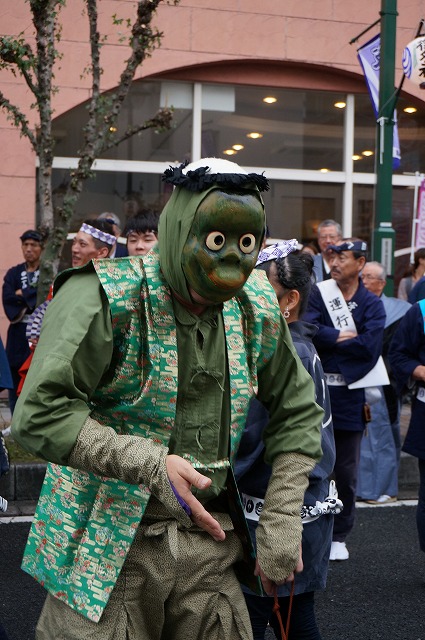
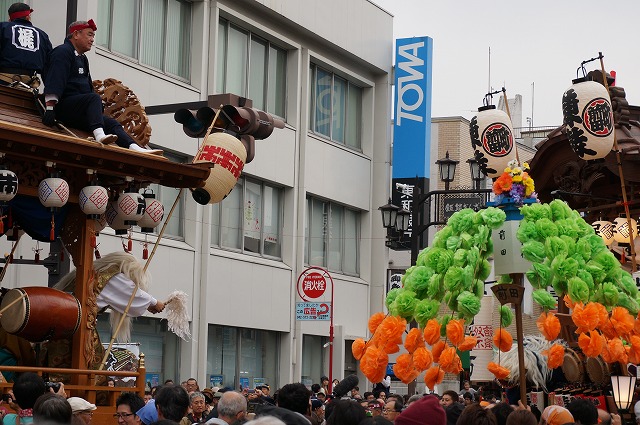
A Showdown of Masked Characters ~Hannou festival 飯能祭り
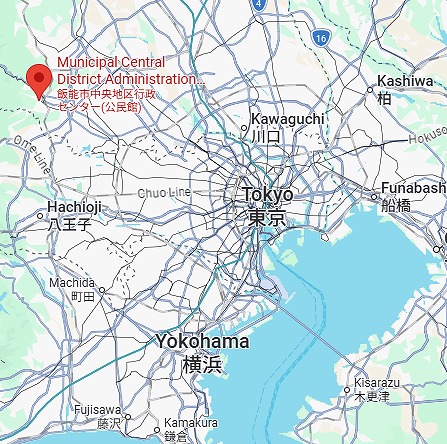
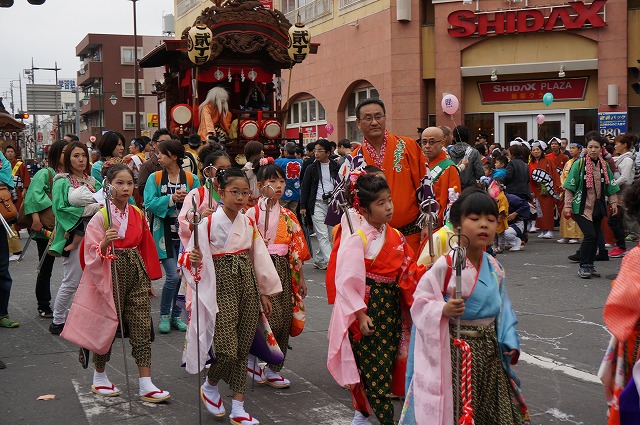
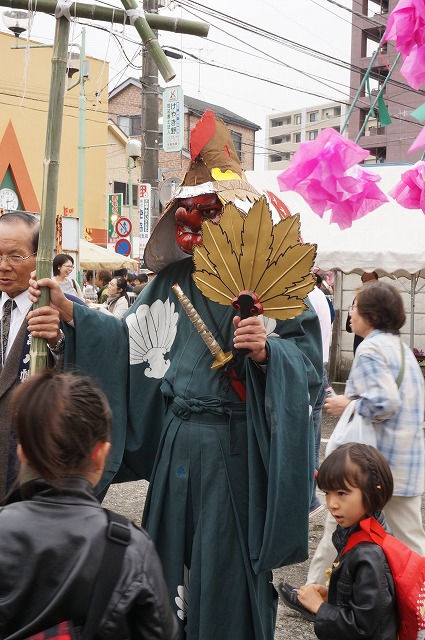
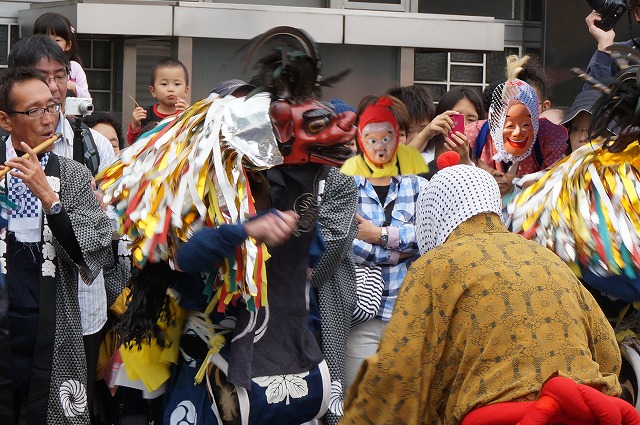
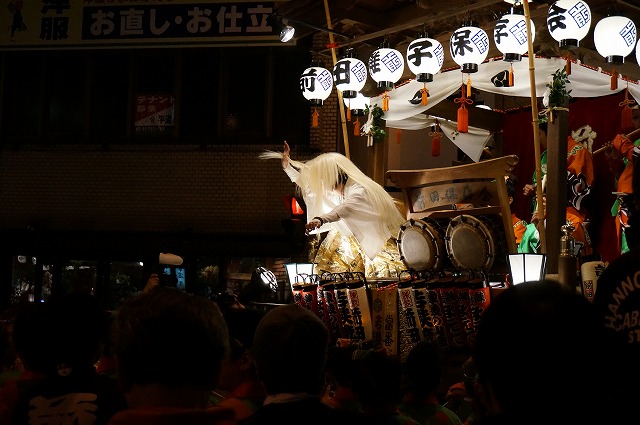
Date; The first Saturday and Sunday in November Location; Hanno, Hanno City, Saitama Prefecture The city centre area stretching from the North Exit of Hanno Station on the Seibu Ikebukuro Line and the West Exit of Higashi-Hanno Station on the JR Hachiko Line to the Hanno City Central District Administrative Centre Access; Right next to the North Exit of Hanno Station on the Seibu Ikebukuro Line; a 2-minute walk from the West Exit of Higashi-Hanno Station on the JR Hachiko Line It takes about one hour to one and a half hours to get to Hanno Station from Tokyo or Ikebukuro.
This article is based on a visit of 4th, November, 2025.
Madara, a mysterious deity of unknown origin, banishes evil ~Madara festival マダラ鬼神祭
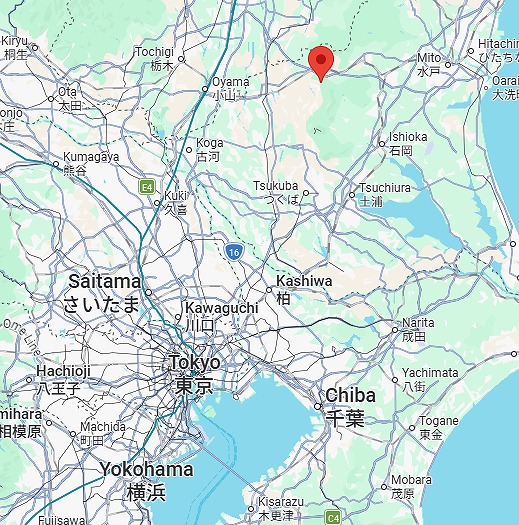
Date; The second Sunday in April every year Location; Amabiki kannon 1 Honoki, Sakurashi City, Ibaraki Prefecture Access; From Iwase Station on the JR Mito Line, take the city bus on Saturdays and holidays to Amabiki Kannon (20 minutes)
This article is based on a visit on Sunday, April 10, 2016.
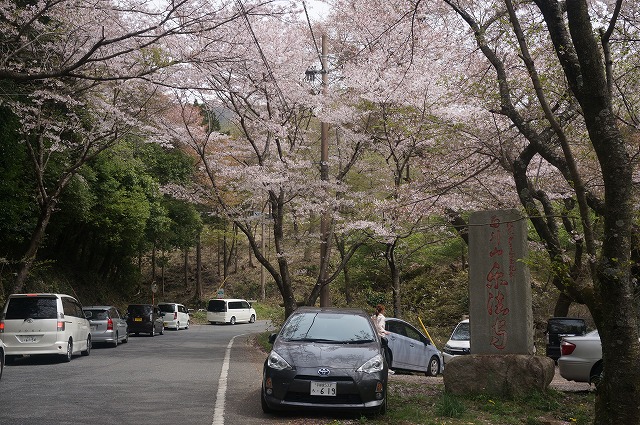
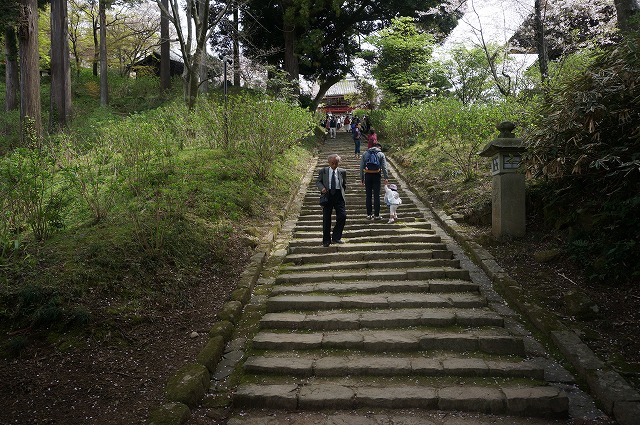
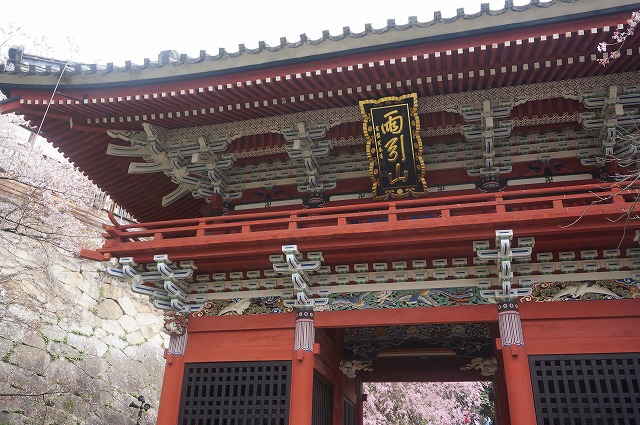
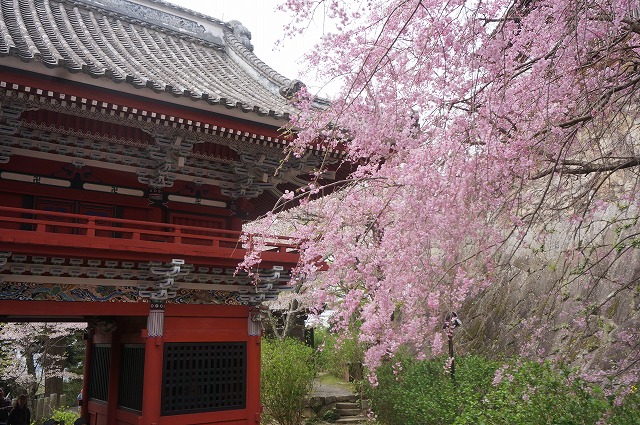
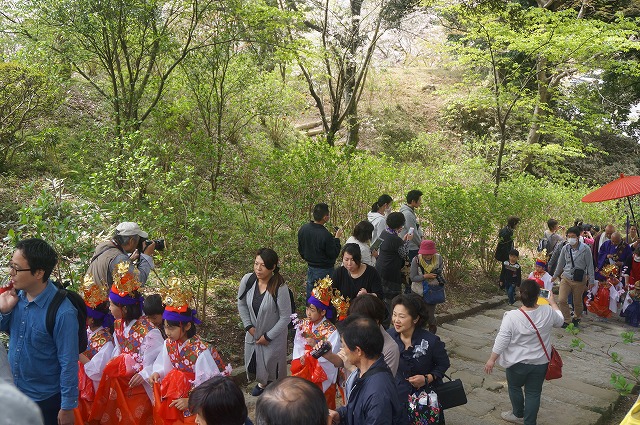
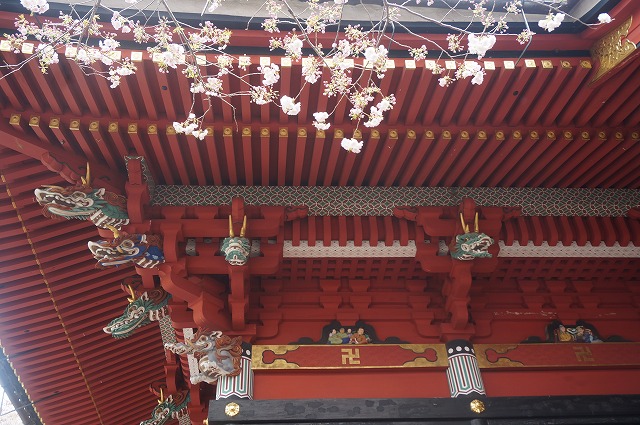
Amabiki Kannon Temple under the falling cherry blossom
Since Amabiki Kannon is a short distance from the station, you’ll need to take a taxi or a bus. One inn near the station offer public bike rentals, but since there aren’t many available, you’ll need to make a reservation in advance. Takasago Inn http://☎0296-75-2165 Cycling Ibaraki https://cycling.pref.ibaraki.jp/ringring/rental/
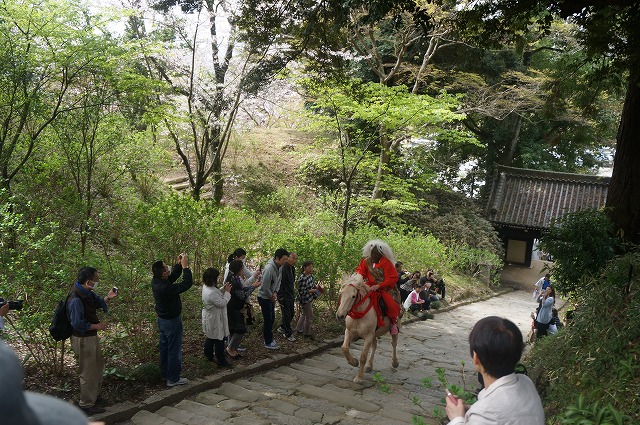
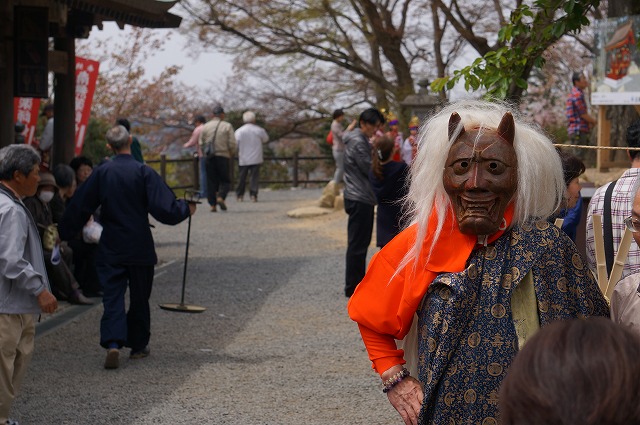
Madara diety is coming
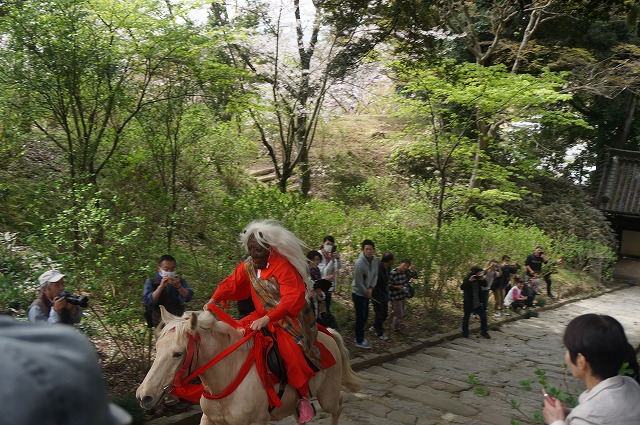
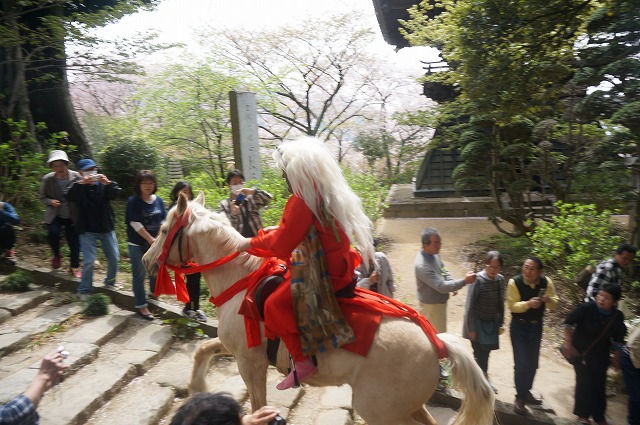
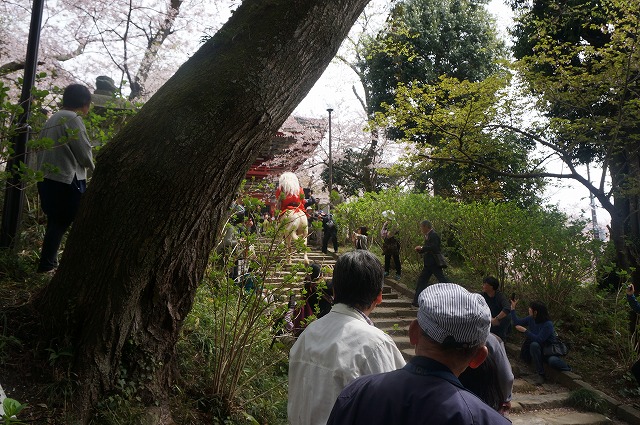
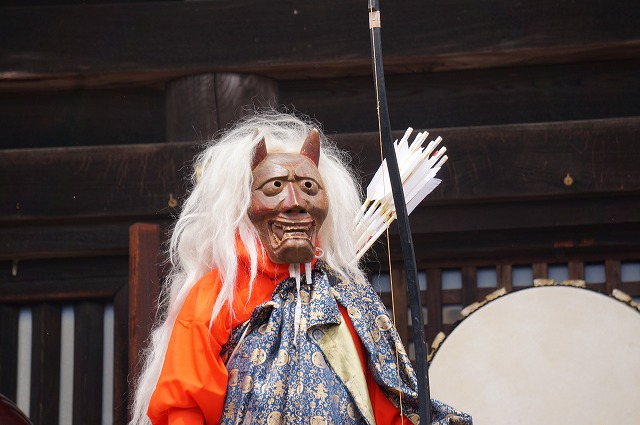
At 11:00, the Madara diety first rushes up the stairs in one go, riding a white horse.
The Madara deity is still a rare deity even in Japan and is not typically worshipped openly. It is, so to speak, a “hidden” deity. Only two places—Amabiki Kannon-ji temple here and Kōryū-ji temple in Kyoto—prominently feature the Madara deity.
According to legend, long ago, when the temple’s founder was traveling by ship and it seemed as if the vessel was about to be shipwrecked, the Madara deity guided the ship, allowing the journey to end safely. Later, when the temple was destroyed by fire during a time of war, it is said that figures with the faces of demons worked night after night to rebuild it. This, it is said, is the reason why this temple holds a festival to honor the Madara deity.
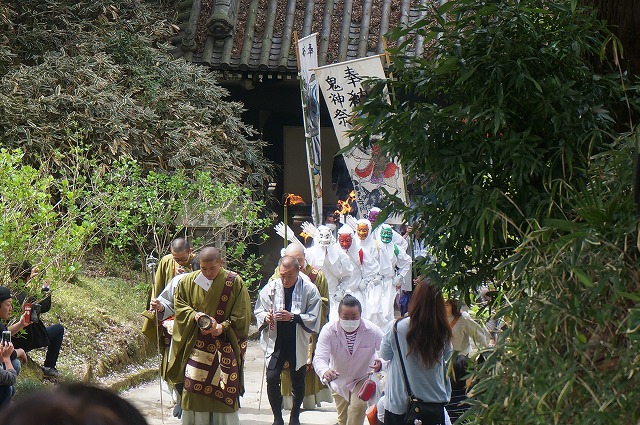
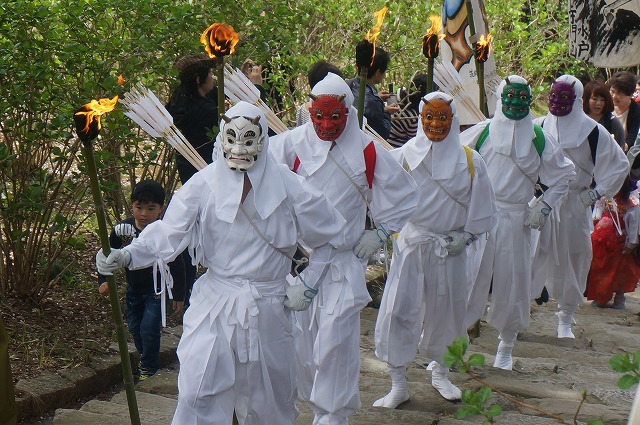
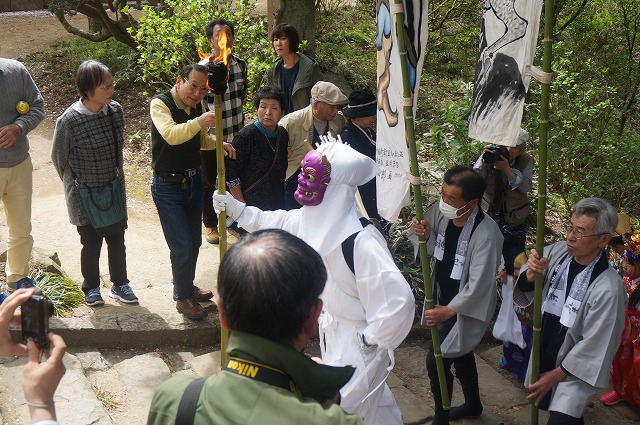
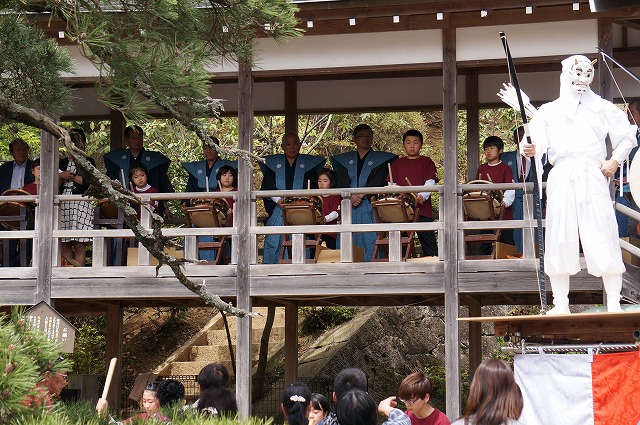
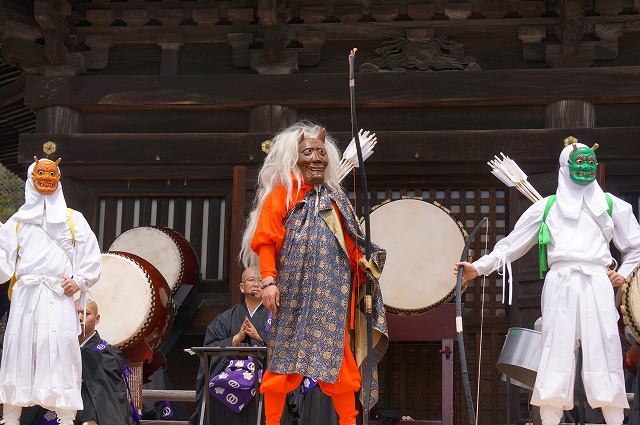
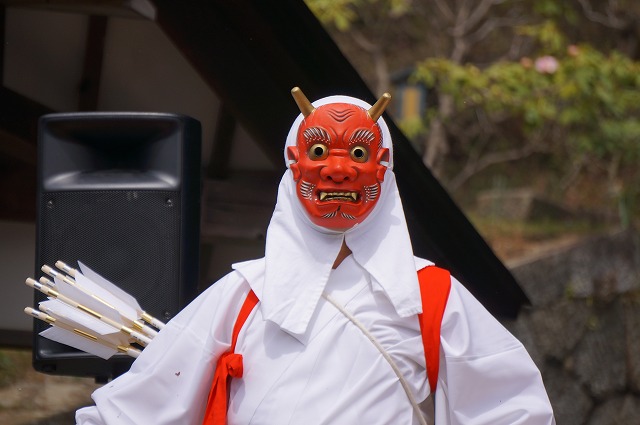
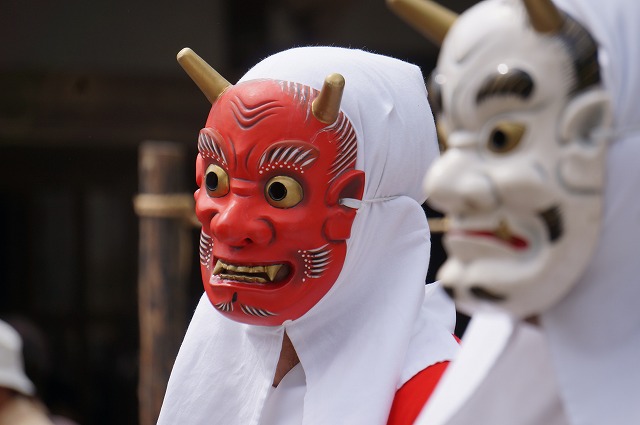
Led by a monk, five ogres and a child performer also make their way up the stairs.
The Dance of the Madara deity and ogres
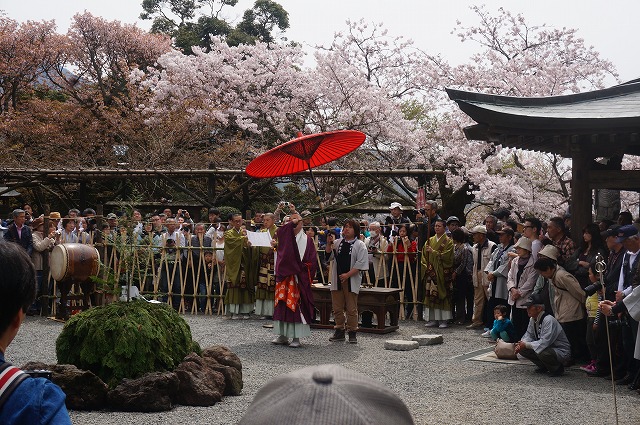
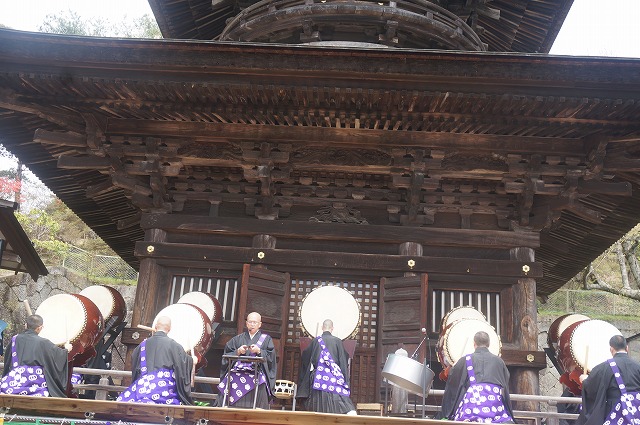
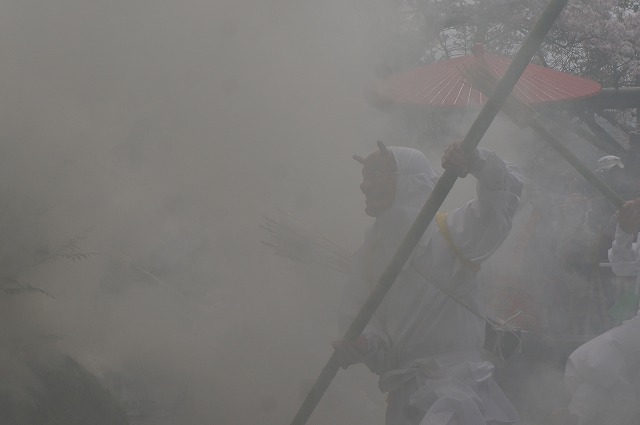
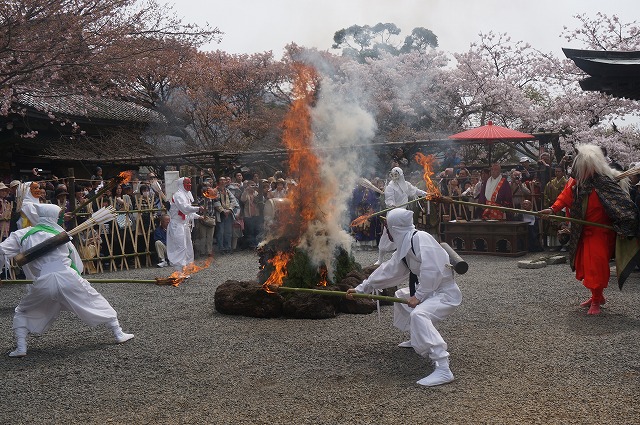
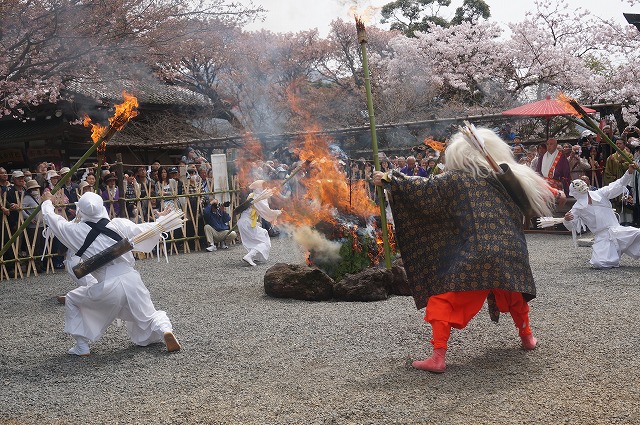
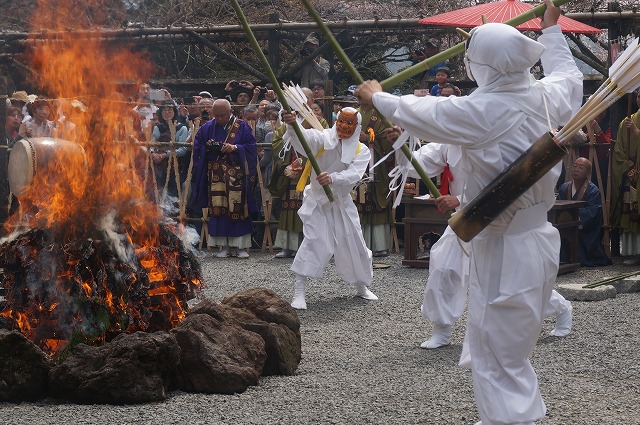
11:30 a.m. Amid the sound of the monks’ drums, a fire for the goma ritual is lit inside a bamboo frame. A goma ritual is a Buddhist religious ceremony in which a fire is lit and wooden tablets inscribed with wishes are cast into it.
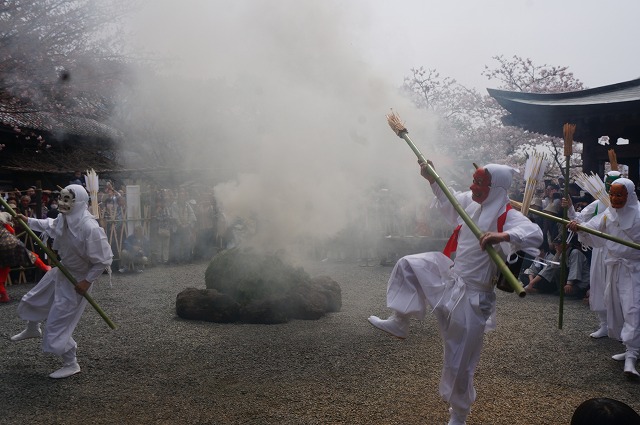
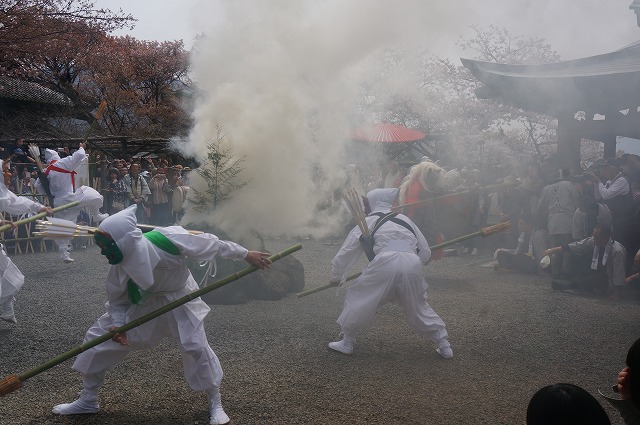
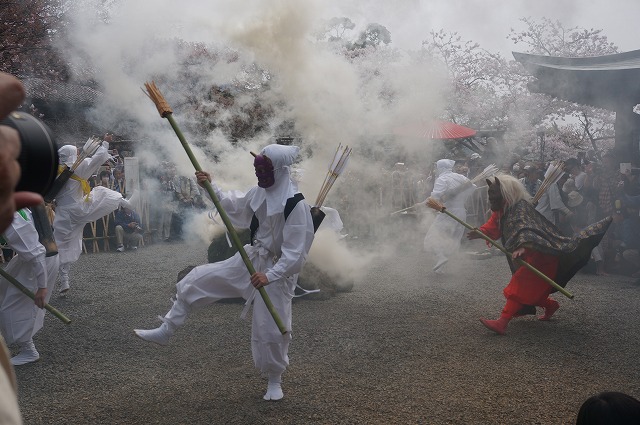
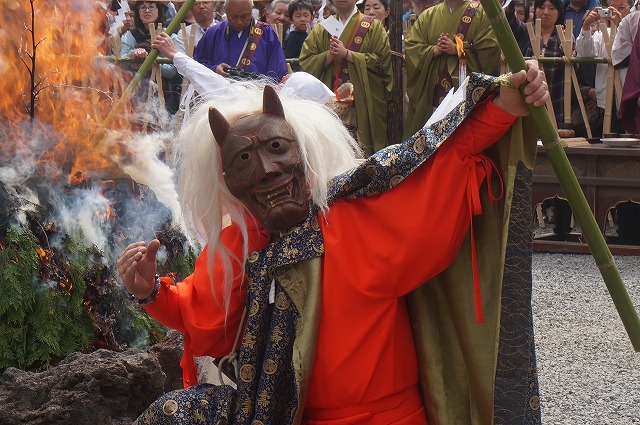
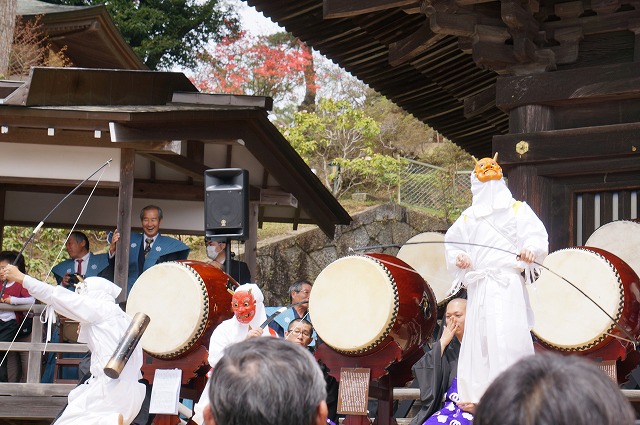
Right now, in the face of the raging flames, at the signal from the Madara deity, the ogres’ wild dance begins.
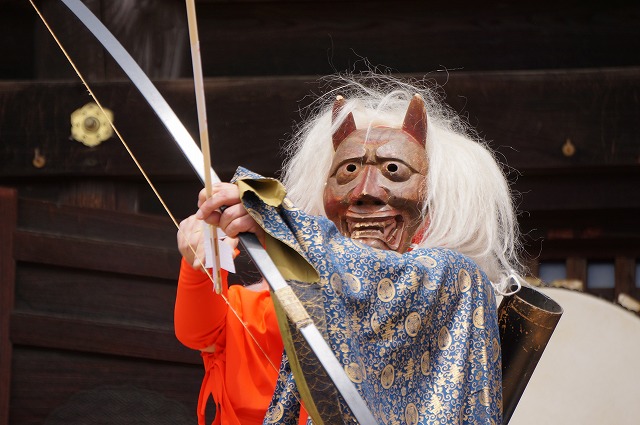
Finally, they release arrows to banish the evil spirit.
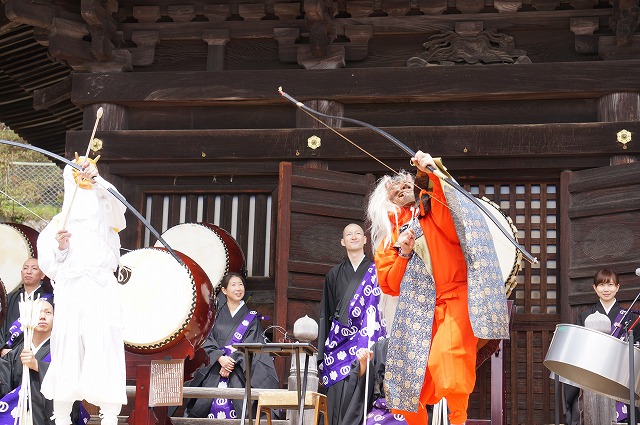
Gathered in front of the main hall, the Madara deity and the ogres fire a total of 49 arrows, one after another, each said to possess the power to ward off evil. People scramble to catch the arrows because they are said to bring good fortune and benefits.
12:30 p.m. Once everything is over, the ogres even pose for commemorative photos. The people head down the mountain, each wishing for their own happiness.
Tochigi 栃木 ~A Town of Warehouses with Three Delights
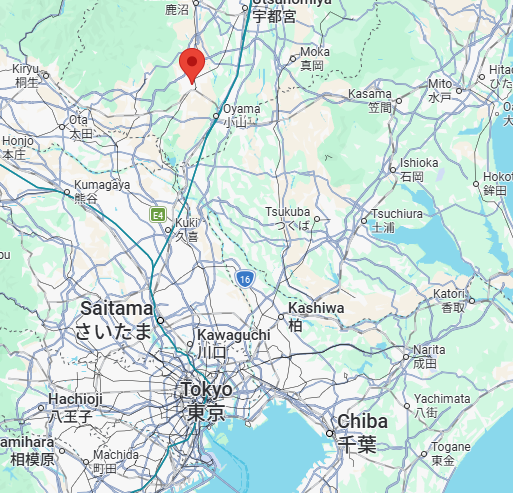
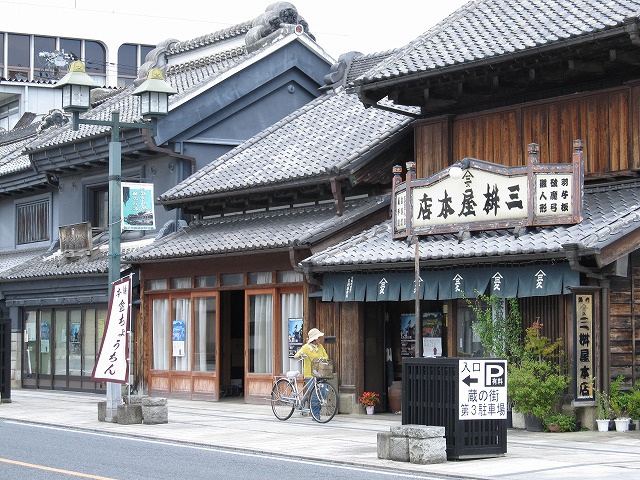
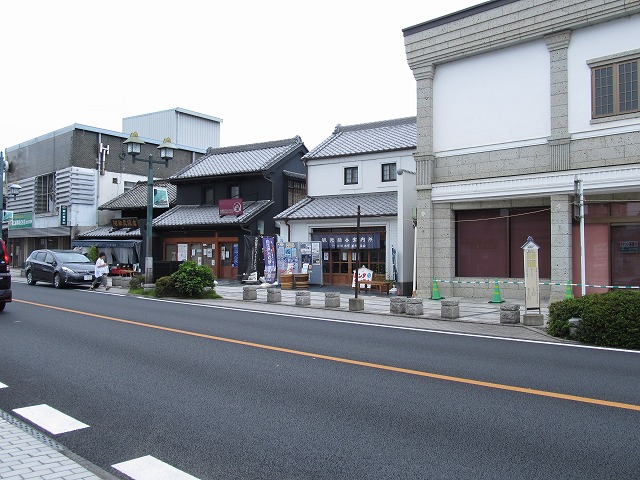
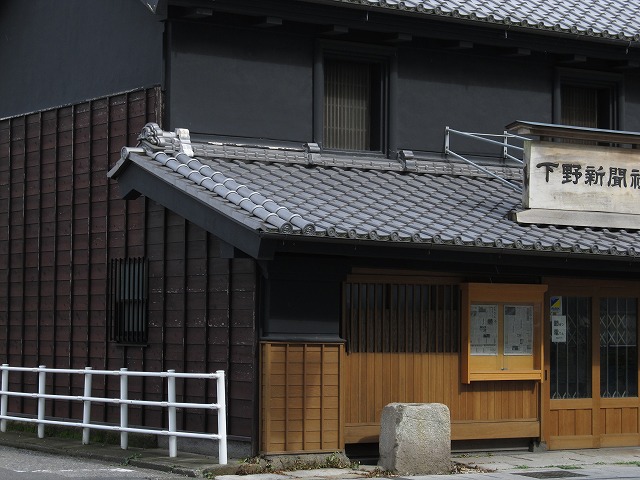
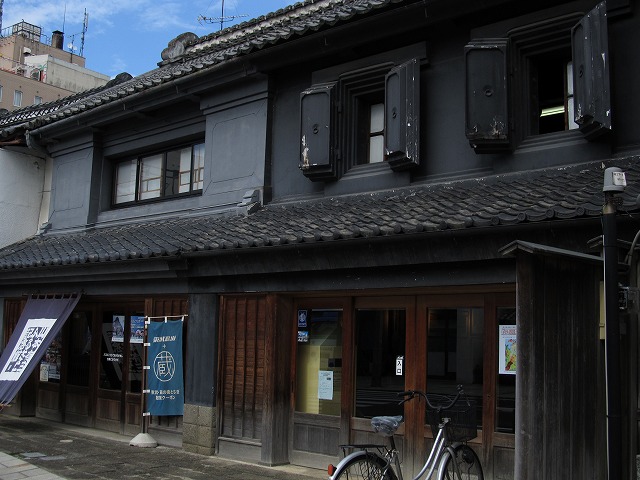
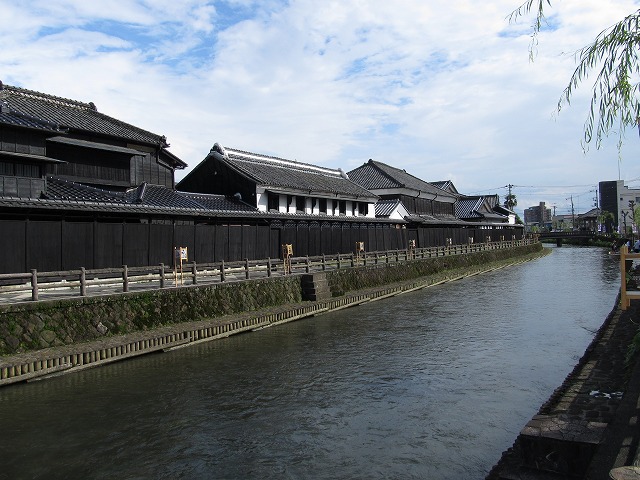
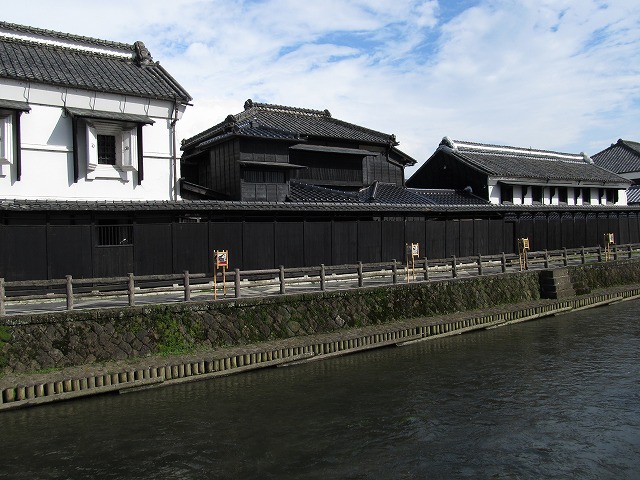
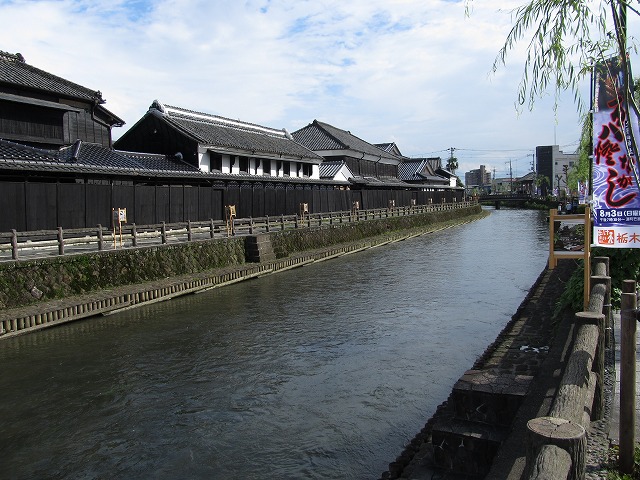
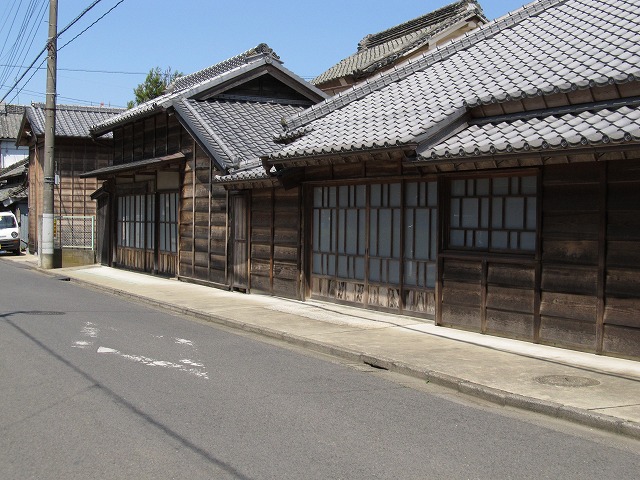
“Tochigi? I’ve never heard of that place.” If asked, most people would probably answer that way. Of course, it’s a town in Tochigi Prefecture, but it’s not the prefectural capital. It’s a town that bears the name “Tochigi” yet isn’t the heart of the prefecture. But… this town, located about an hour from Tokyo, was a town of warehouses with three types of charm.
This town has been designated as a Preservation District for Important Groups of Traditional Buildings.
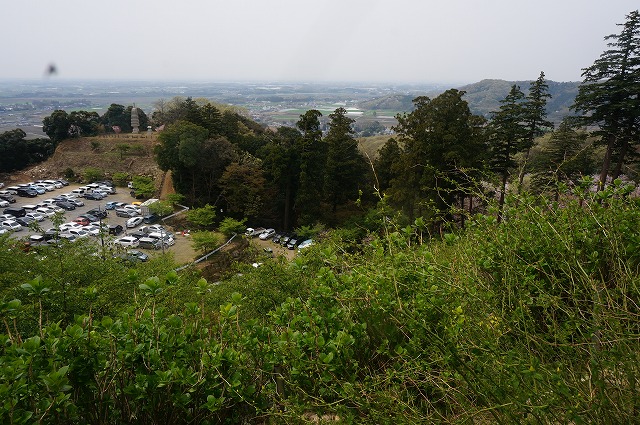
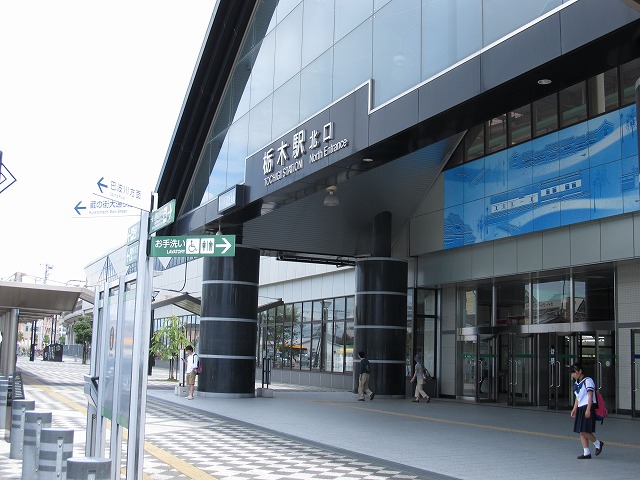
Your journey begins at Tochigi Station. There are several information signs, but here, you’ll start by heading down Main Street.
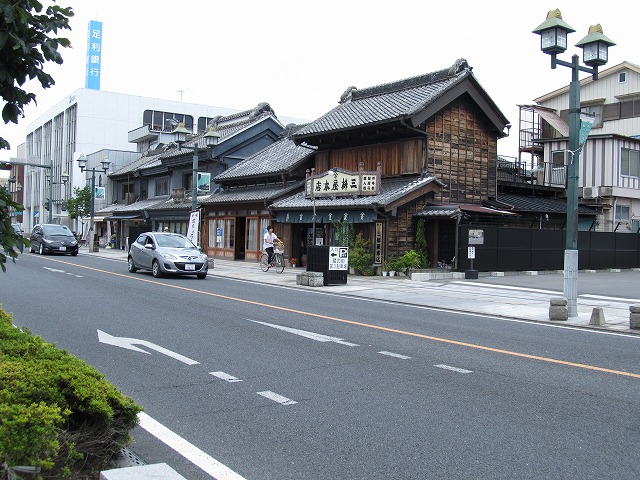
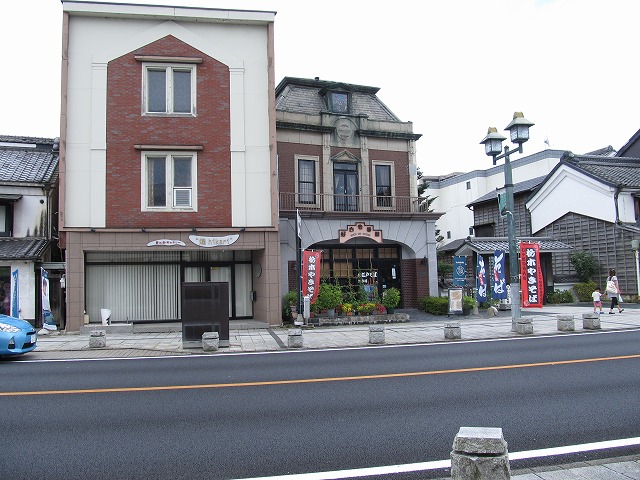
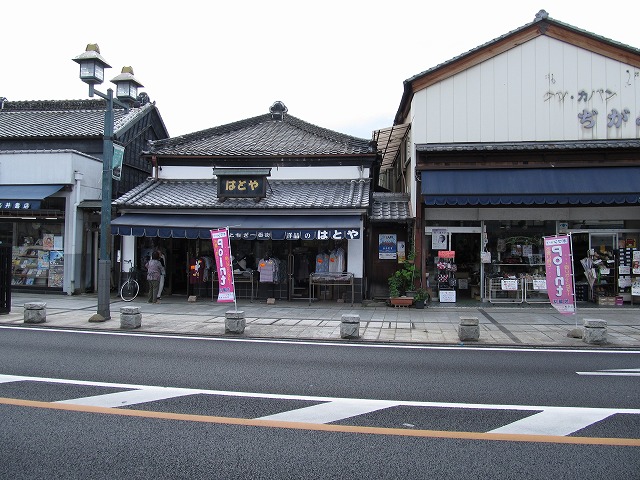
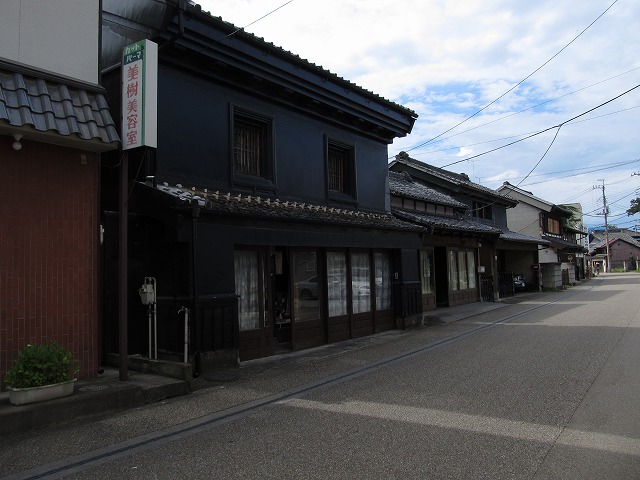
The main street stretching straight from the station looks much like any other street in town. However, if you look closely, you’ll notice that older buildings are scattered among the modern ones.
2. Important Preservation District for Groups of Traditional Buildings
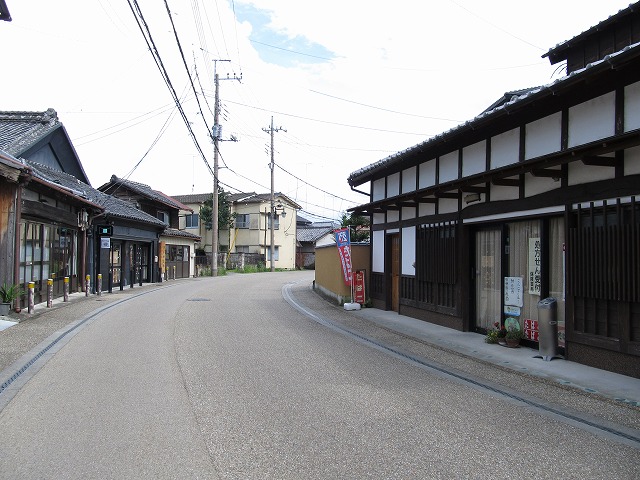
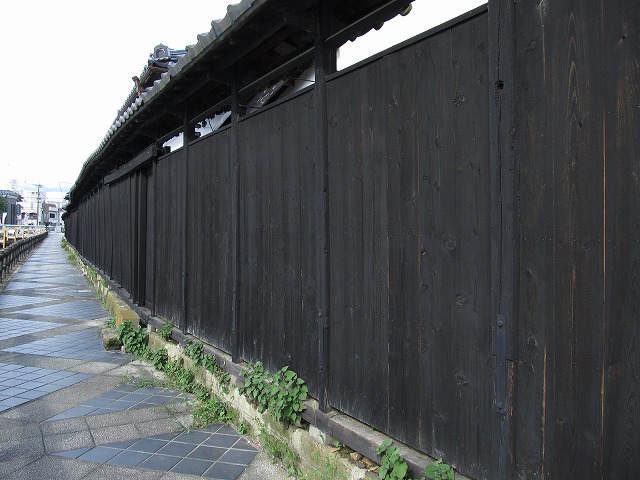
After soaking up the atmosphere of this town of storehouses on Main Street, try walking down the street just past the slight left turn. This is a trace of an old highway that was once maintained for imperial messengers traveling to Nikko. This roadside area is designated as an Important Preservation District for Groups of Traditional Buildings.
After seeing those imposing storehouses, you might feel a little unsatisfied. This is what the Japanese landscape looked like until not too long ago.
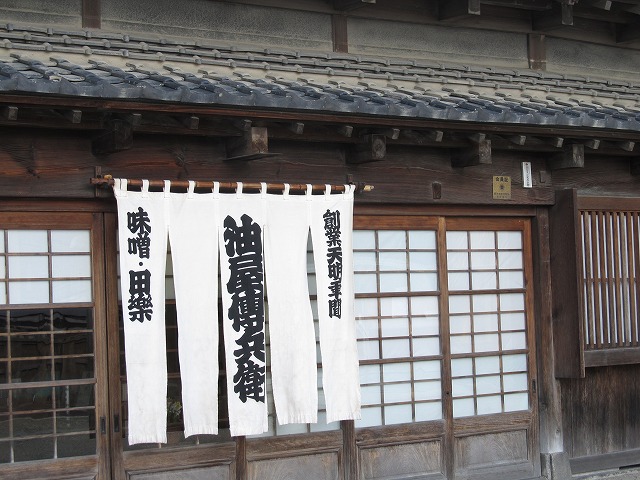
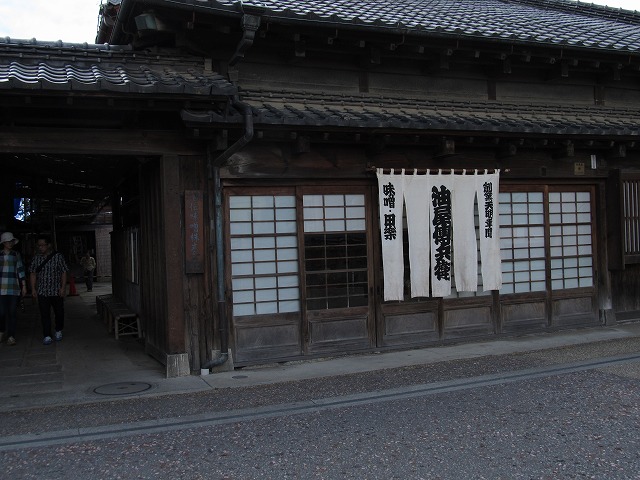
If you come across a shop that has been making and selling miso (味噌 soybean paste) since the late 18th century, turn back. You can also enjoy craft beer and other beverages here, in addition to soybean paste products. official (Japanese) https://abudenmiso.wixsite.com/website
3. Talk about Tochigi, that’s the view
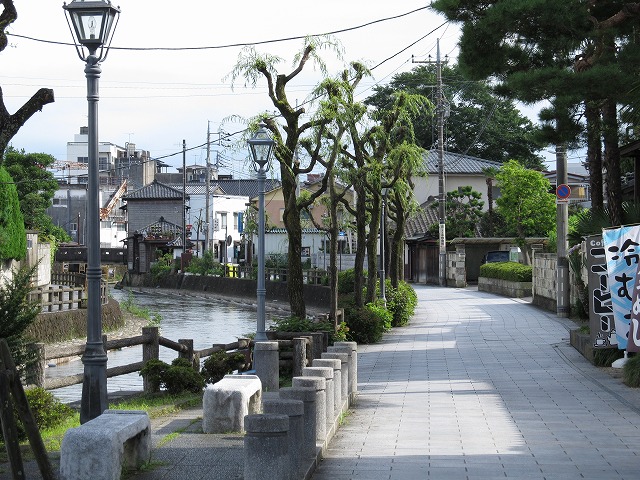
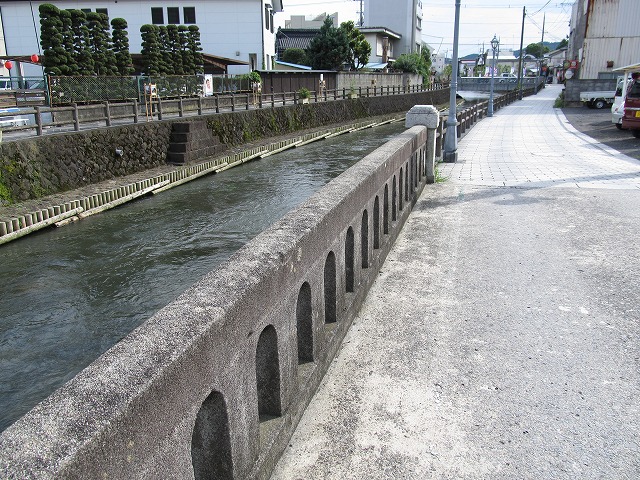
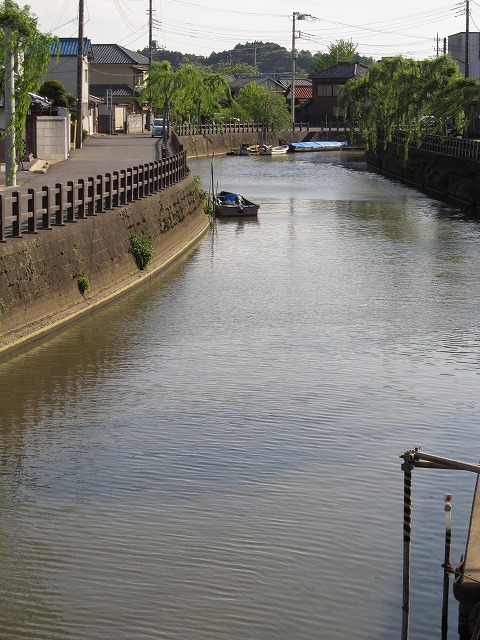
On the way back to the station, instead of taking Main Street, you might want to try the path along the river that runs alongside it. If you stroll along for a while, letting the river breeze blow through you….
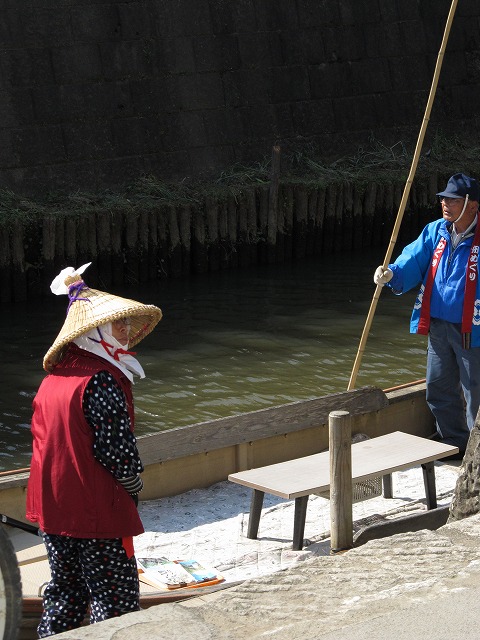
That little song from the boatman has you feeling a little tipsy. If you’re in the mood, it’s also nice to hop on a small boat to clear your head.
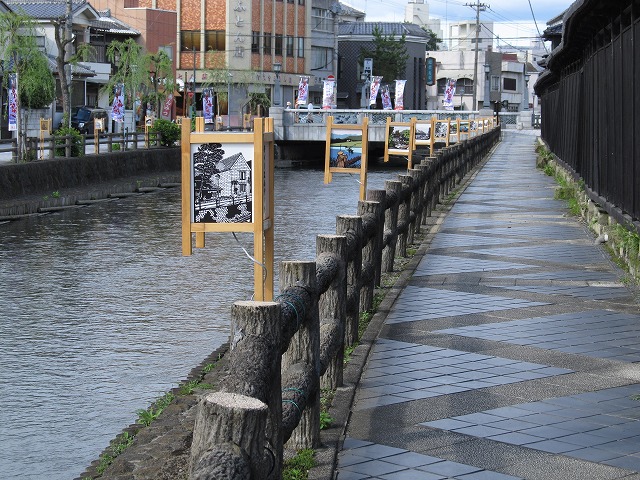
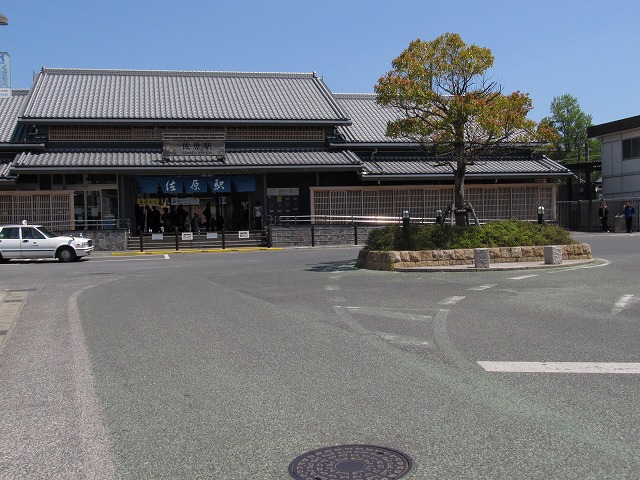
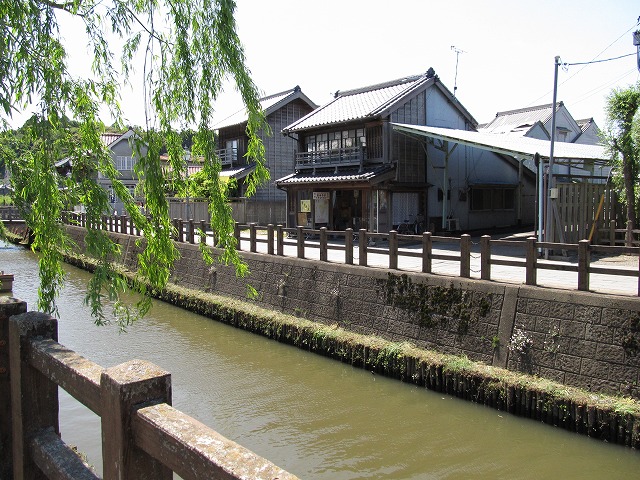
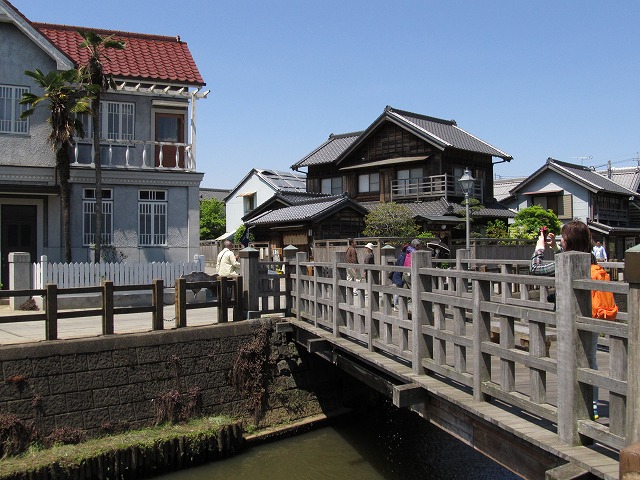
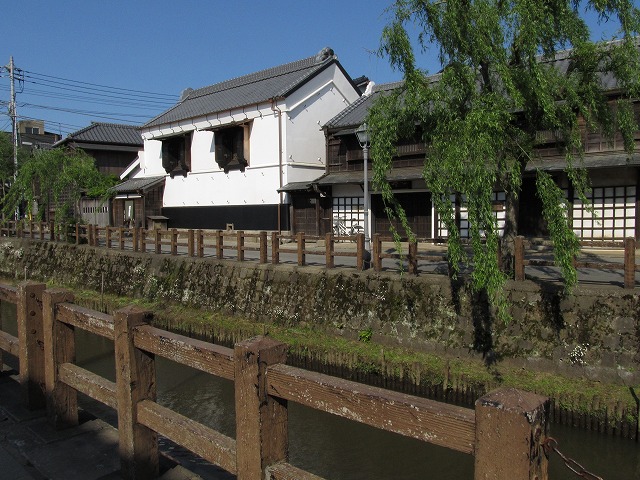
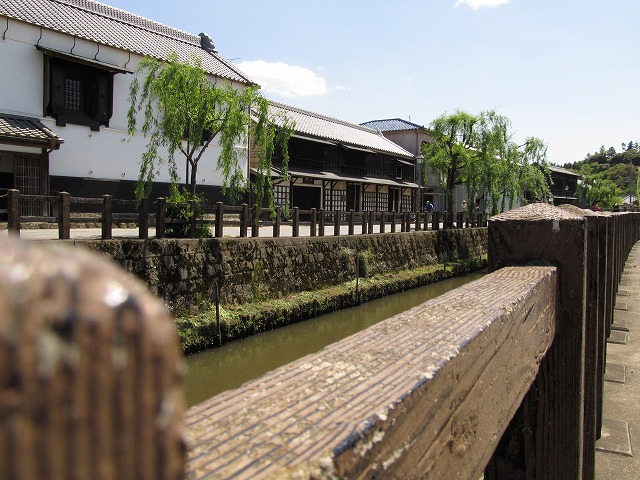
Sawara 佐原 ~old town by the river
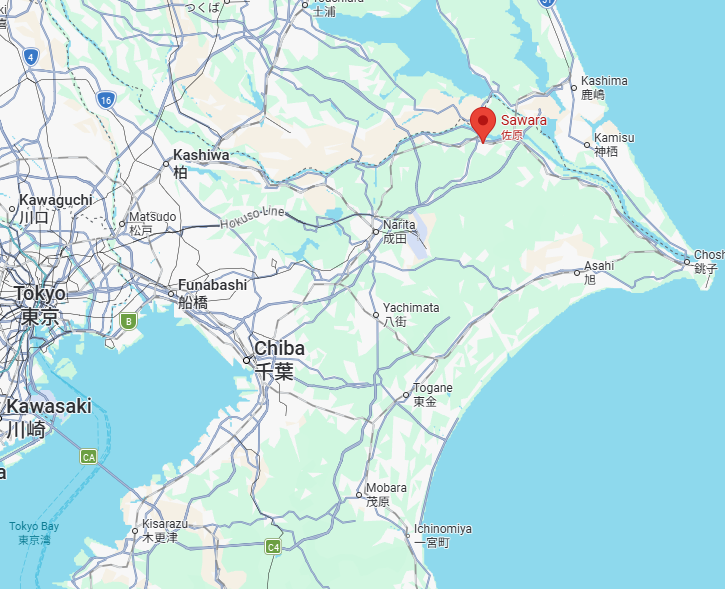
Sawara, Katori City, Chiba Prefecture Access :It takes about 70 minutes by rapid train on the JR Sobu-Narita Line from Tokyo to Narita, and then about 30 minutes on a local train from there. It’s about a 5-minute walk from Keisei Narita Station to JR Narita Station.
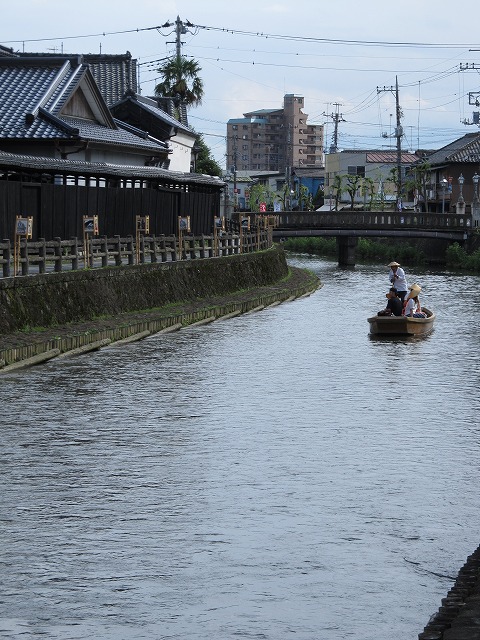
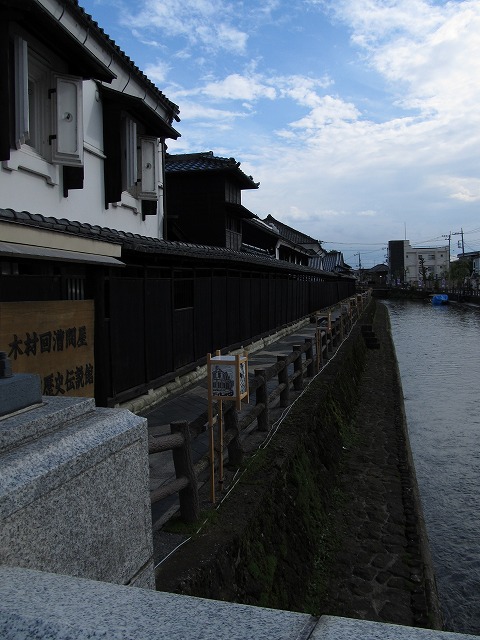
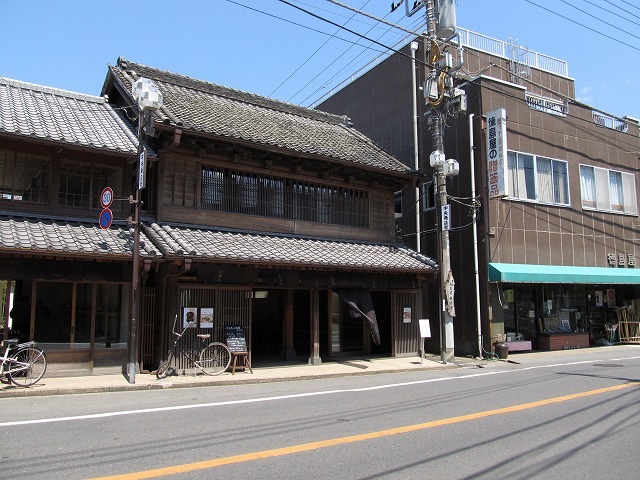
This town has been designated as an Important Preservation District for Groups of Traditional Buildings. It originally flourished as a town near the gates of the nearby Katori Shrine. Later, the town grew in importance as a commercial hub that took advantage of water transportation on the Tone River. At the height of its prosperity, the saying went, “If you want to see Edo, come to Sawara.” Even today, traces of that prosperity can be seen here and there. Official https://www.suigo-sawara.ne.jp/abroad.html?
The tour starts at JR Sawara Station. You can get information at the tourist information center in front of the station. Bicycle rentals are also available.
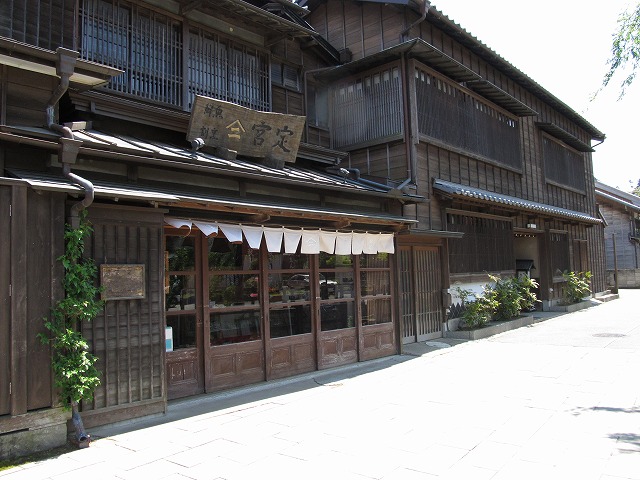
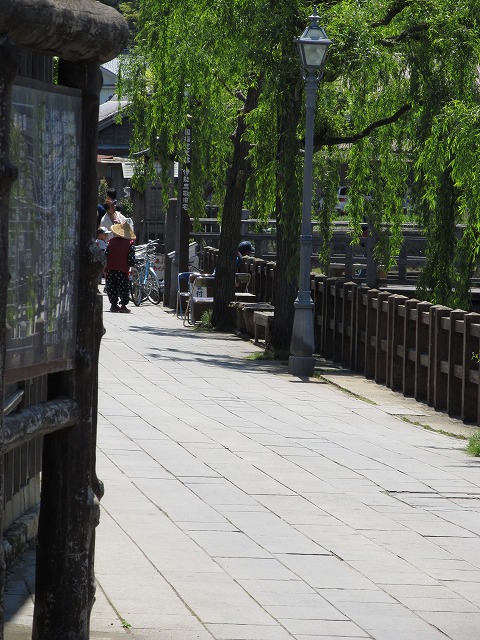
The highlight of this town is the row of houses lining the Onogawa River. However, the area along the road leading there is also lined with plenty of old buildings.
You can also take a sightseeing boat tour along the river.
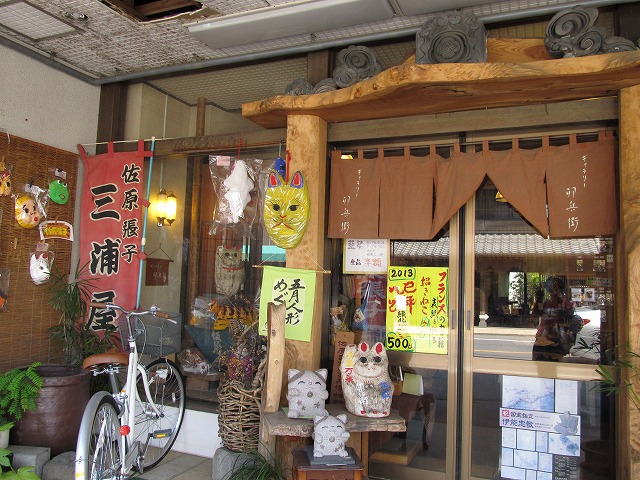
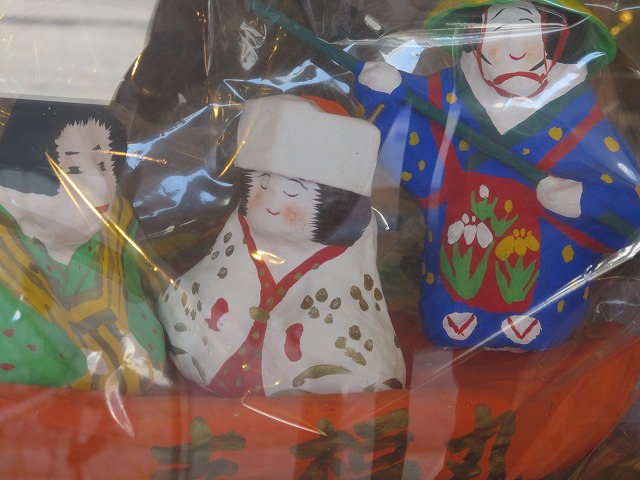
A cute handmade paper-mache doll might make a nice souvenir.
You should definitely make a short detour to visit Katori Shrine. Along with neighboring Kashima Shrine, it enshrines the god of martial arts. Together with Ise Shrine, it is one of the most prestigious shrines in Japan. It takes about 30 minutes to walk from JR Katori Station, so it’s best to take a bus or taxi from Sawara. Buses run about once an hour. The ride takes about 10 to 15 minutes.
If you’re visiting in June, you can’t miss the Irises Park in Itako. Shuttle buses run from Sawara Station during the Ayame Festival. Chiba prefecture site https://www.visitchiba.jp/things/ayame-park/
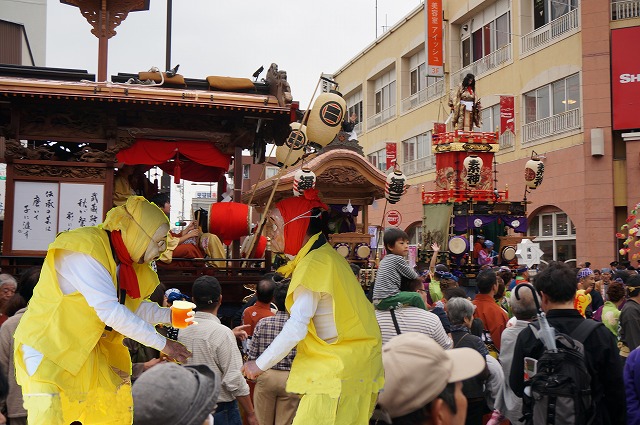
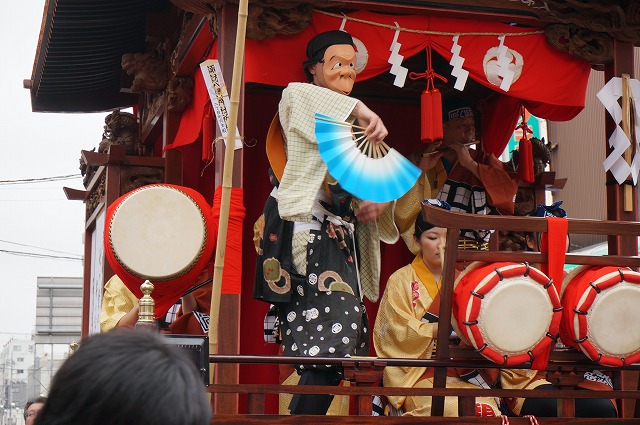
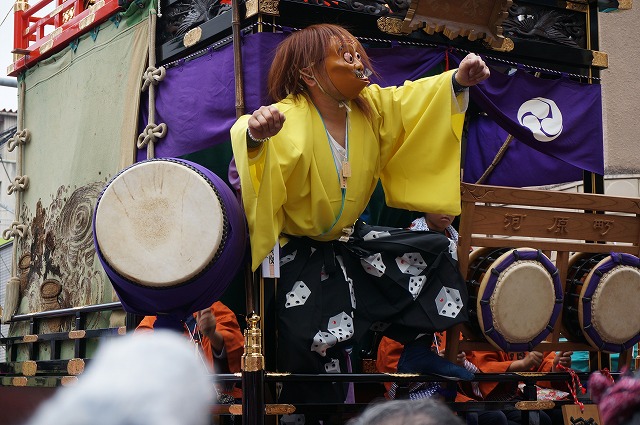
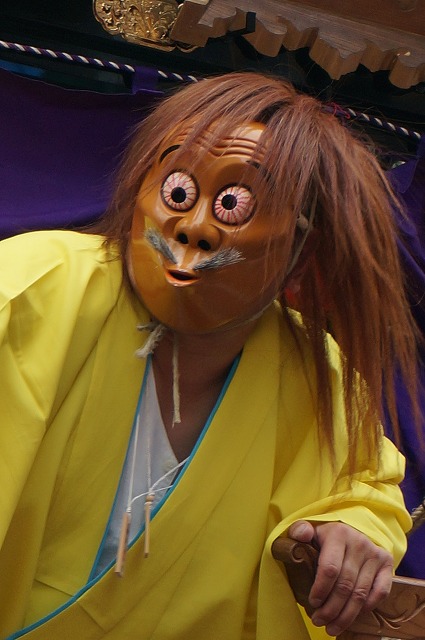
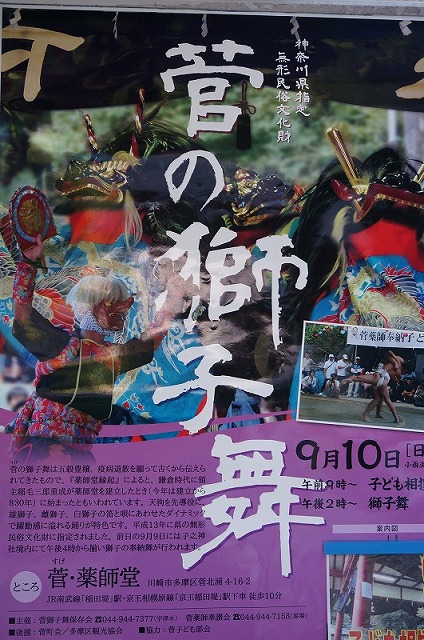
The Lion(Shishi) play dice exposition? ~The lion dance at Suge
When people hear the term “traditional performing arts,” many tend to shy away from them, imagining them to be stuffy and formal. However, they were originally a form of entertainment for people in the past. Naturally, they have evolved over time to better engage their audiences. For this reason, it is not merely a dance; it incorporates various narrative elements. A classic example is the story of two lions competing for a single female. However, here in the Suga district, it is said that tengu and lions drink sake and play dice. Apparently, this is an extremely rare performance even on a national scale. Yet it was imbued with the sentiments of people passed down through the ages.
Date: Sunday close to September 12 Location: Suge Yakushido, 4-16-2 Suga Kitaura, Tama-ku, Kawasaki-city, Kanagawa, Japan Access: 10 minutes walk from Inadazutsumi Station on JR or Keio Line.
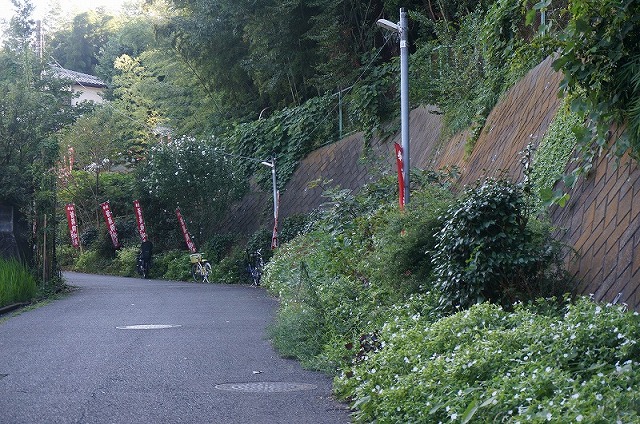
Inada-zutsumi can be reached in 4 or 50 minutes from Shinjuku, Tokyo. Despite its proximity, the Tama River flows nearby, and there is even a promenade for forest bathing in the surrounding area. Nice place to live. The area in front of the station is bustling, but the slope leading up to Yakushido, where today’s event will take place, is a short hike away from the hustle and bustle of the city. The event started at 2:00 p.m., but the grounds were quite crowded, and spectators crowded around the ring, which served as the stage for the event. The reason for this is that a children’s sumo tournament is always held before the lion dance.
A tengu comes rushing in
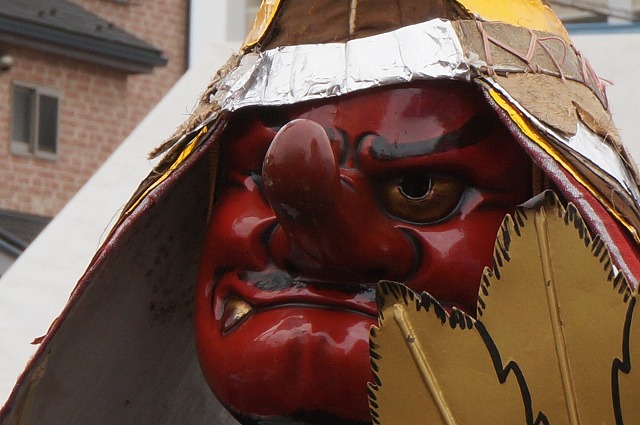
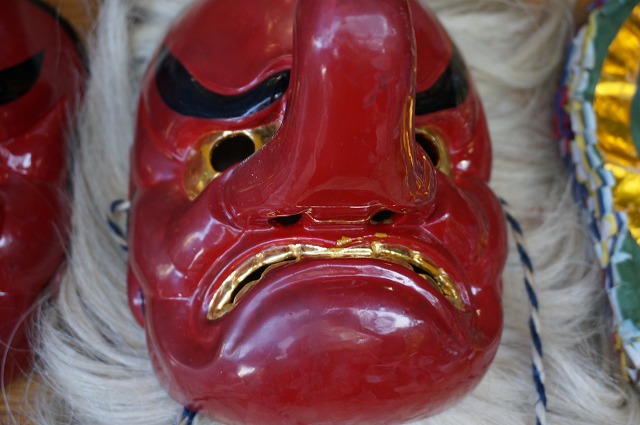
When the time comes, the lions, the stars of the show, arrive to the accompaniment of a slightly sad melody. First of all, a tengu (a kind of long-nosed goblin) jumps into the ring on the stage with great energy. The tengu then repeats this action three times. He comes in, goes back out, and then again. As one would expect, after repeating it three times, the tengu gets tired of it, but on the third time, it scatters confetti. The bright colors of the confetti are a brilliant performance that catches the audience by surprise.
And the lions are coming too
Following the tengu, the lions enter. The tengu welcomes them. In this case, the tengu plays a roll called sakibar先払い, which means to purify the place for the lions, the main performers, and to announce the appearance of them.
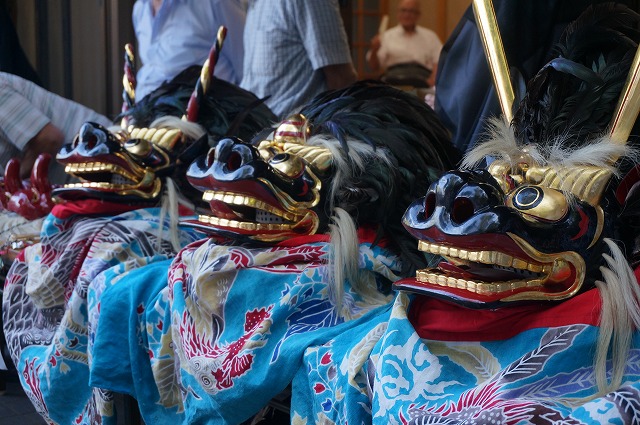
From left to right: “Kyujishi”, “Mejishi”, “Ojishi”.
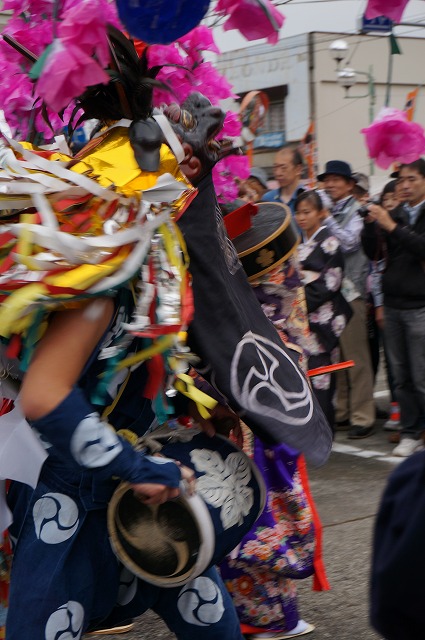
The lions dressed in bright blue, patterned curtains, and their manes are magnificent. The main “ojishi 雄獅子” has gold horns, while the “kyujishi 臼獅子” has red and black twisted horns. And “mejishi 雌獅子” has no horns. It is a typical form of the three lion dances.
The lions here have many strenuous movements that involve standing and sitting on their feet and legs. The lion’s head and drums together weigh about 6.5 kg. It is not hard to imagine how hard it must be to dance with the lion’s head on while the summer heat still lingers, even in September. The reservationists say that only the young people can perform this kind of work. Therefore, daily promotional activities, such as visiting elementary schools and other places to teach lion dance, are essential. Fortunately, there seem to be enough children to hold children’s sumo tournaments, so there seems to be no problem with successors.
Incidentally, the lion dance first appeared in literature in the early 12th century. However, after a period of interruption, it was revived in its present form in the late 18th century and continues to be performed today.
The Tengu proposes a game of dice to the lions
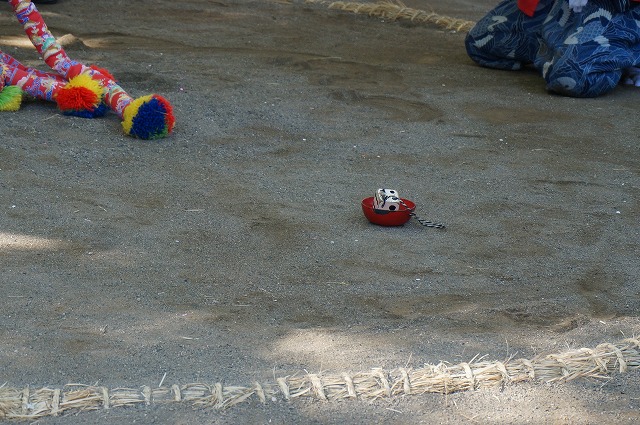
Then comes a rare scene rarely seen in ordinary lion dances. The lions sit in a circle. The tengu then offers them dice. In short, the tengu proposes to play a gambling game with the dice. In fact, this tengu is a man of mischief, gambling, and drinking.
An ill-advised Tengu is punished by the lion he tricked
This is followed by the well-known performance “Mejishi kakushi” (Mejishi hiding), which is a little different from the others. The usual presentation of this performance is that the female lioness disappears and the two lions search for her, and the lioness who finds her first tries to monopolize her, which happens.Here, however, the Mejishi (female lioness) is set as the wife of the Ojishi (male lion). It begins with a tengu doing something wrong and hiding the female lioness from the Ojishi. Then the Ojishi, misunderstanding the situation, starts taking it out on the Kyujishi, and they start a fight.
Naturally, in the end, the lions realize that they have misunderstood and punish the tengu to the hilt. In any case, the tengu is a rare villain here.
Nevertheless, they are working so hard that the lion dance would not be possible without the efforts of these tengu. They were drenched in sweat as they were applauded at the end. Please take a look at this unusual lion dance.
Ending
Kanagawa Prefecture, next to Tokyo, is as small in area as Tokyo, but its population is the second largest, surpassing the regional centers of Osaka and Aichi. More than 30 million in Yokohama, the prefectural capital. The neighboring city of Kawasaki, the area of this report, has a population of 15 million. Even though it is a bit out of the center of the city, it is surprising how the lion dance has been handed down in such a place.
That said, a shortage of successors remains a problem even in areas like this. To address this, the person in charge explains that they have been raising awareness among elementary school students, and as a result, quite a few young people are now stepping up to take on the role.
They also reportedly lifted several restrictions. One of these was the rule that only the eldest son could perform. However, they retained the tradition of all members passing the torch at the same time. They are, after all, the friends who created this lion dance together. That bond will likely last a lifetime. The lion dance carries with it the sentiments of those who came before us and of the people who carry on the tradition today.
Discover the Rich History of Ashikaga’s Kagura Tradition
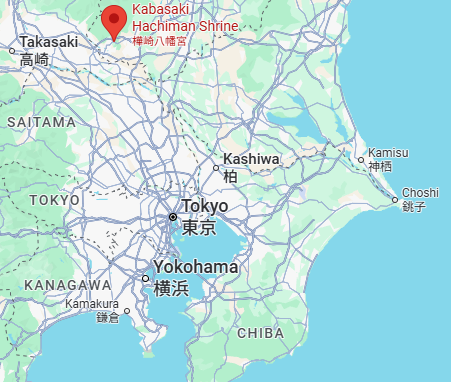
Location; 1723 Kabasaki-cho, Ashikaga City, Tochigi Prefecture
Date; the third Sunday in April and October
Access;It takes about two hours by local train from Tokyo to Ashikaga (JR) or Ashikaga City (Tobu Line). If travelling by Shinkansen, you will need to change at Takasaki. Approximately 6 km from Ashikaga, or Ashikaga Station.
In brief, the history of Japan is that rice cultivation gave rise to large-scale political forces in various parts of the country, which eventually came together in armed struggle to form one united government. These are the ancestors of the present-day Emperors. Thereafter, a long period of political rule centred on the emperor, with influential aristocrats gathered around him. They stayed in the capital cities of Nara and Kyoto, and maintained power by siphoning off revenues from their local fiefdoms. but the territory is limited. Ownership disputes and other conflicts began to arise between neighbouring lands. The nobles then had their armed men settle the disputes. The armed forces rapidly became powerful. They were the samurai. Eventually, the samurai moved into the centre of power, eventually creating their own government in Kanto (Kamakura), far from Kyoto. At the centre at this time was the Hojo clan, who seized power by destroying other clans like a Mafia war. This period lasted for about 150 years. However, the number of people dissatisfied with the Hojo clan potentially increased, leading them to overthrow the Hojo regime and create a new one in Kyoto. The Ashikaga clan was central at this time and became shoguns in the new regime. Eventually, Ashikaga’s power waned and an era of divided warlords dawned; Japan was ultimately reunified by the Tokugawa shogun, but that is a story for another time.
The Ashikaga clan’s home town is now Ashikaga City. The kagura presented here takes place in a town with such a historical background.
Kabasaki Hatiman shrine
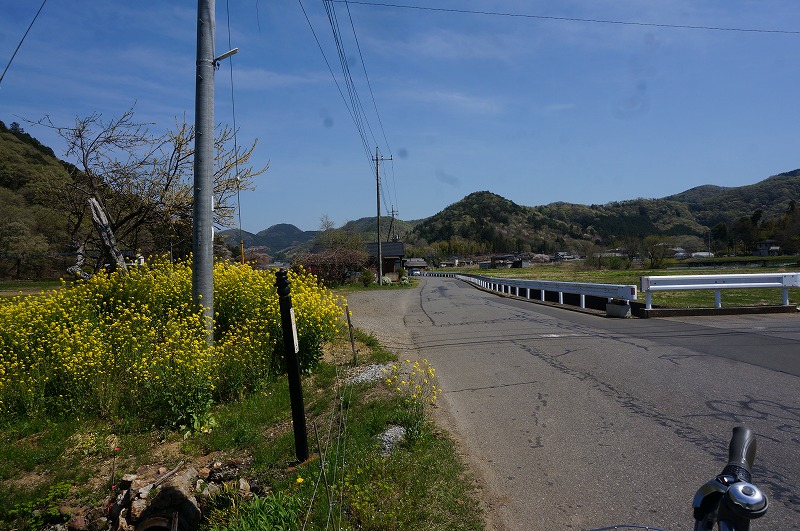
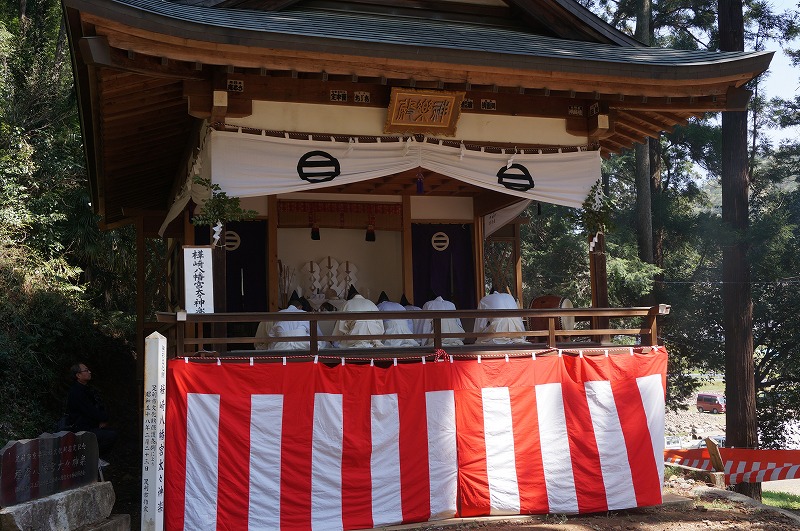
The Kabasaki Hachimangu shrine, where the story takes place, was founded by the Ashikaga clan. As proof, the shrine has a curtain with the Ashikaga family crest on it. This report is about the kagura performed here. It is a bit far from the station, so It is therefore a good idea to hire a bike at the station. The road is flat and straight. It is easy to find. About 45 minutes on a bicycle. The area is away from the city center and the scenery is much more idyllic. Kagura is also loosely in tune with the landscape. It was scheduled to start at 10.00 am, but actually started at around 10.30 am.
The Appearance of the Hachiman Deity
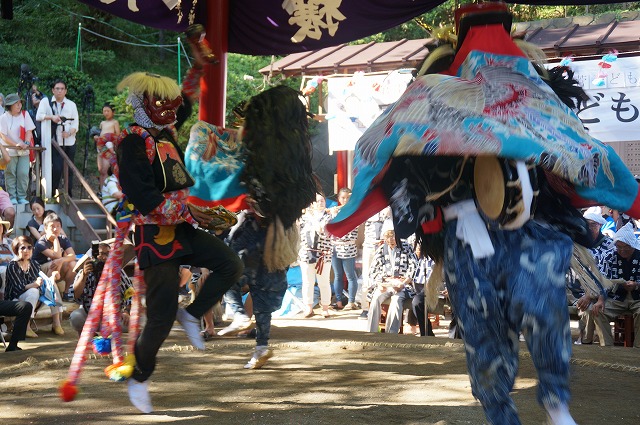
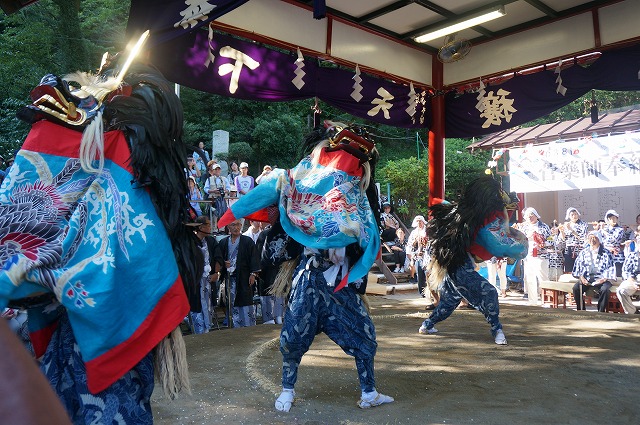
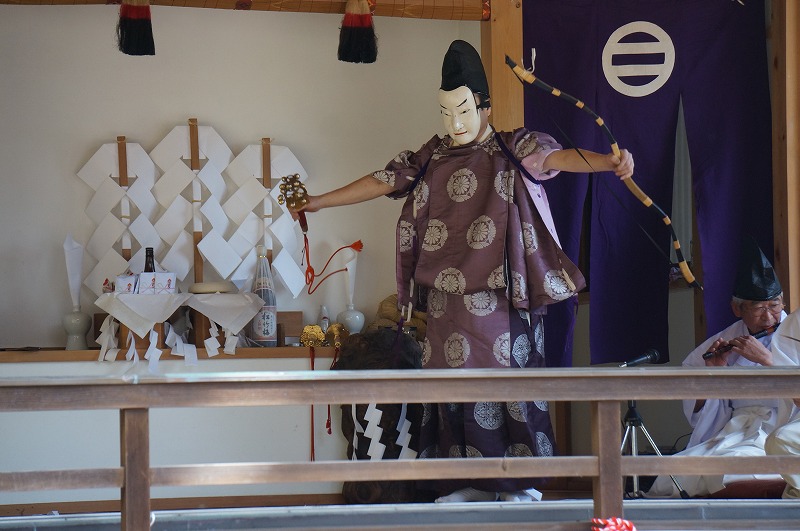
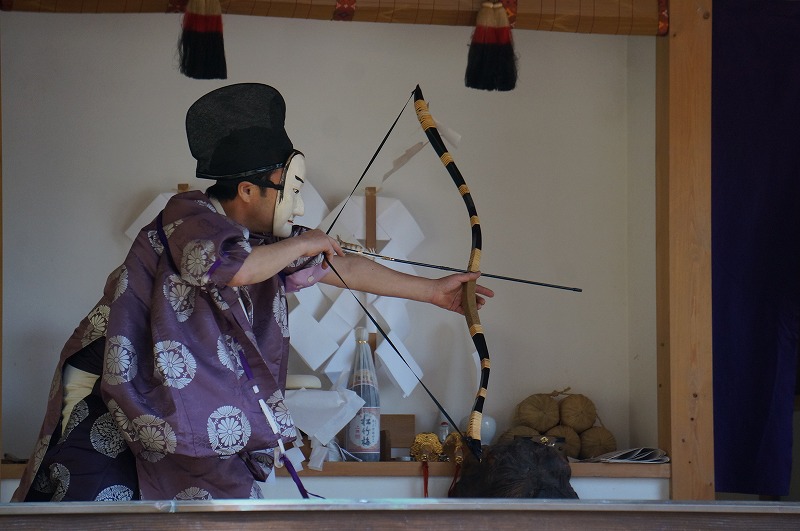
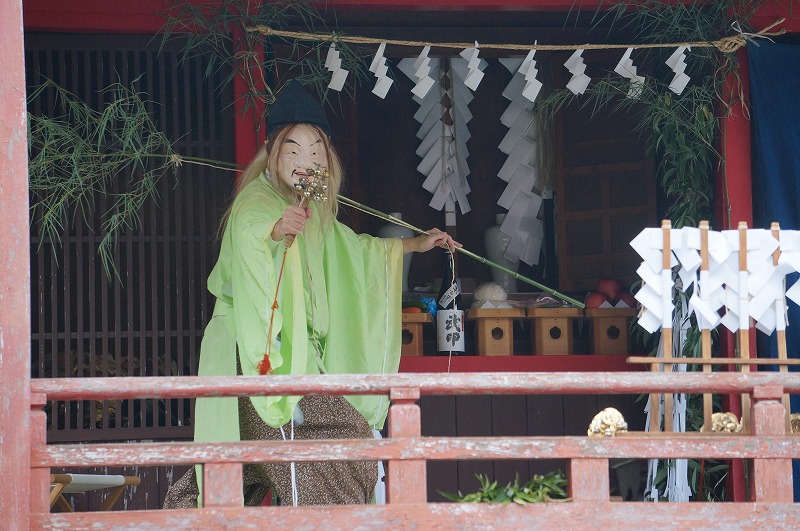
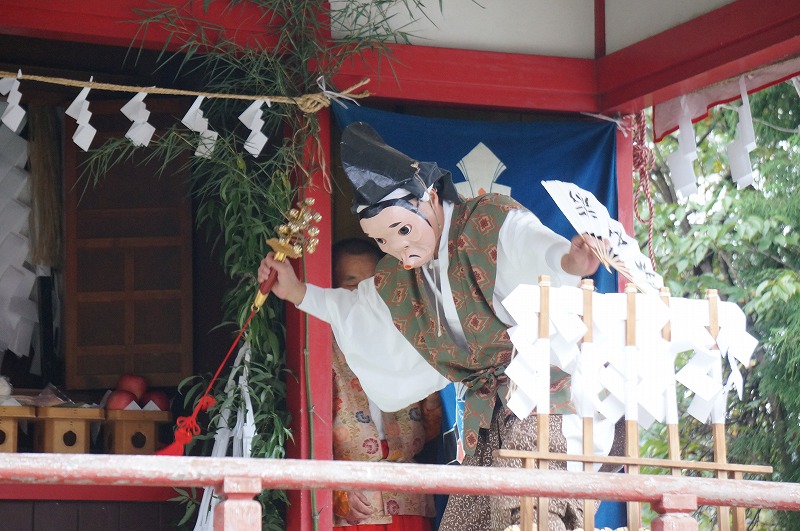
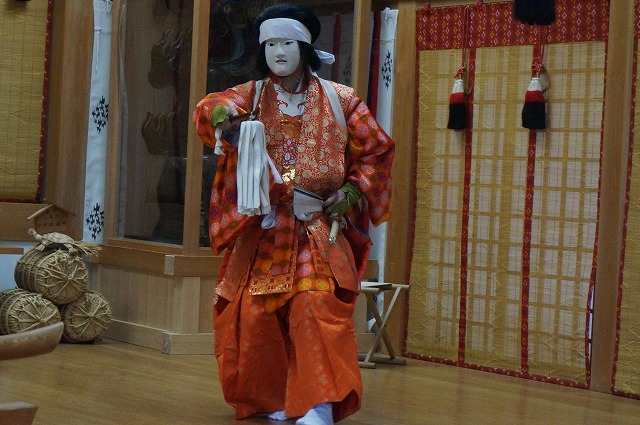
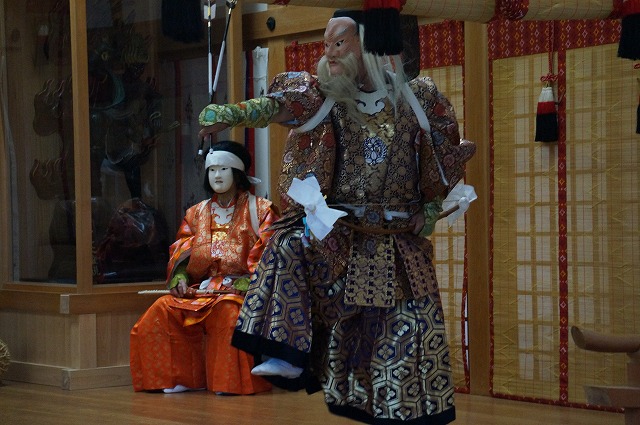
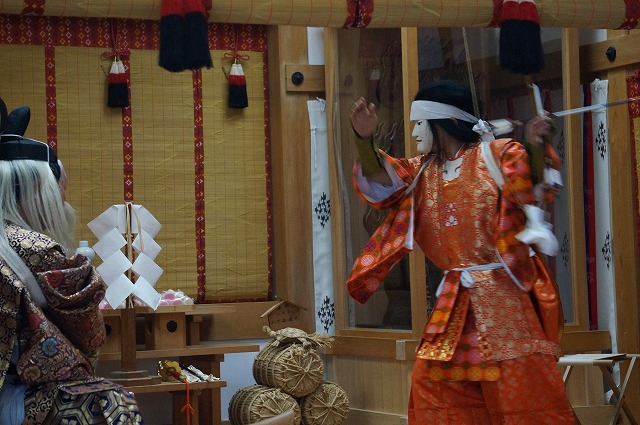
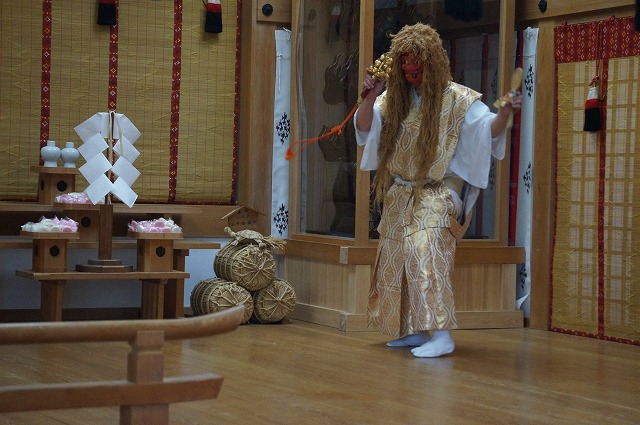
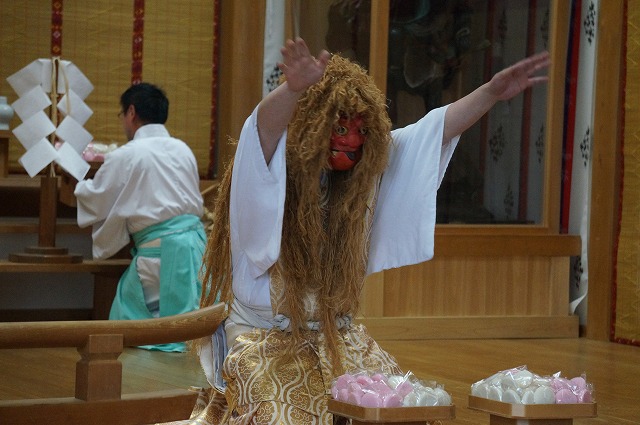
First, one program without a mask. After that was the dance of the god of war, Hachiman. As befits a god of war, he takes his bow and arrow and points it in all directions. This is not to glorify warfare, but to drive away the bad spirits that lurk in the area. He protects shrines, villages and people.
Lunch break here. The locals sold Yakisoba noodles the area for 100 yen. They are almost all volunteers. Cheap. That’s why they sell so well. The shrine is said to be associated with the Ashikaga clan, but it is plain for a family that once ruled the country (from the early 14th century to the 16th century). It is said to have originally been larger and grander, but declined as the Ashikaga regime fell. However, the decoration is fine. There was a person who told me many details, and I thought he was a local historian, but to my surprise he was a descendant of the Ashikaga clan. There are many things that can only be understood by actually going there.
After lunch
The next step is the famous opening of Ama-no-Iwato (the rock door inheaven), where the main actors are Ameno-uzume, Tajikarao and Amaterasu… Ameno-uzume only performs a short dance, and Amaterasu leaves the stage just as soon as she appears. In the end, only Tajikarao was the only prominent performer in the troupe. As village people handed down kagura, They probably omitted more and more parts that were not relevant to real life and Kagura gradually changes to a form more suited to the locality. The story of Amaterasu is important as Japanese mythology, but not so much for the people.
Let’s keep it casual and take it easy
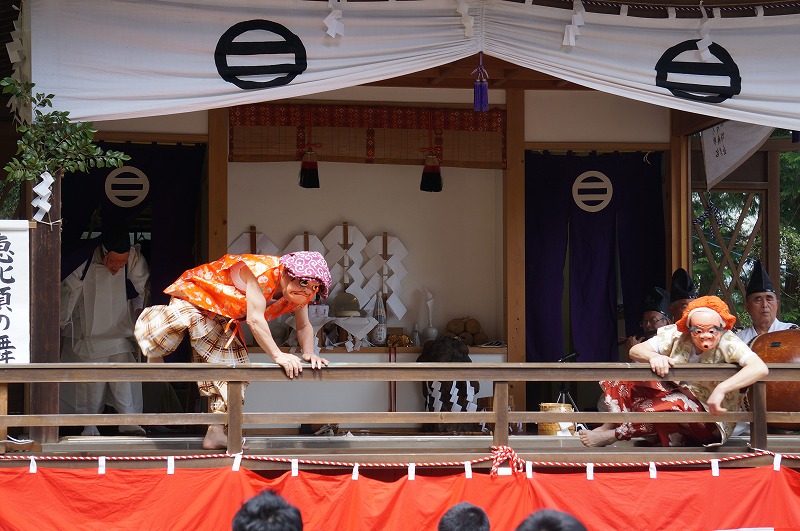
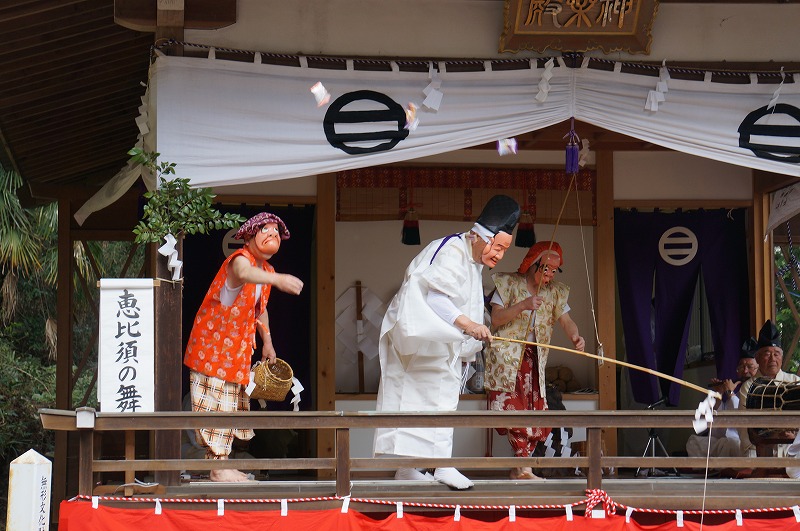
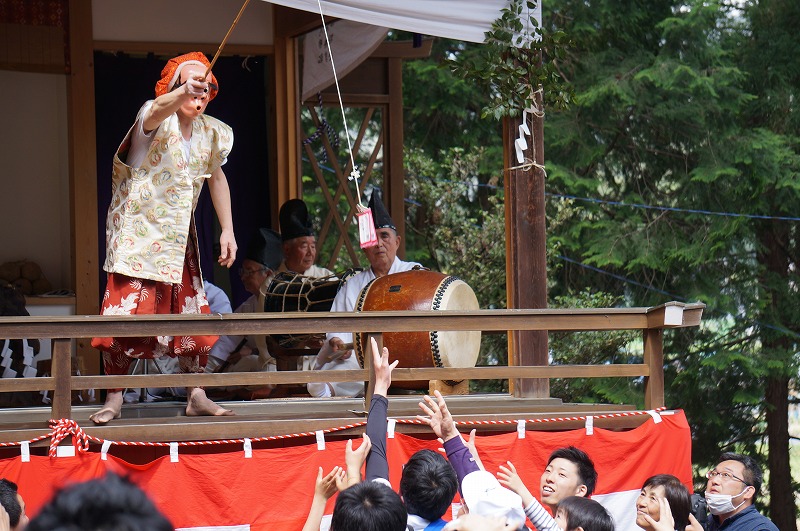
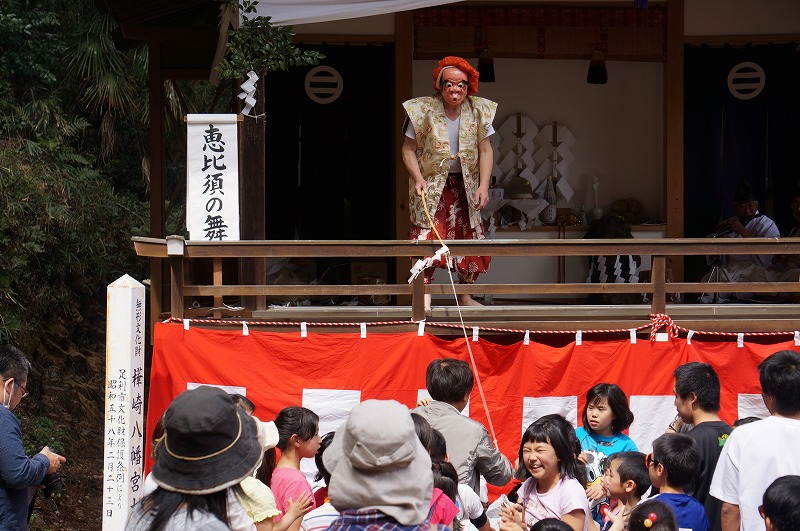
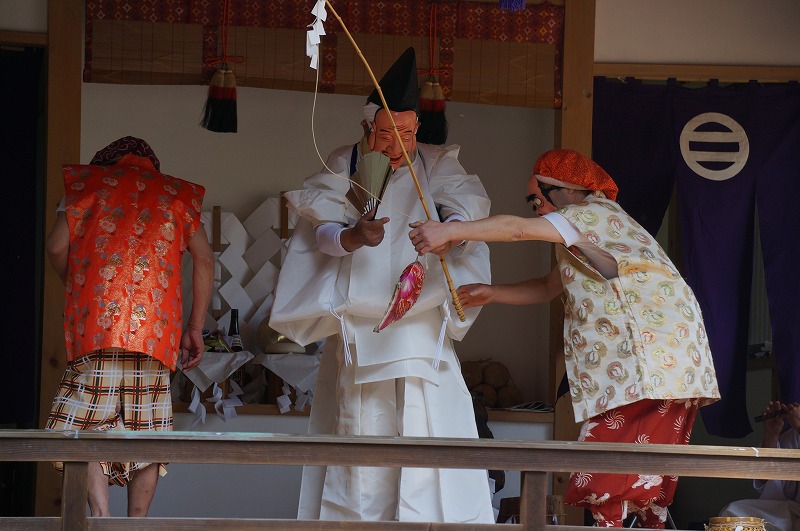
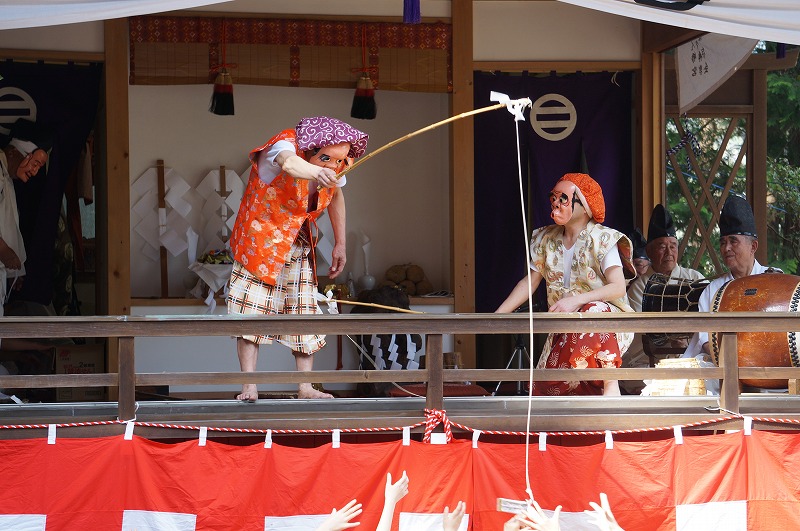
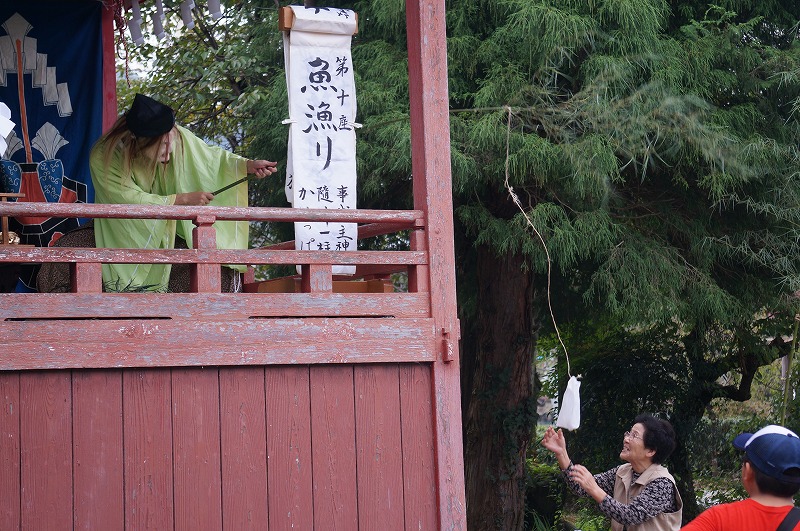
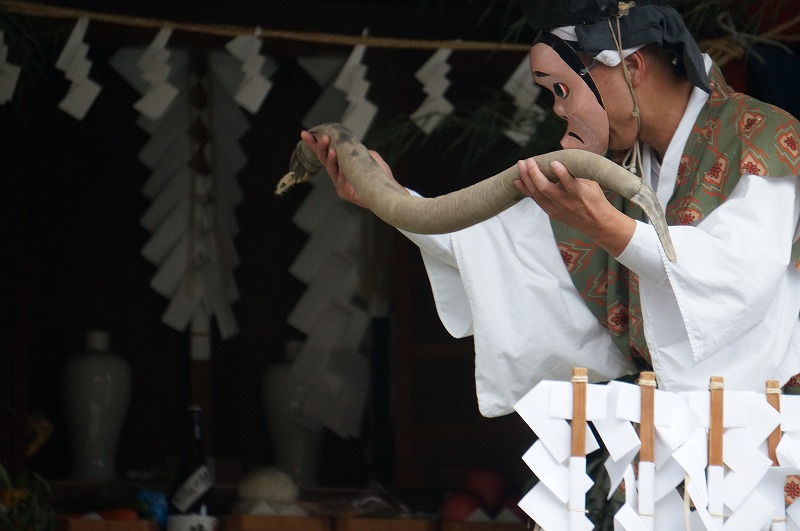
And finally, the common people’s group appears. In case , the god Ebisu (this god represents the common people’s group) is the star of the performance. Seven gods that common people have believed in since the Middle Ages. All of them bring happiness to people. Ebisu is one of the most popular among them. That is why Ebisu plays such an important role in this kind of kagura in the village. But in reality, the main attraction is a droll duo. So, these two people fish on behalf of Ebisu and throw snacks and treats. Many children gather, but for them, this is almost the main thing. That’s why it’s a big deal. But if you look closely, they don’t keep it to themselves. Is this another merit of God?
Next to Ebisu comes a deity named Daikoku, who is as popular as he is. He is able to bring forth treasures by waving a mallet in his hand. So here is another big treat of sweets.
Next is Inari, another indispensable deity in the kagura of the village. Inari is the god of rice cultivation in general, and is served by a fox. However, in terms of order, they usually appear earlier. The audience is already in the mood for sweets, so they put rice cultivation aside and start scattering rice again. Since it is kagura, they dance on stage, but people’s attention has already turned to when they are going to throw things.
The stage is now in full “Mochi-nage (Originally, the name was derived from the throwing of rice cakes. Nowadays, various throws such as snacks or candy)” mode. The Ebisuza has begun again. Exactly the same program, exactly the same flow. This happens sometimes in kagura in the village.
Happiness for everyone
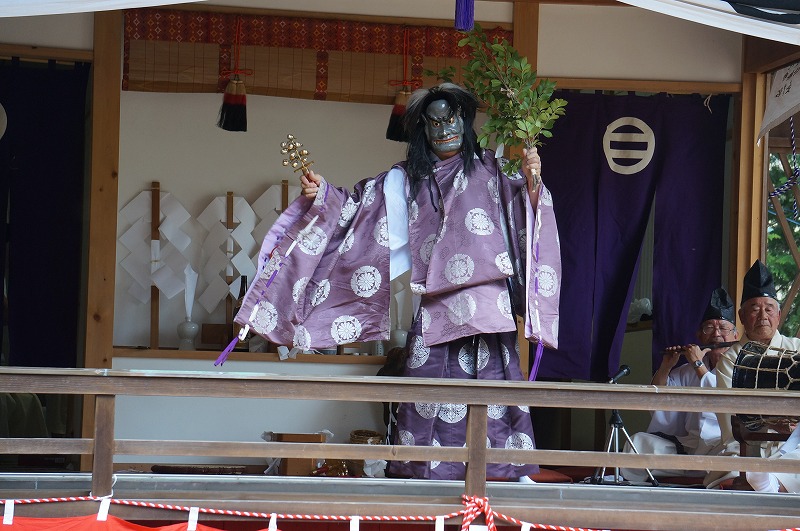
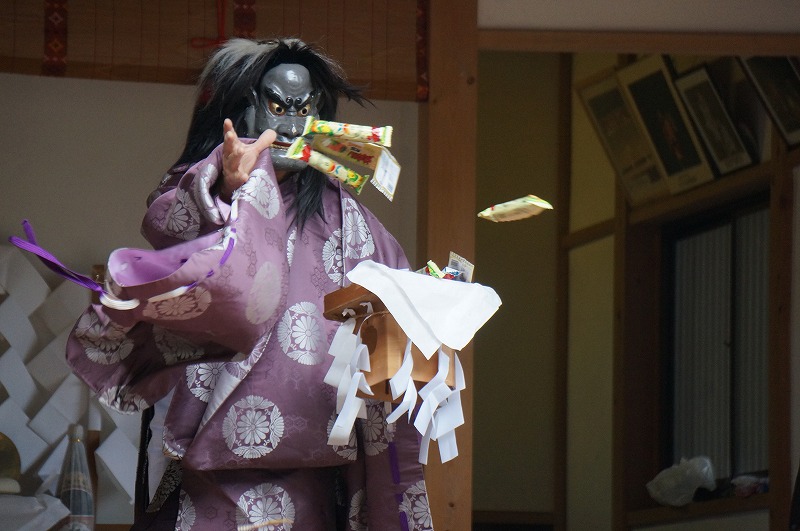
The performance ends with a purification of the stage by a mountain god called “Yama-gami” (mountain god). However, to the surprise of the audience, even the mountain deity do Mochi-nage. It is a great service. The people who had stayed until the very end were very satisfied. Good things come to those who wait. This is how kagura continues into the next year.
The lot of an employee is a hard one~Enjoy the rustic kagura at Titibu village .
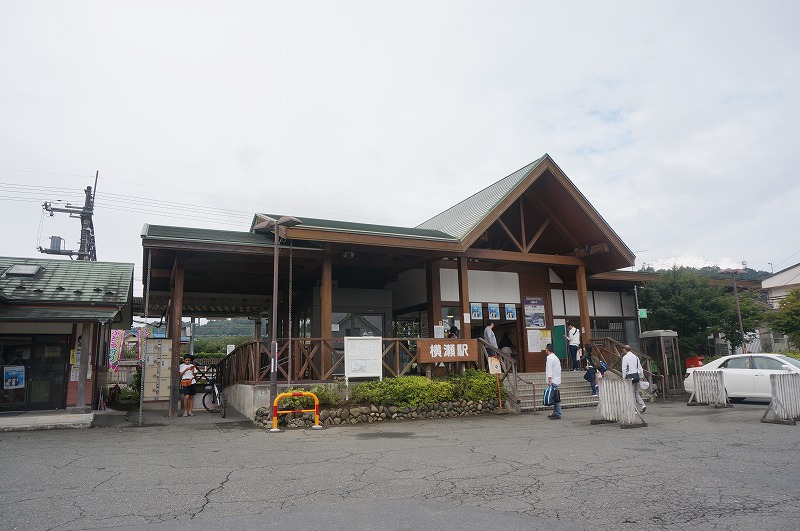
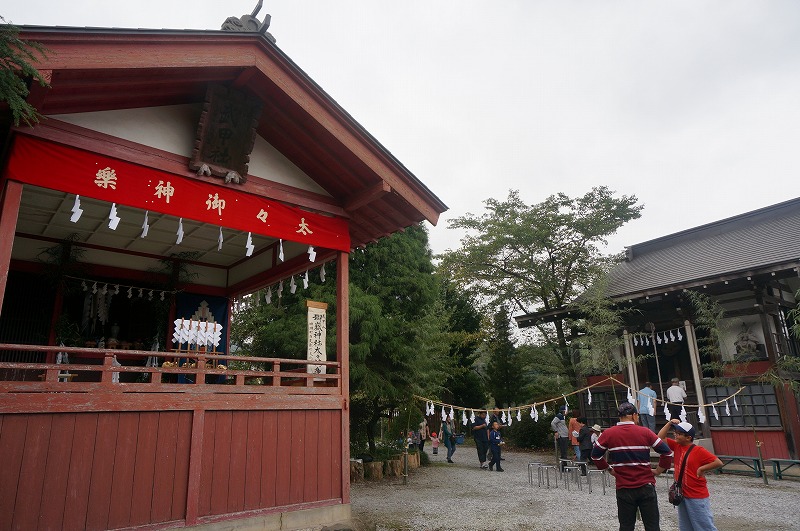
Date: 15 April and 1 October every year Location: 649 Oaza Yokose, Yokose-cho, Chichibu, Saitama, Japan Access: Take Seibu Ikebukuro Line, change at Hanno 飯能 and walk 20 minutes from Yokose 横瀬 on Chichibu Line. It takes about one hour from Tokyo to Hanno, transferring at Ikebukuro 池袋.
*This article is based on October 1, 2016.
Prologue
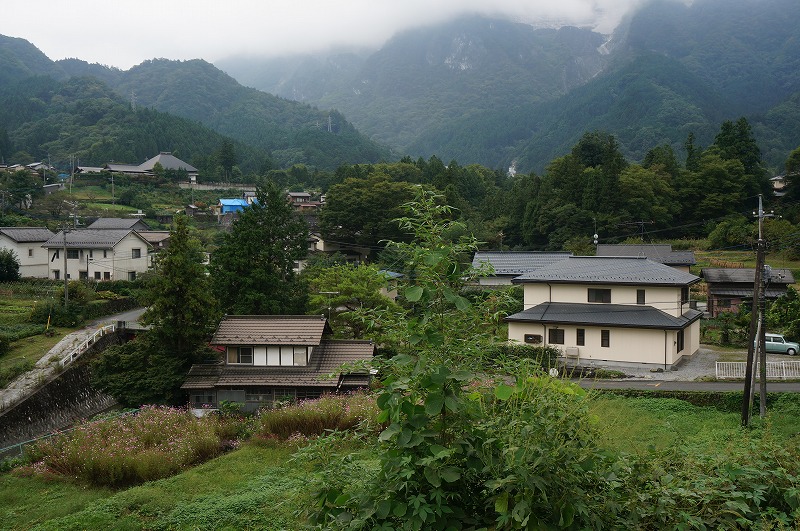
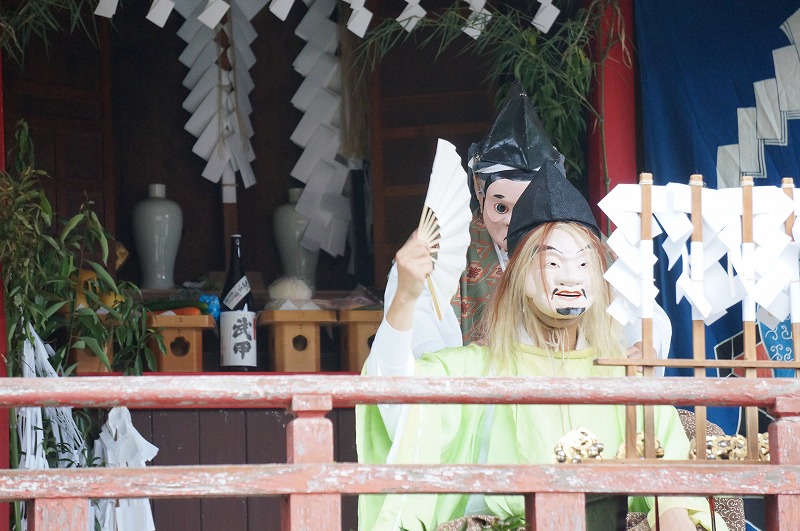
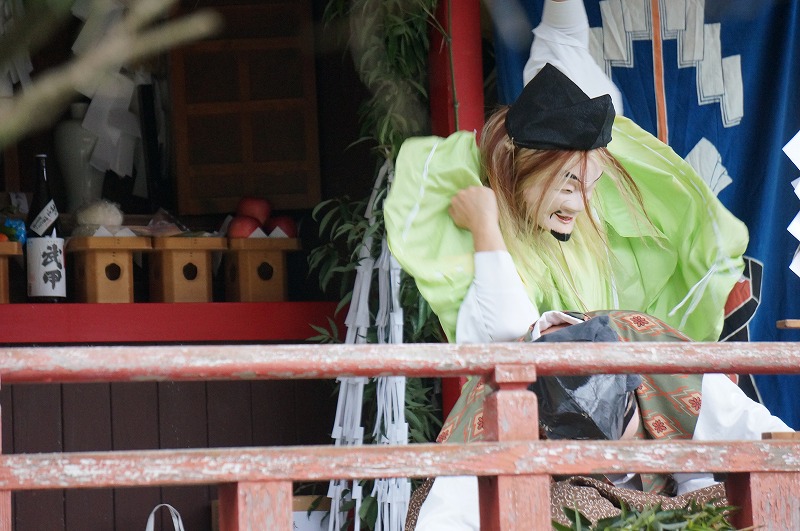
The kagura introduced here is typical Kanto kagura, which has been handed down to the villagers. It takes about two and a half hours by train from Tokyo. In addition, it is a mountain village about 20 minutes’ walk away. Even at the tourist information centre near the station, nobody knows anything about Kagura. All they have is trekking information. Nearby is a mountain called Mt Buko 武甲山. This is a lime mining site and there are a number of cement factories dotted nearby. Kagura has been passed down quietly in such places. The first half is a ritualistic dance based on mythology. The second half gradually becomes more informal in a typical style that is more accessible to the common people.
Start
Although the start time is 10.00 am, a priestly ceremony takes place from 10.00 am. This lasts for less than an hour. Then, at around 11:00, it finally begins somewhat as everyone settles into place. This looseness is one of the good things about the Sato 里 (village) kagura.
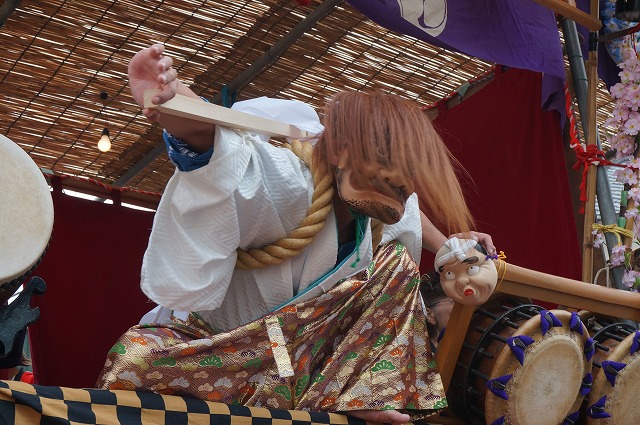
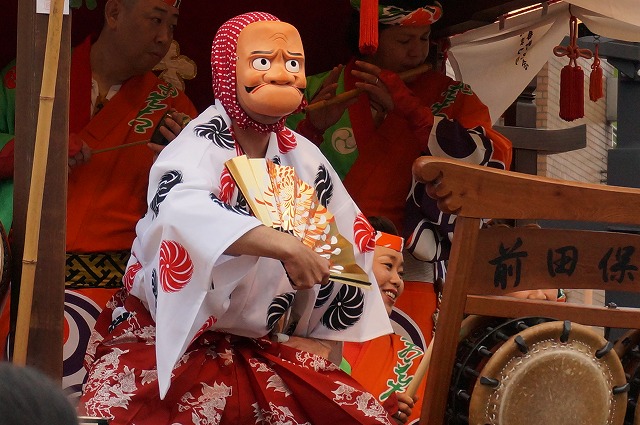
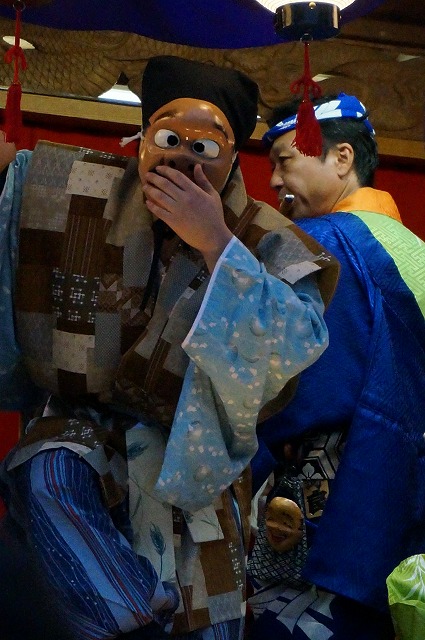
The first stage begins with a purification dance on the stage. This is followed by a dance without masks, and then the masks of the old men appear. The Okina 翁 (old man) mask has a special aspect that is treated as a sacred mask in Noh plays.
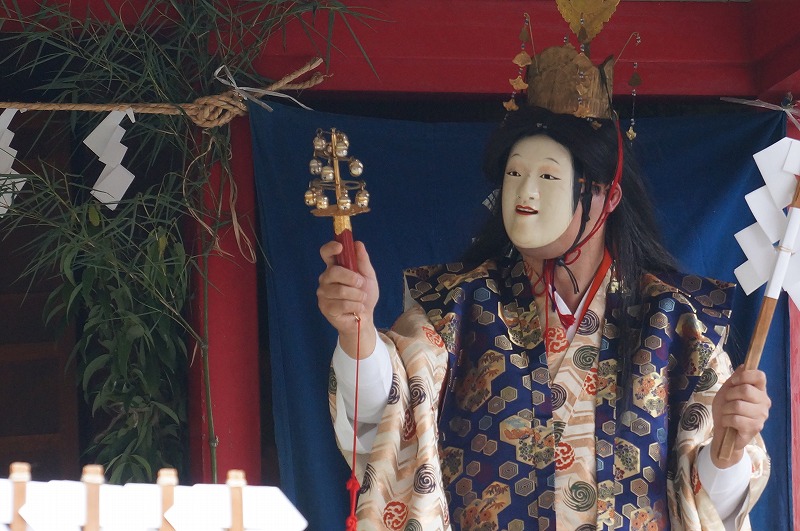
Next to this is the dance of a woman called Ameno-uzume. Ameno-uzume was a deity who played an important role in summoning the sun goddess Amaterasu when she went into hiding, and she often appears in kagura.
Loyal fox serving the boss
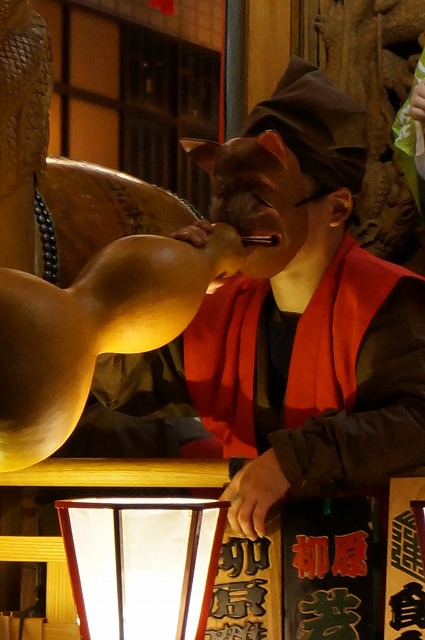
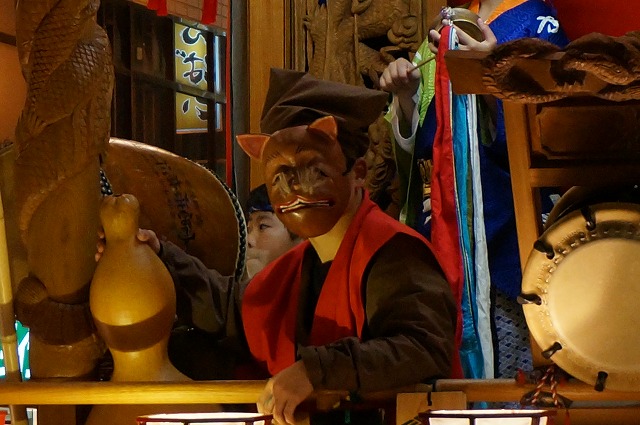
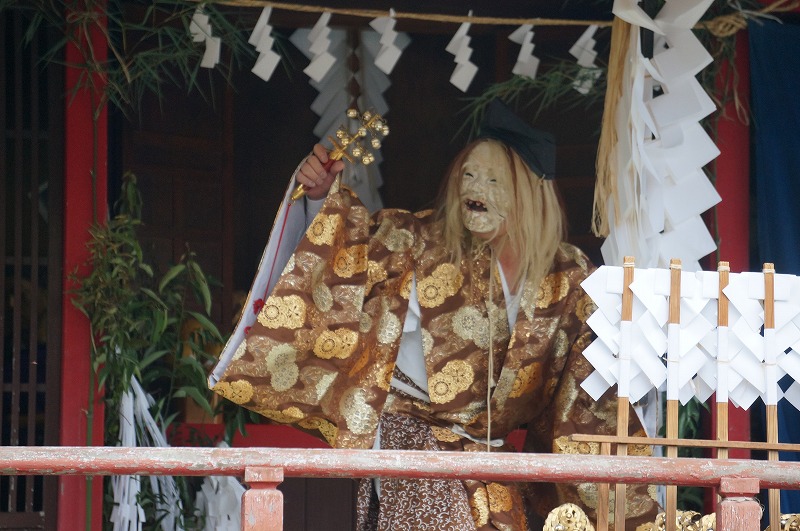
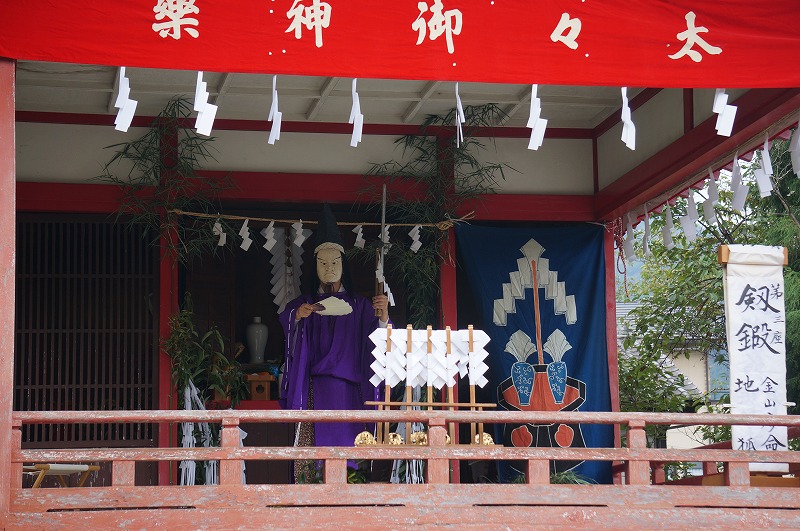
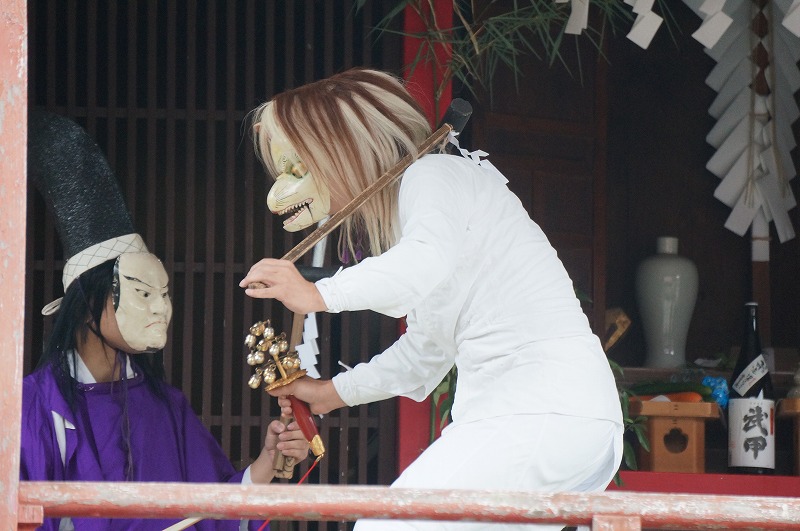
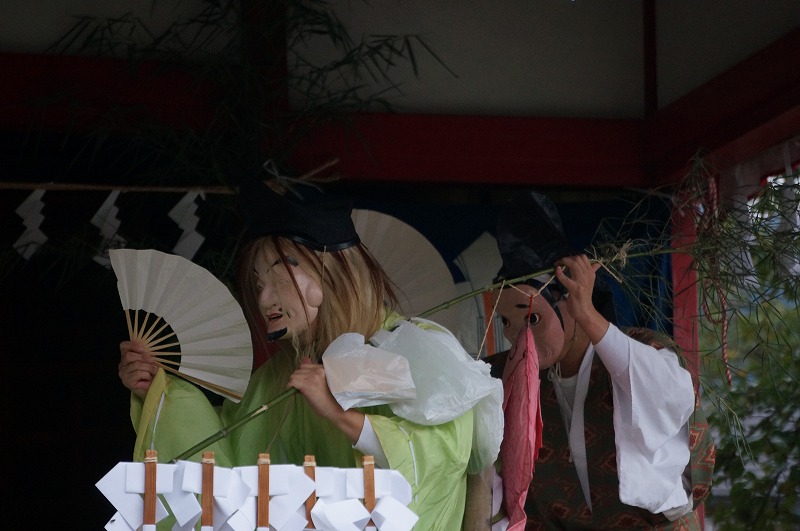
Next program is Kanayama-hiko 金山彦, the god of blacksmithing, who does not play a particularly significant role in mythology but often appears in kagura. It is likely that these gods were more appreciated by the common people than the formation of a large state. The fox appears there as a subordinate. The fox is a familiar character who often appears as a messenger of God. Here, he has a dubious shape with mesh in his hair. Kanayama-hiko immediately begins to make a sword. The fox also helps with the forging. After a while, Kanayama-hiko looks sullenly at the finished sword. The fox looks at it with him, but Kanayama-hiko is still not happy with it and starts to strike again. The fox also helps. A fox who has no choice but to conform to his boss’s self-serving behaviour. There is a reason why it looks like that. The expression and gestures of the fox resting near Kanayama-hiko, who is dancing with the finished sword, seem to be saying, ‘Oh dear’.
A breathing fox who seems to be saying, “Oh, I’m so tired.”
And later, the fox also dances with him, but always one step behind, changing position to the left and to the right to match the movements of his master. When the dance is over, Kanayamahiko leaves. The fox rests at the side of the stage, huffing and puffing. However, as if to say that this is unacceptable, the music suddenly changes and he hurriedly follows his master out of the theatre. This sequence of events seems to focus on the difficulties of employee. it’s tough to be in someone’s service. It is always hard to be a palace worker.
This is followed by the Sarutahiko dance and other activities before a lunch break.
After lunch break
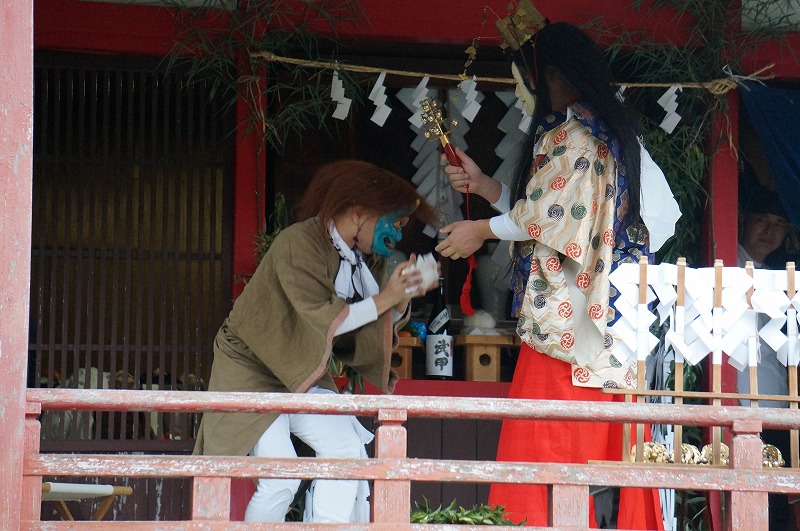
After lunch, a series of iwato-opening ceremonies, also common in kagura in the Kanto region. This event is one of the biggest highlights in Japanese mythology. To put it simply, the sun goddess Amaterasu goes into hiding and the world goes dark. The troubled gods then confer, and as a result, hold a banquet and make a great fuss. Amaterasu becomes suspicious and opens the door to drag her out. The main characters are Ameno-uzume, who enlivens the banquet, and Tajikarao, who boasts of his power to open the rock door.
Although the first name is Amenouzume, here it is also Otafuku. The names Okame and Otafuku are often applied to aspects of common women. Because of her plump and puffy cheeks, Mumps is sometimes called Otaffor cold.
Open the rock door for the world
Amenouzume appears again. Usually, the Otafuku face is used as Amenouzume, but here the rather pretty face is used. Next come the gods. Then Tadikarao comes out strongly. The blue shading on his face represents a big villain in Kabuki, but here it is used to emphasise his strength. The kagura of the common people is influenced everywhere by Noh and Kabuki.
It’s tough being an employee Part 2
From here, the kagura moves a little away from mythology again. Inari, the god of agriculture, appears. This was more familiar to audiences at the time. And the famous messenger of Inari is the fox. So there are often statues of foxes at shrines dedicated to Inari (e.g. Fushimi Inari in Kyoto).
And what does he do? He is the god of agriculture, so naturally he grows rice. But the Inari God just sits there. It is the foxes who do the work. He holds the hoe, sows the seeds and ploughs the fields. Foxes, along with Tanuki (Japanese raccoon dogs), are famous as animals that bewitch people, but, off course, foxes that can be used by gods are different. They are loyal to their masters and work without complaint. They cannot say they are tired.
This imagines the beginning of agriculture, so people appear. The fox has to teach the human to grow rice as well. But he is a bastard and eats the seeds he receives. This scene shows us that kagura was a form of entertainment in those days.
The foxes tie up their mouths so that human beings cannot eat them and hands-on teach him step by step and polite manner but…. It is also very hard to be available to God.
Ebisu and attendant ~Maybe it’s easier this way
The gods of the common people are Ebisu and Daikoku. Ebisu is famous as a god who fishes all the time and is also a symbol of prosperous business. An attendant appears here as well, but he is not quite the same as a fox. They do not appear to be so loyal to their duties. Yebisu fishing immediately. When he catches his catch, his followers praise him for his skill. However, he soon starts fishing himself, and eventually catches something strange.
Evisu is tired and asks for a shoulder rub. So far so good, but when Evisu falls asleep in a good mood, attendant does it with Ebisu’s buttocks. So Ebisu is quick to do the same thing back. This kind of relationship between boss and subordinate may be what is needed today. At the end of the day, they caught the bream safely and left carrying it together. Happily ever after.
Others ~Oroch and Oni
A number of performances follow. There is not space to introduce them all, but I would like to mention two. One is called ‘Tamatori’, a performance that can sometimes be seen in Kanto kagura. The content is simple: an evil Oni, enchanted by a ball in the princess’s possession, comes to take it away. The main plot, however, is that the warrior deitiy soon exterminate them. However, there is a further development here. The ogres have a magical cloak and hat that allows them to disappear, making themselves invisible to the warrior gods. The ogres could have just run away, but for some reason they start tickling and messing around with Takejin. decides to take matters into his own hands and brings the demon’s mother with him, telling him: “If you don’t show yourself to me, I’ll show your mother to you instead.
The fact that Oni has a mother is a surprise, but it also takes off its own straw hat and cloak for her and allows itself to be beaten by the warrior gods. The story ends as a sad humanistic tale, with the Oni finally exiting with his mother on his back. The fact that the prototype has been handed down in such a modified form gives some indication of the temperament of the villagers of the time.
The extermination of demons is easy to understand and there are others. But what is noteworthy is the extermination of the Orochi. Compared to the spectacular and entertaining western Japan, which is strongly influenced by *Iwami kagura, the Kanto treatment is not so big, and although it has its own innovations, it is somewhat cheap. →
There were 16 performances that day, and it was nearly 5pm when it was over. It is not necessary to see them all. But sometimes it’s not bad to see a kagura performance that touches the hearts of the villagers.
Chichibu attracts many hikers. This is because it is home to numerous shrines and temples, including Chichibu Shrine, and is also a region rich in natural beauty. Despite this, it’s conveniently located just an hour and a half from Tokyo. In particular, the pilgrimage to the 34 sites of Chichibu continues to attract many visitors to this day. While experiencing the nature and culture of Chichibu, it might be a valuable opportunity to experience the local kagura if the chance arises.
Shishimai as a hero that carries the legend to the present~ Kanpaku Shishimai
Date: First Saturday of August Location: 667, Kanpaku-cho, Utsunomiya, Tochigi, Japan Access: Bus from Utsunomiya. Get off at Kamikouchi West Elementary School Entrance by city bus. 3-minute walk. Take Kanto Bus bound for Tamao or Imazato, 30 minutes. 20-minute walk from Kamikawachi Jichi Centre.
Access
Buses are the best way to get there, but unfortunately they are extremely infrequent. If you are physically fit, we recommend cycling. Utsunomiya used to host Asia’s only road cycling world championships. There is a place in front of the station where you can rent a full-fledged sports bicycle. Of course, regular bicycle (including electric) hire places are also located close by. Once out of the city centre, the road is surrounded by greenery and not too much traffic, so it is recommended. The journey from Tokyo to Utsunomiya takes around 50 minutes on the Tohoku Shinkansen. If travelling by conventional rail, take the Ueno-Tokyo Line and change at Ōmiya or Akabane, then take the Shonan-Shinjuku Line; the journey takes around two and a half hours. The Shinkansen fare is roughly double that of the conventional rail service.
A lion is a strange being. Sometimes they are treated as spirit animals, and sometimes they are beings to be exterminated. Originally, it was propagated from mainland China, but while the original Chinese version specialized in entertainment elements, in Japan, it was introduced along with Buddhism, which added many religious elements to it, and various other elements were added. In order to establish their own authority, each of the various lion dances established in various regions began to call themselves a school of their own, and even created a book of secrets not to be shared with anyone outside the school. As for the lion dance introduced here, it is called “Kanpaku style”. The lion dance in this article is called “Kanpaku-ryu,” but it is also called “Tenka-ichi,” which means “the best in the world” in Japanese. There is a reason for this, and it is said that the third shogun of the Edo period praised it as “the best in the country”.
Long ago, bandits from the Tohoku region settled in this area. They robbed the residents of their money, goods, and grains. They also used the people like cattle and horses, and many of them died. The people repeatedly petitioned the capital to conquer the bandits, but received no response from the capital. However, in 911, a conquering army led by Toshihito Fujiwara 藤原利仁 finally arrived. The bandit army fought against the attack of elite troops from the capital, but finally abandoned the residence and retreated into the mountains. The government forces were unable to attack the mountain, but Lord Toshihito read the sky and predicted snowfall in the near future. He secretly sent out scouts to check on the enemy forces. When the snow fell as predicted, he took advantage of the enemy army’s inattentiveness and attacked them in one fell swoop. After fulfilling his role, Lord Toshihito suddenly became ill and died in this place as he was about to return home. His men, grieving, tried to bury him, but the sky suddenly became overcast and it was dark all day and night. After fulfilling his role, Lord Toshihito suddenly became ill and died in this place as he was about to return home. His men, grieving, tried to bury him, but the sky suddenly became overcast and it was dark all day and night. They made a golden lion’s head in the shape of a dragon by various curses and used thousands of bird feathers, which they put on the head and made it dance. Later, the Kanpaku 関白, the chief priest of the time, visited this place and erected a stone monument, claiming that it was the land of his ancestors. The village was then designated as Kanpaku Village.
About Shishimai
A person named Fujiwara Toshihito 藤原利仁 is a real person, not famous today, but who was once granted various legends. The lore is quite specific, and he may have actually conquered the bandits in this area. However, the lion dance itself must have originated much later, so it is assumed that it was probably created in the guise of a legend. However, there is a performance in which the lions exterminate demons, and this is certainly a rare performance that cannot be seen in other lion dances.
The shrine where the event is held is surrounded by mountains and is still somewhat dark during the day. The shrine grounds are quite large, but the area for dancing is limited to one place, which is small. Okara (soy pulp) is laid out there. Hanagasa hats stand on all four sides. The hanagasa here are solid and carved out of wood.
The first part of the performance always starts with a performance of swordsmanship with sticks. After that, the lions waiting in the background rush into the dance space. There are other ways in which the lion dance here is different from others. For example, the main part of the performance, called Mejishi Kakushi (Female Lion Hidden), is a fierce confrontation and fight between two male lions over a female lioness. And yet here they search jointly, but do not confront each other afterwards. In fact, they even sleep together.
Exterminate Oni
The lion dance began at 11.00 am and the final and biggest highlight, the demon extermination, comes to an end at around 2.30 pm.
First, the two hunters appear. Then suddenly a demon arrives. This represents the bandits in the legend.
The two manage to get rid of the demons at least once. But then, for some reason, they start drinking. Still, they are good masks with a lot of flavour. The masks of the lion and the hunter seem to have been made by craftsmen of a certain calibre.
Then the demons, which were supposed to have been chased away, appeared again. Perhaps attracted by the smell of alcohol, they come peeping in greedily. The hunters notice this and invite the ogres to a feast. They drink heavily and start playing some kind of game.
The two men take up the Oni’s belongings. So this was the aim. The two men quietly leave. The Oni falls asleep with a cask of sake. Then…
The Shishi army is coming. The Oni are no match for them, and a fierce battle ensues. In the end, the Oni meet their end with a single thrust from the Shishi. This performance alone lasts about 40 minutes. Only this performance is quite powerful because it leaves the dance arena and uses the entire place as a large area. Regardless of the authenticity of the legend, it is assumed that it was entertaining enough for people in the past.
The lion dance started at 11am and continued until about 3.30pm in the afternoon with a lunch break. A different kind of lion dance, if you get the chance.
Various other lion dances
This time we introduced the lion dance of Utsunomiya City, but in fact there are several similar lion dances performed in this area.
Kanpaku-ryu Lion dance (Gasoyama shrine)
Date; Every year on 23 September Location; Gasoyama shrine 713 Iriwano, Kanuma City, Tochigi Prefecture Access; Approximately 60 minutes by th *Ribus Iri-Awa-no-kami-Satsuki Line from Kanuma Station on the JR Nikko Line Alternatively, approximately 50 minutes by the Ribus Iri-Awa-no-kami-Satsuki Line from the entrance of Shin-Kanuma Station on the Tobu Nikko Line; get off at ‘Ozaku-yama Shrine’ and walk for approximately 2 minutes *community bus https://www.tochigiji.or.jp/event/e16030/
Date; Every year on 15 August Location; Hakusan shrine 2059 Nakazato-cho, Utsunomiya City, Tochigi Prefecture Access; From JR Utsunomiya Station, take the Kanto Bus bound for ‘Imazato’ for approximately 30 minutes, get off at ‘Nakazatohara Jumonji’, then walk for about 30 minutes
Date; Every year on 15 August Location; Hakusan shrine 678 Sakagami-cho, Utsunomiya City, Tochigi Prefecture Access; From JR Utsunomiya Station, take the Kanto Bus bound for ‘Imazato’ for approximately 25 minutes, get off at ‘Kakinoki’, then walk for about 10 minutes
This Kanpaku lion dance is mainly found in Utsunomiya and Kanuma; in Utsunomiya it can be seen in August, whilst in Kanuma it takes place in autumn, from September through to October.
Experience Traditional Kagura Performances Near Tokyo~Mitake Kagura
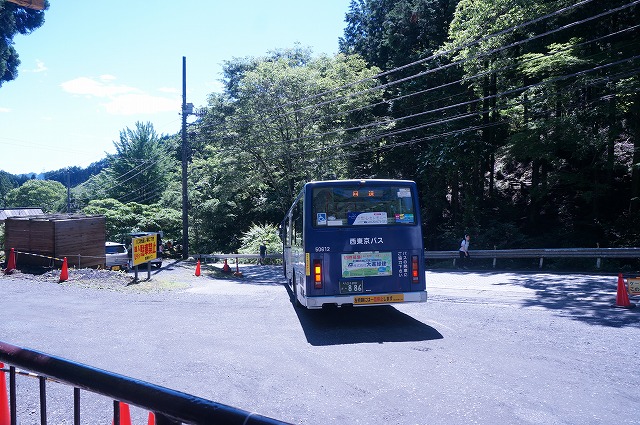
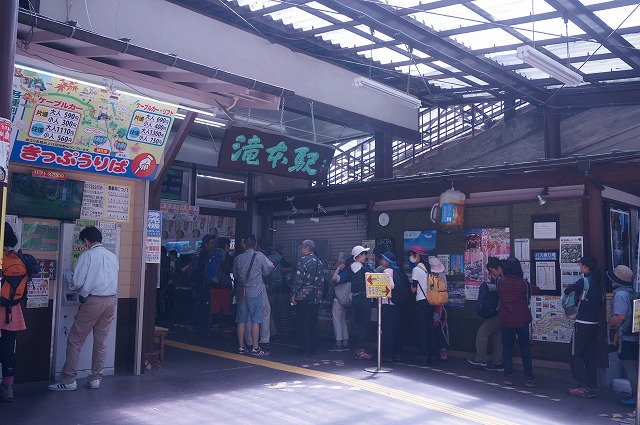
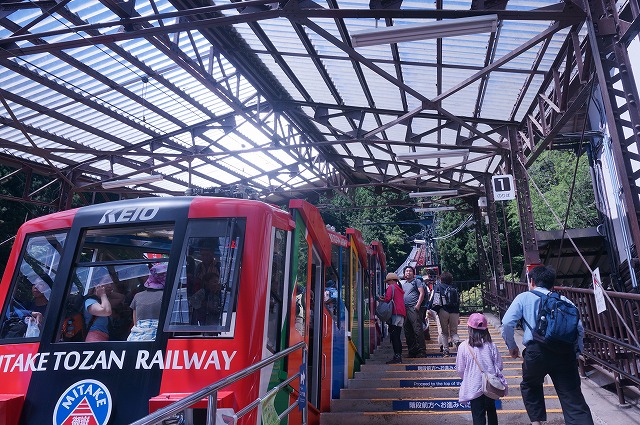
Date: Third Sunday in June and October, Concert begins at 11:00 a.m. Night kagura is held on the fourth Sunday of the month from June to November at 8:00 p.m. In July and September, firewood kagura (at 8:00 p.m.), not firewood Noh, is also held! Location: 176 Mitakeyama, Ome-shi, Tokyo Access: Take the Chuo Line to Mitake Station (about 1.5 hours from Shinjuku), then take a 10-minute bus ride to Takimoto Cable Car Station. Climb to the top of the mountain, and then walk along the approach for about 25 minutes.
this article is based on 2019 visit
Welcome to Mitake
Long ago, when Tokyo was still called Edo, there was a word If you live in Edo for three generations, you are an Edokko (an Edo person). Since that time, Edo and Tokyo have been a place where people come and go. At that time, Edo was the largest city in the world with a population of one million. Inheritance is important in the performing arts. For this reason, the performing arts have not been widely transmitted in Tokyo. However, there were still rural areas outside the center of the city, and some of them still remain in the surrounding areas.
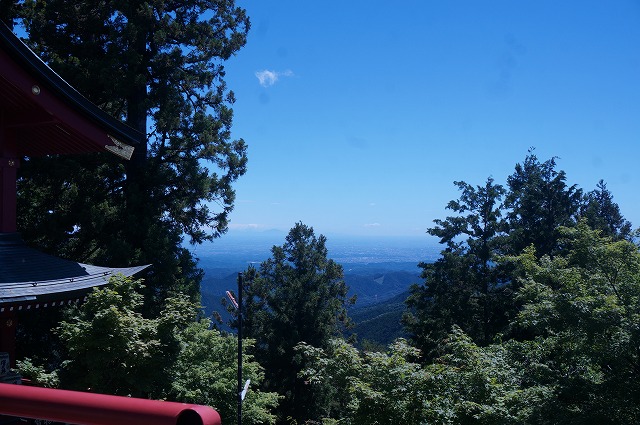
The location is in the Okutama area, which has been introduced several times on this site. Just an hour’s train ride from central Tokyo, the area is a cool and refreshing mountainous region that could be described as a different world. The performing art that this site introduces today is Mitake Kagura, which is performed several times a year at the Mitake Shrine in this area.
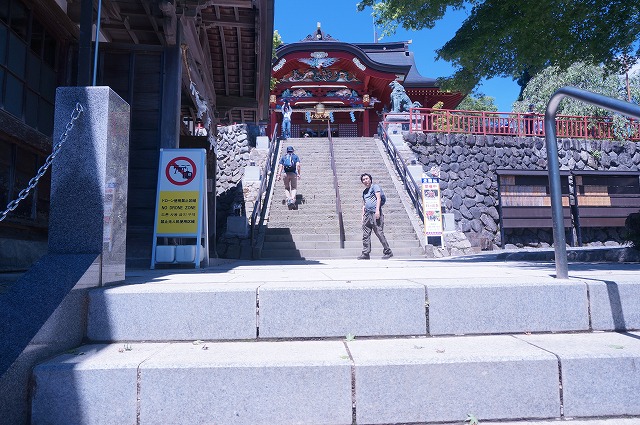
Since ancient times, Japan has had what should be called mountain worship, and in the midst of this, religious groups such as yamabushi (mountain priests) were born. This Mitake Shrine is one of them. Therefore, to get there, you have to climb a mountain. First, take the train to Mitake Station. From there, there is a bus to the cable car station. If the weather is good, quite a few people will ride. Of course, you can also go on foot. Eventually, you will arrive at the station at the top of the mountain, which is the beginning of the approach to the shrine. From here, it is necessary to climb further up the hill.
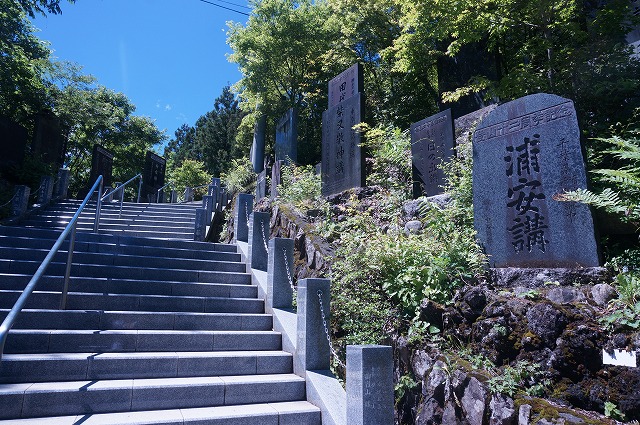
There are a number of monuments along the way. These are the prayer monuments of a religious group called “Kou. This is a group of people who used to collect money to visit shrines in their town or other units, and when they had saved up a certain amount of money, a representative would collect enough for everyone to visit the shrine. Since travel was not as freely available and expensive as it is today, there were many such groups in various parts of the country.
Experience the Mitake Kagura
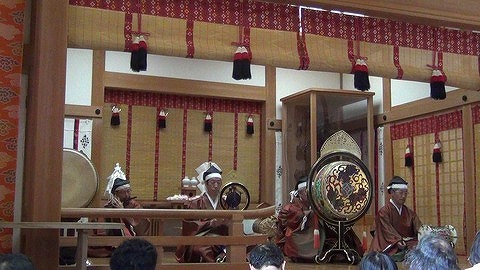
The start time is 10:00 a.m. The first performance is called Gagaku. This music was introduced from mainland China through the Korean peninsula about 1200-300 years ago. It is still performed at events and other occasions, mainly at court. Even in the private sector, this technique has been handed down to historic shrines and other places of worship.
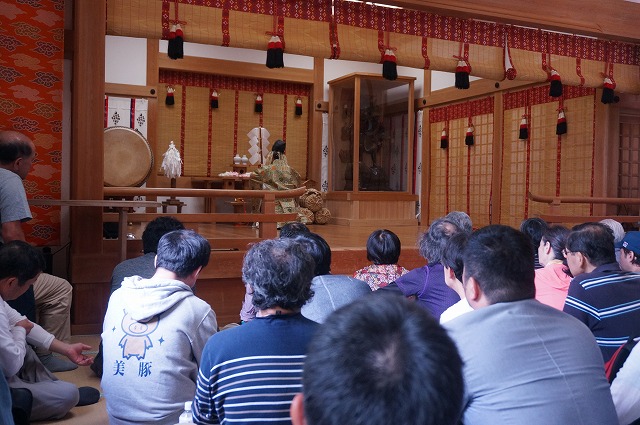
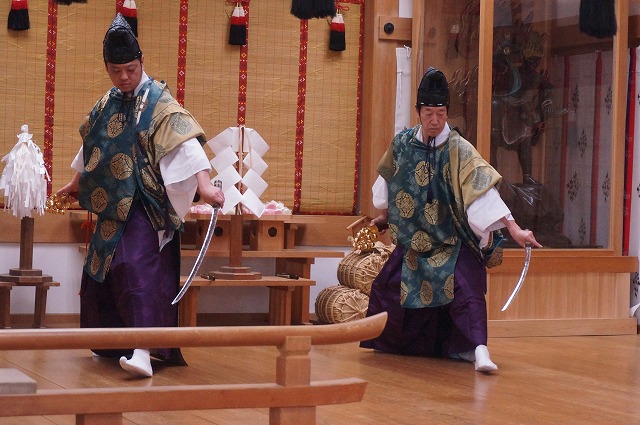
After the performance, the kagura begins. Since this is a venerable shrine, there is no element of joking around, and the ritualistic dancing continues unabated. There is not much movement. There is no ” hyottoko” that comes out in the latter half of the performance and does something funny to entertain the audience.
However, since it is kagura, the point remains the same: to pray to the gods, to appease the evil spirits of the earth, and to express the world of mythology.
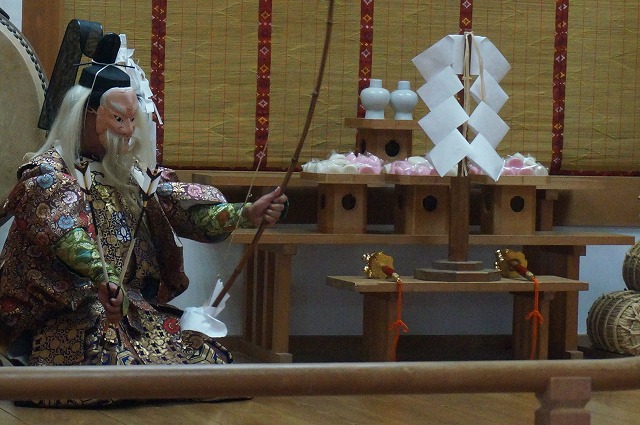
This is a kagura adaptation of the episode of Empress Jingu and her loyal retainer Takeuchi Sukune. Empress Jingu was the queen of the 14th emperor and mother of the 15th emperor. Compared to her husband, the emperor, whose achievements are not so well documented, this mother is amazing. Legend has it that she traveled to the Korean Peninsula and conquered several countries while still a woman. Takeuchi Sukune helped her in this endeavor. In fact, there is no such historical fact, so historians say that there must have been some intention for such history to be written. However, the intention is unknown, although there are various theories.
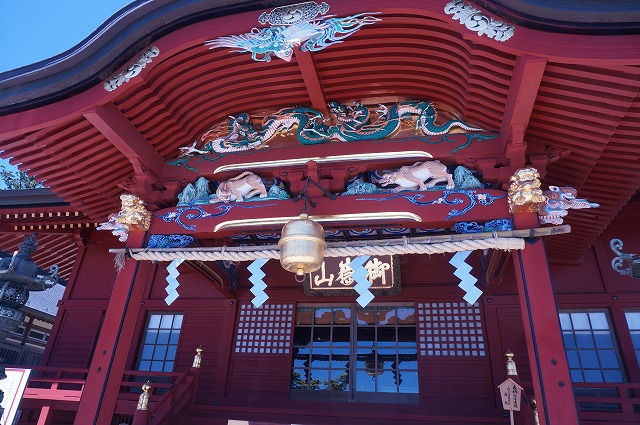
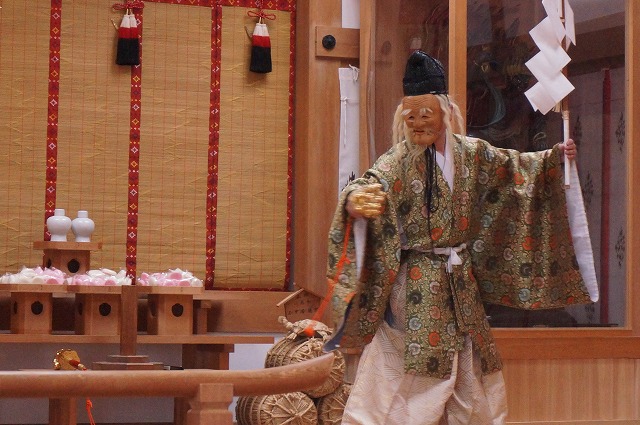
The performance ends with a slightly comical masked “mountain god” with his tongue sticking out, which is unusual for the occasion. The mountain god throws rice cakes at us. The rice cakes, if taken well, bring good luck. The masks are well made and the costumes are gorgeous, as it is a kagura of a prestigious shrine. According to the explanation of an official, each costume costs about one million yen. Although there is no element of entertainment, the experience of listening to this prestigious music and music that is more than 1,000 years old is quite rare. To be able to do so so close to Tokyo is quite an experience. That is, if you are confident in your legs and feet.
Get in touch with nature and view artworks
Nice hiking trails with canyons and small museums in the vicinity. There are frequent trains from environs. If you are tired of the city, come here once. https://www.omekanko.gr.jp/spot/80401/