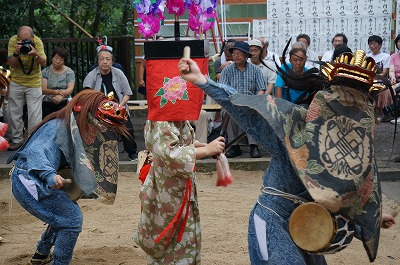
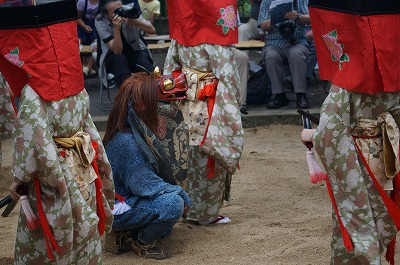
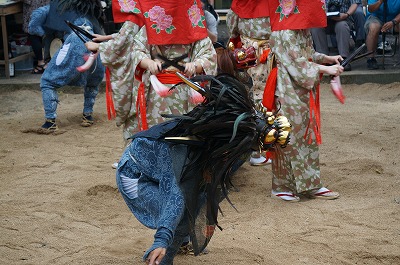
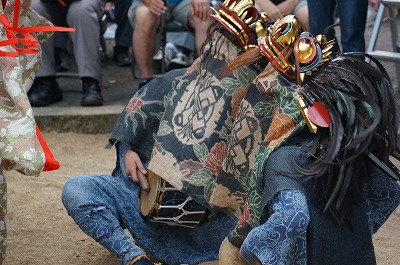
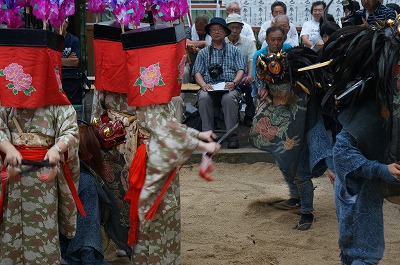
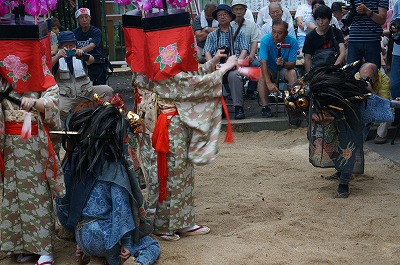
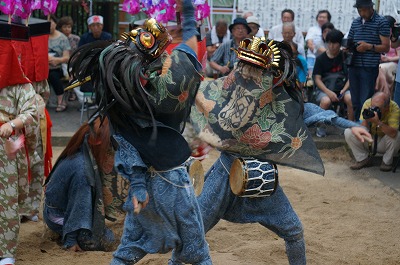
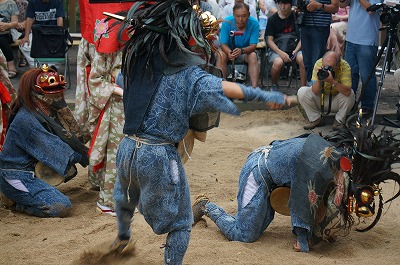
Experience Traditional Kagura Performances Near Tokyo~Mitake Kagura
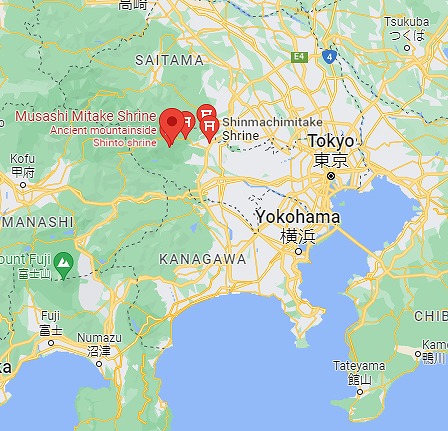
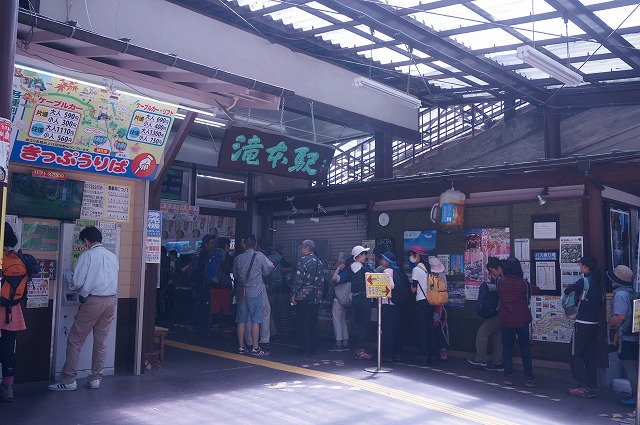
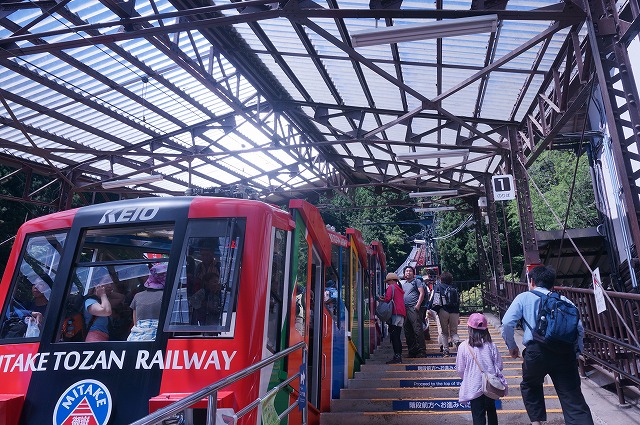
Date: Third Sunday in June and October, Concert begins at 11:00 a.m. Night kagura is held on the fourth Sunday of the month from June to November at 8:00 p.m. In July and September, firewood kagura (at 8:00 p.m.), not firewood Noh, is also held! Location: 176 Mitakeyama, Ome-shi, Tokyo Access: Take the Chuo Line to Mitake Station (about 1.5 hours from Shinjuku), then take a 10-minute bus ride to Takimoto Cable Car Station. Climb to the top of the mountain, and then walk along the approach for about 25 minutes.
this article is based on 2019 visit
Welcome to Mitake
Long ago, when Tokyo was still called Edo, there was a word If you live in Edo for three generations, you are an Edokko (an Edo person). Since that time, Edo and Tokyo have been a place where people come and go. At that time, Edo was the largest city in the world with a population of one million. Inheritance is important in the performing arts. For this reason, the performing arts have not been widely transmitted in Tokyo. However, there were still rural areas outside the center of the city, and some of them still remain in the surrounding areas.
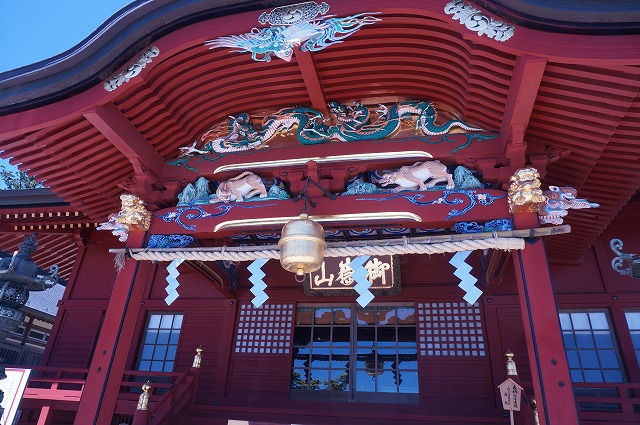
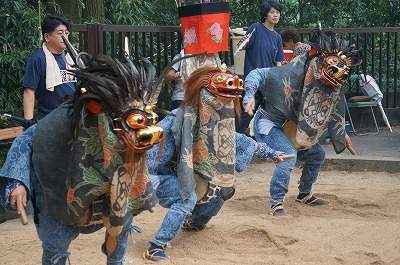
The location is in the Okutama area, which has been introduced several times on this site. Just an hour’s train ride from central Tokyo, the area is a cool and refreshing mountainous region that could be described as a different world. The performing art that this site introduces today is Mitake Kagura, which is performed several times a year at the Mitake Shrine in this area.
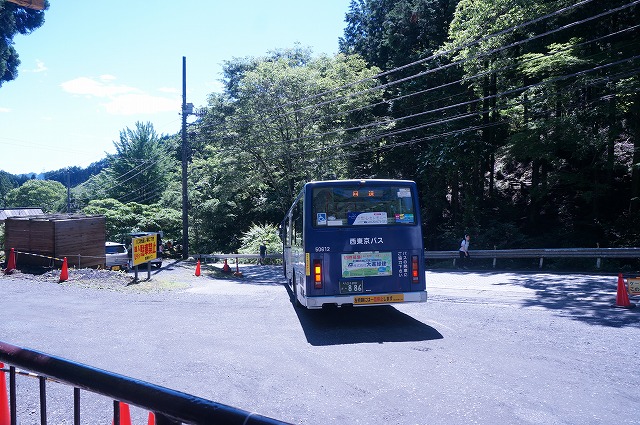
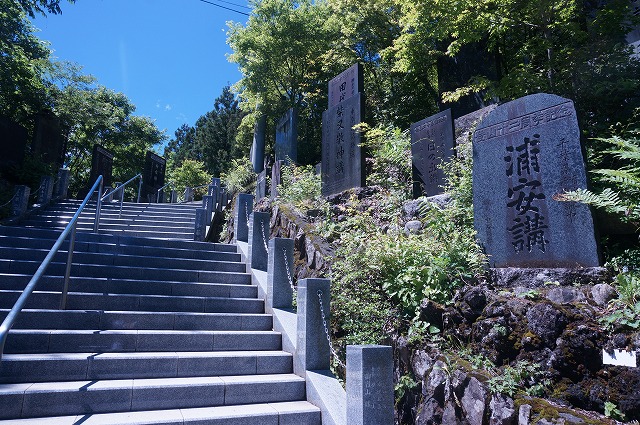
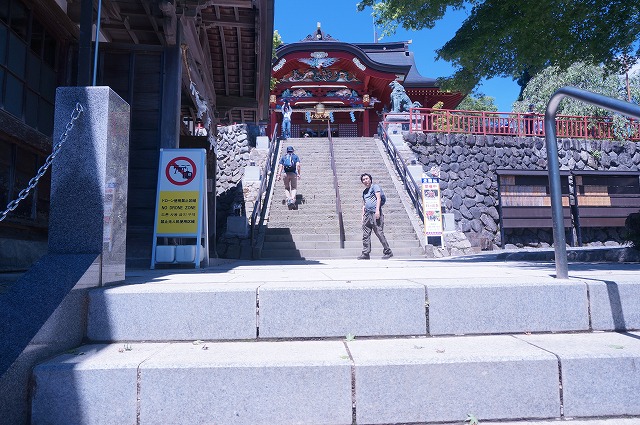
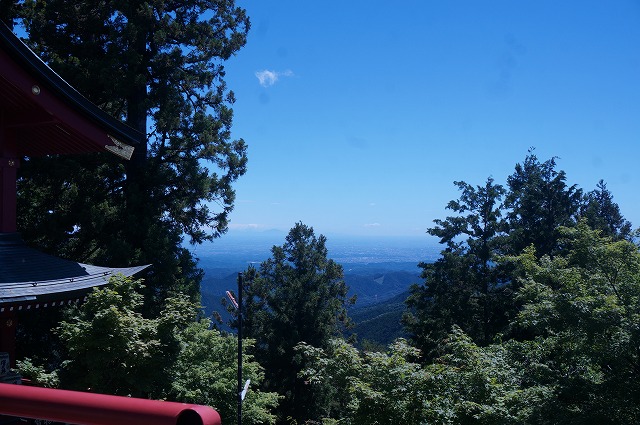
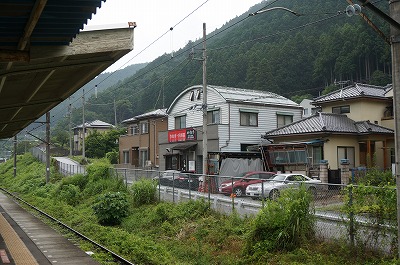
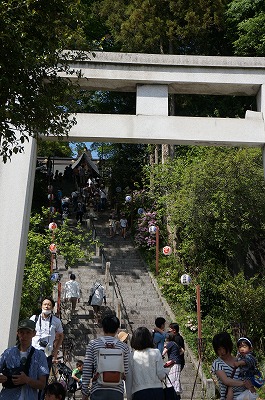
Since ancient times, Japan has had what should be called mountain worship, and in the midst of this, religious groups such as yamabushi (mountain priests) were born. This Mitake Shrine is one of them. Therefore, to get there, you have to climb a mountain. First, take the train to Mitake Station. From there, there is a bus to the cable car station. If the weather is good, quite a few people will ride. Of course, you can also go on foot. Eventually, you will arrive at the station at the top of the mountain, which is the beginning of the approach to the shrine. From here, it is necessary to climb further up the hill.
There are a number of monuments along the way. These are the prayer monuments of a religious group called “Kou. This is a group of people who used to collect money to visit shrines in their town or other units, and when they had saved up a certain amount of money, a representative would collect enough for everyone to visit the shrine. Since travel was not as freely available and expensive as it is today, there were many such groups in various parts of the country.
Experience the Mitake Kagura
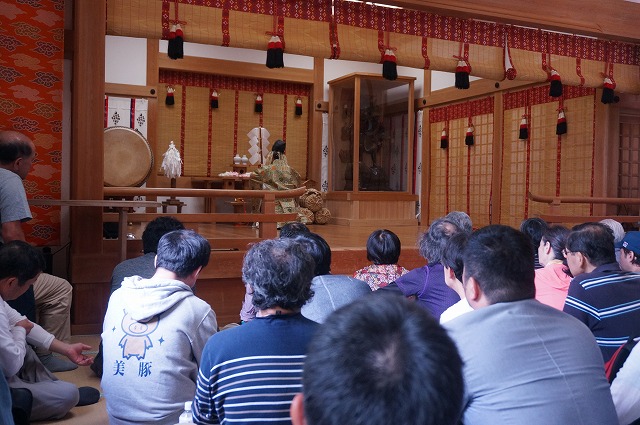
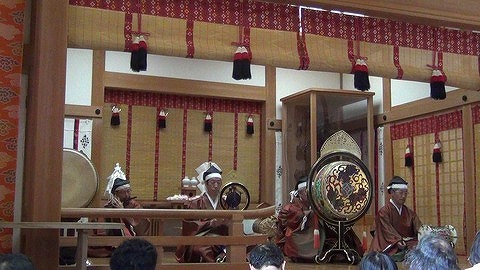
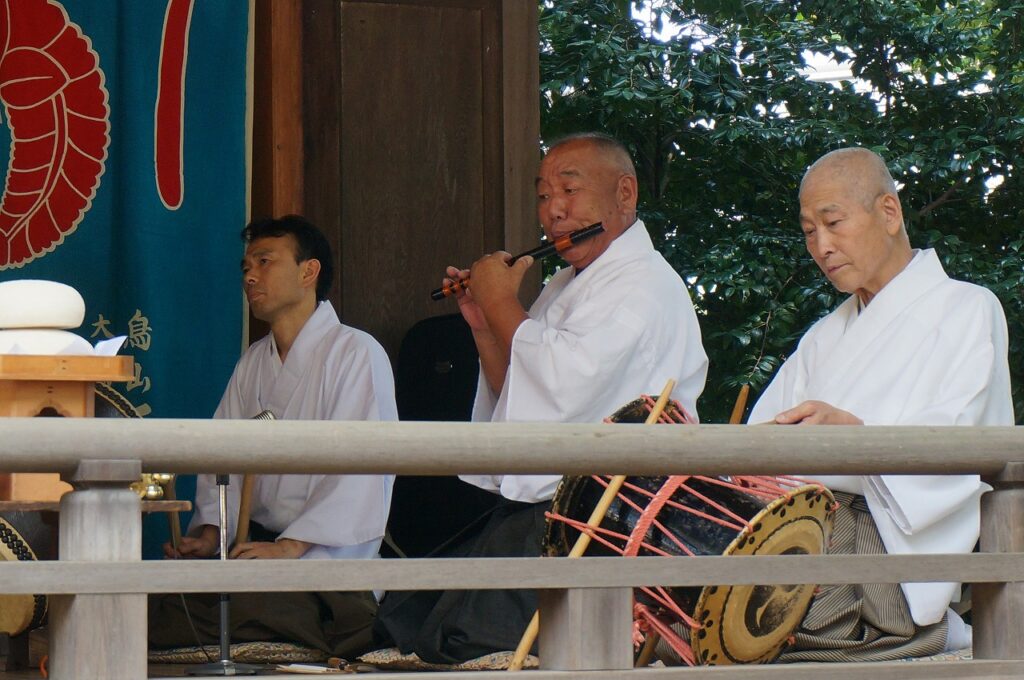
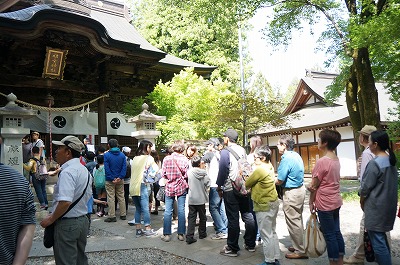
The start time is 10:00 a.m. The first performance is called Gagaku. This music was introduced from mainland China through the Korean peninsula about 1200-300 years ago. It is still performed at events and other occasions, mainly at court. Even in the private sector, this technique has been handed down to historic shrines and other places of worship.
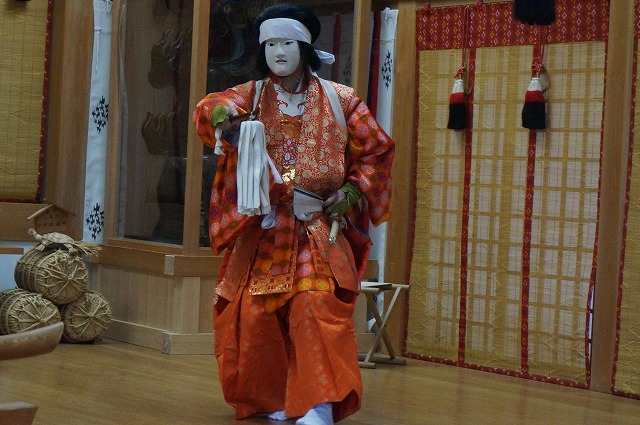
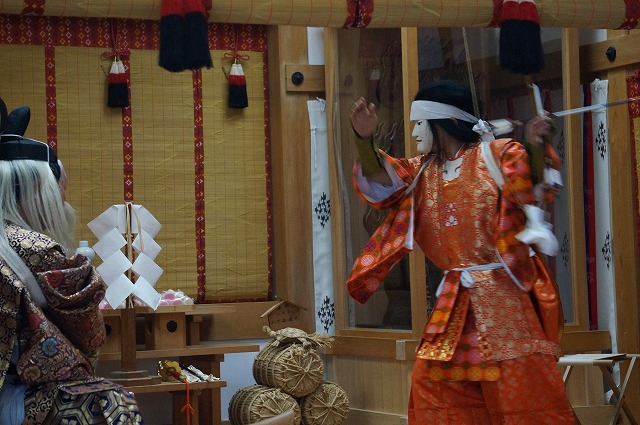
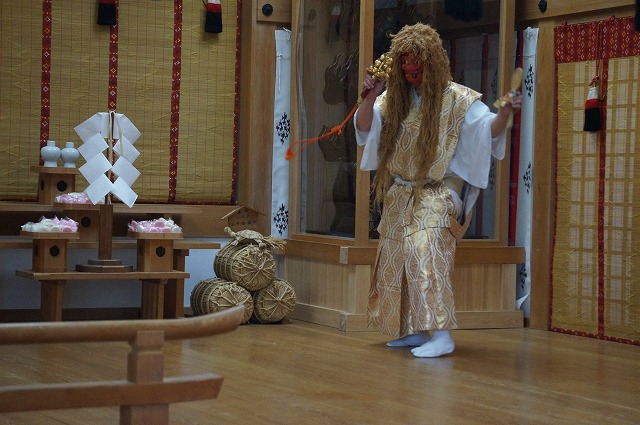
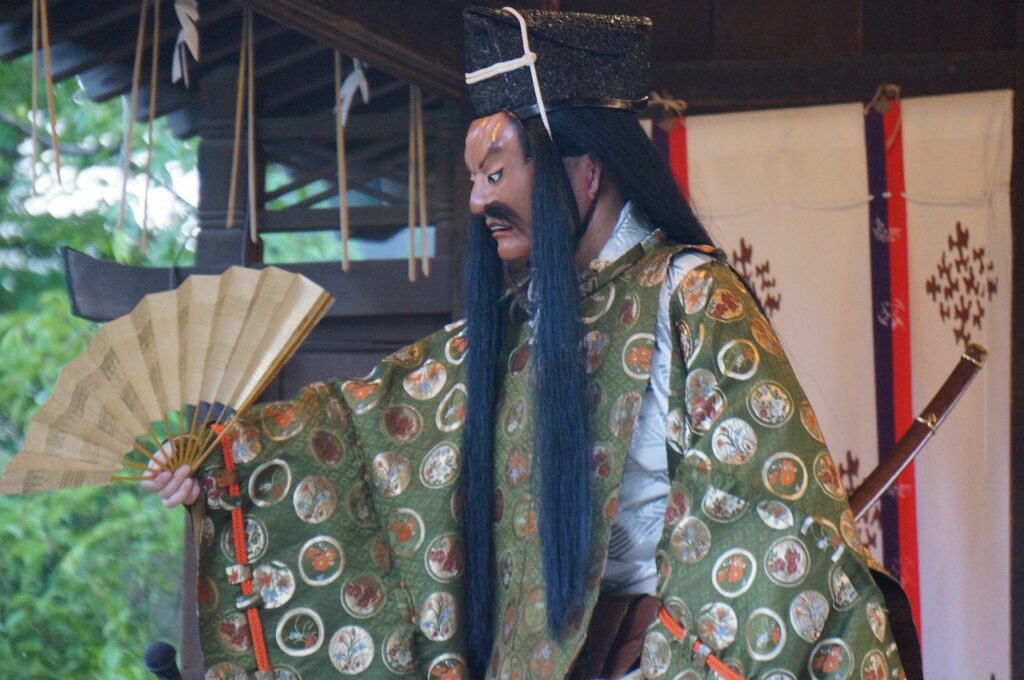
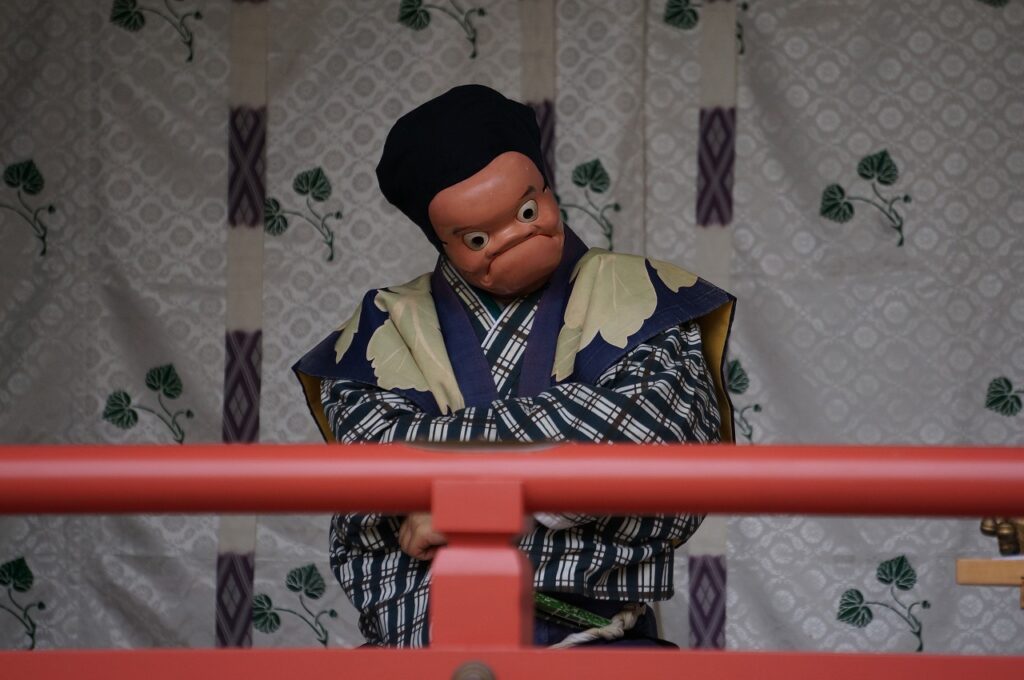
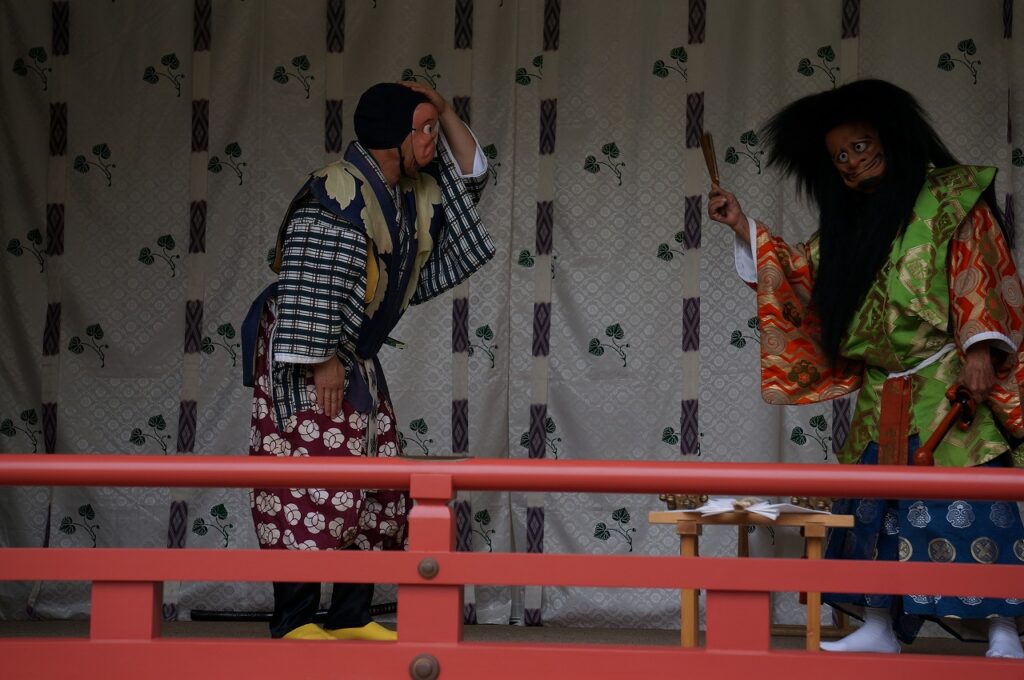
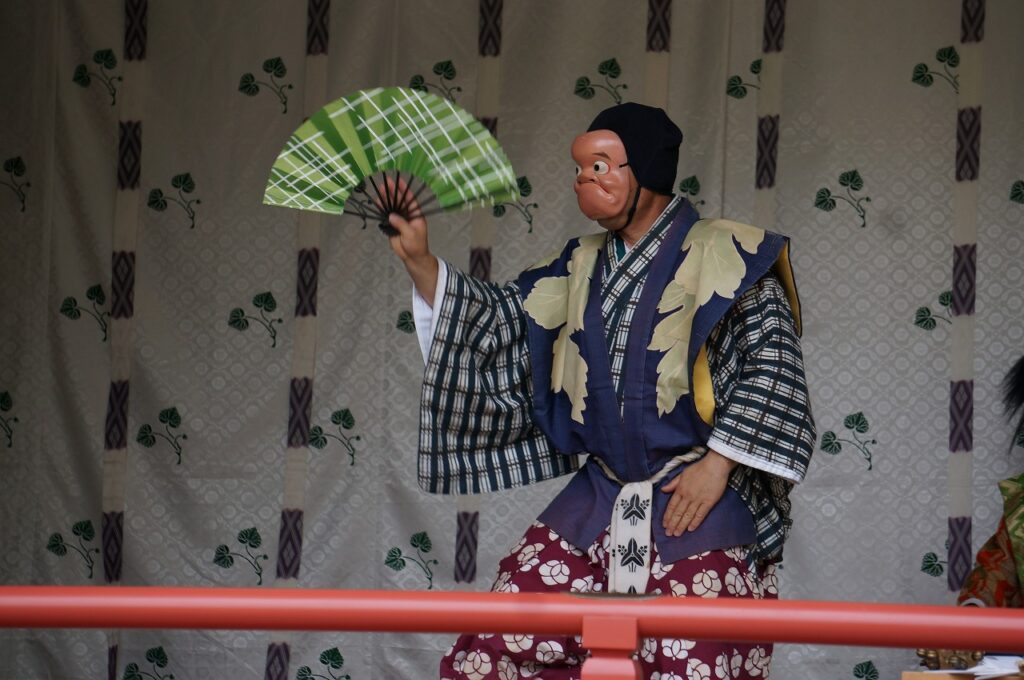
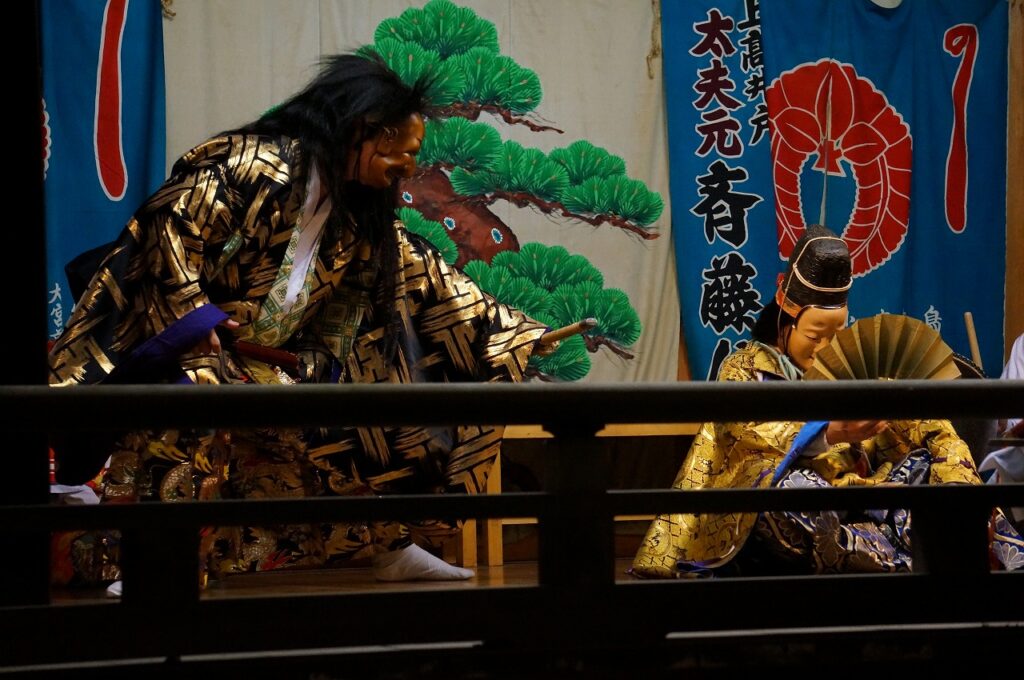
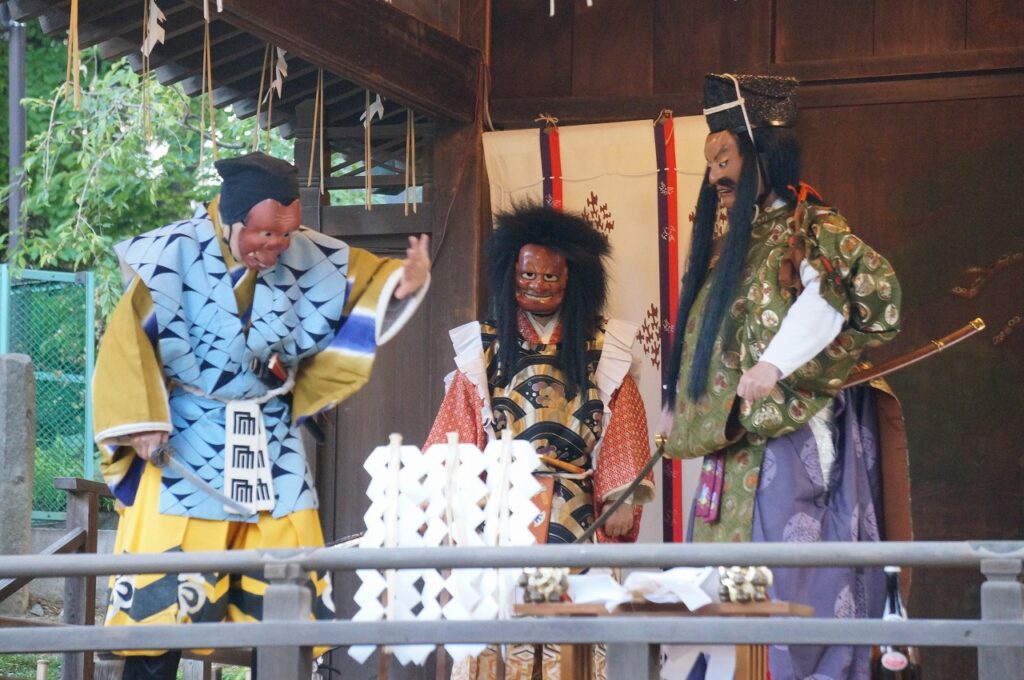
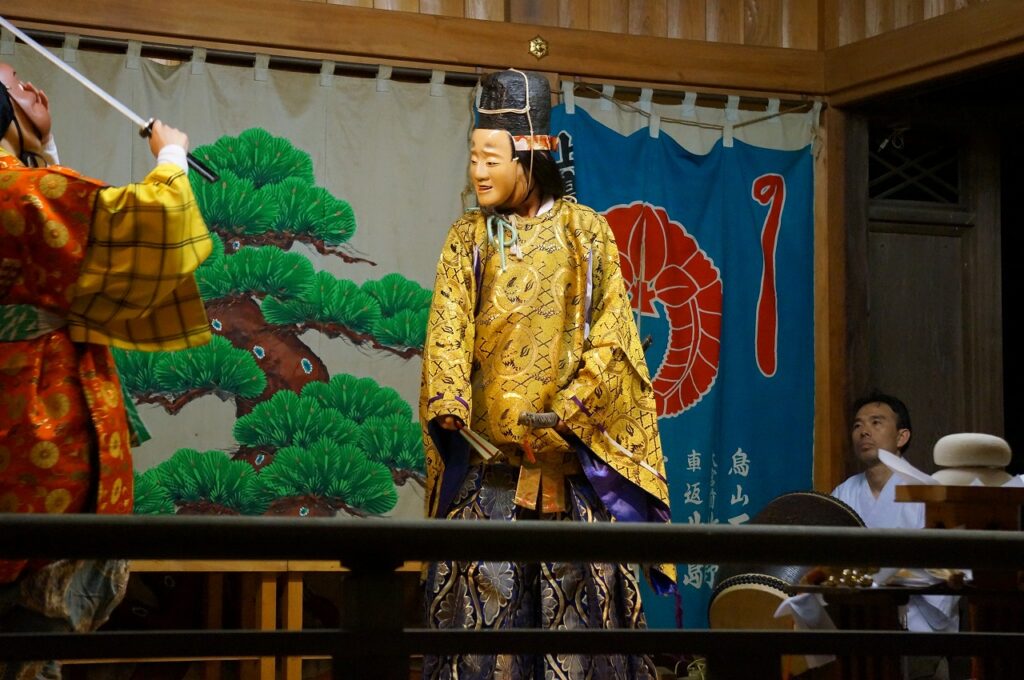
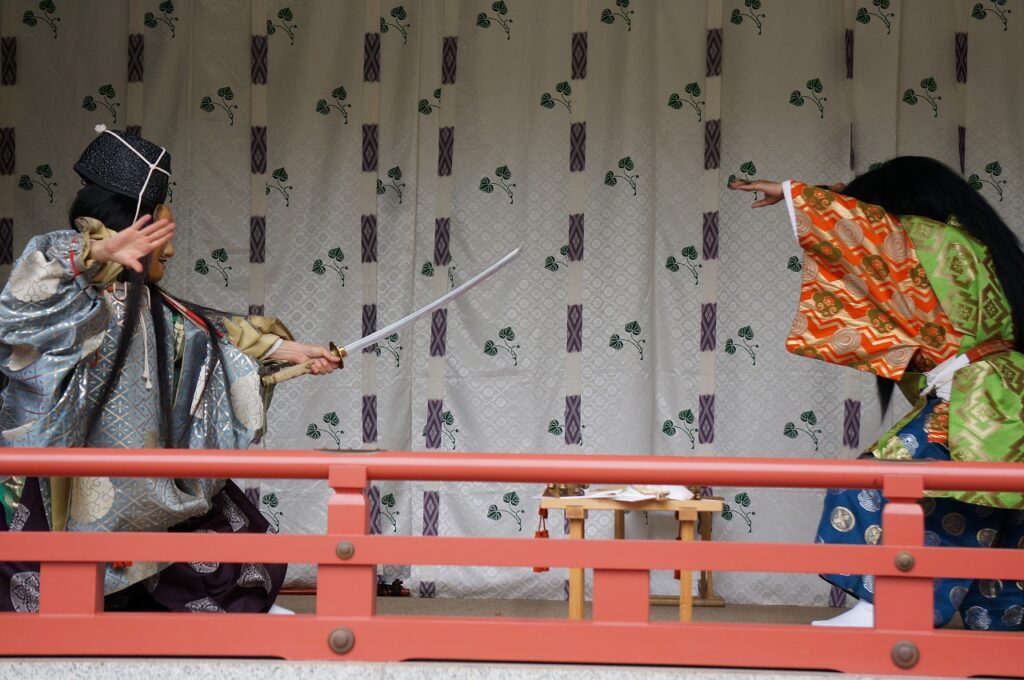
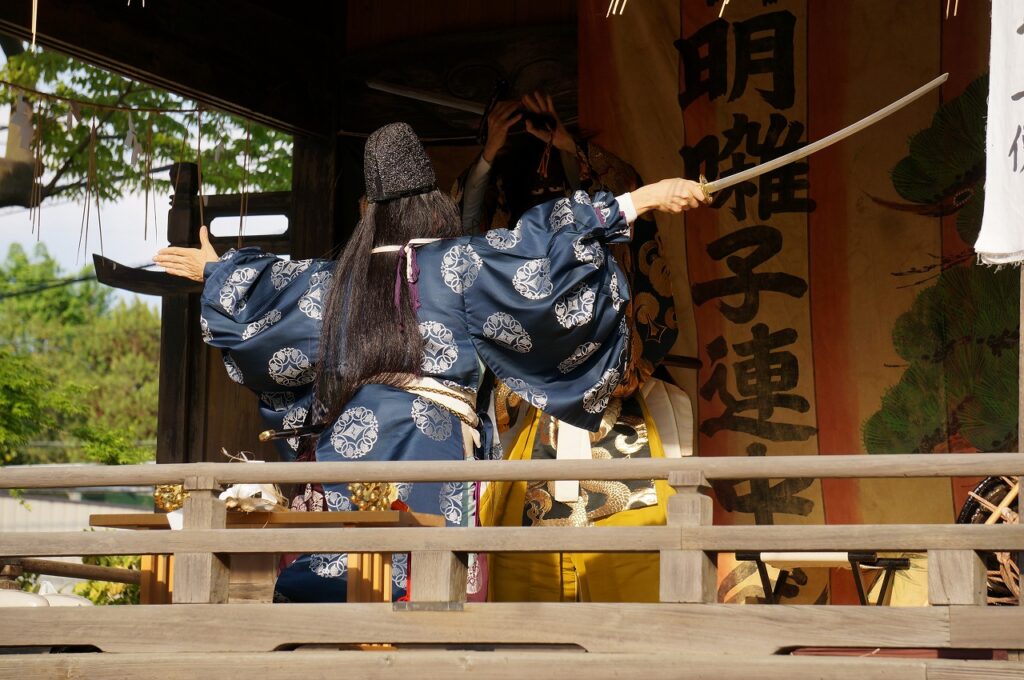
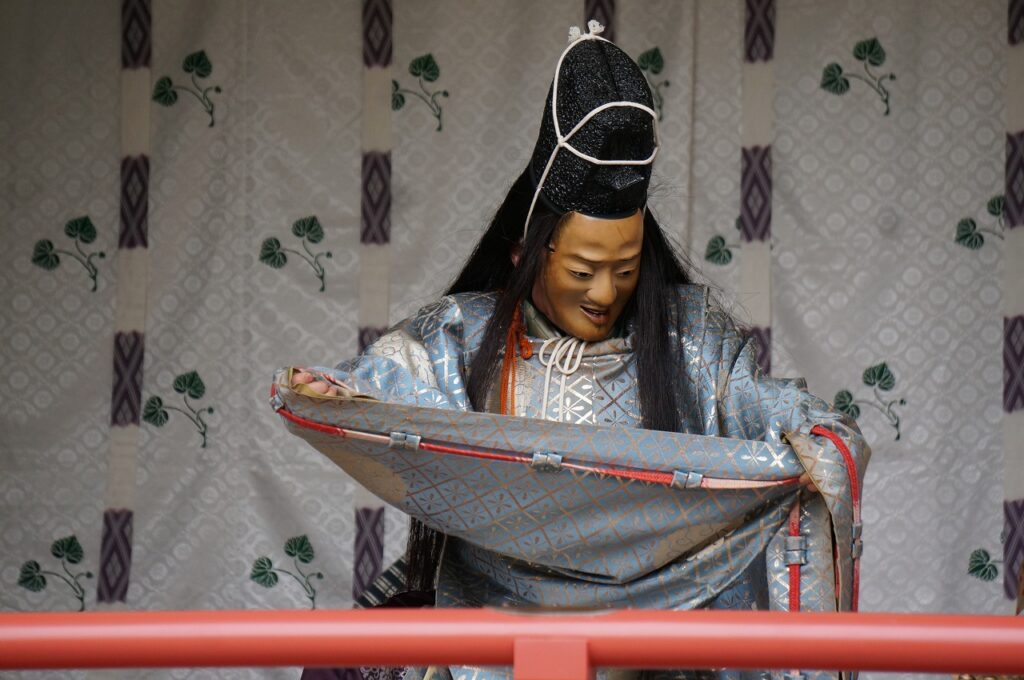
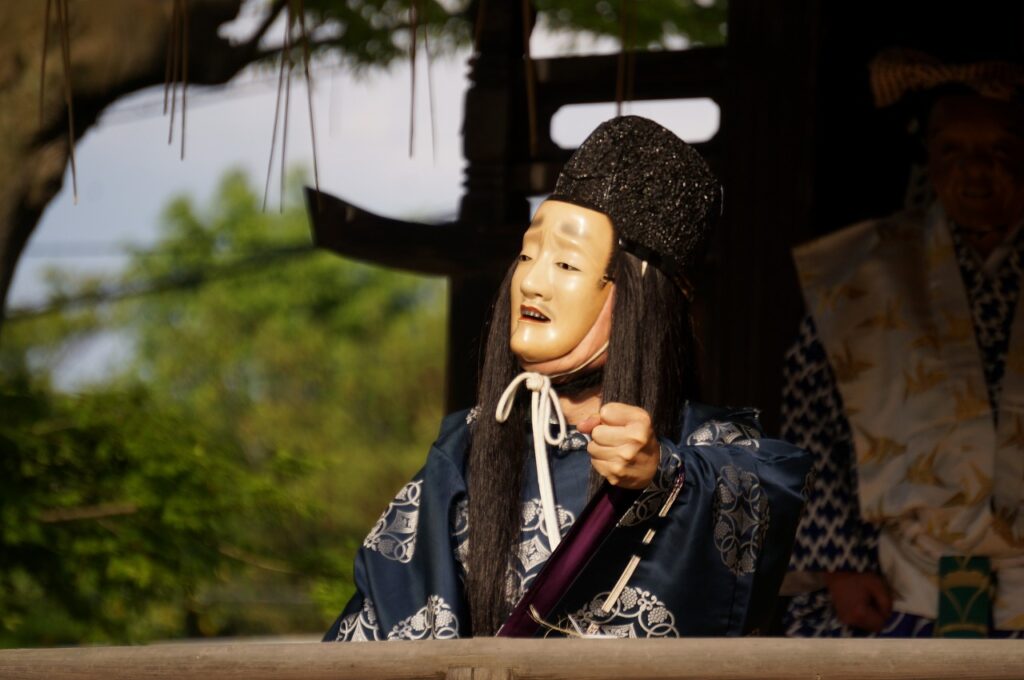
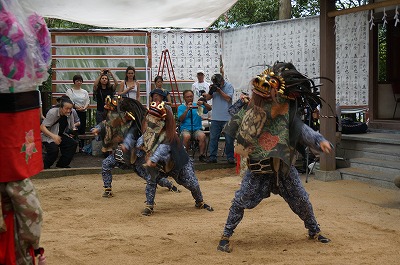
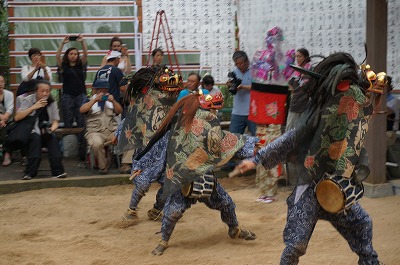
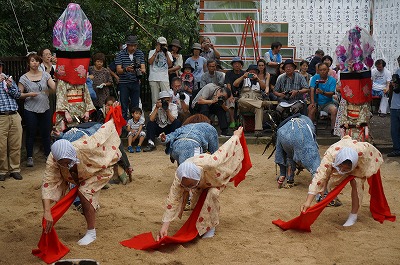
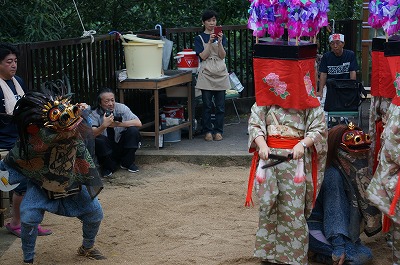
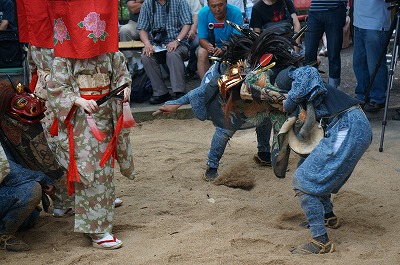
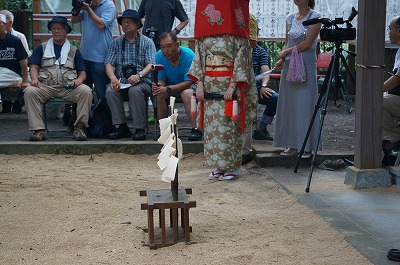
After the performance, the kagura begins. Since this is a venerable shrine, there is no element of joking around, and the ritualistic dancing continues unabated. There is not much movement. There is no ” hyottoko” that comes out in the latter half of the performance and does something funny to entertain the audience.
However, since it is kagura, the point remains the same: to pray to the gods, to appease the evil spirits of the earth, and to express the world of mythology.
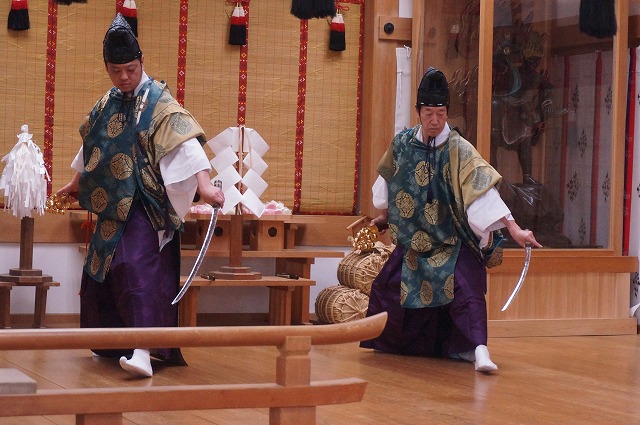
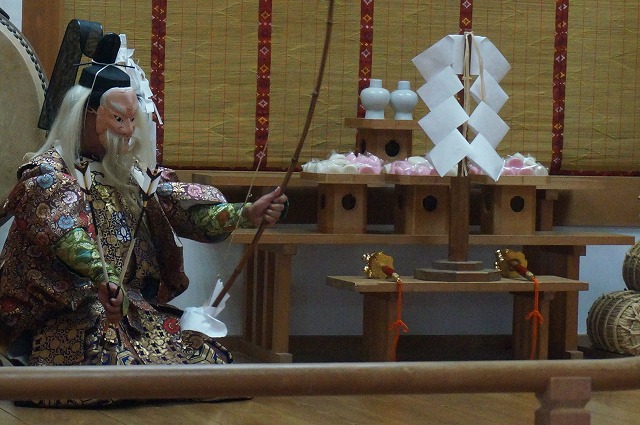
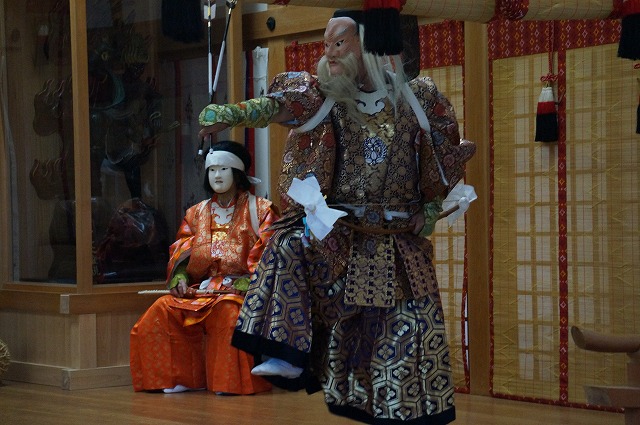
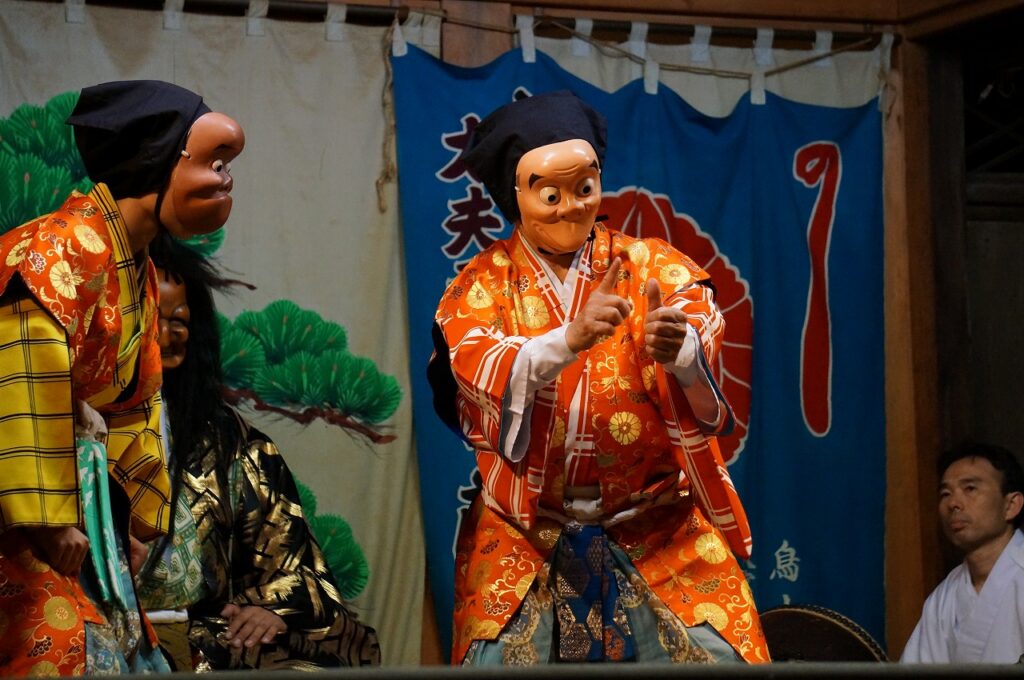
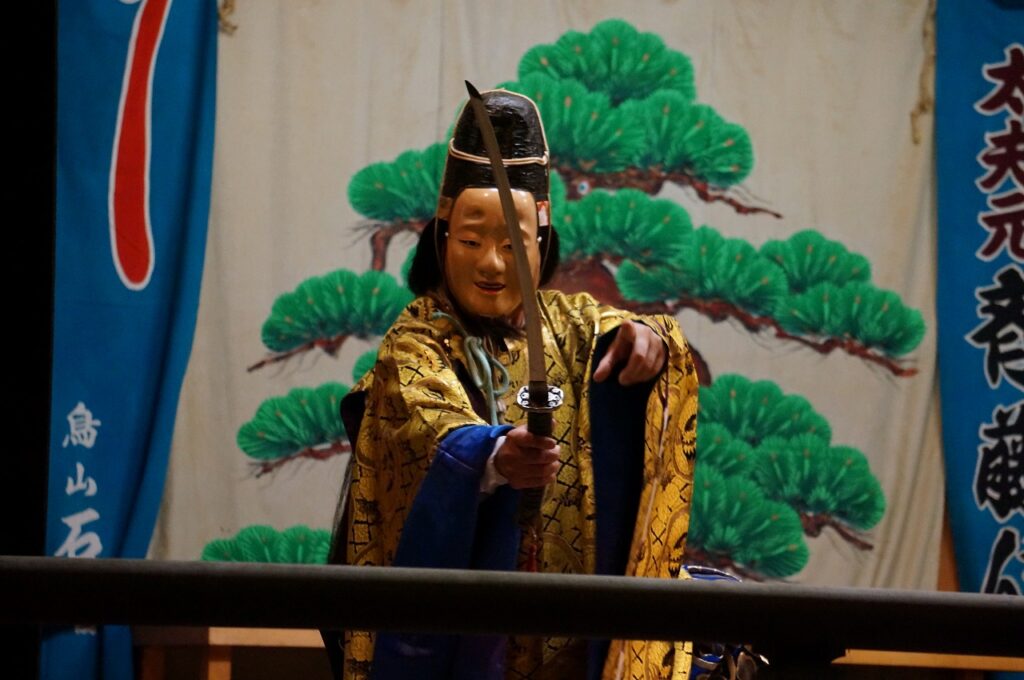
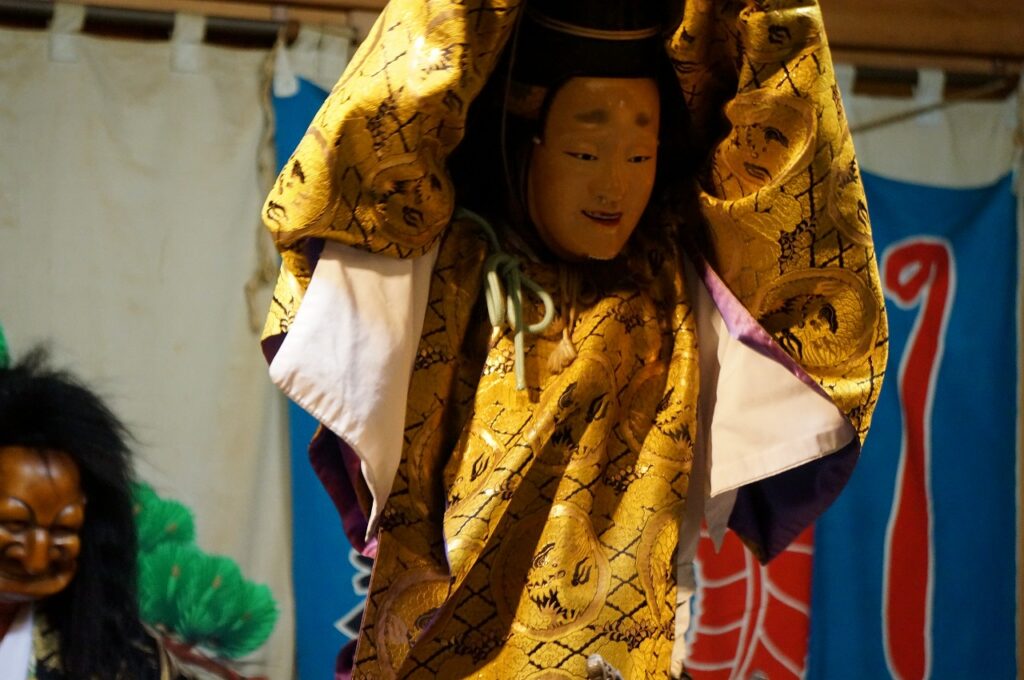
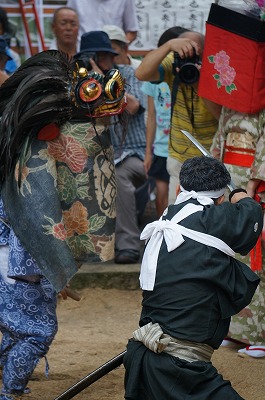
This is a kagura adaptation of the episode of Empress Jingu and her loyal retainer Takeuchi Sukune. Empress Jingu was the queen of the 14th emperor and mother of the 15th emperor. Compared to her husband, the emperor, whose achievements are not so well documented, this mother is amazing. Legend has it that she traveled to the Korean Peninsula and conquered several countries while still a woman. Takeuchi Sukune helped her in this endeavor. In fact, there is no such historical fact, so historians say that there must have been some intention for such history to be written. However, the intention is unknown, although there are various theories.
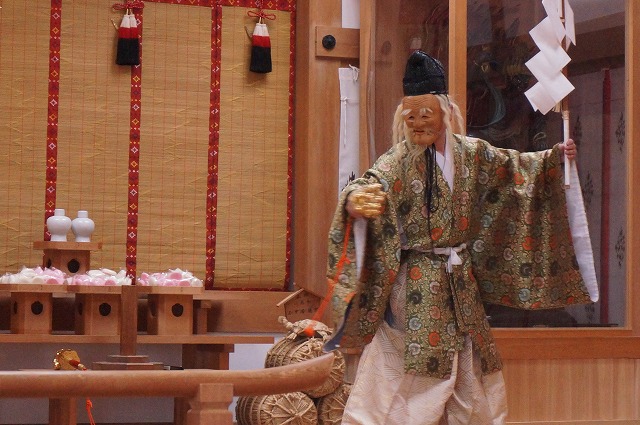
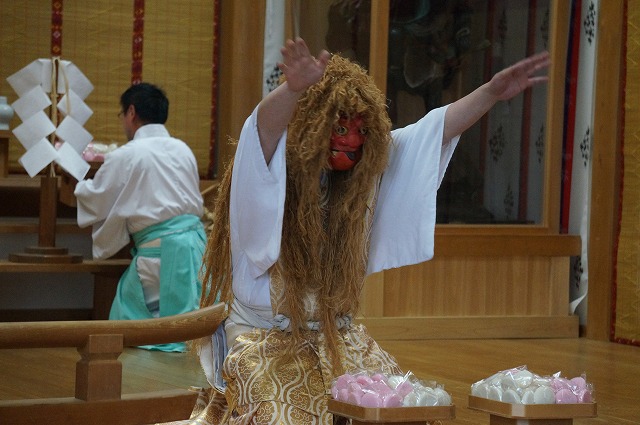
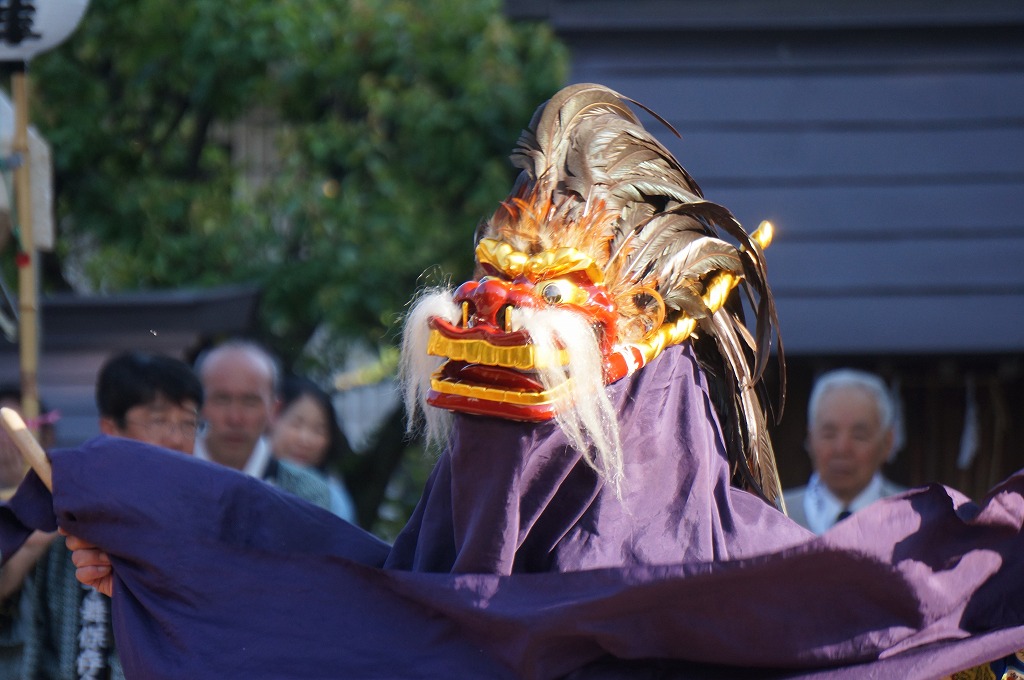
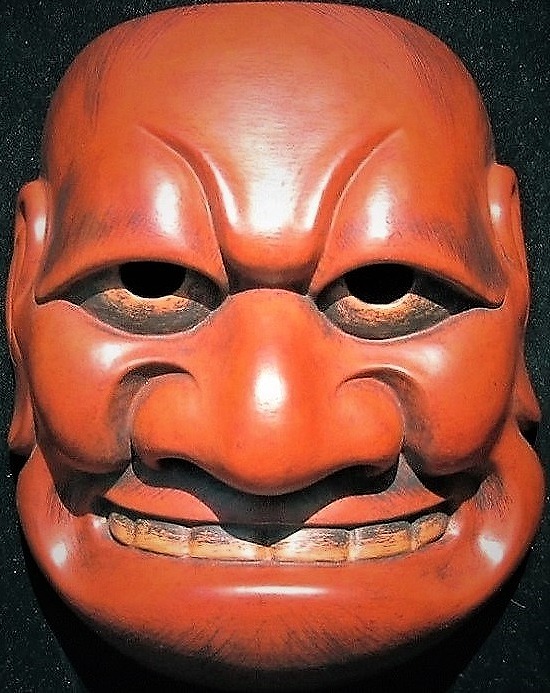
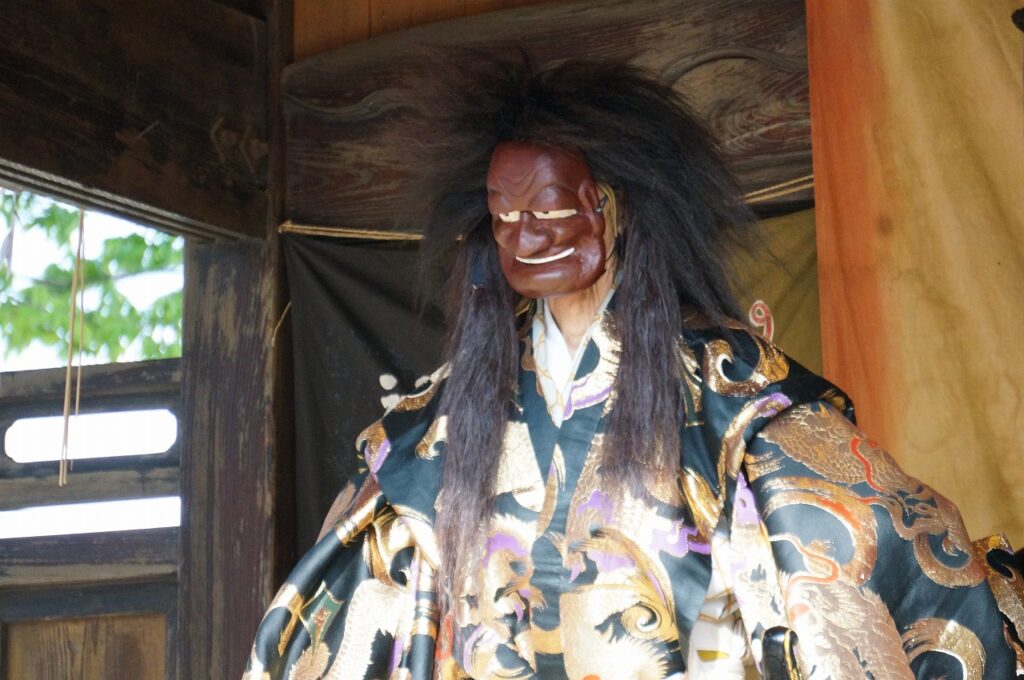
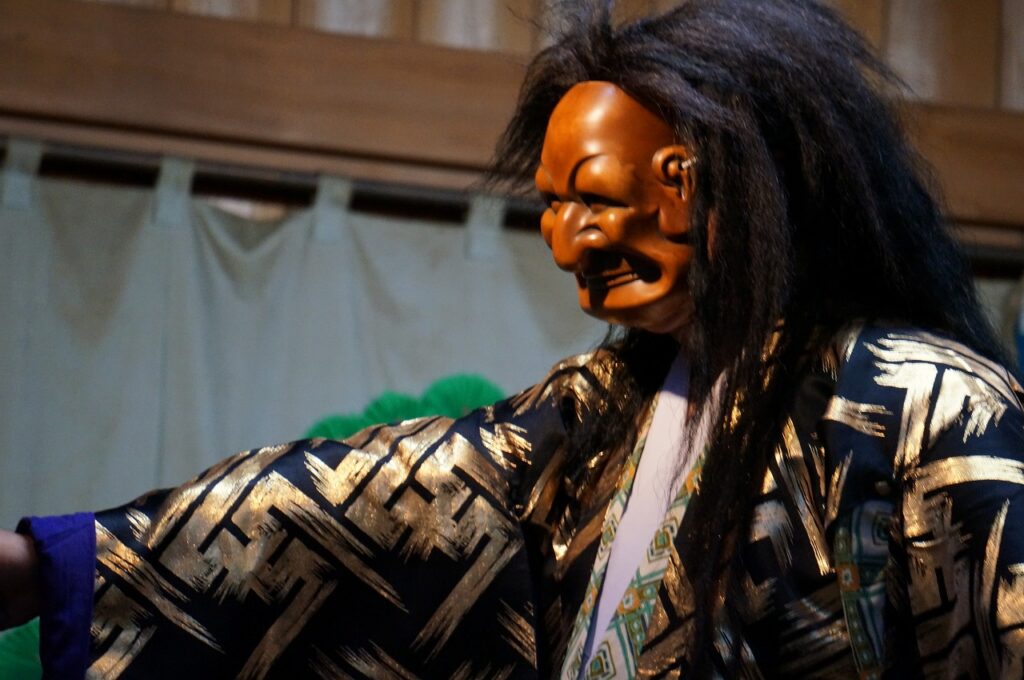
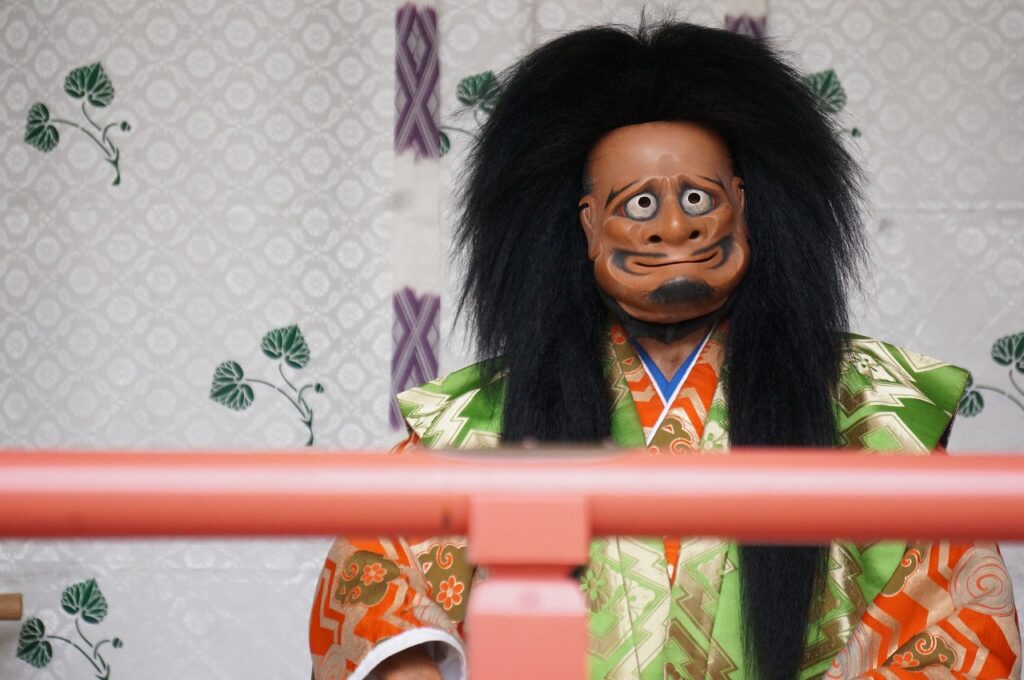
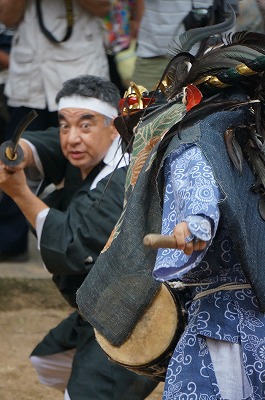
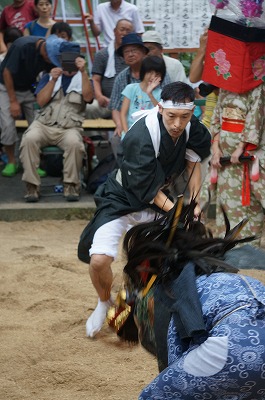
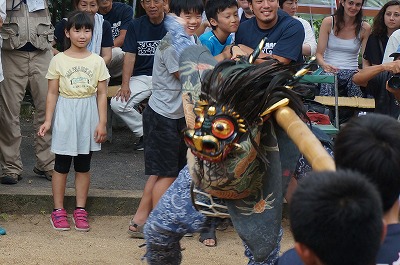
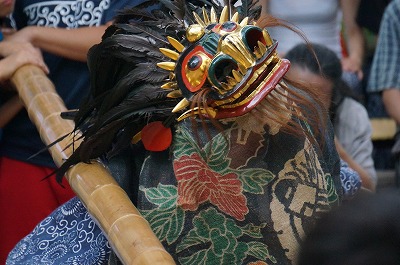
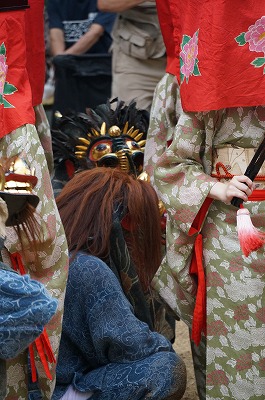
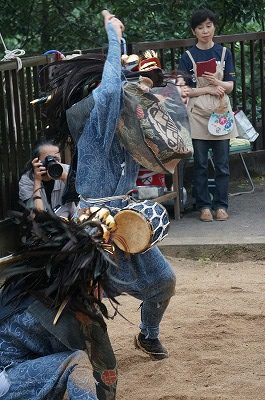
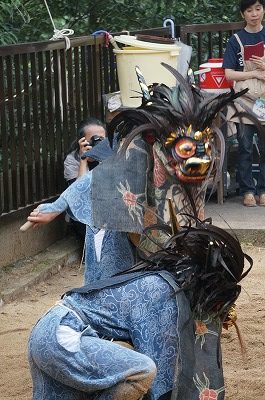
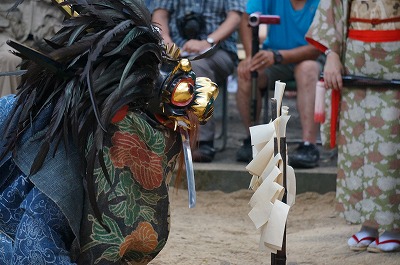
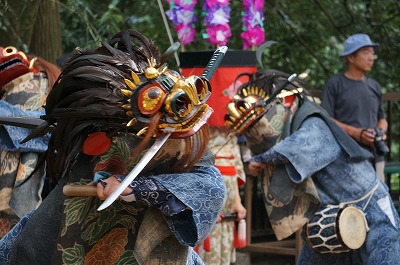
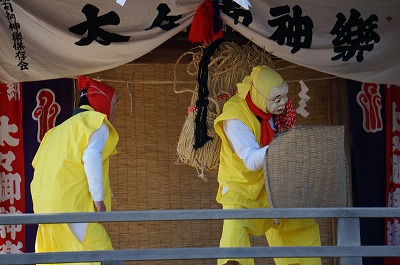
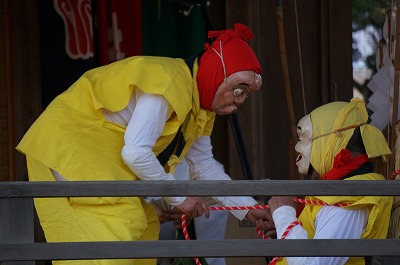
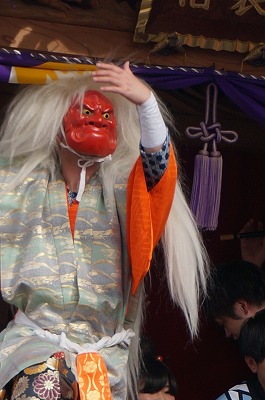
The performance ends with a slightly comical masked “mountain god” with his tongue sticking out, which is unusual for the occasion. The mountain god throws rice cakes at us. The rice cakes, if taken well, bring good luck. The masks are well made and the costumes are gorgeous, as it is a kagura of a prestigious shrine. According to the explanation of an official, each costume costs about one million yen. Although there is no element of entertainment, the experience of listening to this prestigious music and music that is more than 1,000 years old is quite rare. To be able to do so so close to Tokyo is quite an experience. That is, if you are confident in your legs and feet.
Get in touch with nature and view artworks
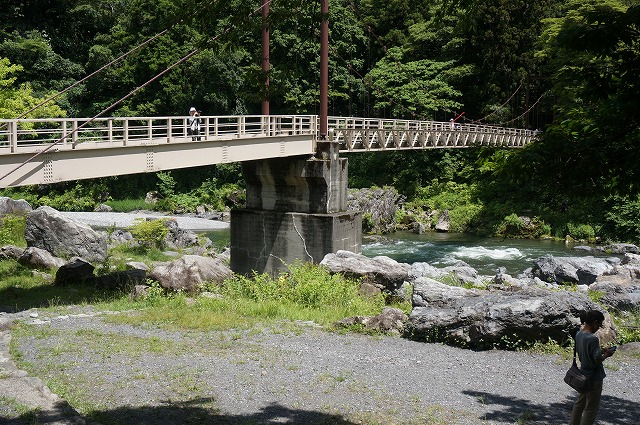
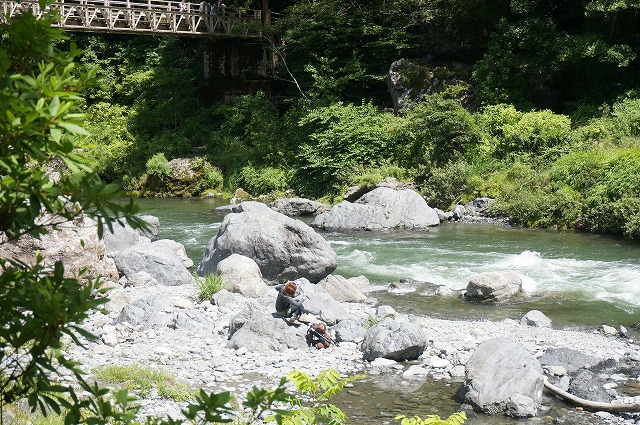
Nice hiking trails with canyons and small museums in the vicinity. There are frequent trains from environs. If you are tired of the city, come here once. https://www.omekanko.gr.jp/spot/80401/
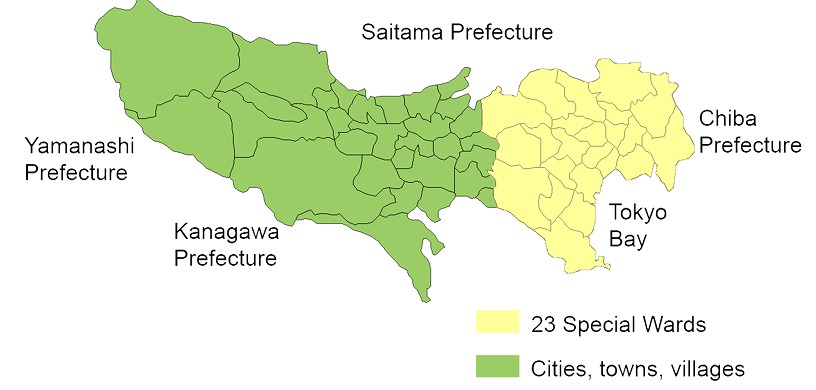
Tokyo, the capital of Japan, consists of two parts: the wards and the rest of the cities and villages. There are 23 wards in total, and people usually think of these wards while they think of Tokyo. Among them, the area facing the bay is the most popular place and land prices are high. Tokyo Station, Asakusa, Shinjuku, and Ginza are all located in this area. Tokyo (then called Edo) has always been a place where people moved around a lot, and it was said that if one have lived in Edo for three generations, he or she was a native Edo resident. Nowadays, this is still the situation, and it is said that half of the people in Tokyo are of local origin with a slight irony . The “Tokumaru 徳丸 no Shishimai” (lion dance of Tokumaru), which is the subject of this article, is a valuable lion dance that still remains in the district. This is because it takes more than three generations to carry on the lion dance.
Date: 5th May, every year Location: 北野 shrine Tokumaru 徳丸 6-34-3, Itabashi 板橋 ward, Tokyo Access: ① Get off at Narimasu Station on the Tobu Tojo Line, take the Kokusai Kogyo Bus bound for Akabane Station West Exit from the ‘Narimasu Station North Exit’ stop (approx. 10 mins), get off at ‘Koubai Elementary School’, then walk for approx. 5 mins ② Approx. 15 mins’ walk from Tobu Nerima Station on the Tobu Tojo Line ③ Approx. 15 mins’ walk from Takashimadaira Station on the Toei Mita Line
It takes about 10-20 minutes from Ikebukuro, the center of this area, to Nerima.
This article is based on a 2017 visit.
Let’s go !
Even in the 23 wards of Tokyo, the buses are not frequent here, because the area is located on the periphery of the city. This is especially true during the daytime. For example, there were times when you had to take the 2:00 p.m. bus even though the event would start at 2:00 p.m. That said, there’s no rush; it doesn’t start immediately at 2:00. The rituals will be performed first.
Few buses, but the sun is nice. The beginning of May is one of the best weather periods of the year. Spring is over and summer is beginning, so temperatures are starting to get a little warmer, but not too much, and it is very comfortable. This time of year is commonly known as “Golden Week” in Japan. This is because it is a period of consecutive vacations, and unusually long vacations in Japan (though they last from a week to 10 days at the most) are possible.
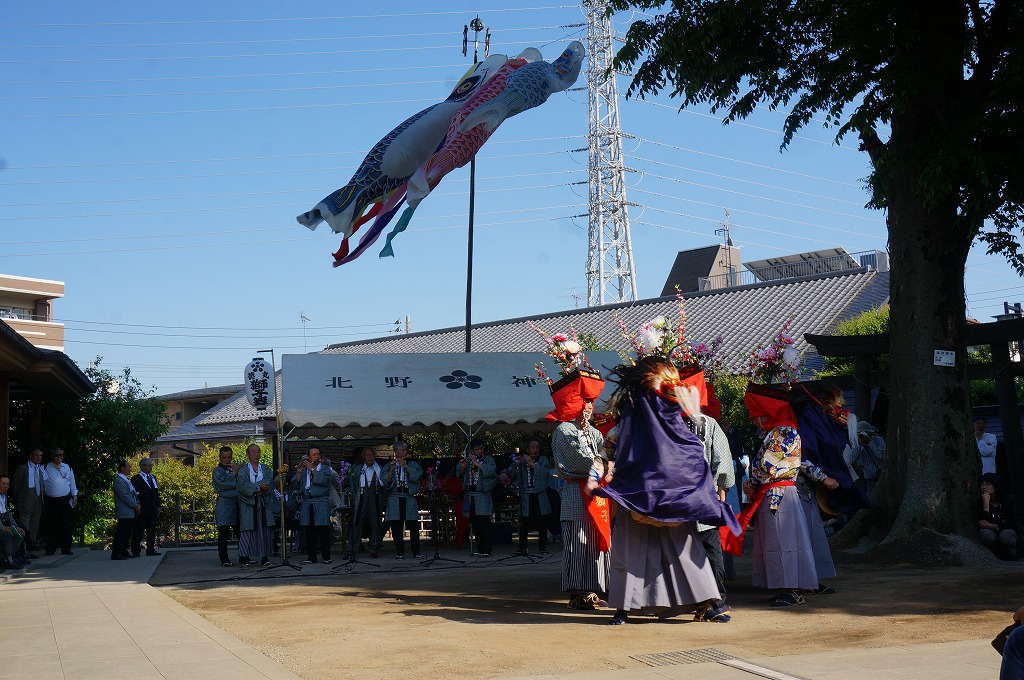
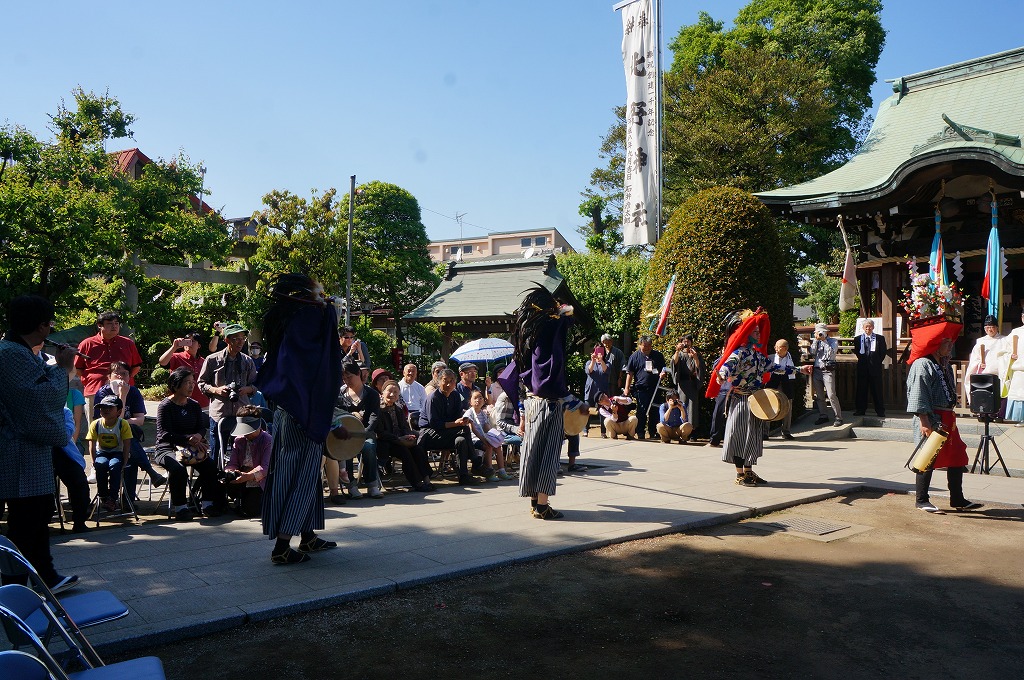
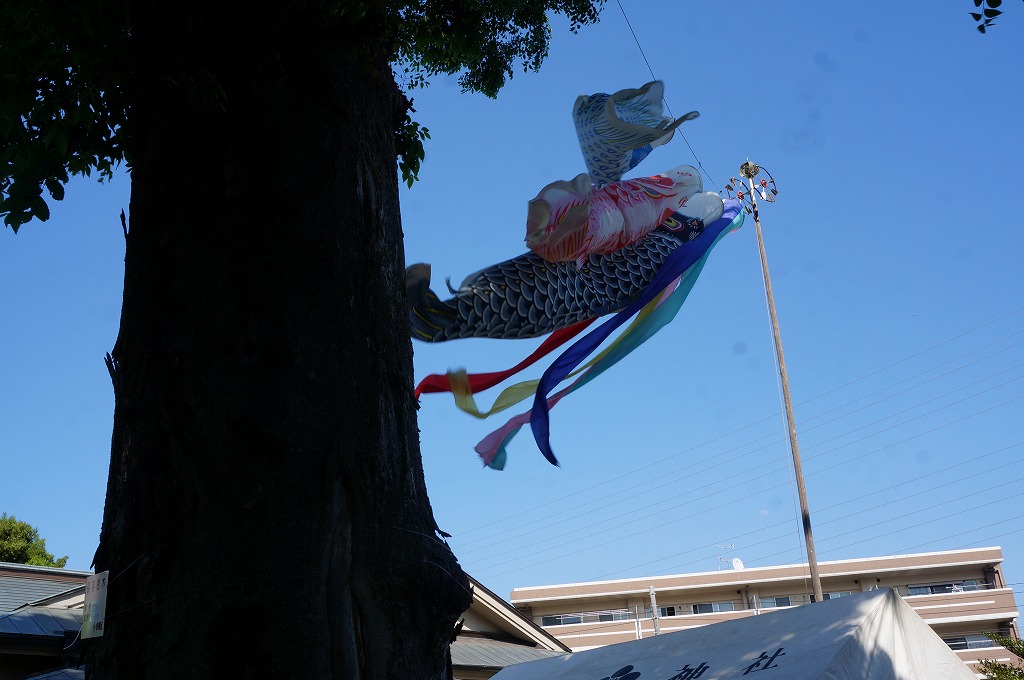
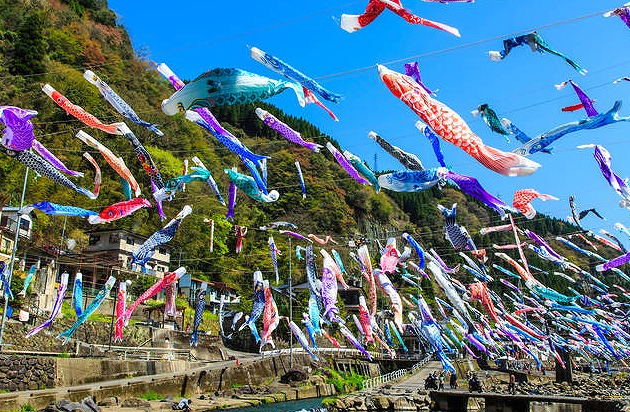
In the lion dance grounds, Koinobori, carp streamers held high flutter in the wind. This is a digression from the main topic, but let me briefly explain about carp streamers. You may skip it if you like. In fact, May 5 is Children’s Day or Boys’ Day, a national holiday to wish for the growth of children. The carp is a symbol of growth, based on a Chinese legend. The carp is never hung alone, but usually several of them. They express the father, the mother, and the children. In the city, there is no place to hang a large carp streamer, and many people put up small ones on windows, but in the countryside, there are still many magnificent ones. Parents also decorate their houses with dolls that resemble warriors. If you go to department stores, you will find many such dolls on sale during this season. Inside the house, parents display a heroic doll representing a warlord. By the way, there is also a holiday for girls, which is March 3. At this time, too, parents decorate their homes with dolls, sometimes as many as a dozen or more in a row for girls, in contrast to only one doll for boys, which costs a lot of money.
Outline of Shishimai
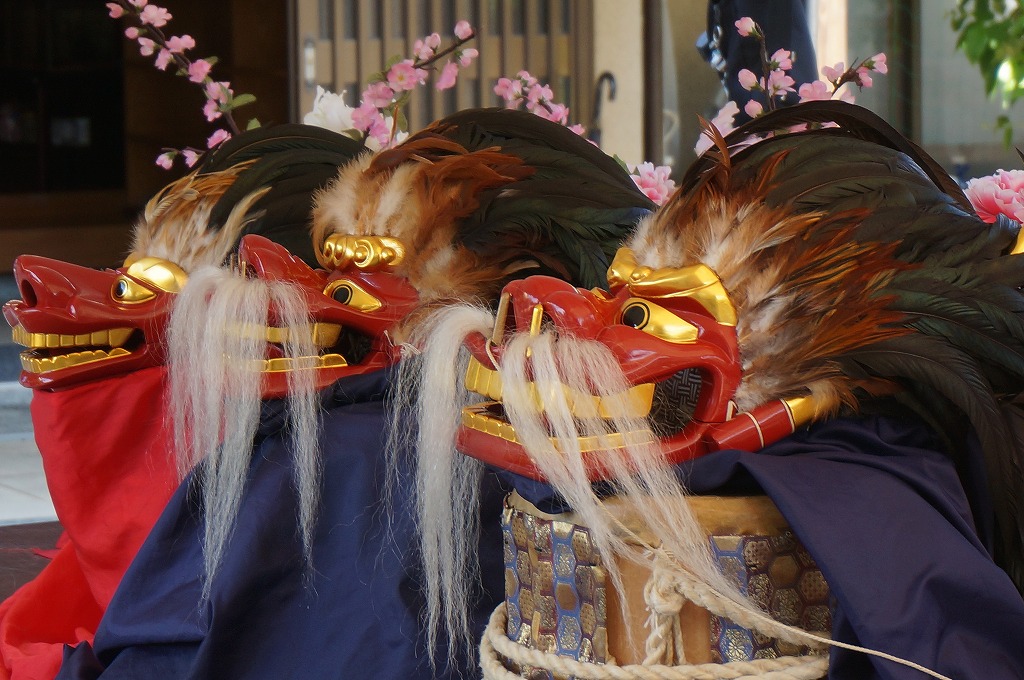
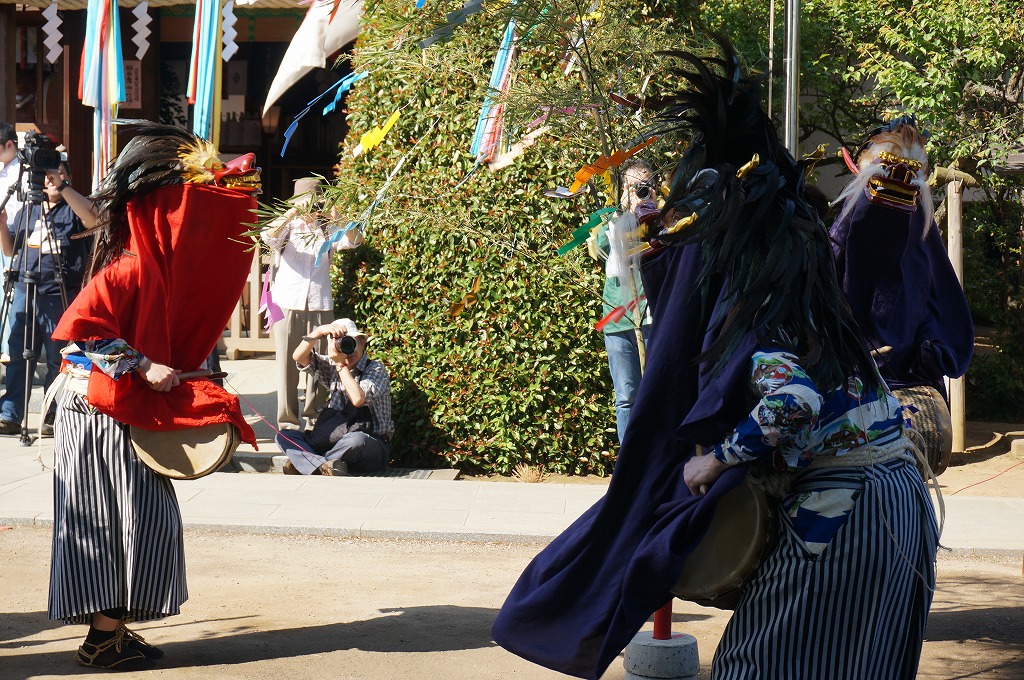
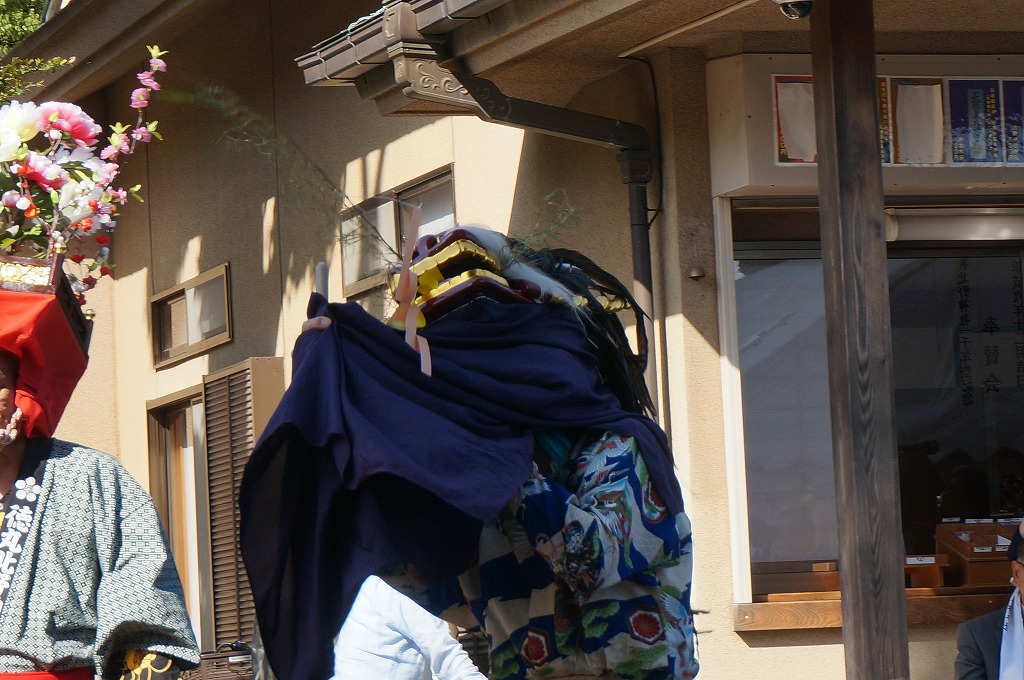
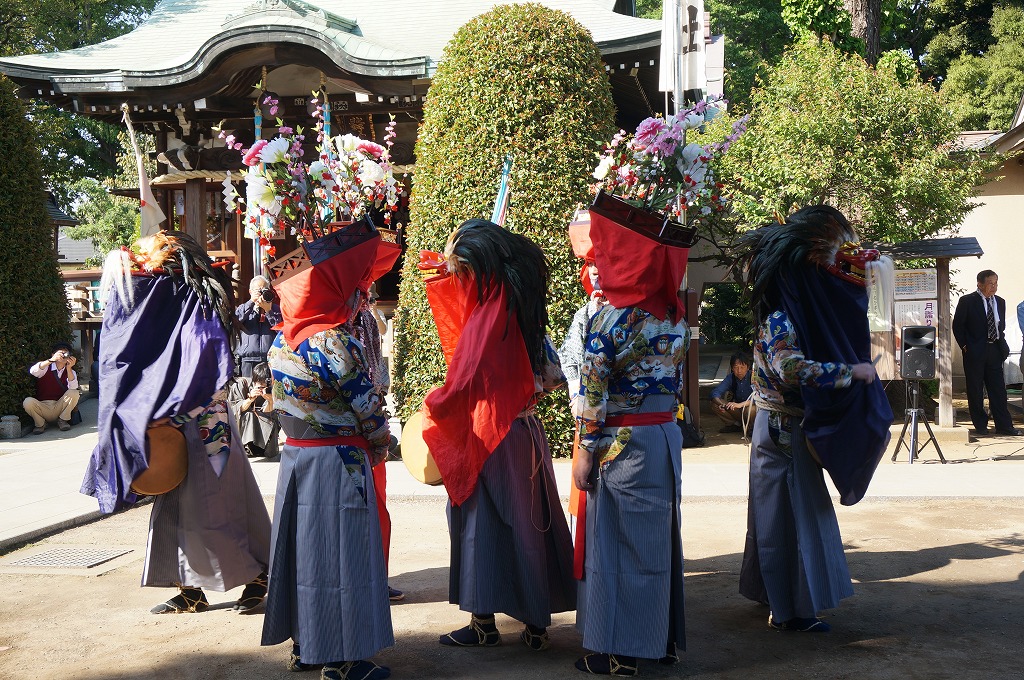
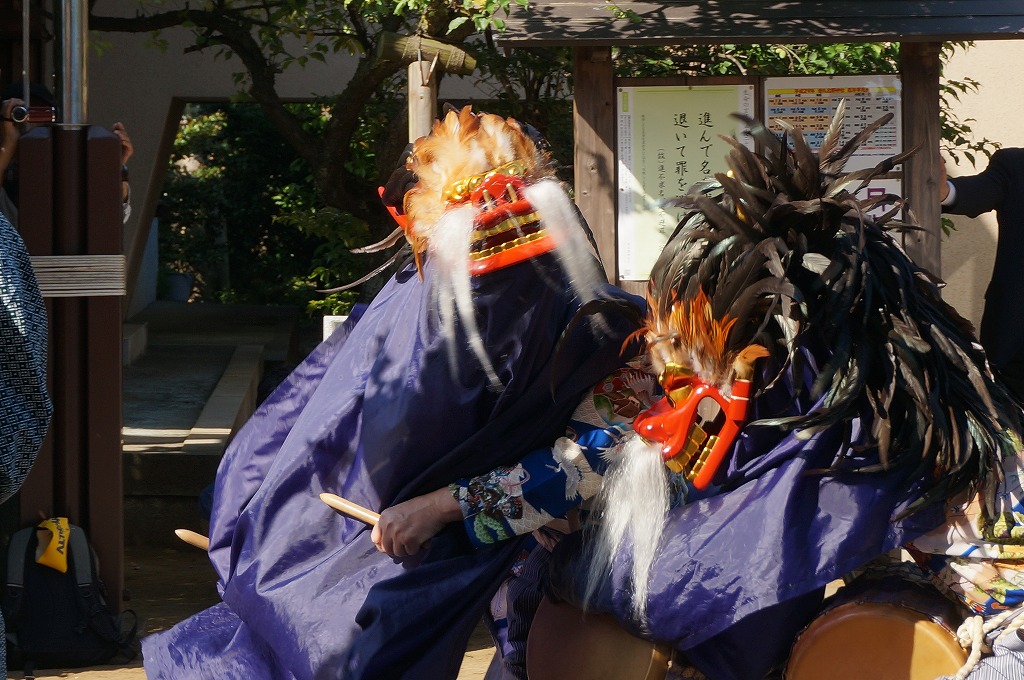
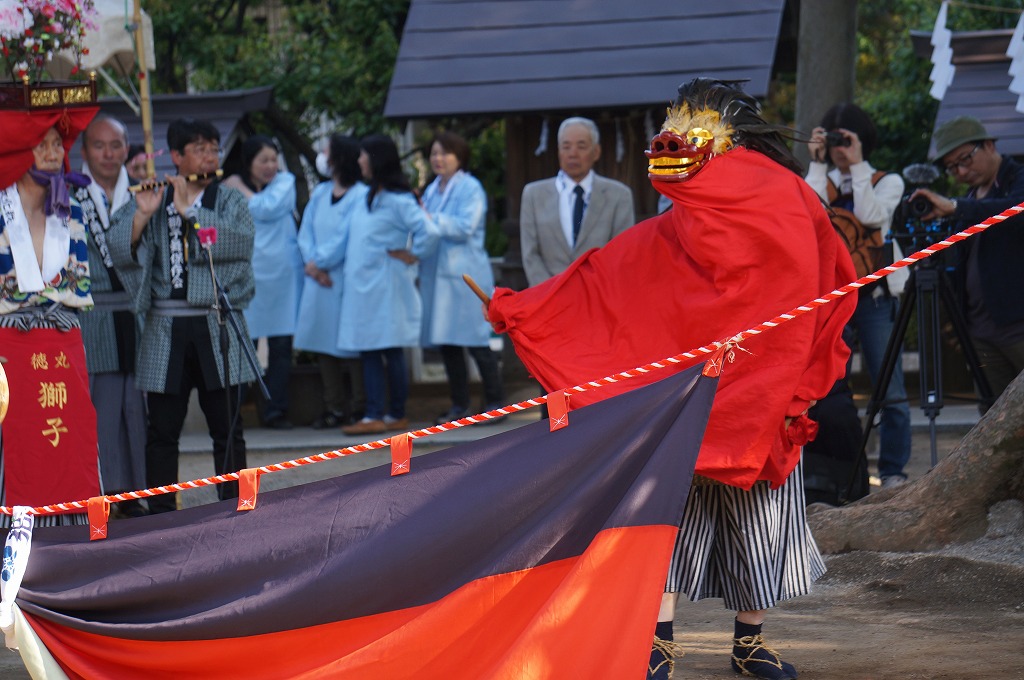
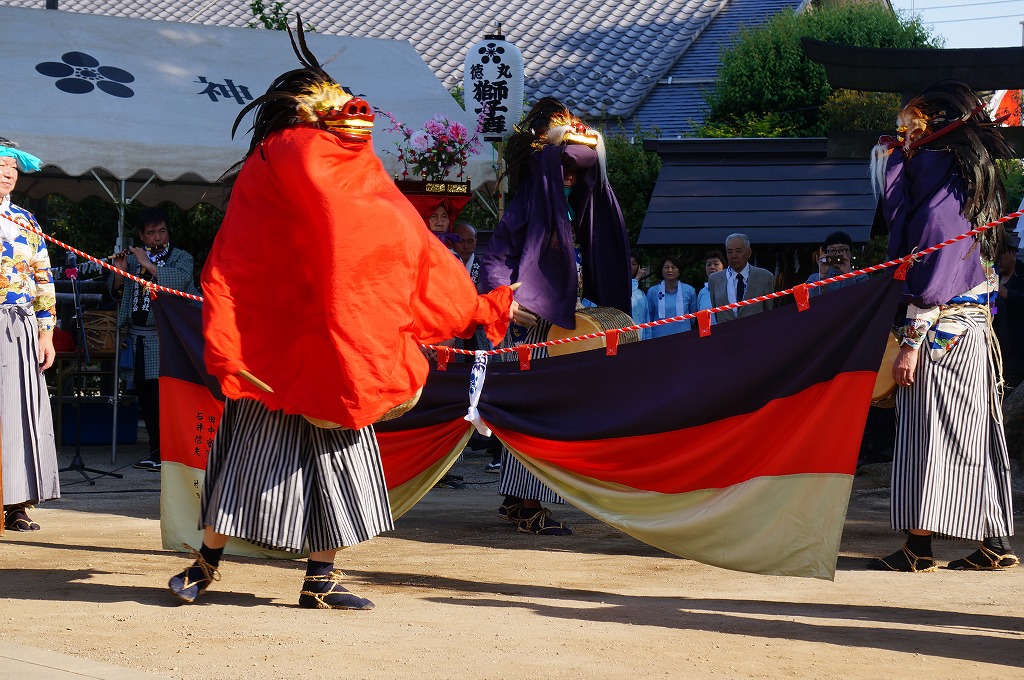
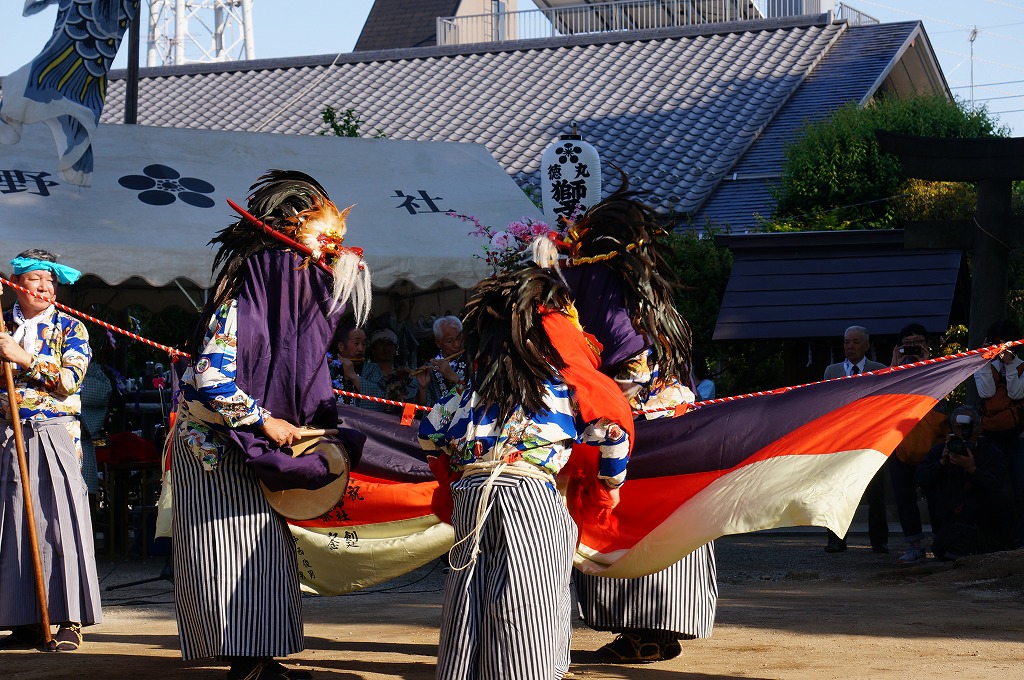
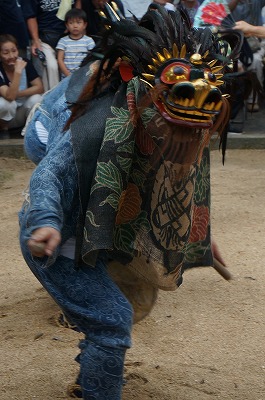
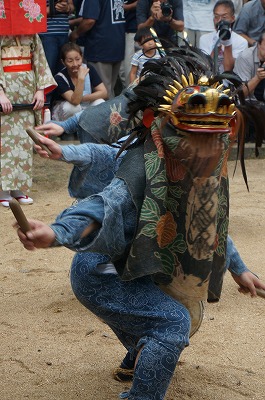
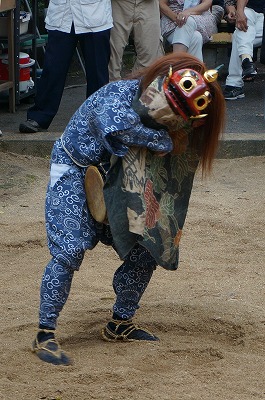
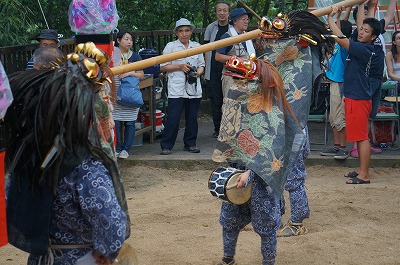
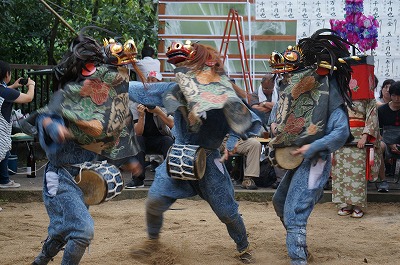
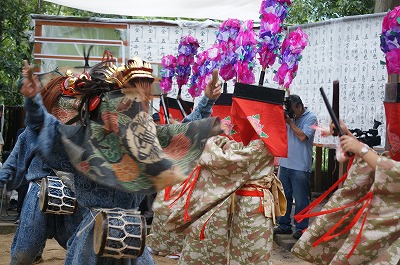
The lion dance is performed by a group of three lions, which is common in eastern Japan. One person is in charge of one lion, and the drum is attached to the front of the lion’s belly and struck by the lion himself. The three lions are an adult lion (called Oh-jishi), a young lion (Naka-jishi), and a female lion (Me-jishi), respectively. The difference can be judged by the shape of the horns. In addition, there are Hanagasa (headgear with flower decorations), several flutes, and others.
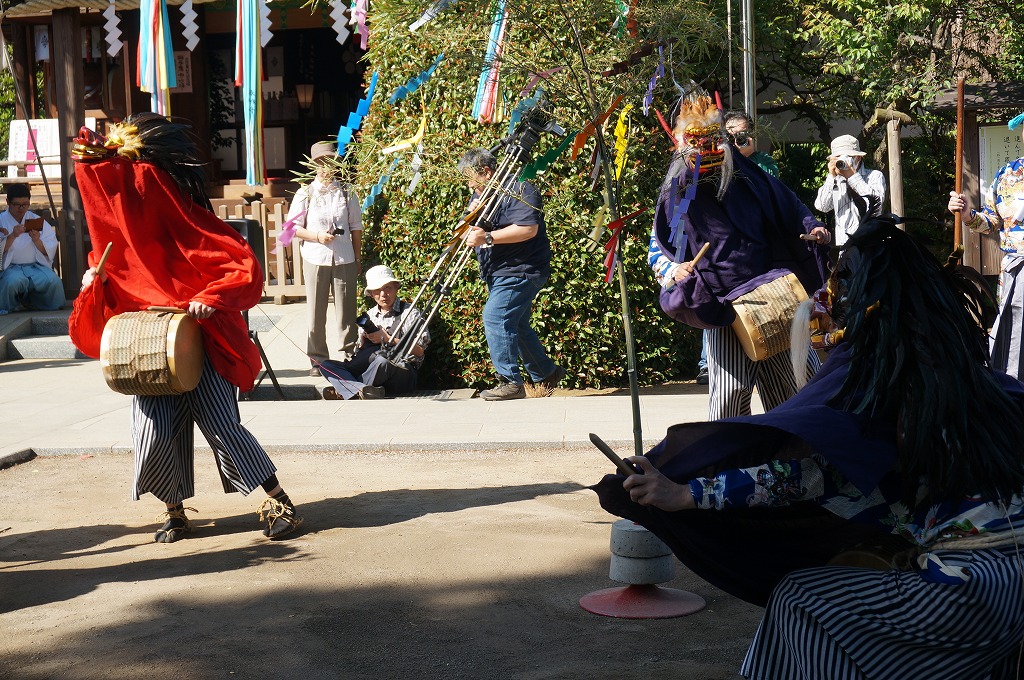
Around 2:30 p.m., the lion dance finally begins. There are a total of seven performances that have been handed down. The first dance is performed in front of the house of the chief priest next to the shrine. In the past, the dance used to go around the town, but the current trend has simplified it. There are three main dances. They are ” Sasagakari,” “Hana-Meguri,” and “Makugakari. Kakeri” means to be involved with something, and “sasagakari” means to be involved with bamboo grass. Hanagasa stands in each of the four directions. This serves as a kind of boundary. In this case, the bamboos represent all the diseases and calamities of the world, and Shishi swallowing them is expected to have the effect of dispelling the calamities. Shishi (lions) keep their posture low and exert themselves to drive away all the calamities.
Hana-meguri ~Garden of strife
“Hana-Meguri” is a performance called “Female Lion Hiding,” which is a common part of lion dances in eastern Japan. In this performance, the three lions are initially friendly, but as soon as the female lioness disappears, a mood of disquiet envelops them. Here in Tokumaru, it’ s no exception. The three animals are in a state of friendly head-to-head contact. Eventually, only the female lioness disappears into the flower garden (hanagasa, or flower hats, are gathered together to form a flower garden). What’s happening?” Two lionesses ask each other, “What happened? The two males split up and go looking for it. Then young male finds the female first, and although he could have just reported right then and there that she was there, he doesn’t. He tries to monopolize the female. The older male lion comes later. Naturally, he’s not amused. A fierce battle ensues. This is repeated mutually. By the way, why did people in the past create such performances, and why did they continue to do so endlessly?
Maku-gakari ~beyond this world
The last performance is called “Maku-gakari”. As far as I can see, this is the most important performance in this lion dance. First, a curtain is placed in the center. In front of this curtain is a world filled with suffering. This is the world we are in now, or in Buddhist terms, this is the present world and the other side is the Pure Land. And they are interested in the world beyond. They timidly approach the curtain to see what appears to be going on.
The first to break through the wall is the lioness. Yes, the female always overcomes constraints with ease. At the time this was created, the restrictions on women were even stricter than today. Despite this, they may have seen that this is essentially what people are like. They seem to be sending a message that transcends time. “In fact, it is women who are the most free and courageous.” It is the young male who will be the next to overcome. Youth gives us more power than anything else. The oldest male lion is the last one left. The lions who went before them call out. “There is a wonderful world out there,” they say. “Come quickly.” He is sure they know this. But he can’t cross over, can’t venture out. That’s what it means to grow older. The things one carries become heavier and heavier. So he must be thinking, “If I go on an adventure, I might ruin everything.”
This “Ohjishi” is performed by the most seasoned veteran. The performers must have a certain amount of experience in order to express their anguish and conflict. So, when they overcome the difficulties, they are moved deeply. ”I can still do it. It is still too early to grow old. Only by continuing to boldly take on challenges will life shine brightly.” It seems that this Ohjishi are conveying to us the voice of those who lived long ago.
When this is over, it will be after 4:00 pm. It’s the end of all the performances. The early summer sun was already beginning to set.
Report: Seven Deities of Good Fortune Parade Celebrating the New Year at the center of Tokyo
Date: 7th, January every year Location: 1-2-7 Toranomon, Minato-ku, Tokyo Access: From Toranomon station (subway, Ginza line) within 1 minutes walk,
What are the seven deities of Good Fortune?
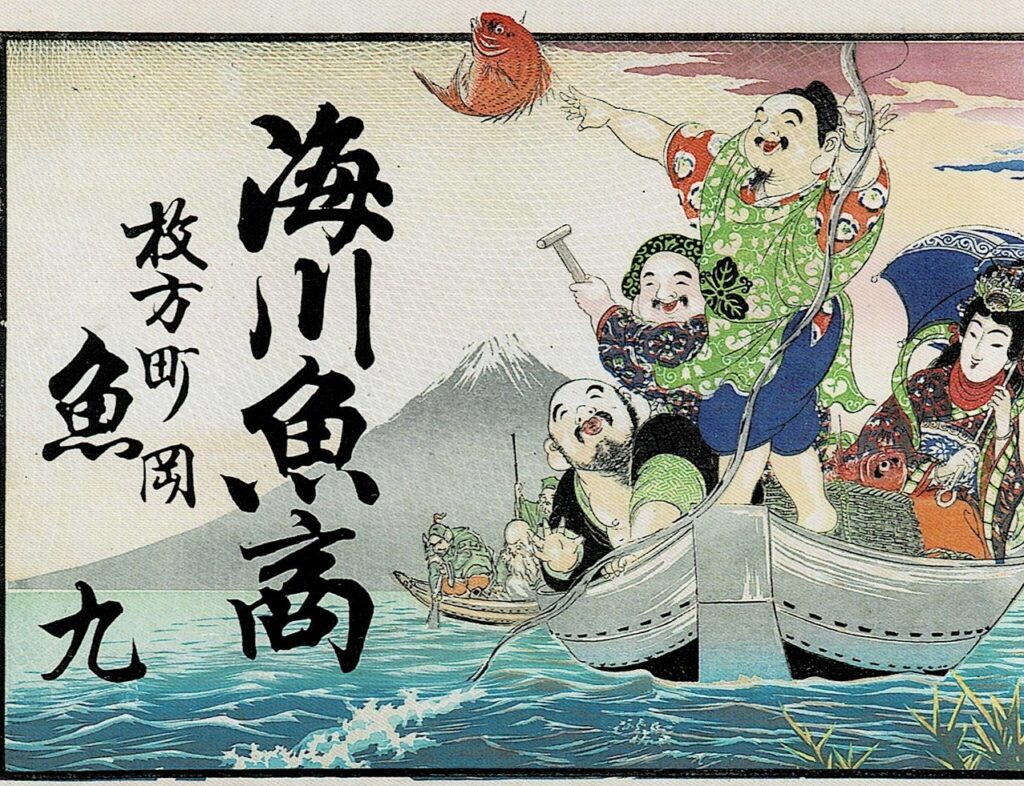
seven deities on the treasure ship
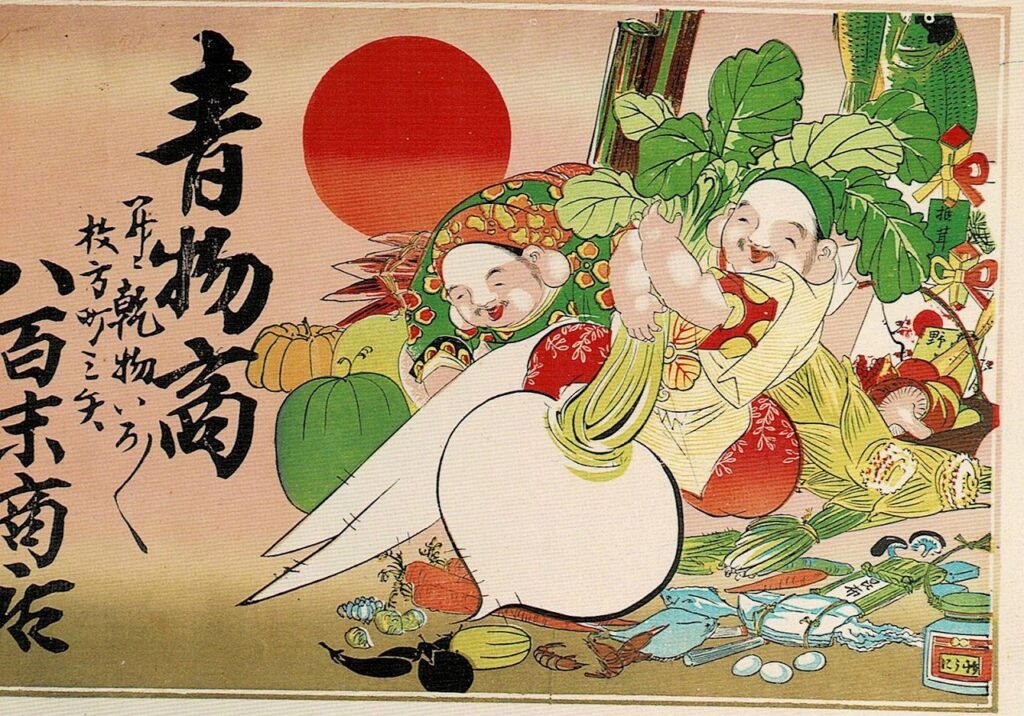
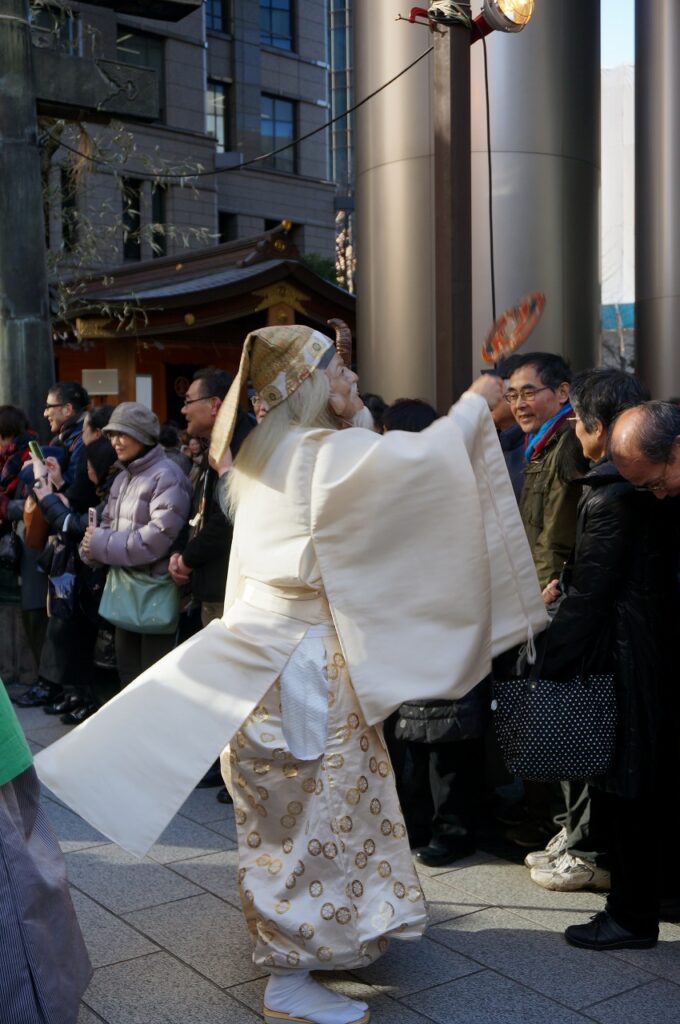
Ebisu and Daikoku
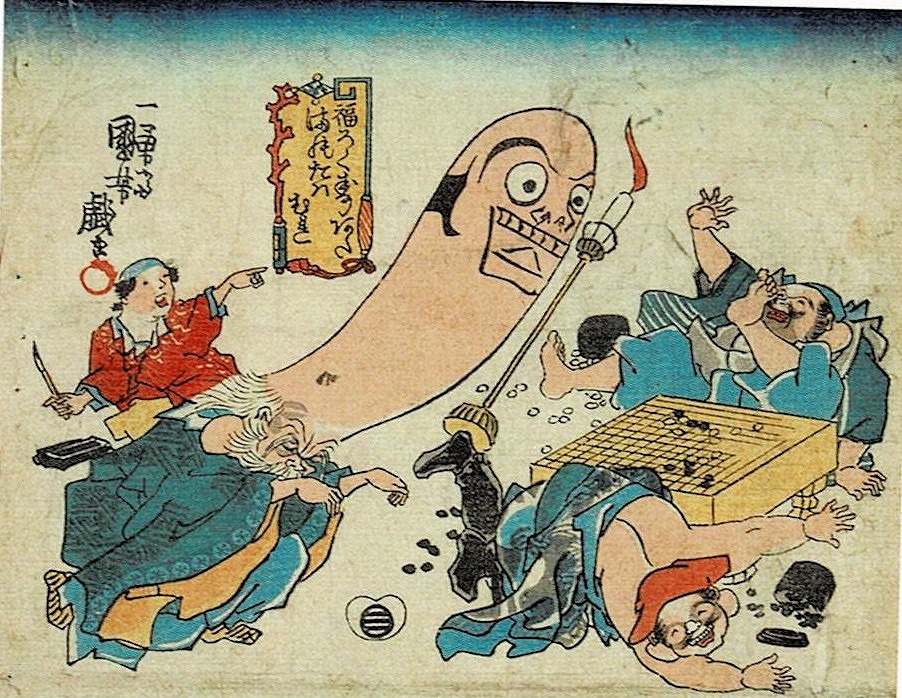
All of the above are from Edo-period merchants’ advertising fliers.
It seems that Japanese people are considered to be lax about religion. Sometimes, they say that Japanese are even described as irreligious. I have mentioned this before on this site. One of the reasons for this is that the Japanese are polytheists by nature. When Japan accepted Buddhism, people faced the conflict with their original religion (which I now call Shinto). Therefore, people came up with the theory of “Shinto-Buddhist syncretism. They said that God and Buddha are the same. This theory continued on and on until the Meiji Restoration (1861). The best example of this is the Seven Deities of Good Fortune. This belief introduces seven deities that signify happiness as one group and began in the late 15th and 16th centuries. The seven deities are Ebisu, Daikoku, Hotei, Bishamonten, Benzaiten, Fukurokuju and Jurojin, seven in all. The Seven Deities of Fortune in Japanese Mythology has the following characteristics : Ebisu (恵比寿): the deity of success in business (The country of origin is Japan) Daikoku (大黒): the deity of commerce, agriculture, and prosperity (The country of origin is India) Hotei (布袋): the deity of happiness, contentment, and good fortune (The country of origin is China) Bishamonten (毘沙門天): the deity of war and victory (The country of origin is India) Benzaiten (弁財天): the deity of financial fortune, music, and art (The country of origin is India) Fukurokuju (福禄寿): the deity of wisdom, luck, and longevity (The country of origin is China) Juroujin (寿老人): the deity of longevity (The country of origin is China) As you can see, they have different origins and different sources. There is only one deity of Japanese origin, Ebisu. Moreover, there are many complications such as assuming that Daikoku (大黒) and Okuninushi (大国主 Japanese deity) are the same because they are pronounced the same. (大国 can be pronounced “Daikoku”). There are both shrines and Buddhist temples where they are enshrined. Of course, these are beliefs that have spread among the common people, so nobody has officially decided on them. Since the seventeenth century, they have taken on the currently known form and have been popular ever since. Today, each region has its own shrines and temples dedicated to the seven deities of good fortune, and a tour of the seven deities of good fortune during the New Year is a common sight.
Why is this shrine located at the center of Tokyo ?
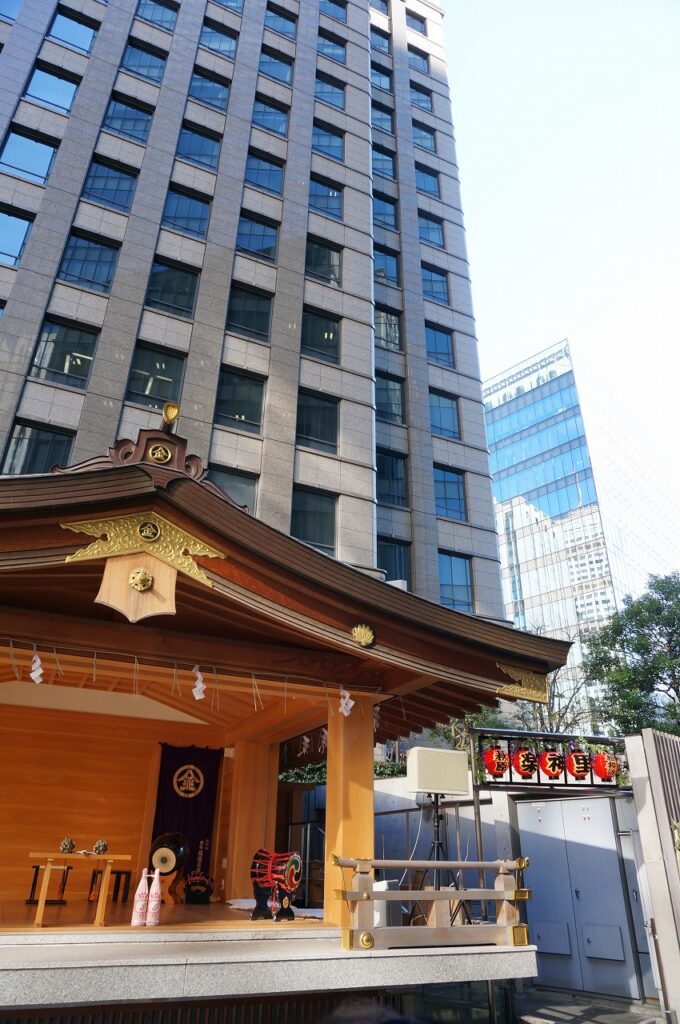
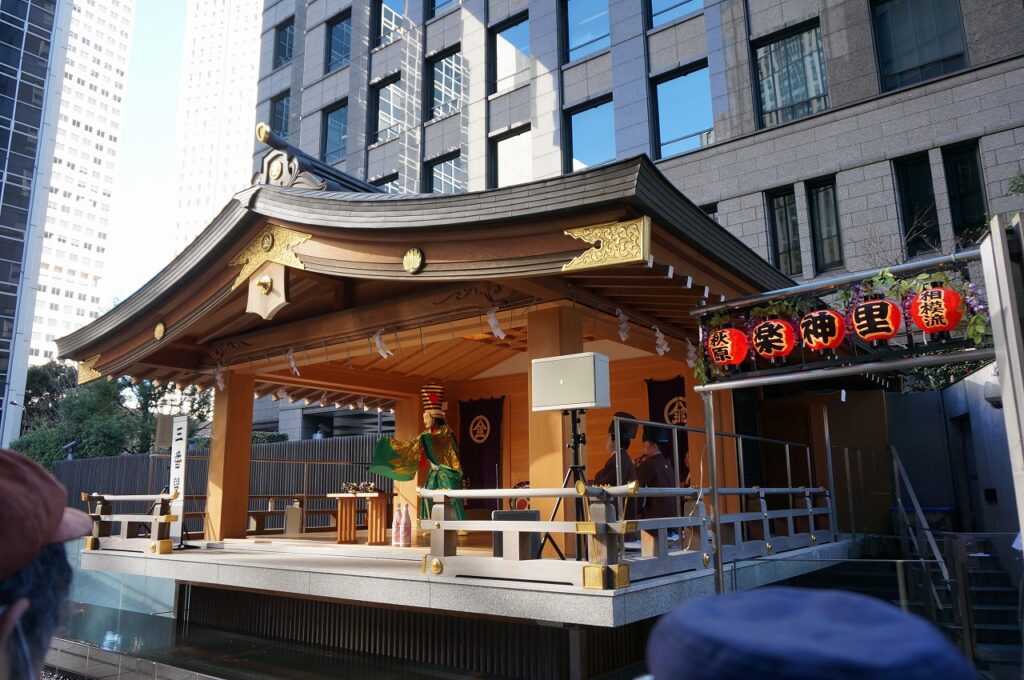
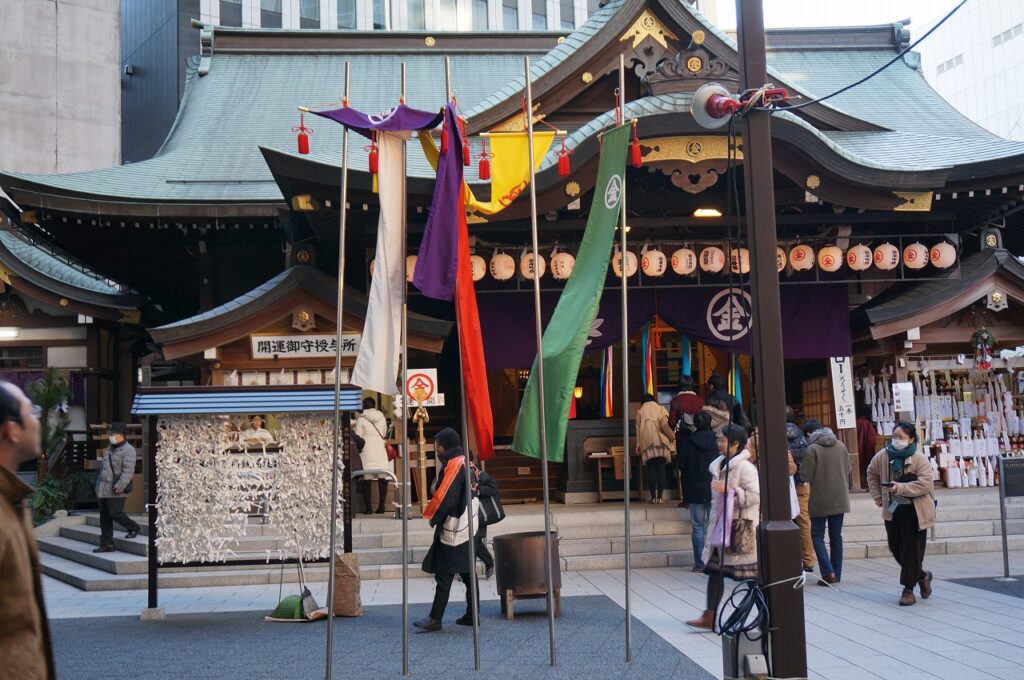
The “Seven deities of Good Fortune Procession” that this site introduces is held at Toranomon Kotohira Shrine. The Kotohira Shrine is a famous shrine in Kagawa Prefecture that everyone knows. This is a branch shrine built by inviting a deity from there. It is located at Toranomon. It’s location is not too much to say right in the center of Tokyo. It is right next to Kasumigaseki, where the National Diet Building and other central government offices are located. Toranomon Hospital, which is just a minute’s walk away, is where the Prime Minister and other famous people are hospitalized. As a result, the area is surrounded by a forest of buildings. The reason why there is a shrine in such a place is that this area was once home to a series of feudal lords’ residences, and the feudal lords of what is now Kagawa Prefecture built the local Kotohira Shrine here, which has remained without change.
What else will take place besides the Seven Lucky Deities Parade?
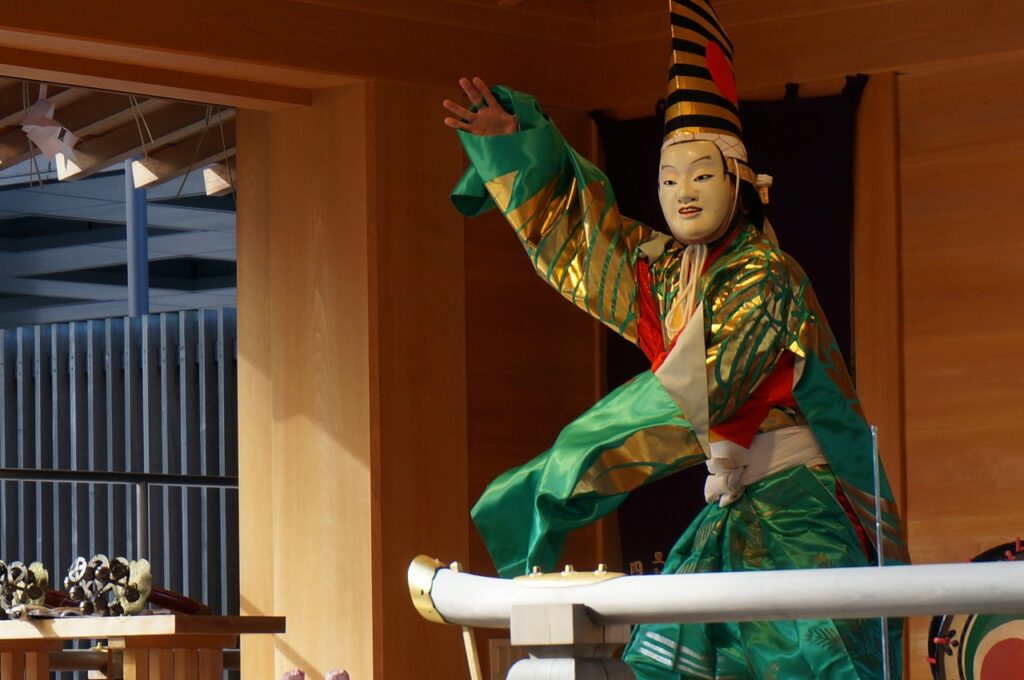
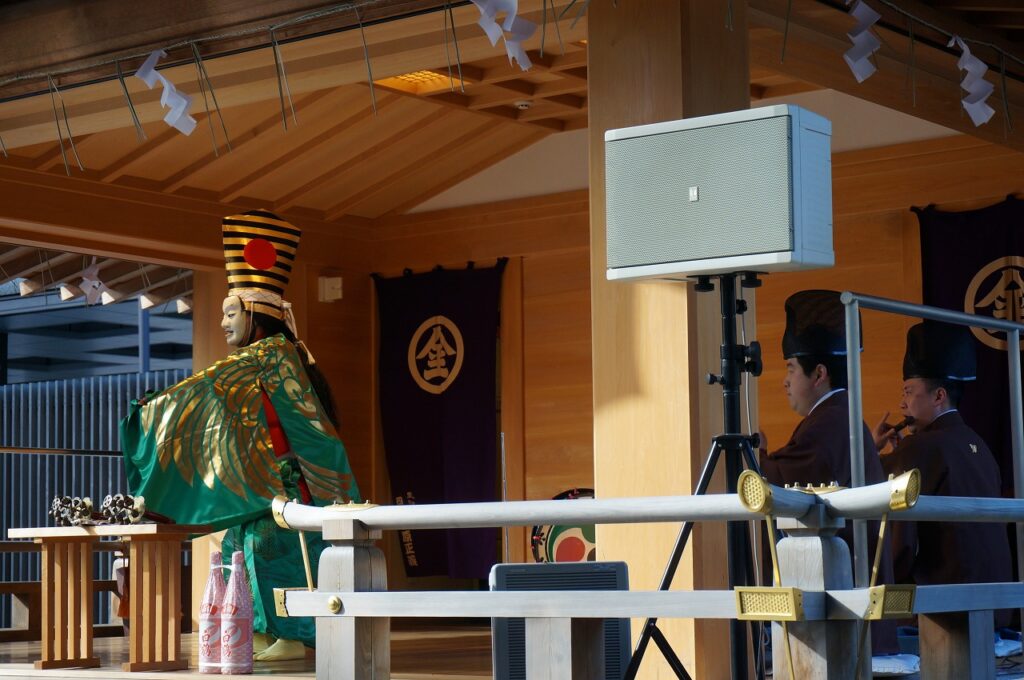
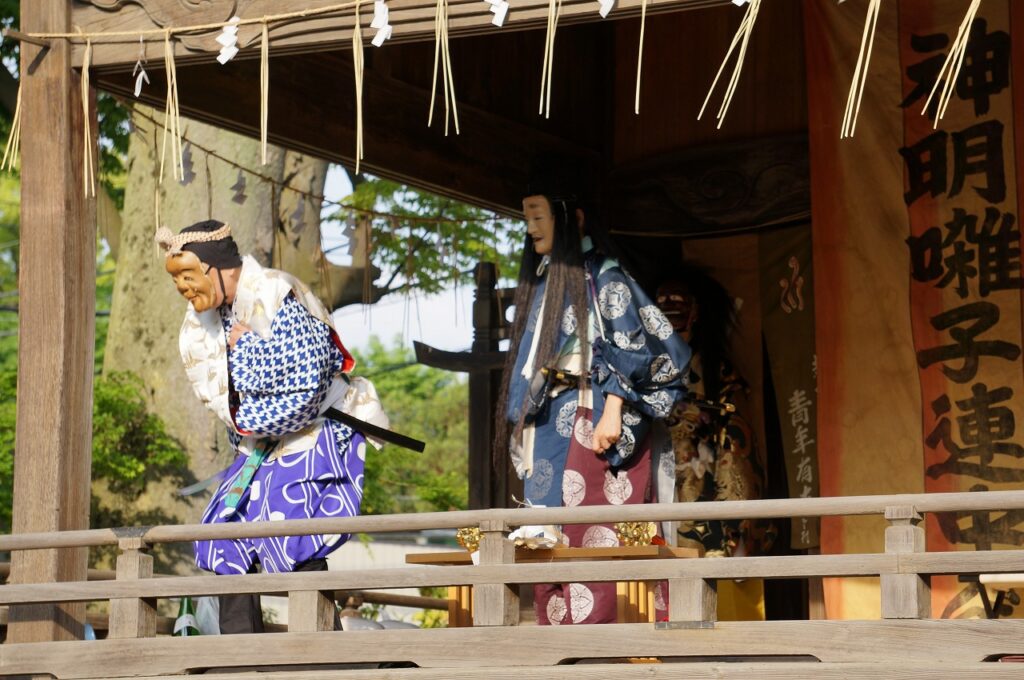
※This article is based on the year 2015. However, the program will basically remain the same. The parade of the Seven Gods of Good Fortune that we wanted to see started at 11:00. But there is no harm in going early. There are many other events besides the parade. One of them is the performance of Edo Sato kagura. It starts at 10:00. This fixed time is one of the characteristics of this place. This is something peculiar to business districts. The first performance was “Sanbaso” in 2015. This is also originally from Noh, and is often performed in Kabuki. When it is performed in Kagura, the performers often wear hats with bright red circles, costumes with crane designs, and long sleeves. Hagiwara troupe performs. This troupe is prestigious, so the dance is elegant. About 45 minutes.
1st Parade ~Are the Japanese really so devoid of religion?
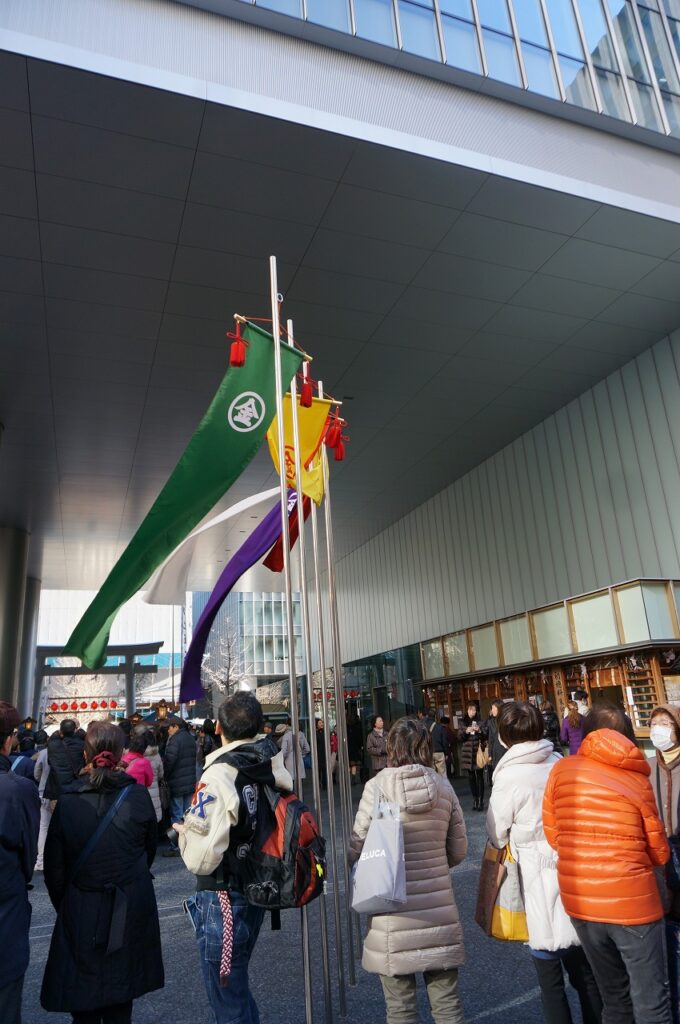
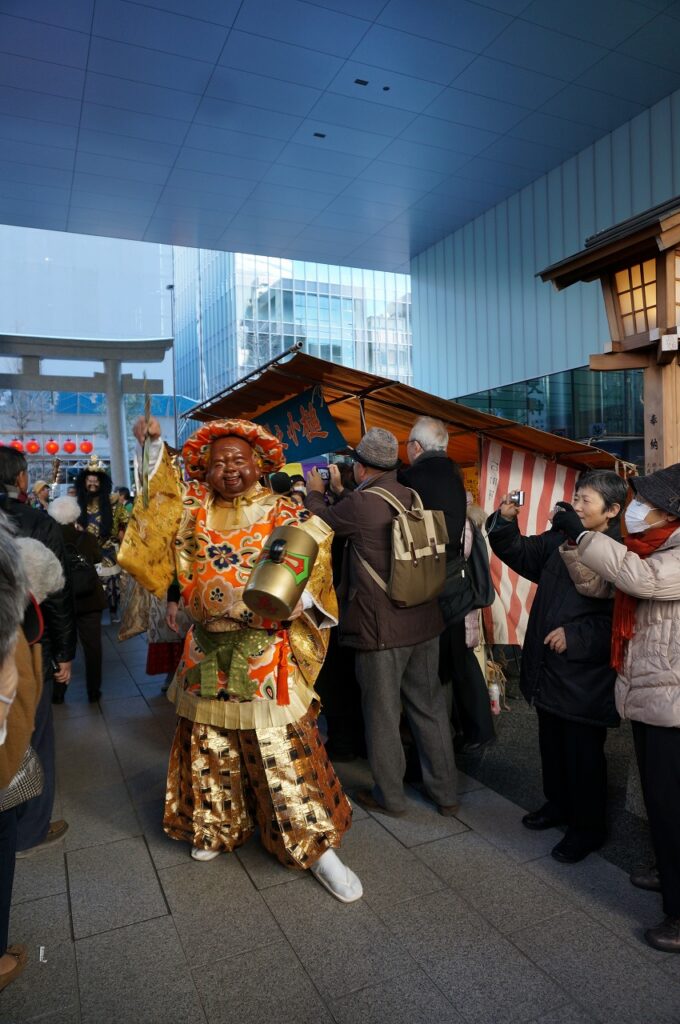
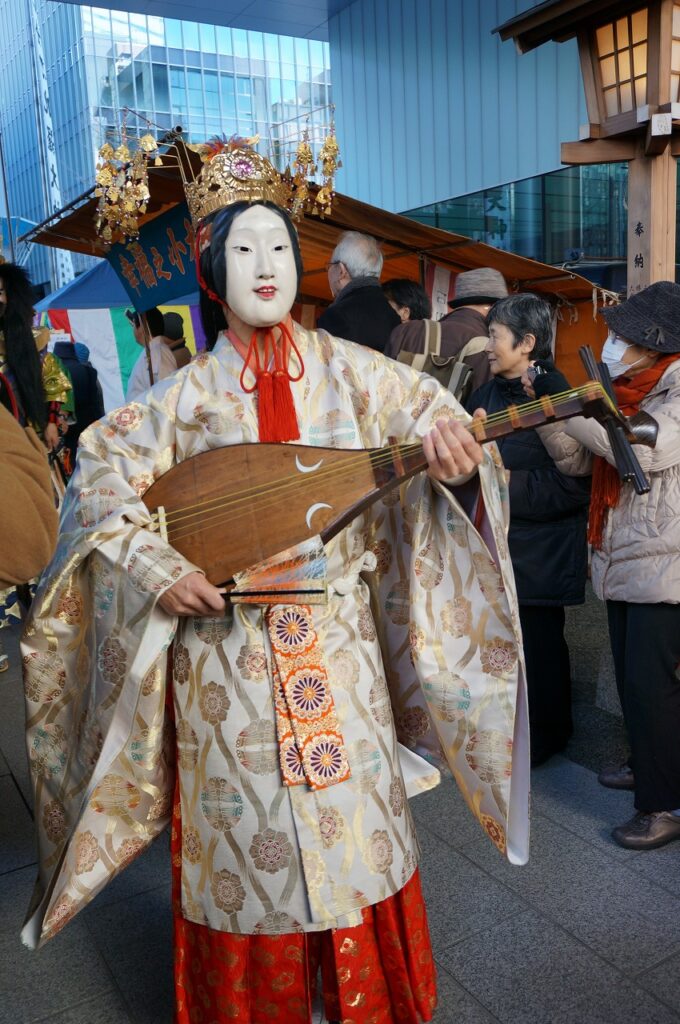
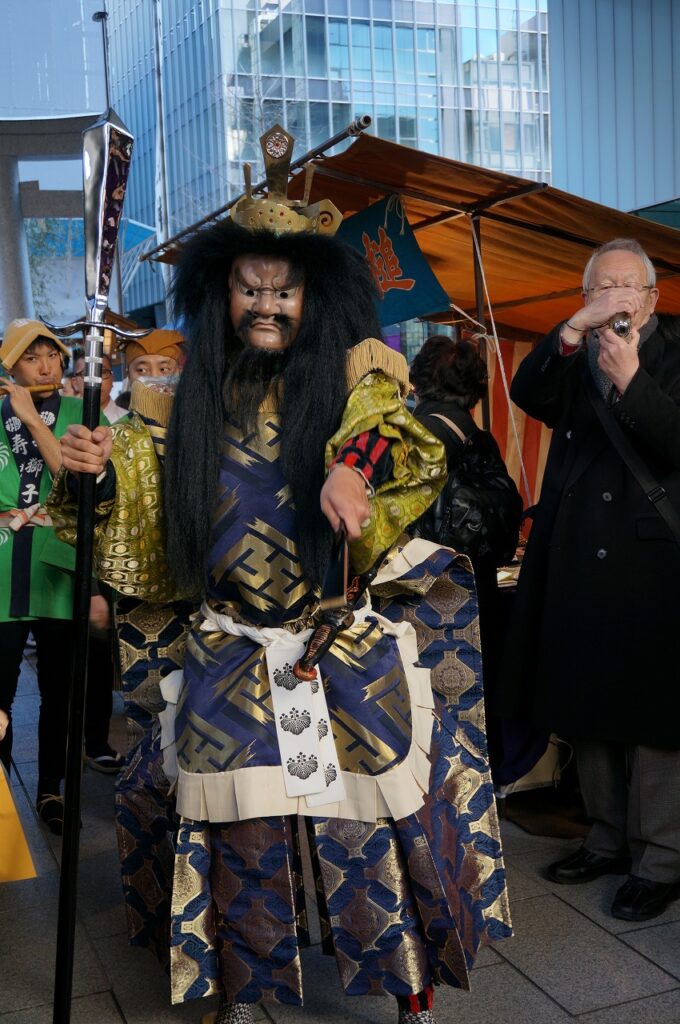
At eleven o’clock, the procession of the seven gods of good fortune that you are looking for begins. The procession takes place twice a day, and this is the first one. There are two entrances to the temple grounds. The procession comes from one of them where three stalls are standing.
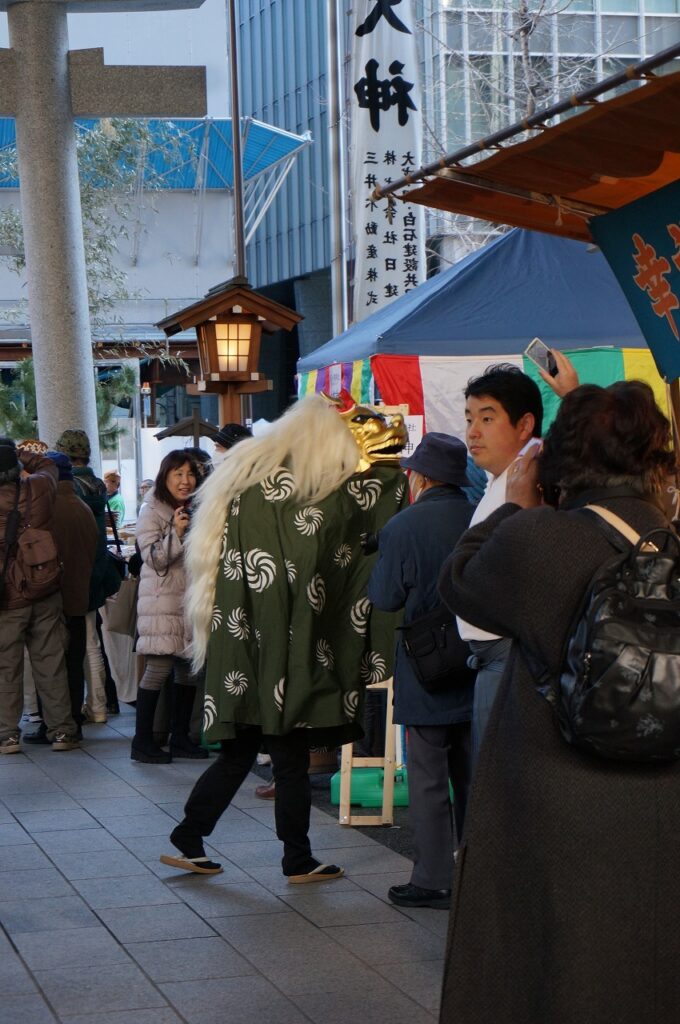
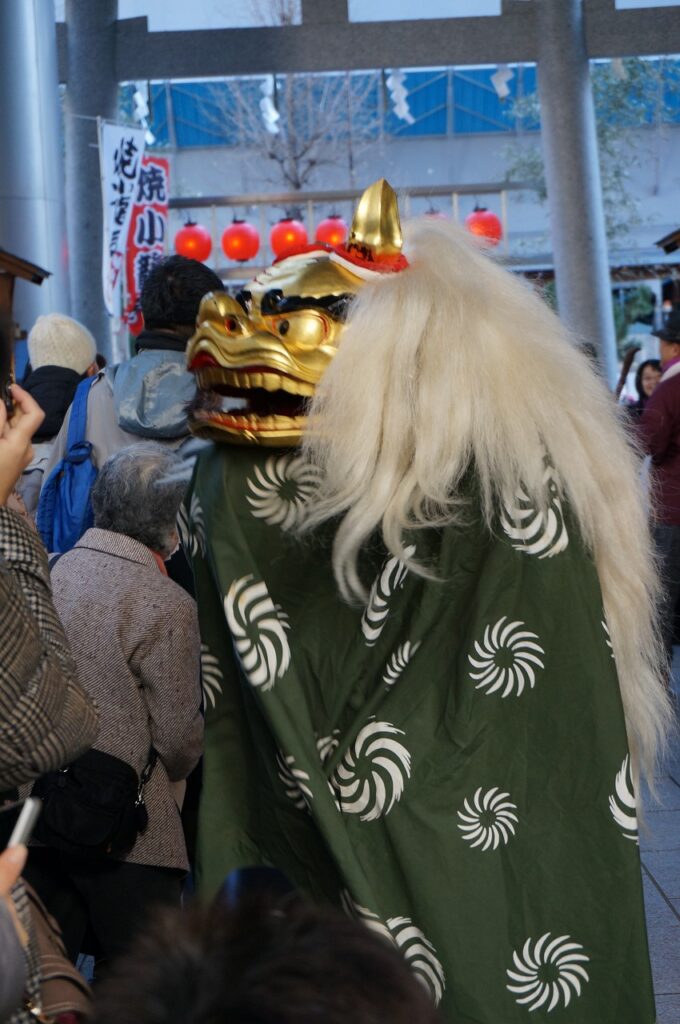
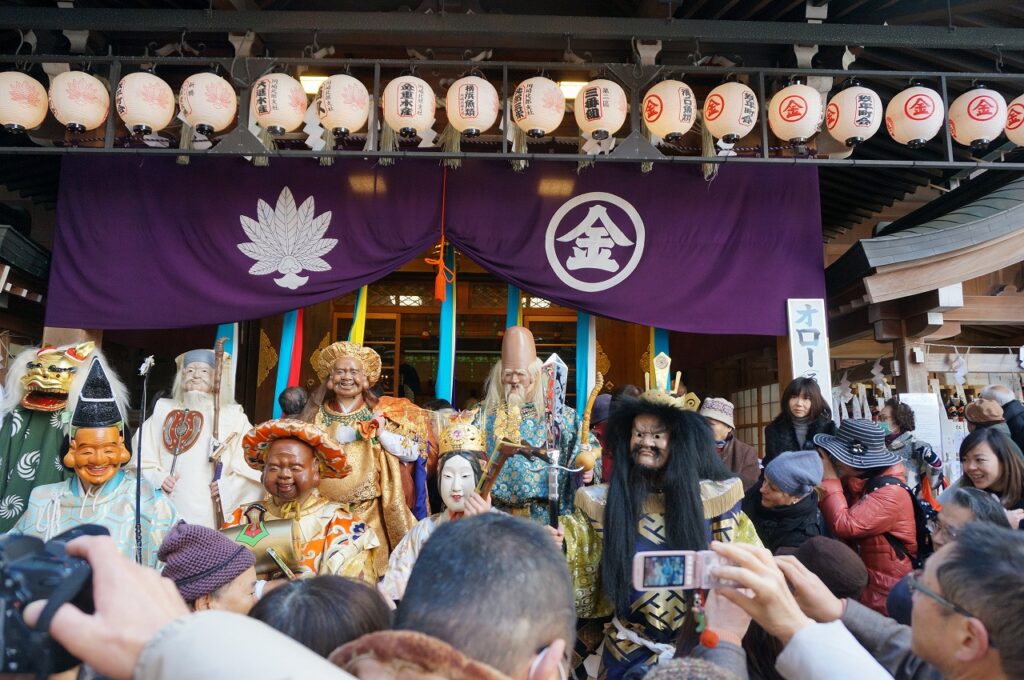
First up was the lion dance. A New Year’s tradition. The head of the lion is also gold, an auspicious look. There is a legend that if you ask a lion to bite your head, you will be happy, so if you meet one, be sure to offer your head. Next, the seven deities of good fortune continued to appear.
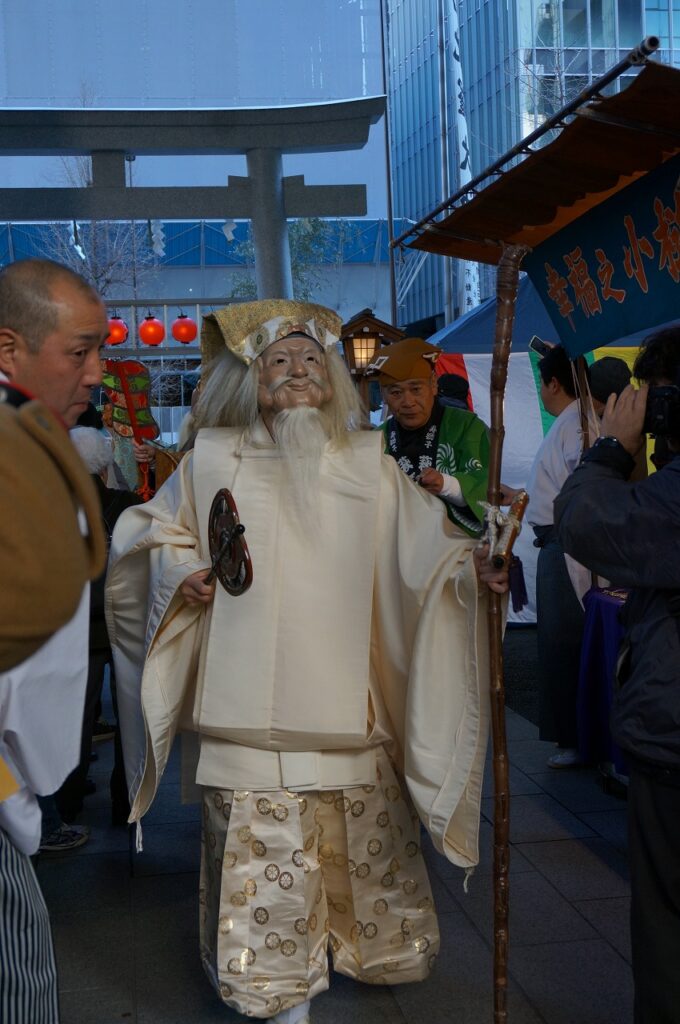
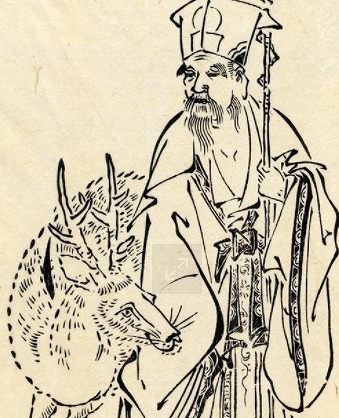
Jurojin 寿老人
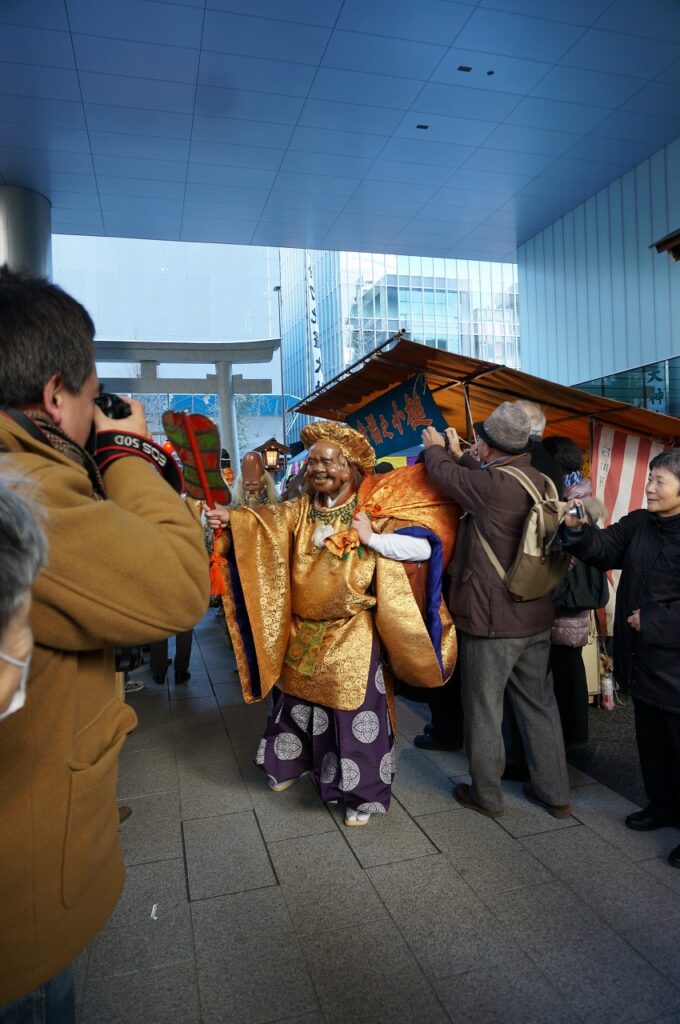
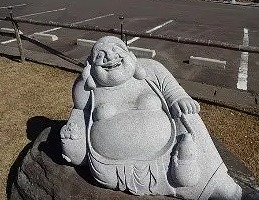
Hotei 布袋
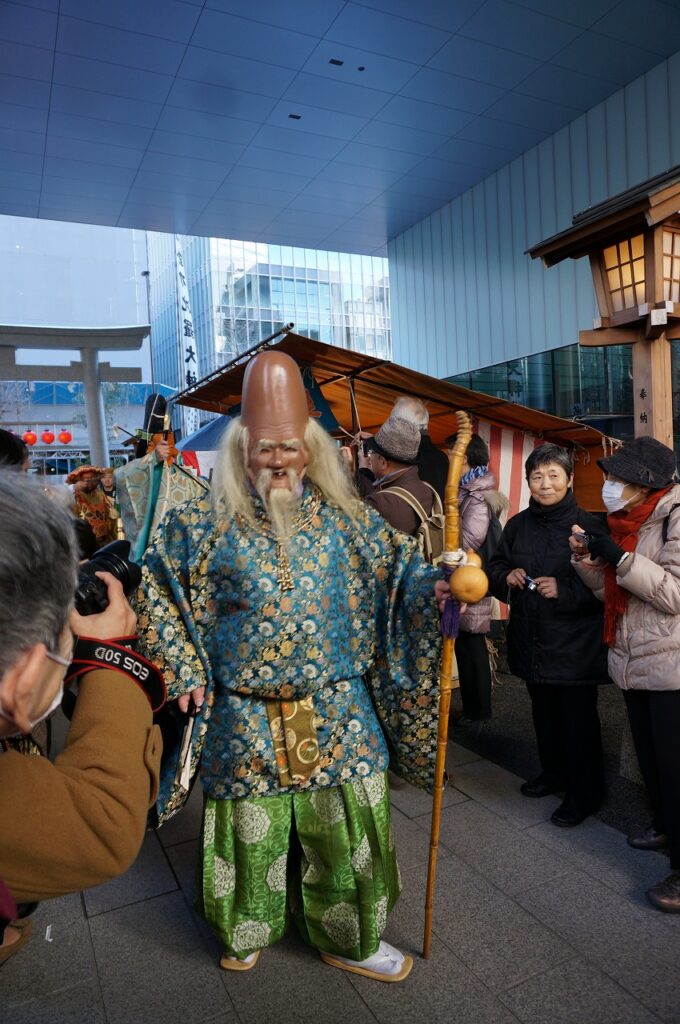
Fukurokuju 福禄寿
Hotei was originally a Chinese monk who was modeled after several real people. The image is that they carry a large sack, bare their large bellies, and travel in poor attire. He wears light clothes even in winter, but legend says that strangely enough, it never snowed around him. Jurojin and Fukurokuju are very similar because they were originally one deity that split into two. However, while Jurojin has the appearance of a noble old man in China, he is also characterized by an unusually long head.
a typical image of Jurojin
a typical image of Hotei
a caricature of Fukurokuju, Ebisu and Daikoku
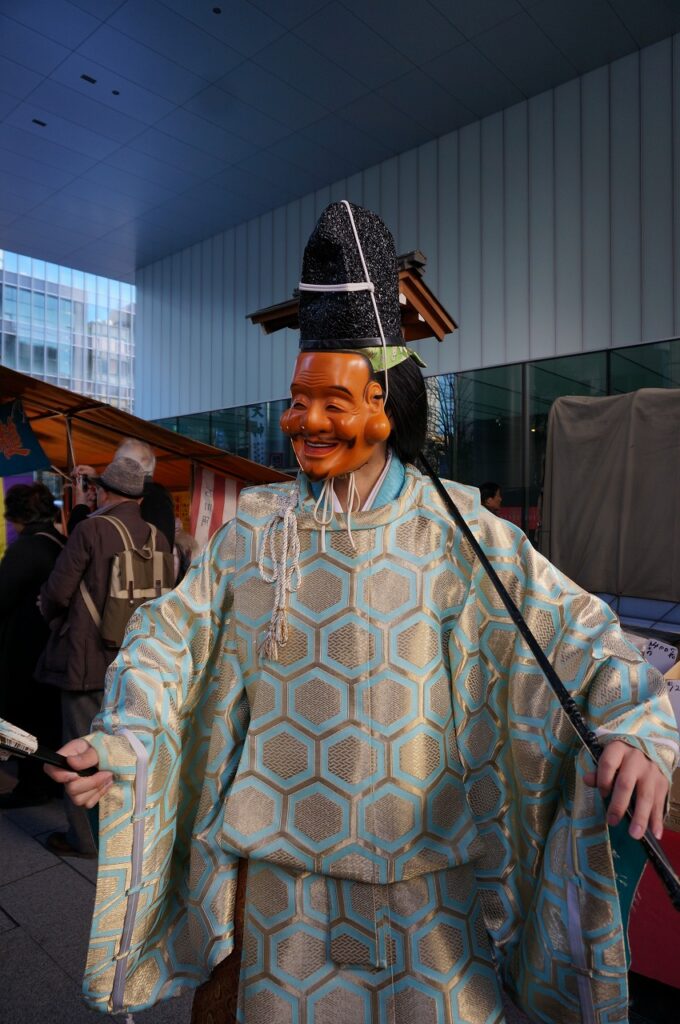
Ebisu
Daikoku
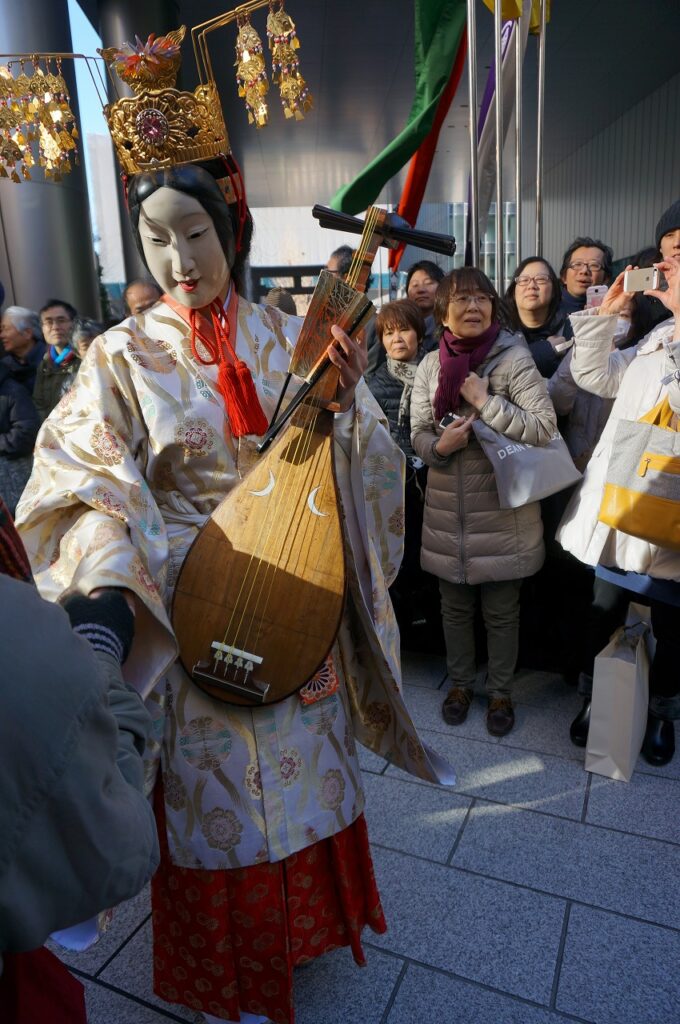
Benzaiten
Ebisu and Daikoku have appeared many times on this site. Ebisu catches sea breams with his fishing rod, while Daikoku brings good fortune with the mallet he carries. Benzaiten is the only female deity. She is said to bestow arts and wealth.
Bishamonten
Hyottoko
Okame
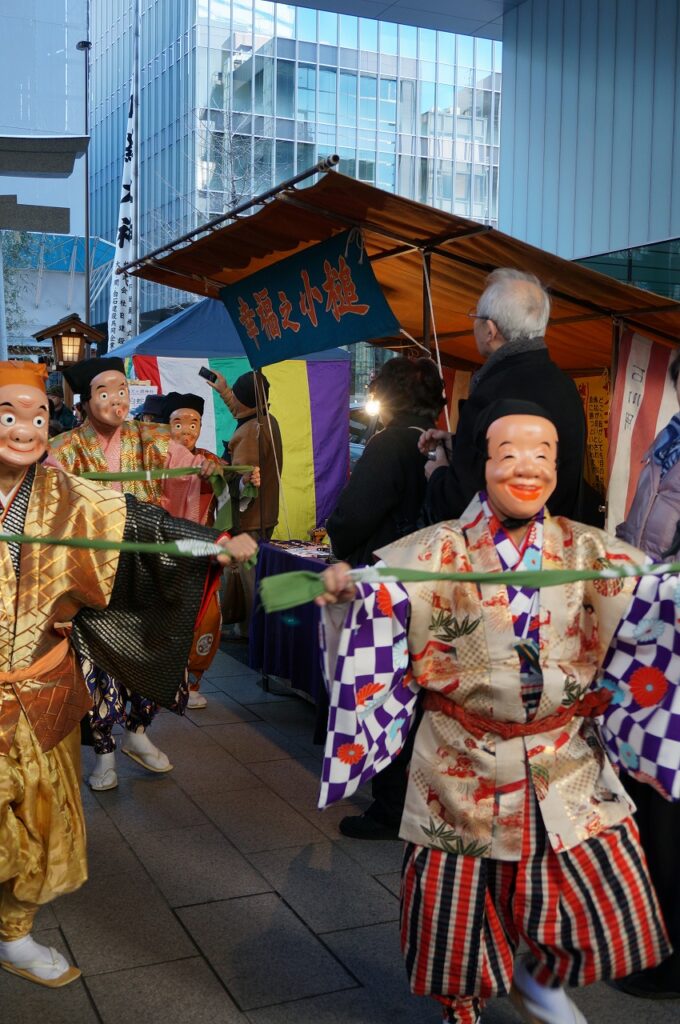
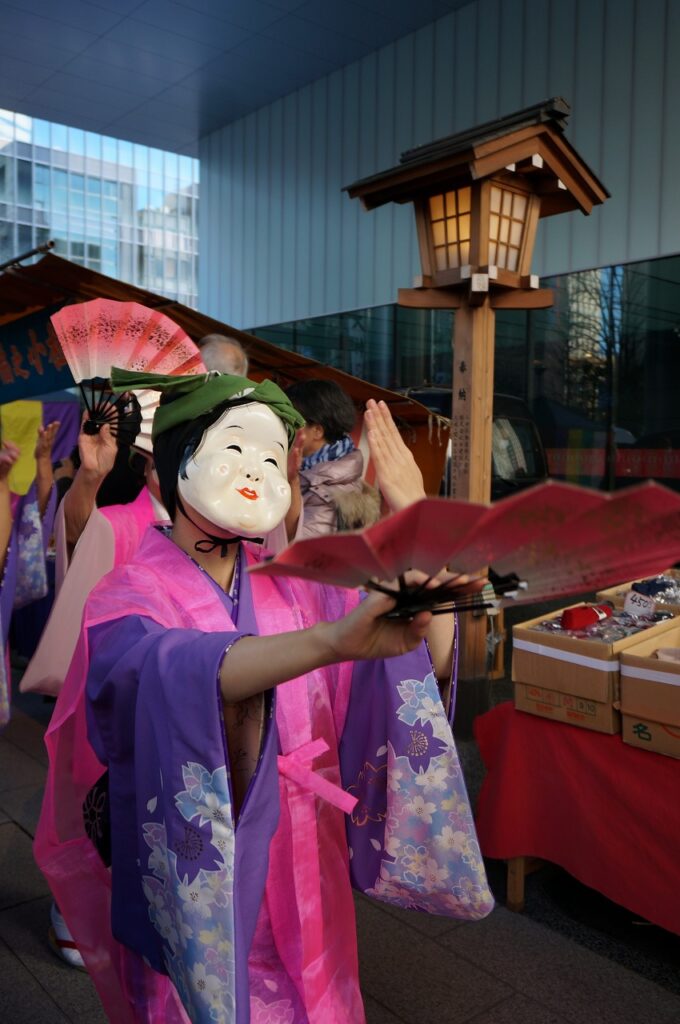
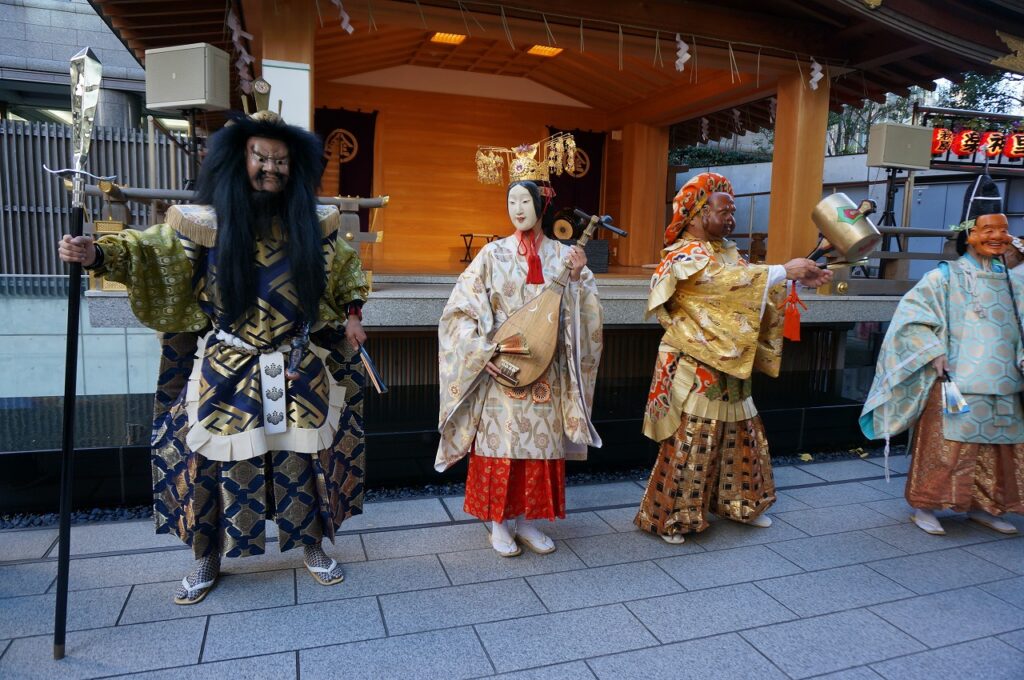
Bishamonten is the god of war. Originally, he is one of the four guardian deities protecting the Buddha. However, his name changes to “Tamonten” at that time. Complicated? Don’t worry about it. Even Japanese people don’t know much about it. Behind them are the familiar entertainers, Hyottoko and Okame.
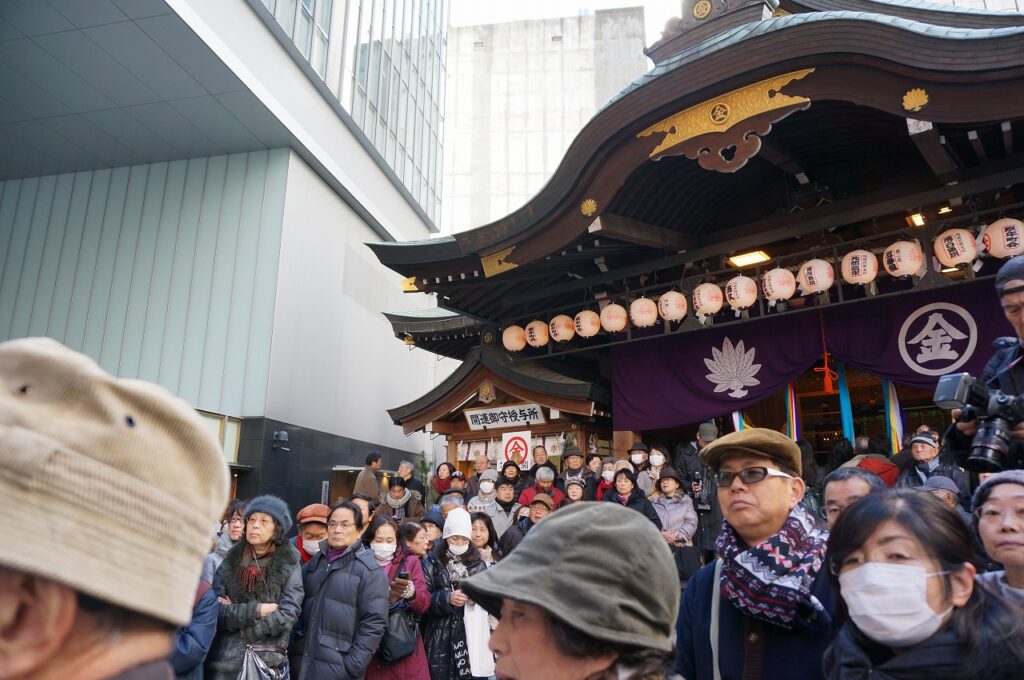
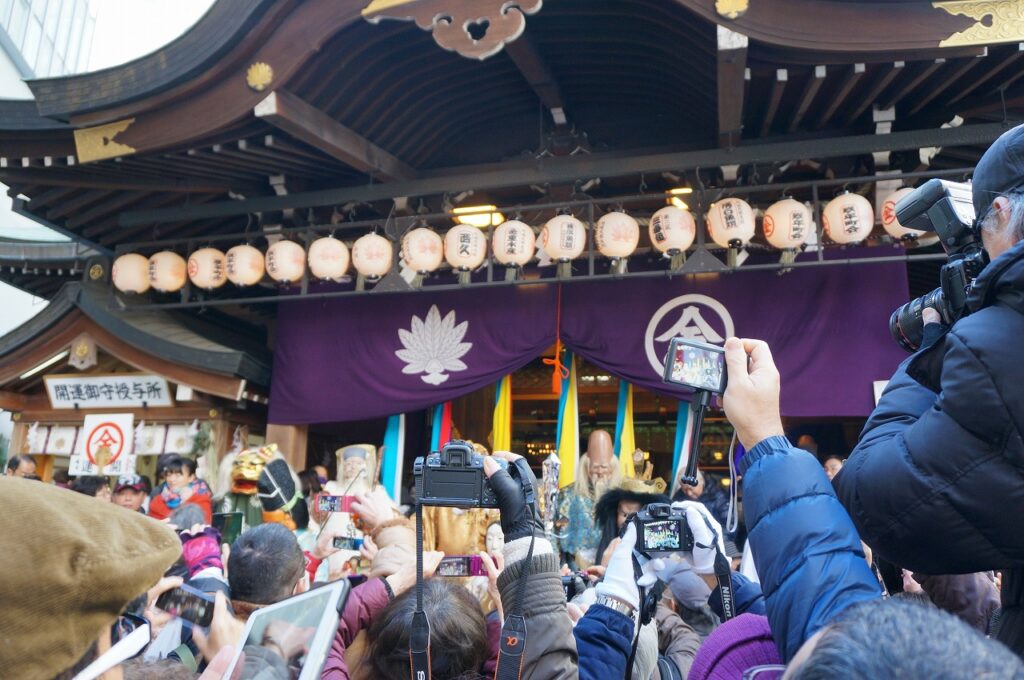
There is already a line of people ahead in front of the main shrine. It is like waiting for a star to appear.
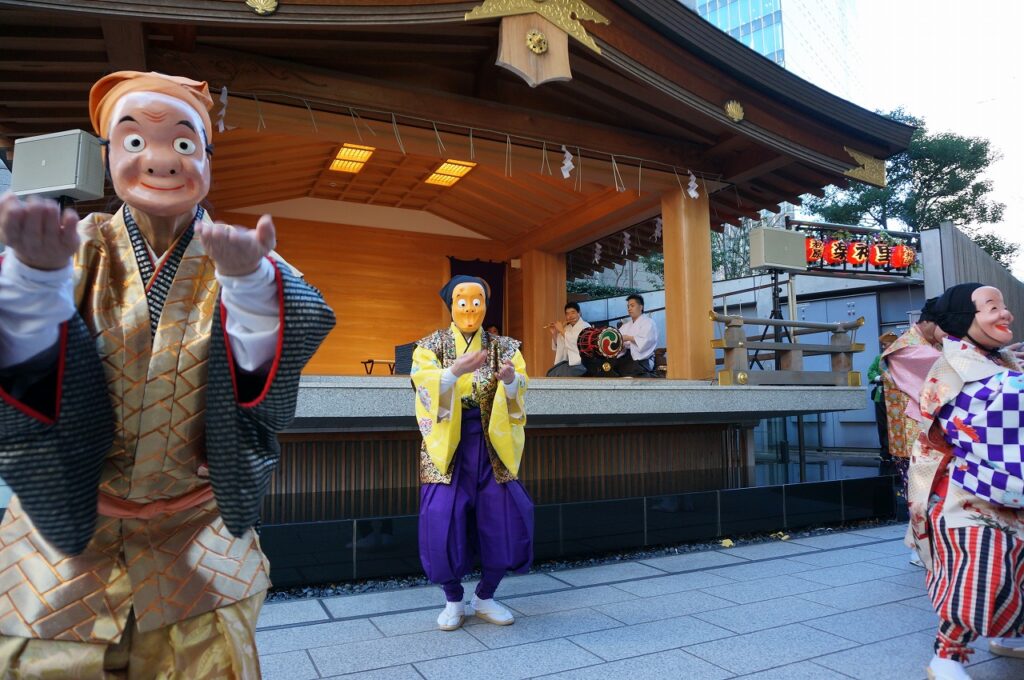
At this situation, it seems almost like a red carpet, although there are no screams of excitement. The staff announced, “We have a little more time for photos. The star line-up doesn’t change every year. After this, they all gather in front of the stage and performed the Hyottoko and Okame dances. About 40 minutes. If you miss it here, don’t worry. The Seven Lucky Gods will appear again later.
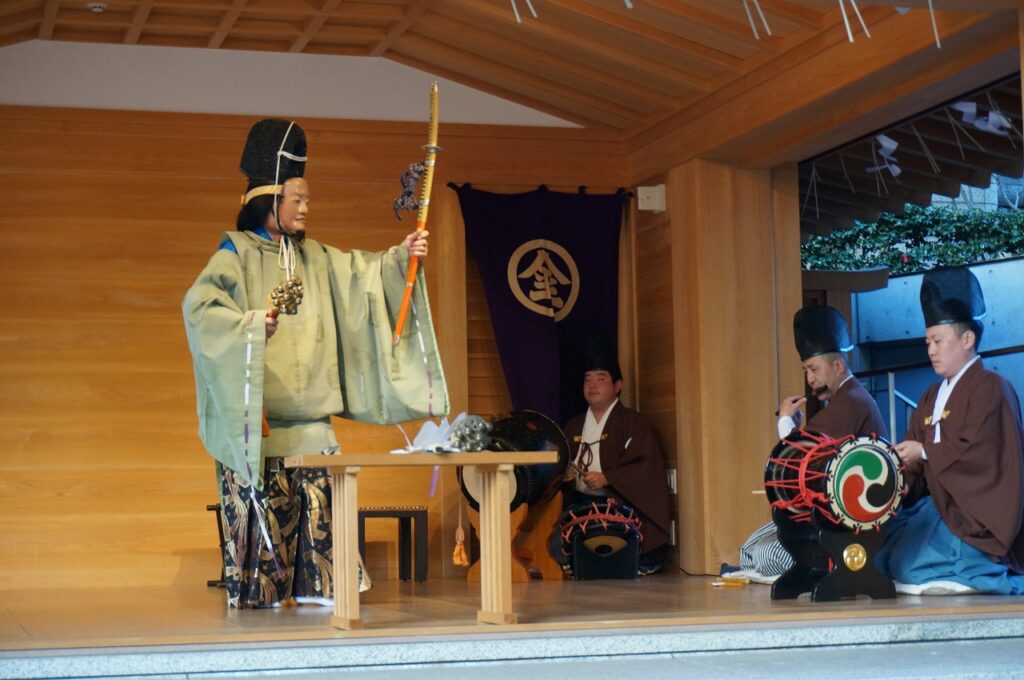
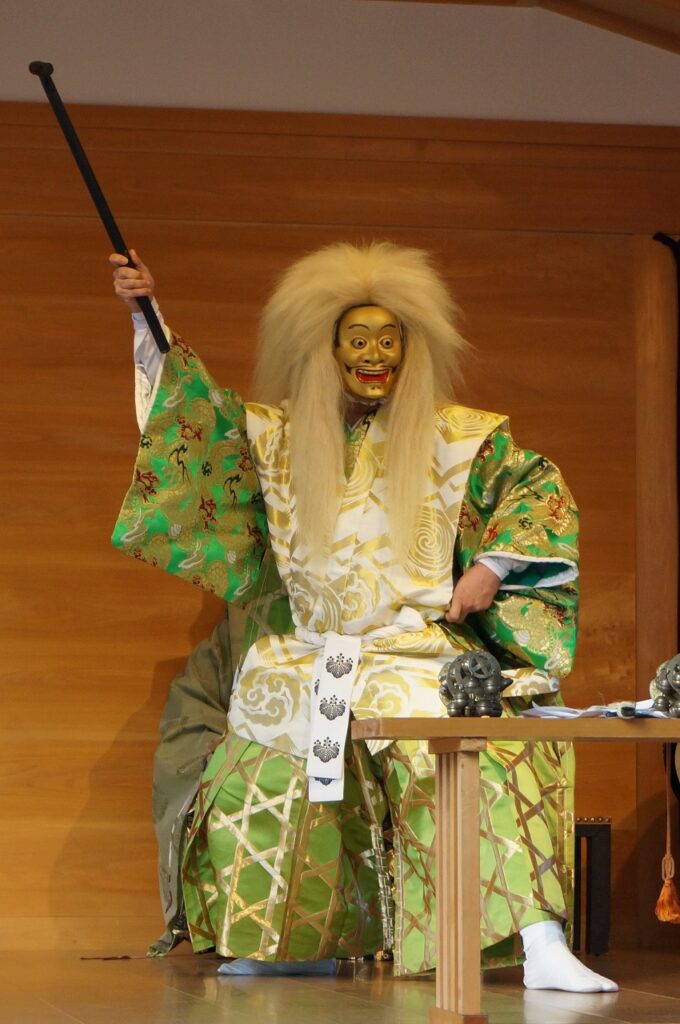
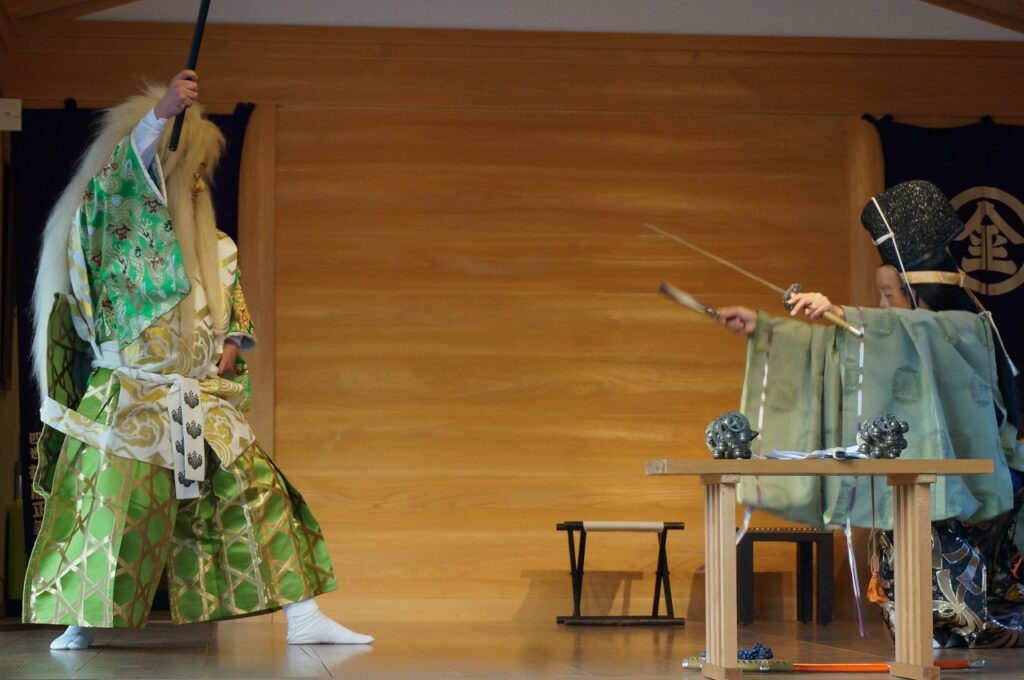
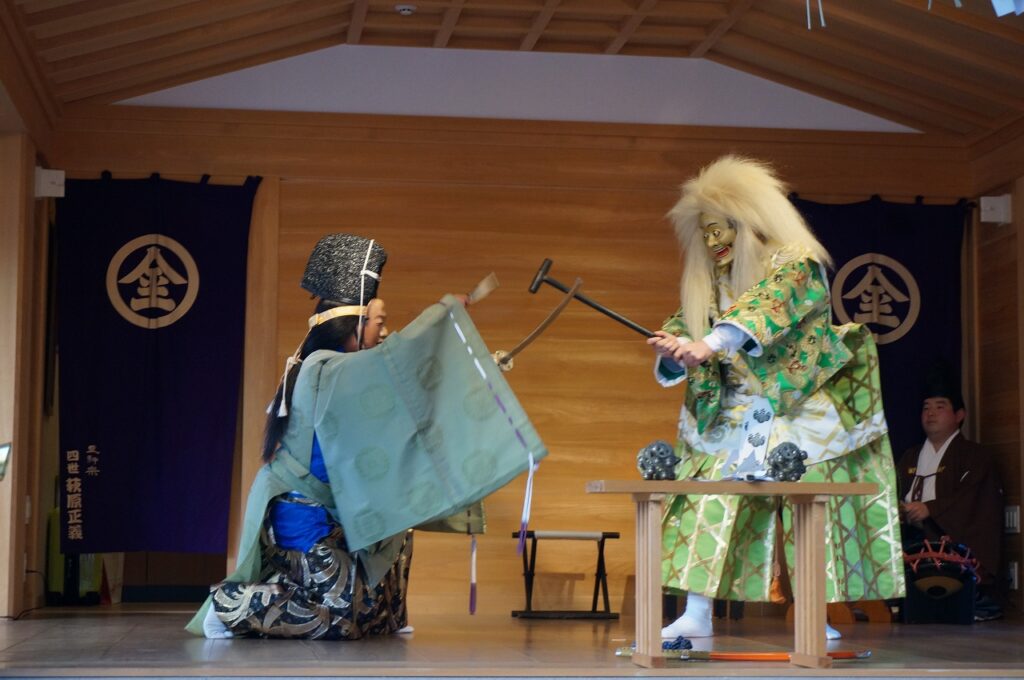
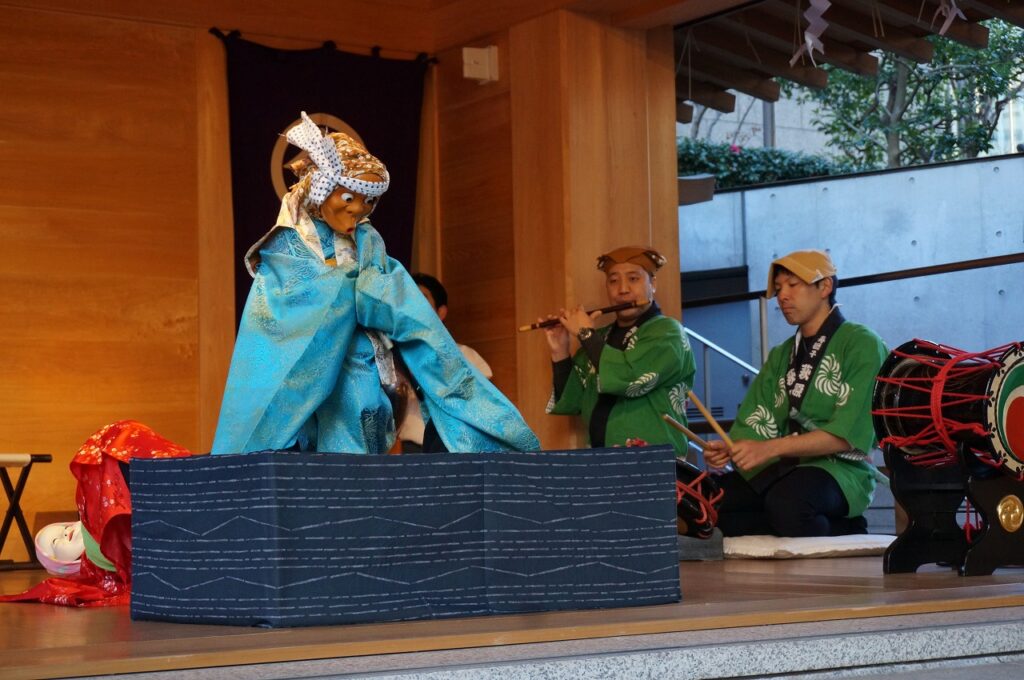
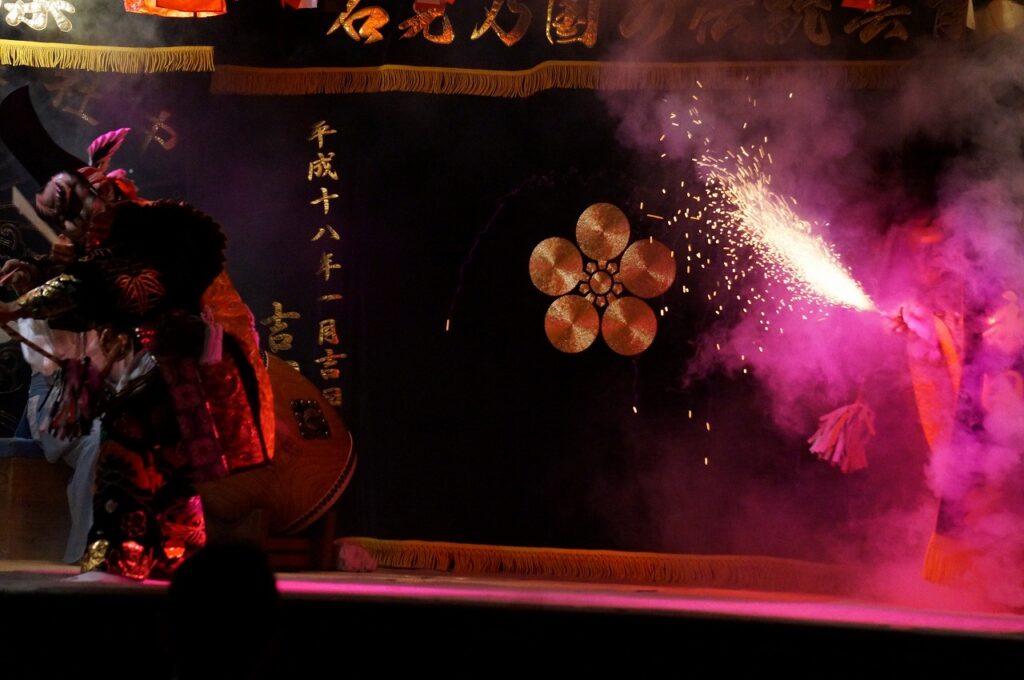
At 1:30 in the afternoon, the event resumed again, starting with Kagura. This is the story of a sword smith. The emperor asks him to make a sword, and the master smith forges it every day. At the last moment, a god appears and breathes his soul into the sword.
Now the enthusiasm again
The parade starts again at 2:00 p.m. Even though it’s the second time, it’s just as exciting as the first. There are as many people as the first time.
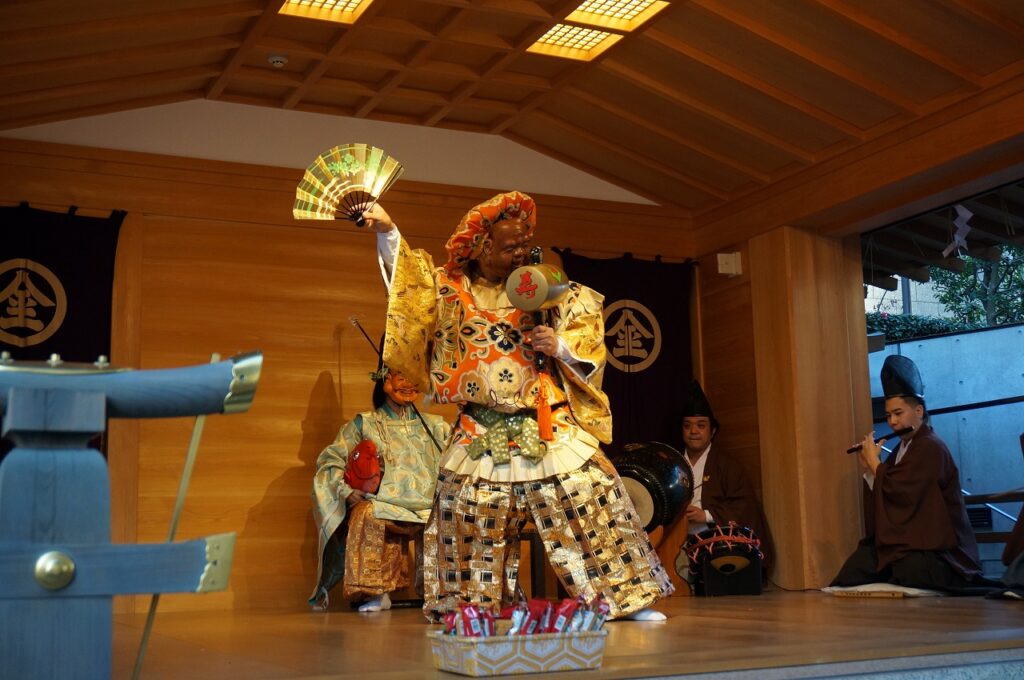
The second time, the flow is almost the same. A photo session in front of the main shrine (actually, the seven deities of good fortune don’t go in front of the main shrine for the photo session, they go to worship.) Then they all line up in front of the stage. And the Hyottoko and Okame perform a fun dance.
What is different from the first time is that folk dances and the stage performances of slightly different tricks are performed. This site is not the place to go into details of these unusual arts, but they are worth seeing at least once. Please come and enjoy it.
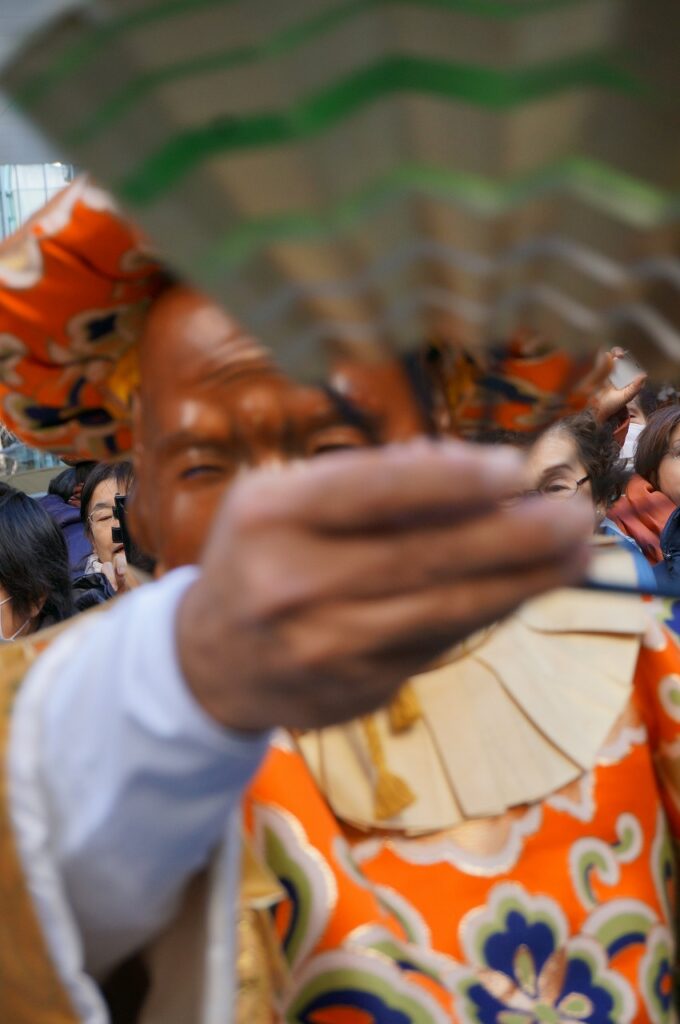
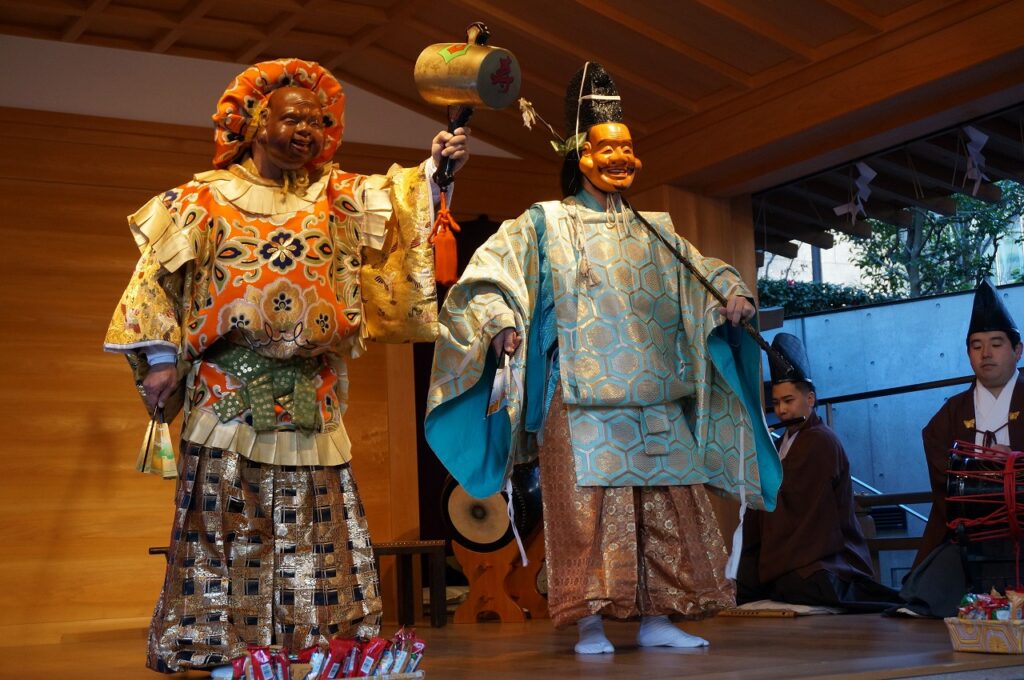
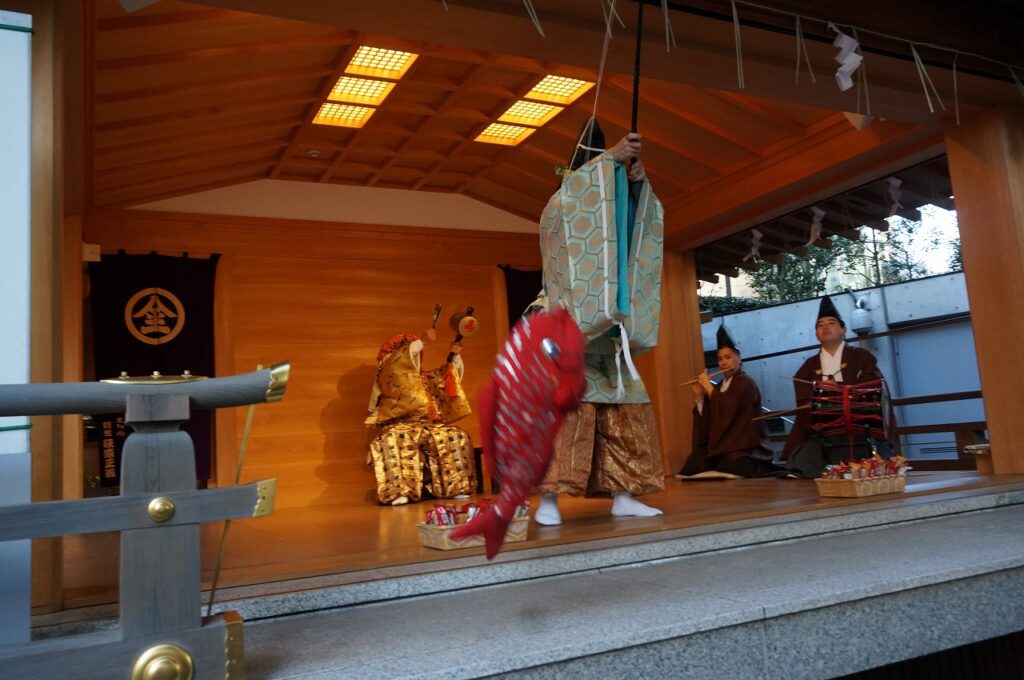
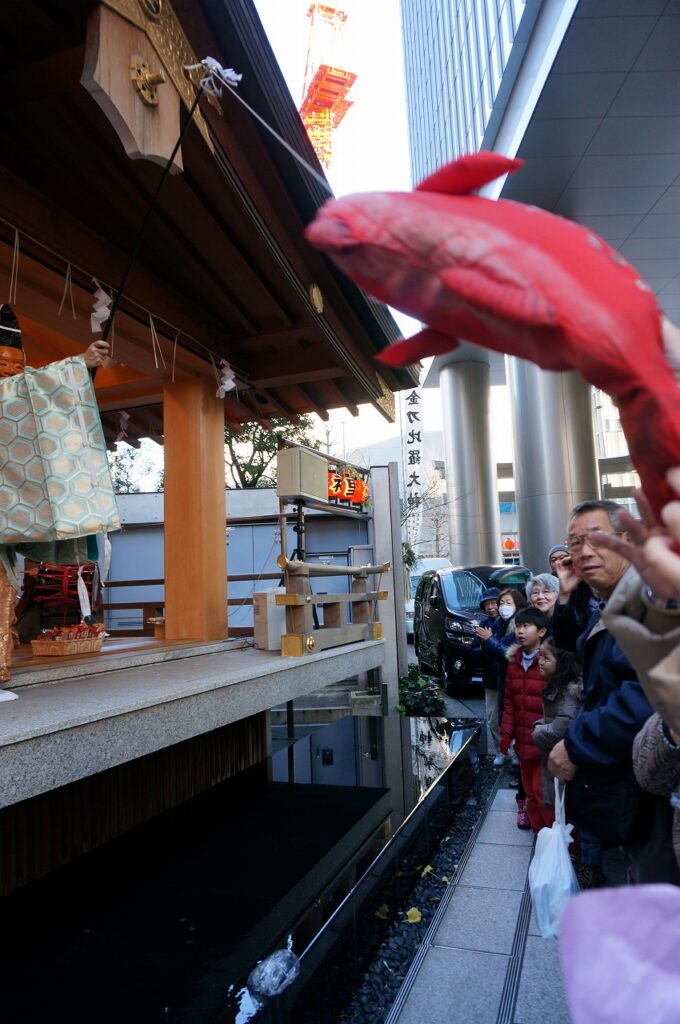
Among the Seven deities of Good Fortune, the most popular duo is Ebisu and Daikoku. And they have a performance that every Japanese person knows. In the case of Ebisu, he uses his fishing line to catch a sea bream. The sea bream is a fish that symbolizes celebrations. While in the case of Daikoku, it is said that if he waves the mallet, good fortune will immediately appear. On the other hand, if Ebisu catches a sea bream, nothing will happen. Actually the sea bream is just a fake attached to the end of a hook. Nonetheless, when he catches a sea bream, people go into a frenzy. They fight to touch the snapper (even if it is fake).
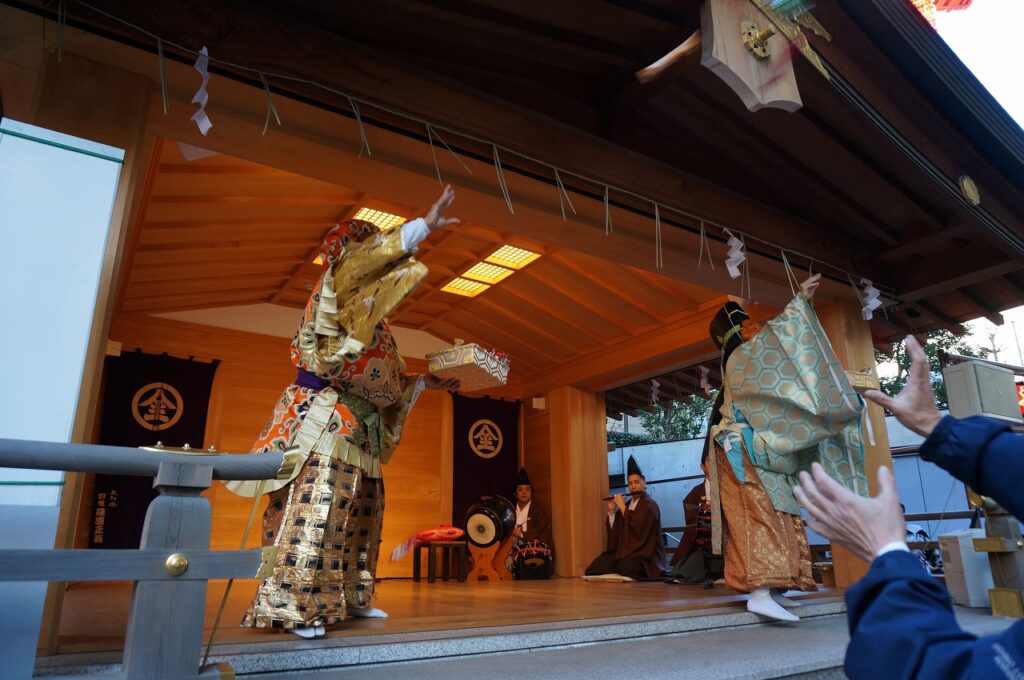
And when Ebisu warms up the people enough, Daikoku comes out and literally brings good fortune out of his mallet. However, only cheap sweets are thrown. If you want to buy them, you can buy them at a nearby store. But people still fight to get their hands on these small blessings.
At the end
Until the 3rd, it is still in the festive New Year’s mood, and until the 7th, it is said to be within the period of celebrating New Year’s. As a way to mark the end of the year (although few people do this anymore), there is a custom of eating “nanakusa-gayu”(seven herb rice porridge) on the 7th. On New Year’s, TV personalities also wear kimonos. The number of people wearing kimonos increases in the town. It is also a time when the so-called “Japaneseness” of the country overflows. Not only the seven deities of good fortune, but also various other events are held. It might not be a bad idea to experience the Japanese New Year at least once.
Report: Is “Edo Sato Kagura” boring or not?
Hollywood movies are simply interesting. These movies are made with huge production costs, using talent from all over the world to focus solely on entertaining people. They can’t be boring. However, human beings may think , “Well, they are interesting”, but there’s not much left to enjoy. I want to see something more social” and so on. Of course, Hollywood movies can be empty, but the general image is one of great entertainment. Deeper movies can be seen in the Cannes Film Festival and the Venice Film Festival, for example. The film which gets the grand prix at these festivals has an image of the complete opposite of Hollywood. There are many films that make you think after seeing them. Nevertheless, the strength of their message can be a burden. In the worst case, it can make you sleepy. Movie fans go back and forth between the two.
In Japan, there is “Edo sato kagura” which is in the genre of Kagura, a traditional performing art. It is almost exclusively performed in Tokyo and the surrounding areas. But it is not popular and is hardly known. It does not hold the elements of entertainment like “Iwami kagura”, and it does not have a local following like “Hayachine kagura.” These are held in obscurity at the corner of a shrine in the Shrine Festival . When I went to see a Edo sato kagura one day in Yokohama, there were only a few people . This situation is not usual but it is almost always held in such conditions. Many people aren’t aware it is being performed. Sometimes even the staff of the shrine doesn’t know! Although it gets a lot of influence from Noh, most Japanese people don’t differentiate Edo sato kagura from Noh…. As I write this, I am becoming sad.
Iwami Kagura
Edo sato Kagura
Why isn’t “Edo sato kagura” popular? Is it really boring? Isn’t it worth seeing? I will try to verify this now. Now, I will give you a rudimentary knowledge about “Edo sato kagura”. After that, I will teach you how to enjoy it.
History
Kanto region
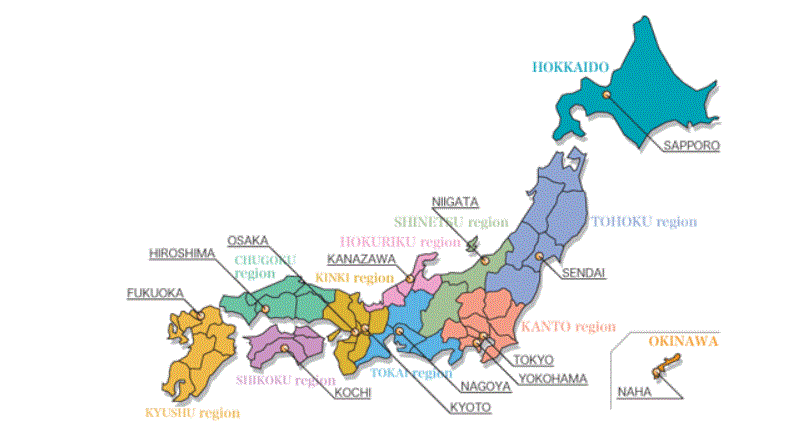
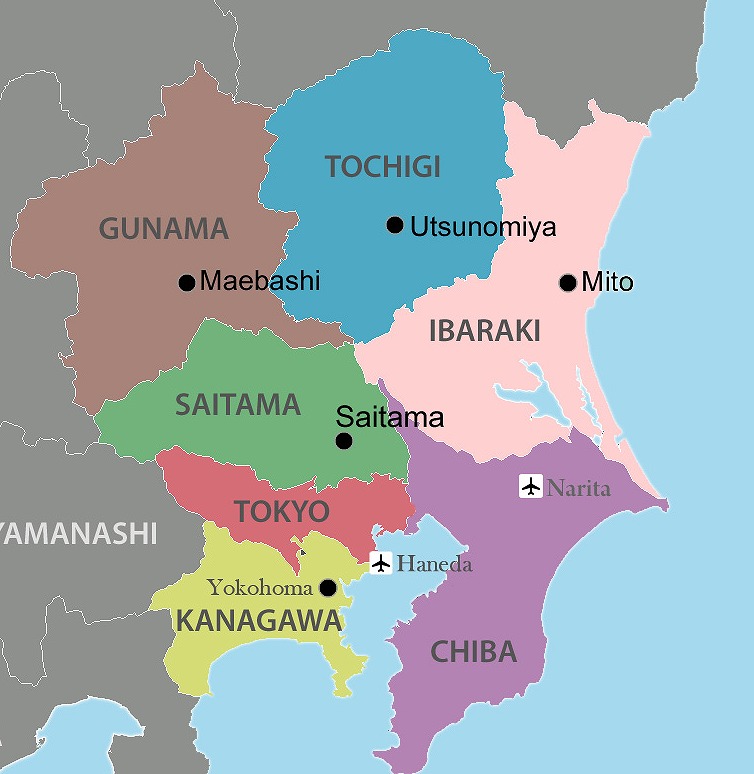
Edo is the old name of Tokyo. The region that “Edo sato kagura” is held is around Tokyo. Tokyo is located almost the center of the main island called “Honshu (本州)”. This region is called “Kanto (関東)”, which consists of seven prefectures, Gunma, Tochigi, Ibaraki, Chiba, Saitama, Kanagawa and Tokyo. The Kanto region’s kagura was originally introduced from the Izumo region (The Izumo region is the eastern area of Shimane prefecture). The Shinto priest at Sada shrine in the Izumo region learned “Noh” in Kyoto and he created the new art of kagura. This is the origin of “Izumo kagura”. After the Introduction to the Kanto area, two styles developed. One consisted of isolated programs and rituals, another was performed as a historical play like theater. The historical play was performed by a professional group called “Shachu 社中”. They perform Kagura in shrines after being invited. This is the origin of “Edo sato kagura” today.
Where can we watch “Edo sato kagura” ?
“Edo sato kagura” is performed by professional groups called “Shachu (社中)” today as well, so we can watch each festival at shrines. Japan’s festivals are held most often in spring and autumn, followed by summer, and least in winter. In spring, the Japanese hope for a good harvest as they enter the rice planting season, and in autumn, they give thanks for the harvest. The meaning of each festival is to pray for the prevention of plagues in summer and for the revival of the sun in winter. Generally speaking, spring and autumn festivals are held in many places in Japan, but in eastern Japan, Kagura tends to be performed in spring, while in western Japan, it tends to be performed more in autumn or later.
A few more details
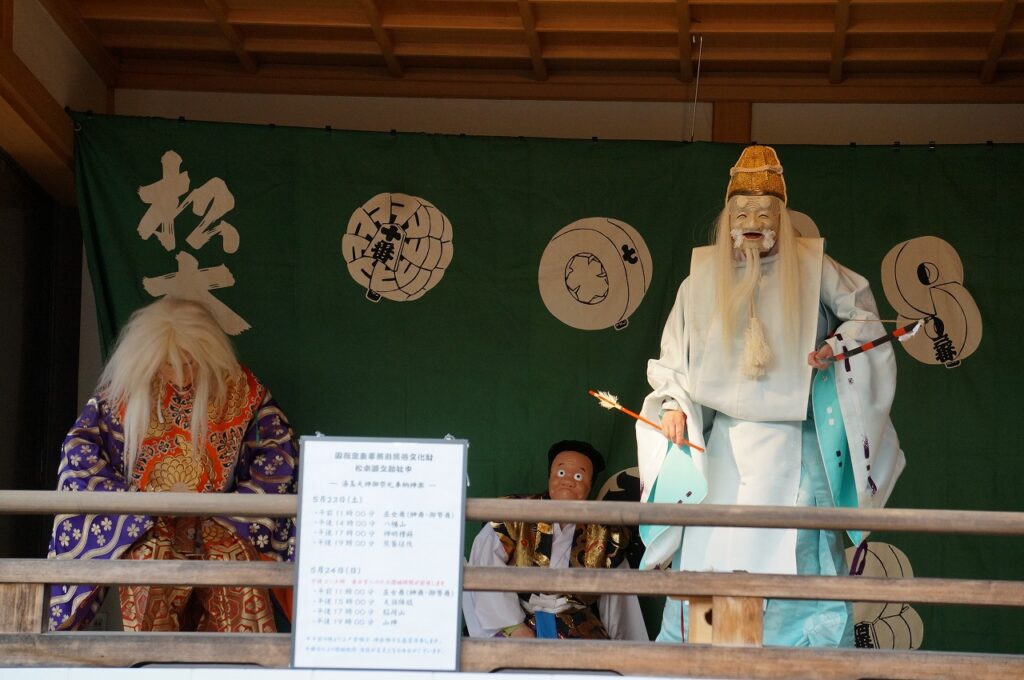
There are four shachu as national intangible cultural assets in Edo-sato Kagura: Matsumoto (松本), Ishiyama (石山), Wakayama (若山), and Mamiya (間宮) . In addition, there are several other famous groups, such as Hagiwara (萩原) group. Each of them has its own territory. For example, the Hagiwara group is invited by shrines in the Shinjuku area, while the Mamiya group is invited for festivals at shrines in the Shinagawa area. They go out there and perform a kagura or simply enliven it with a musical performance.
Edo sato Kagura is performed approximately three times a day. Each performance lasts from about 30 minutes to no more than one hour. In some cases, a related storyline is followed in the performance, and in other cases, completely unrelated programs are performed. Sometimes the time is posted on the stage, and sometimes there is no indication of the program. And I think this is the biggest problem: after one program, there is a two-hour gap between performances. There are various reasons for this, such as the return of the portable shrine that left the shrine, but many times I have seen people who wanted to continue watching the show, but they got tired of waiting because it didn’t start for a long time. I wonder what can be done about it.
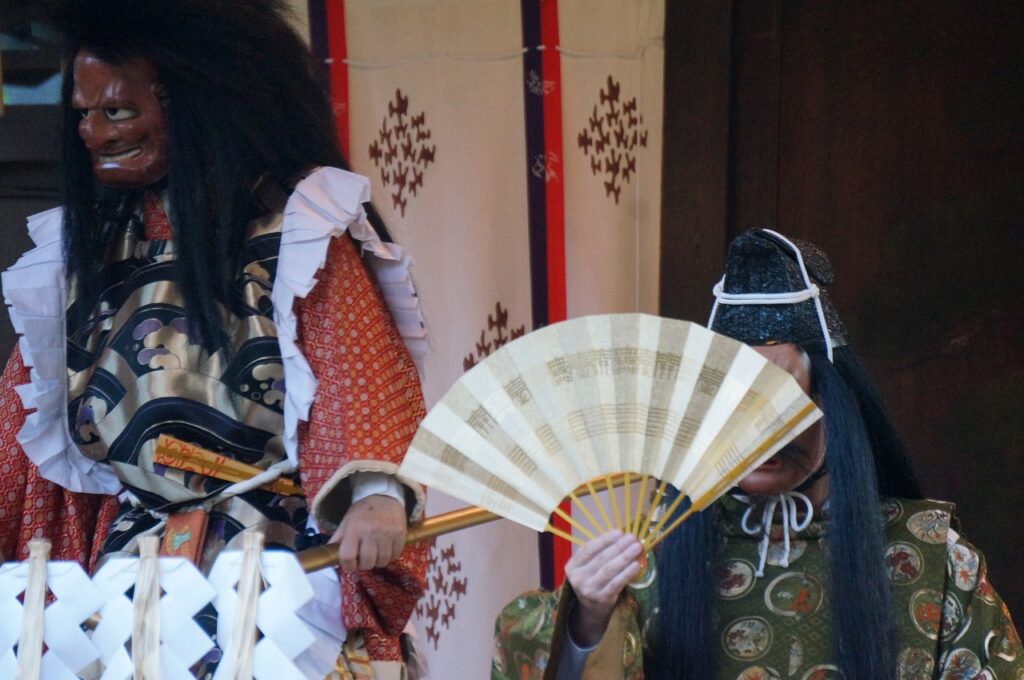
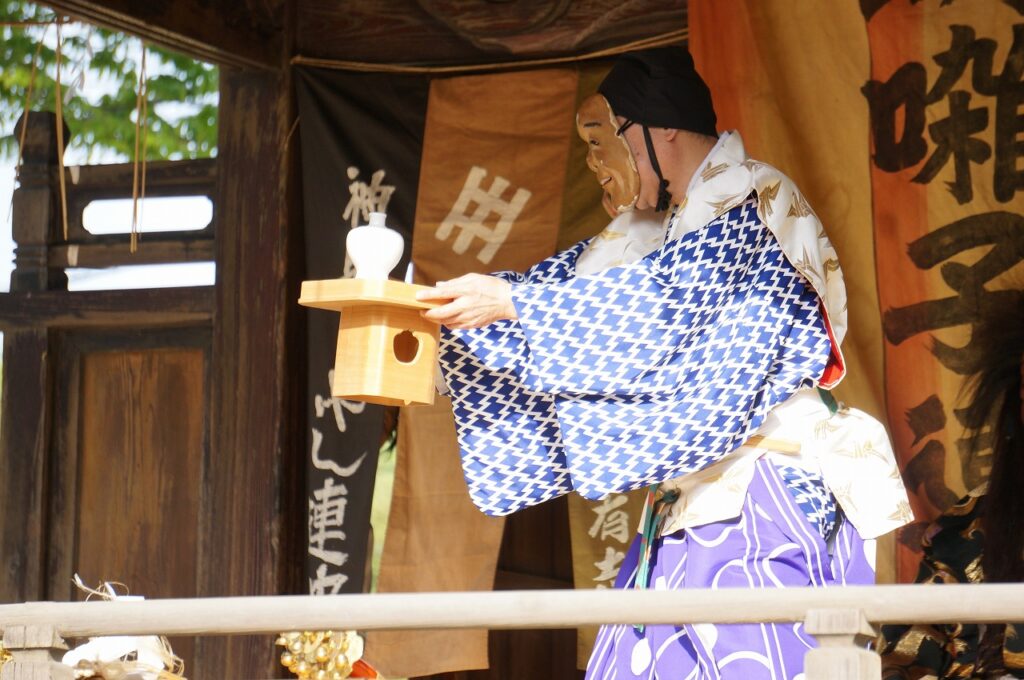
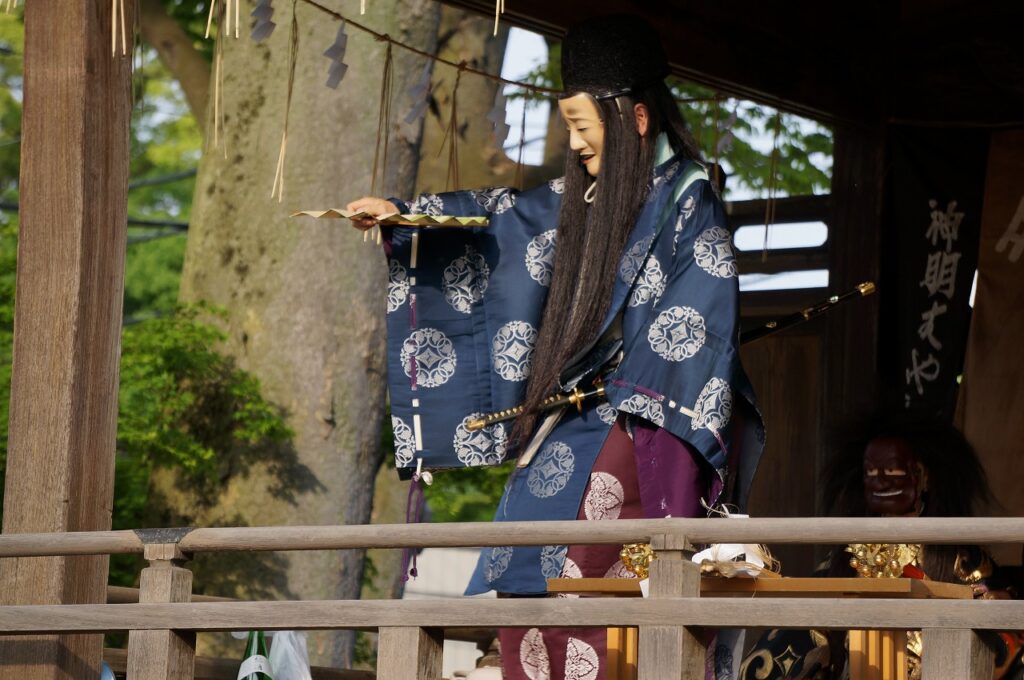
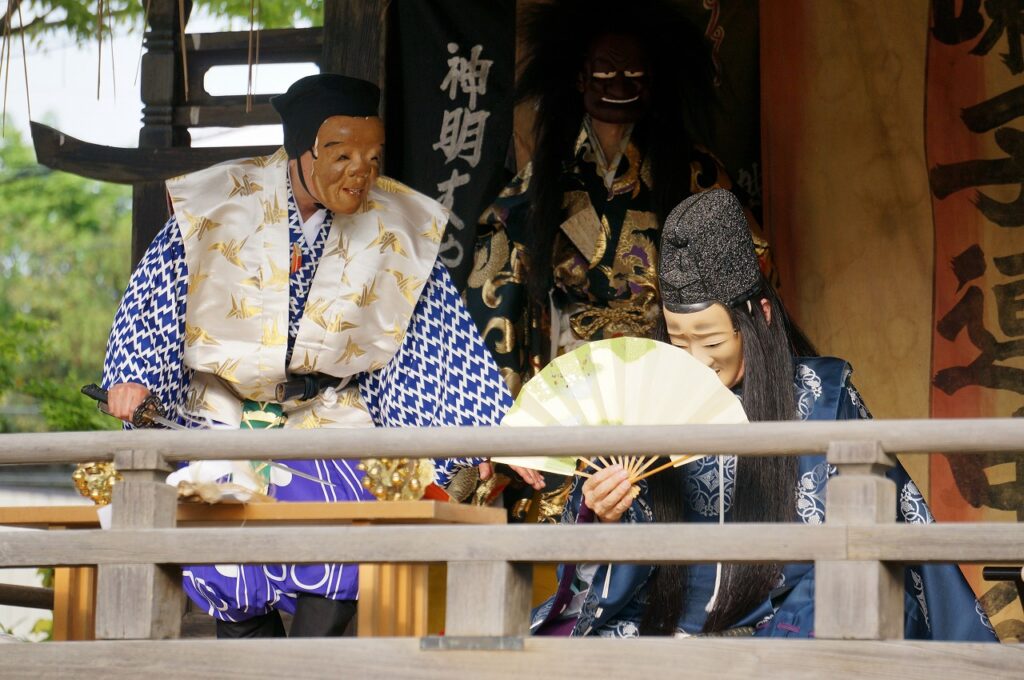
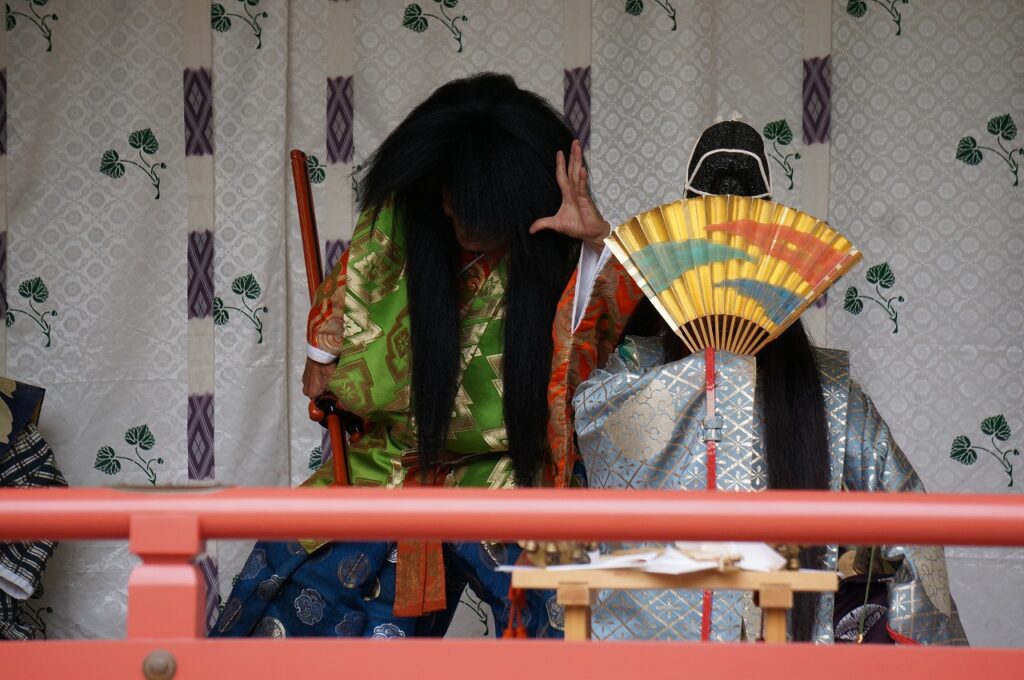
Another thing that may keep audiences away from Kagura is the fact that there are some unique rules and regulations that are not communicated to the audience. For example, if the performer sits down and hides his face with a fan, it is a sign that the performer is asleep. This is rather easy to do, so you might be able to see it for the first time. However, some techniques take a bit longer. For example, there is a scene in which the servant is ordered by his master to fetch a bottle of wine and other things, and for some reason the servant dances his way out, which is a kind of “Hakobi (it means carrying)” rule and has no deep meaning. It’s just a way of giving the supporting actors a chance to show off their skills or maybe it’s just a little break in a serious scene. However, the characters seem to go so far out of their way that it’s quite common for the audience to be confused.
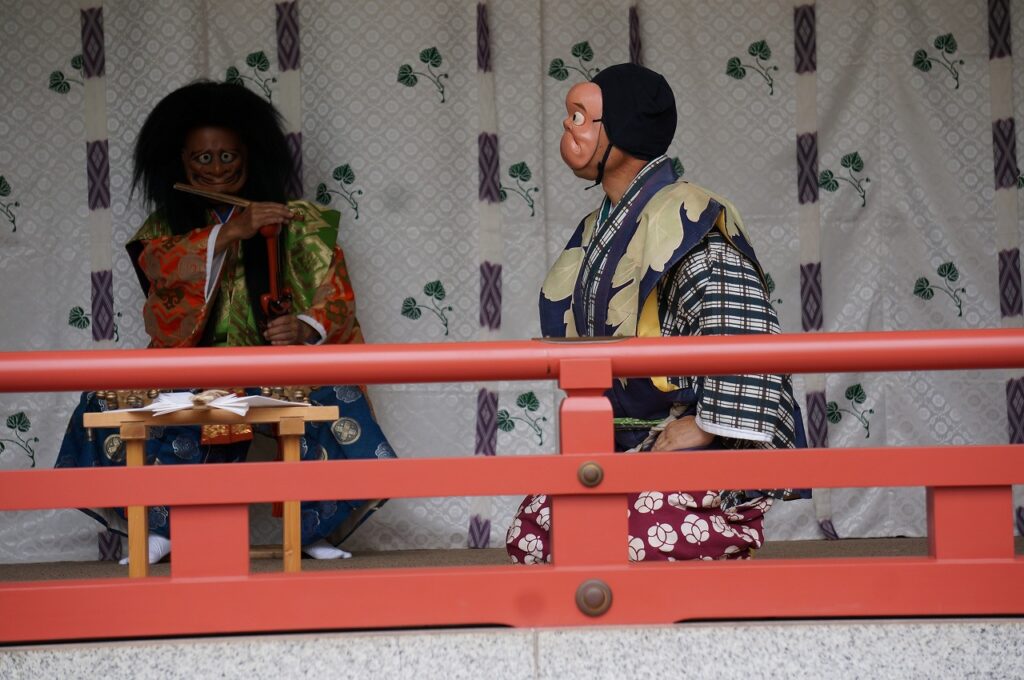
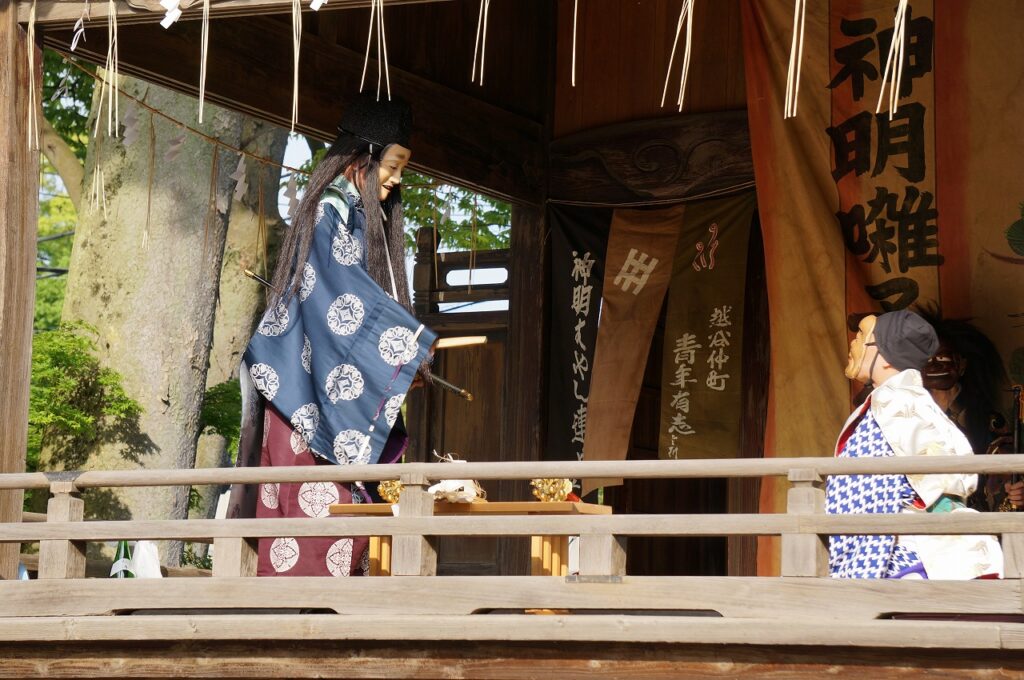
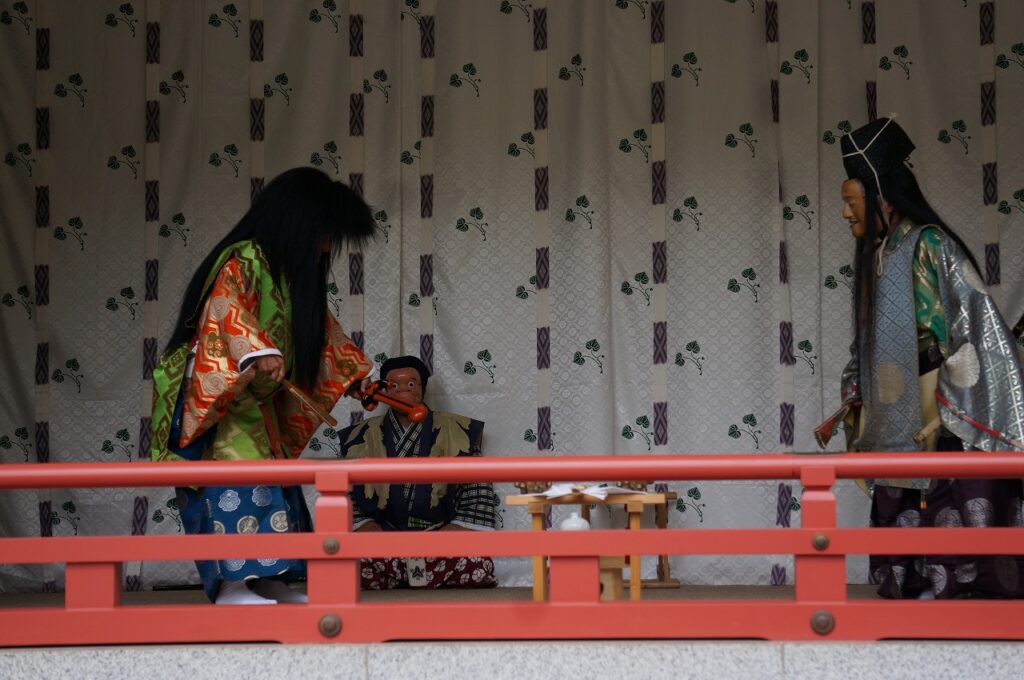
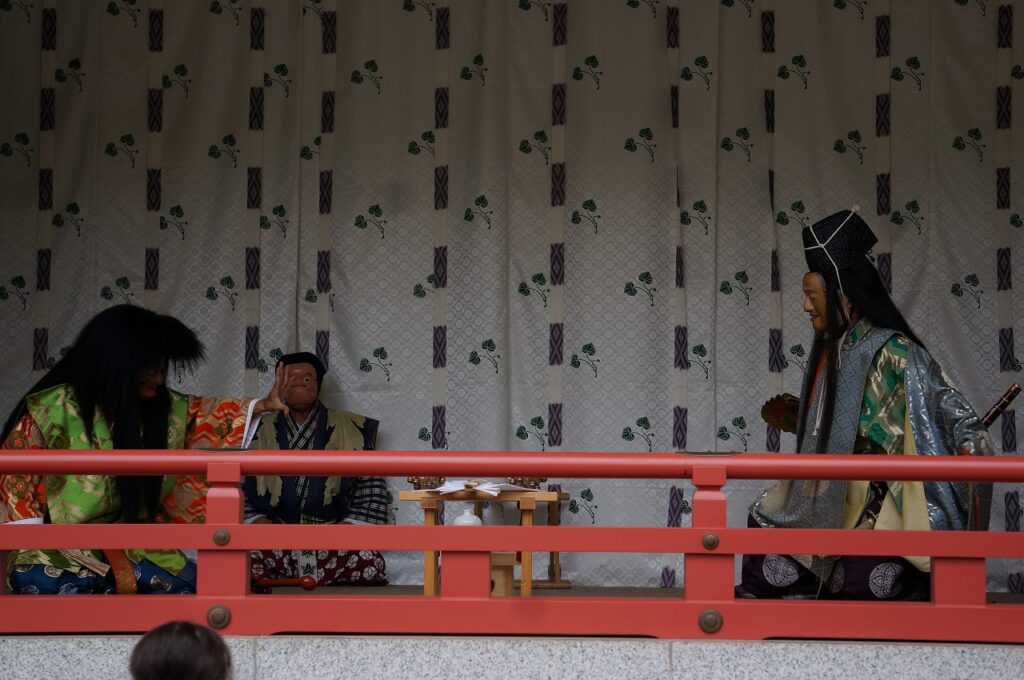
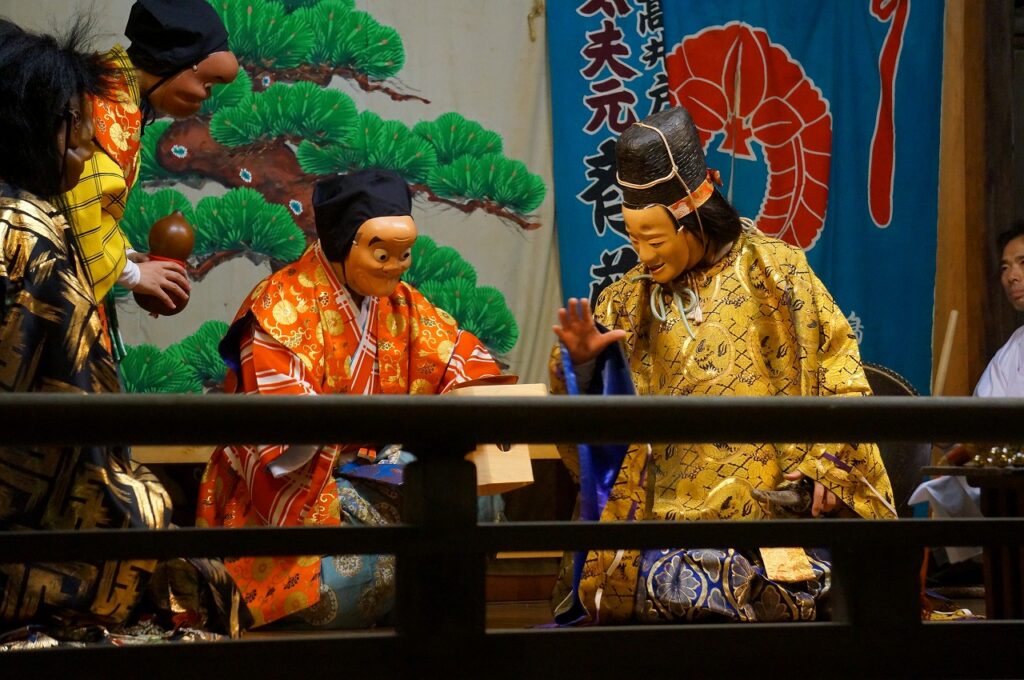
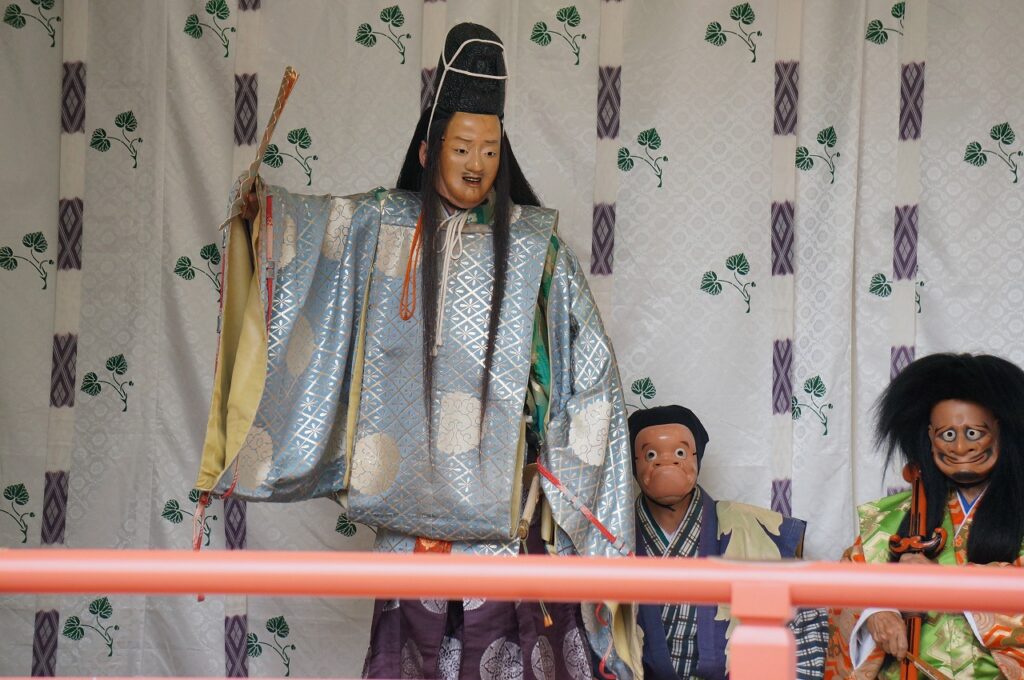
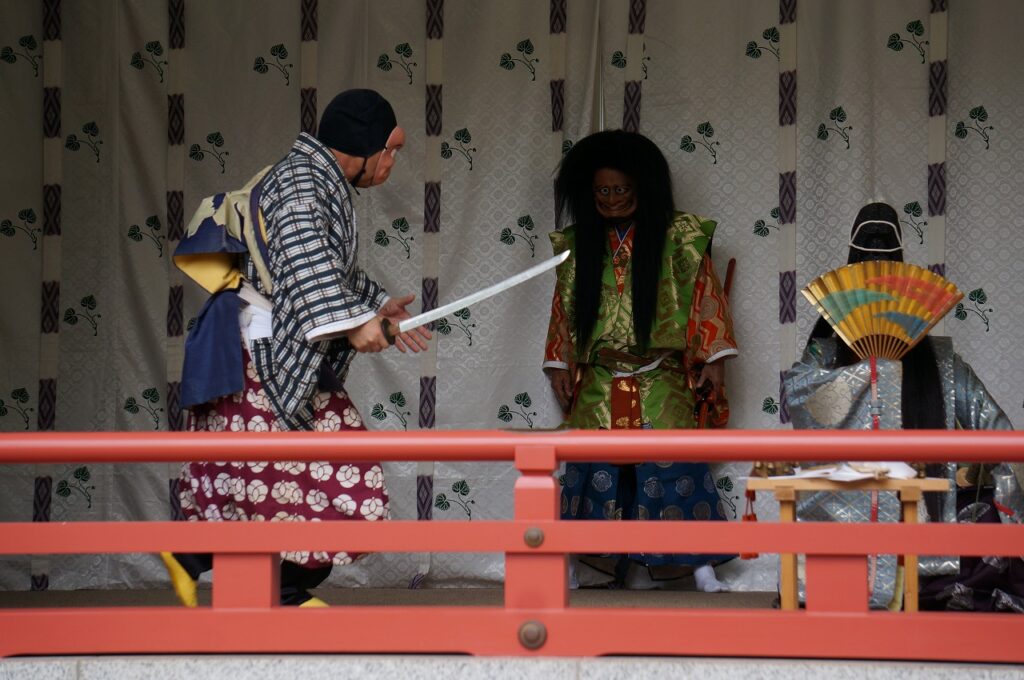
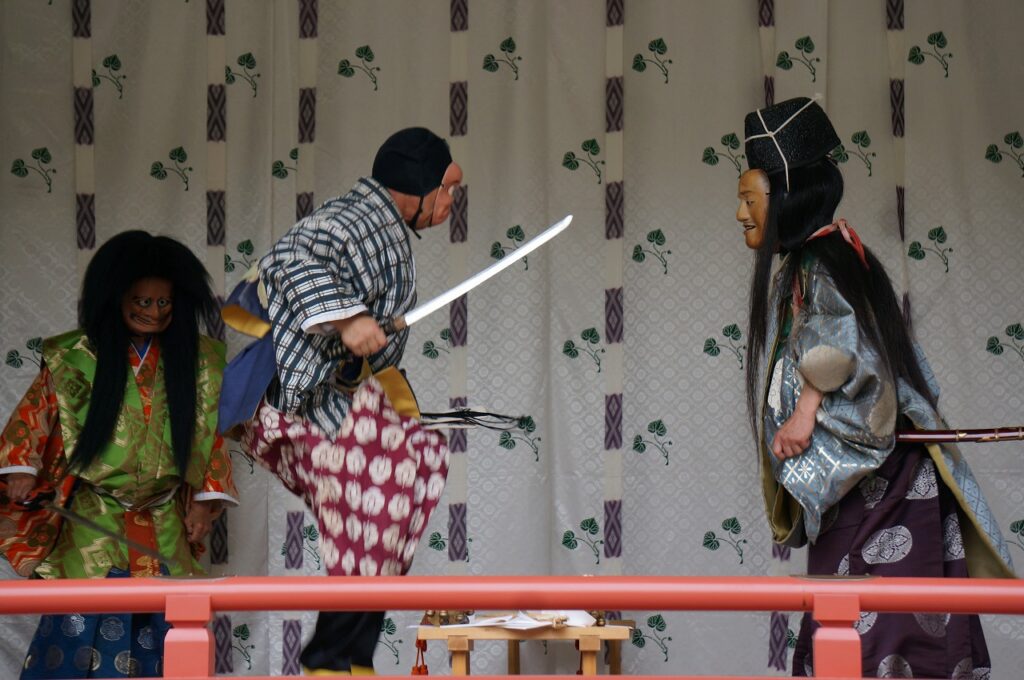
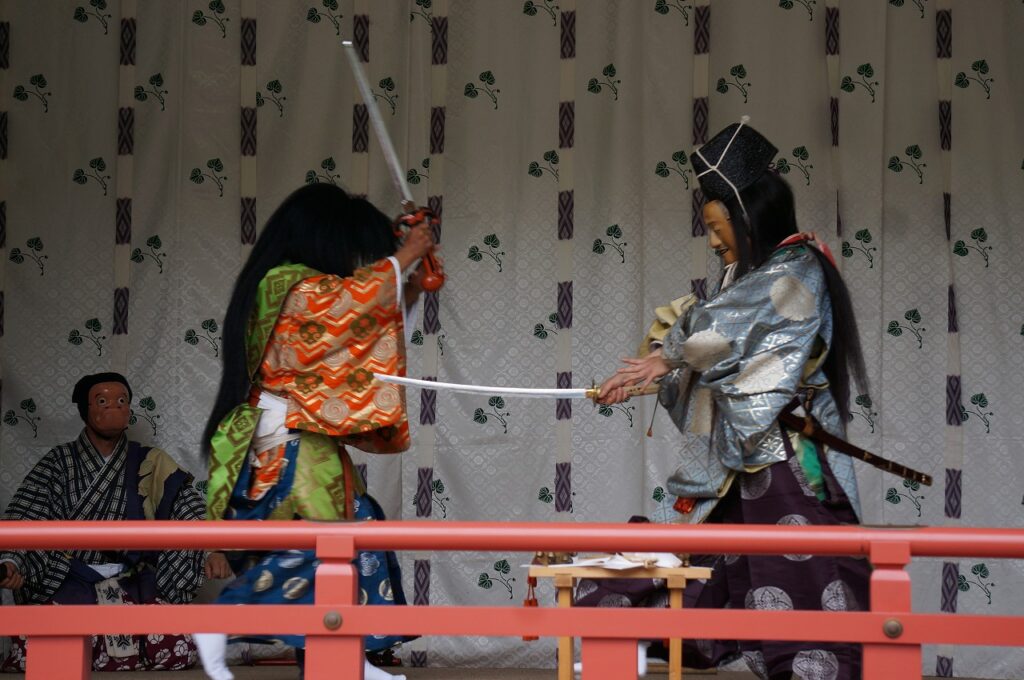
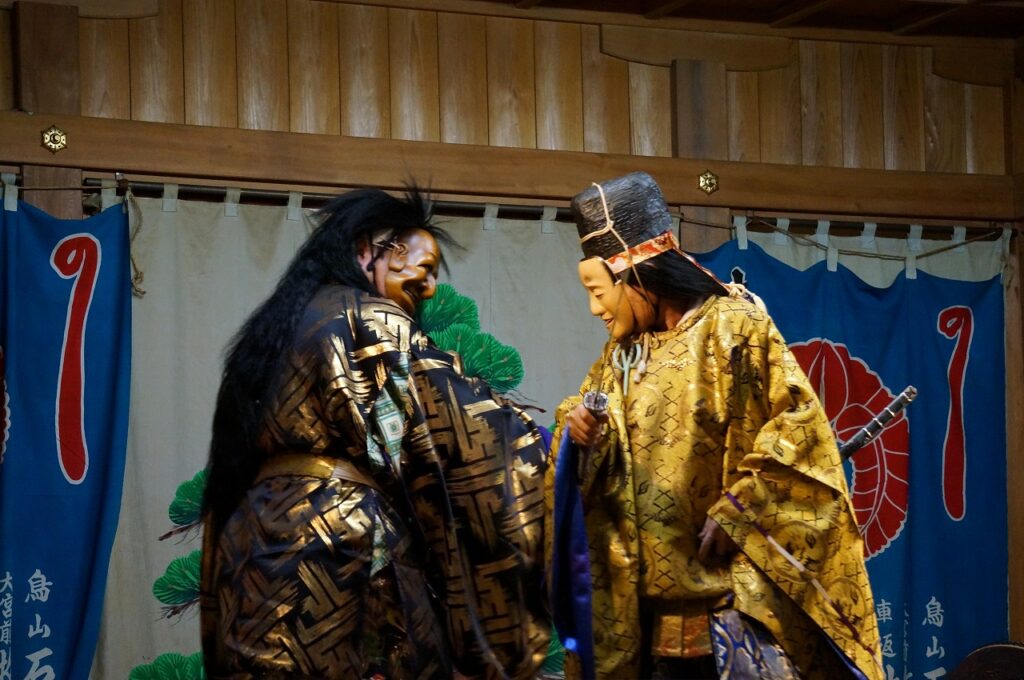
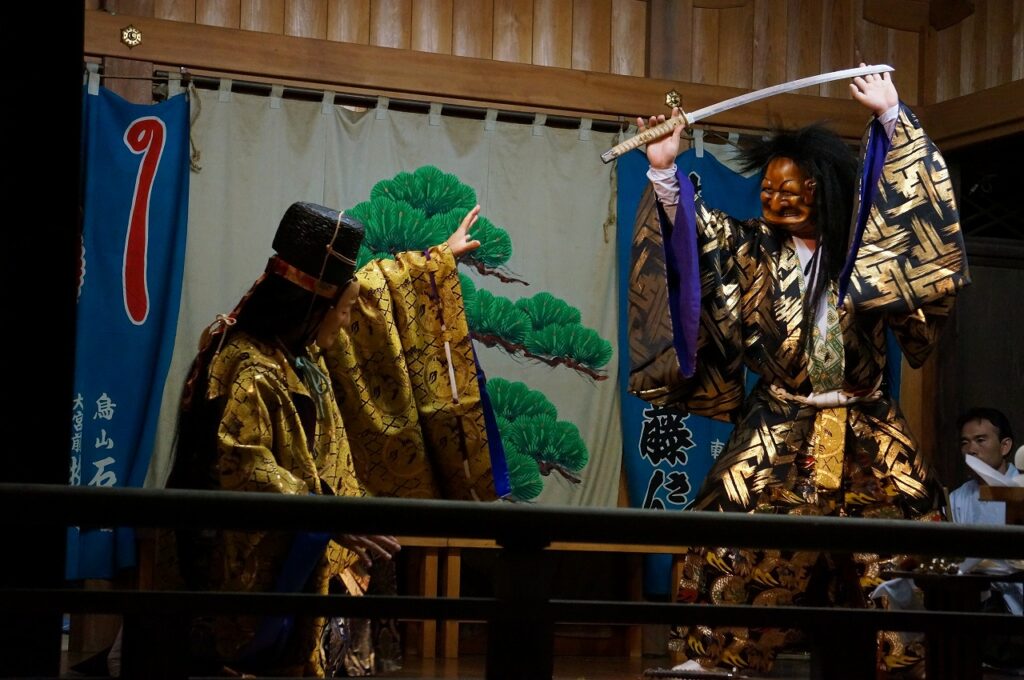
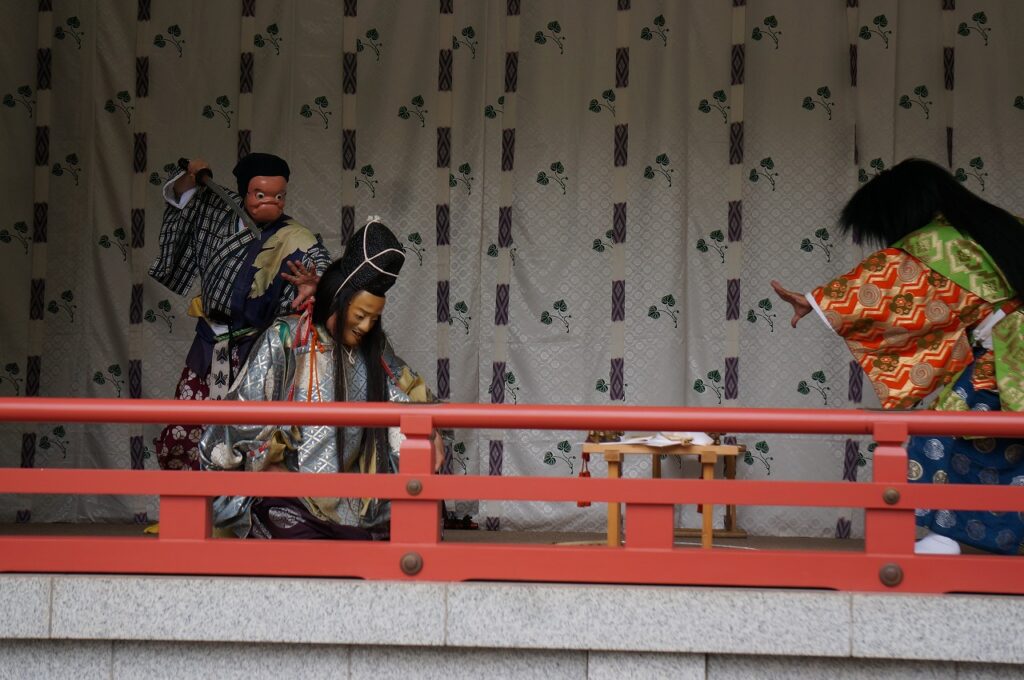
So let’s take a look at one specific stage from here. The program is “Bohijoshi (菩比上使)”. To put it simply, it is a play about handing over the country in Japanese mythology. The lord of the Ashiwaramizuho-no-kuni receives a messenger from Amaterasu of the Amatsu-kuni (state), asking him to hand over the country to the lord. In conclusion, three messengers come, and in the end, the Lord is defeated by force and gives up the country. (cf. Reference →Japan mythology and history) The first messenger is known as “Ameno-Bodhi”. The title “Bohi” is derived from the name of this messenger. In the mythology, Bohi became a retainer after being pardoned by the lord of the country, but in the Kagura, the story goes that the lord’s son, Takeminakata, tried to kill Bohi by getting him drunk. Originally, in mythology, Takeminakata appears when he confronts the third messenger. He would fight the third messenger as a warrior against handing over his country. It is clear that the story of Kagura is not entirely true to the mythology.
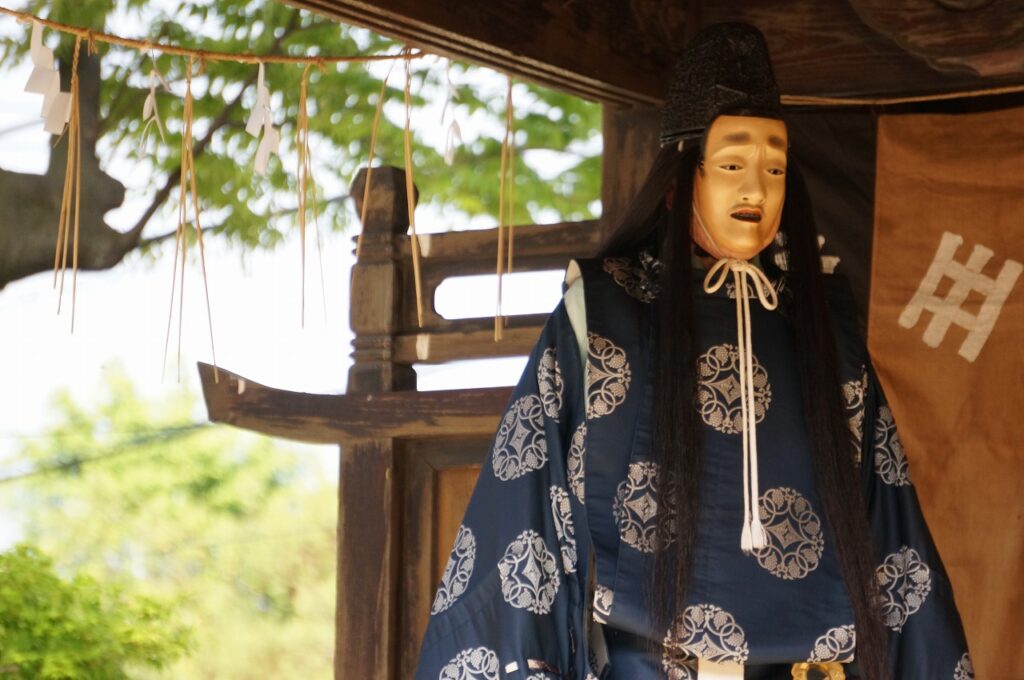
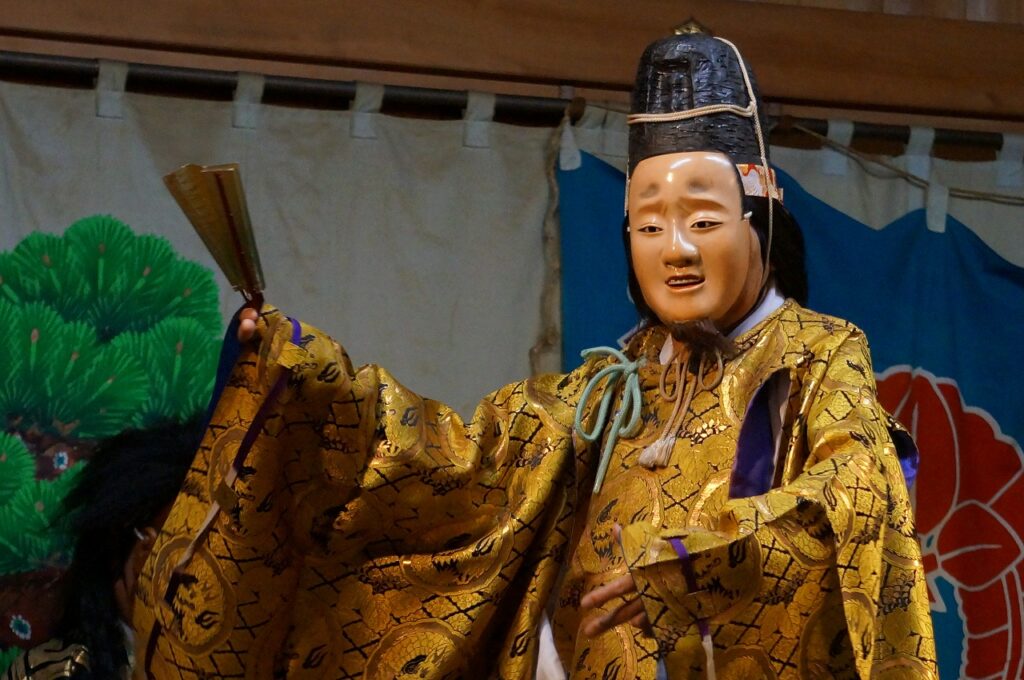
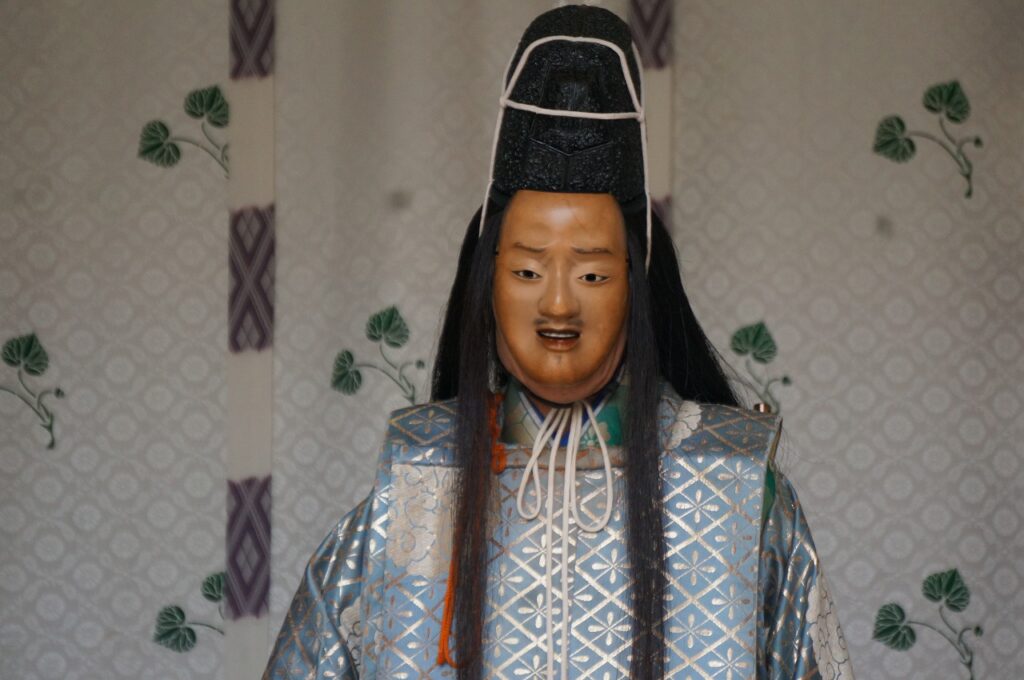
This is a rather common performance, and I will try to compare the four Kagura groups. This time, I would like to compare four Kagura companies: the Wakayama troupe, the Saito troupe, the Hisaizu Shrine group, and the Hagiwara troupe. (Hagiwara troupe only refers to the second half.) Except for Hagiwara Shachu, the mask is basically the same. They are probably based on the same mold
Takeminakata
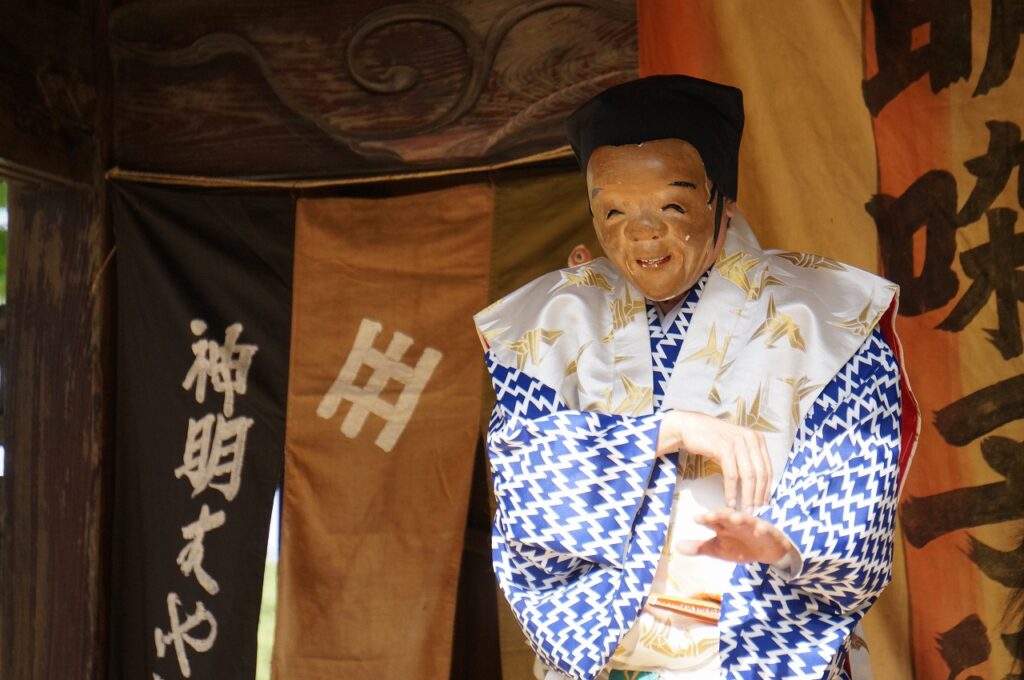
The first thing that happens is that Takeminakata appears. They are all using Kyougen masks of the “Buaku” style.
Buaku 武悪 mask
Hisaizu shrineSaito troupe
Wakayama troupeHagiwara troupe
Retainer (Modoki or Hyottoko)
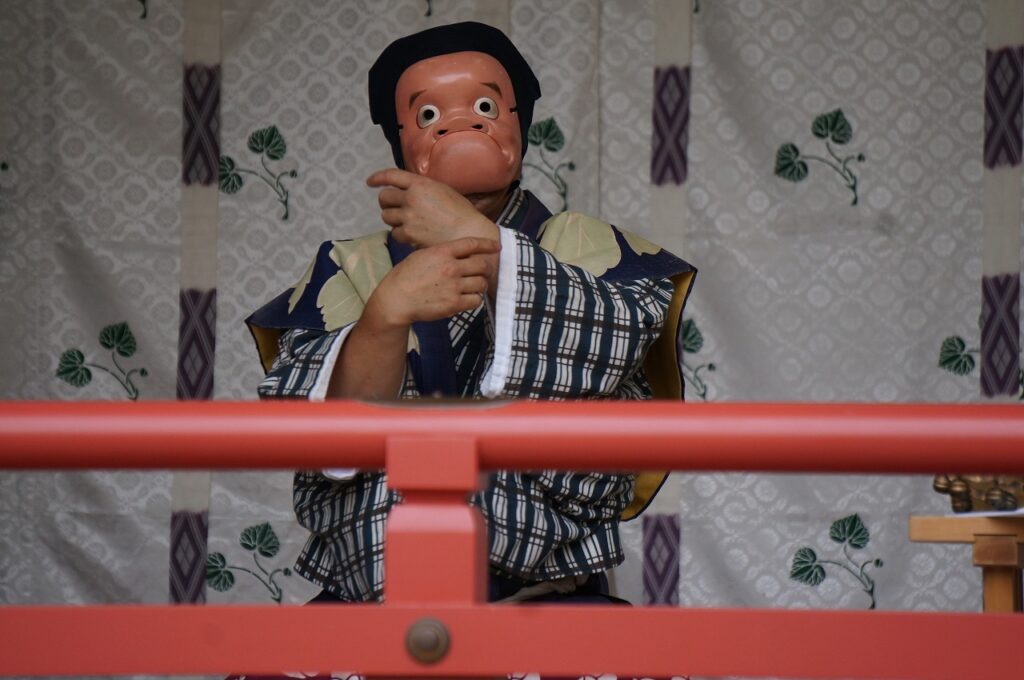
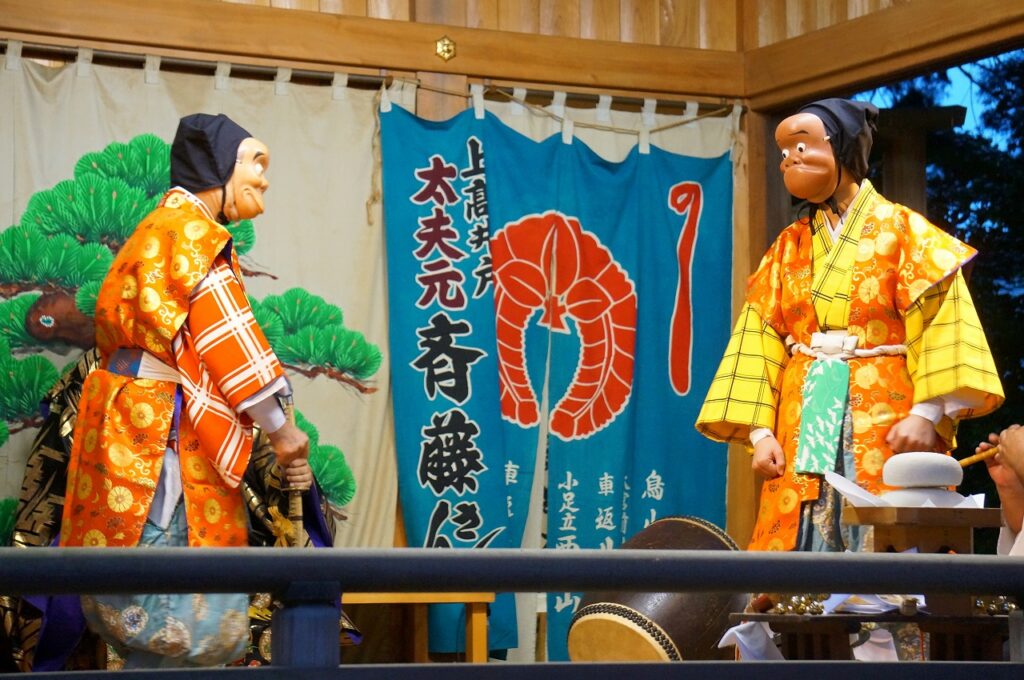
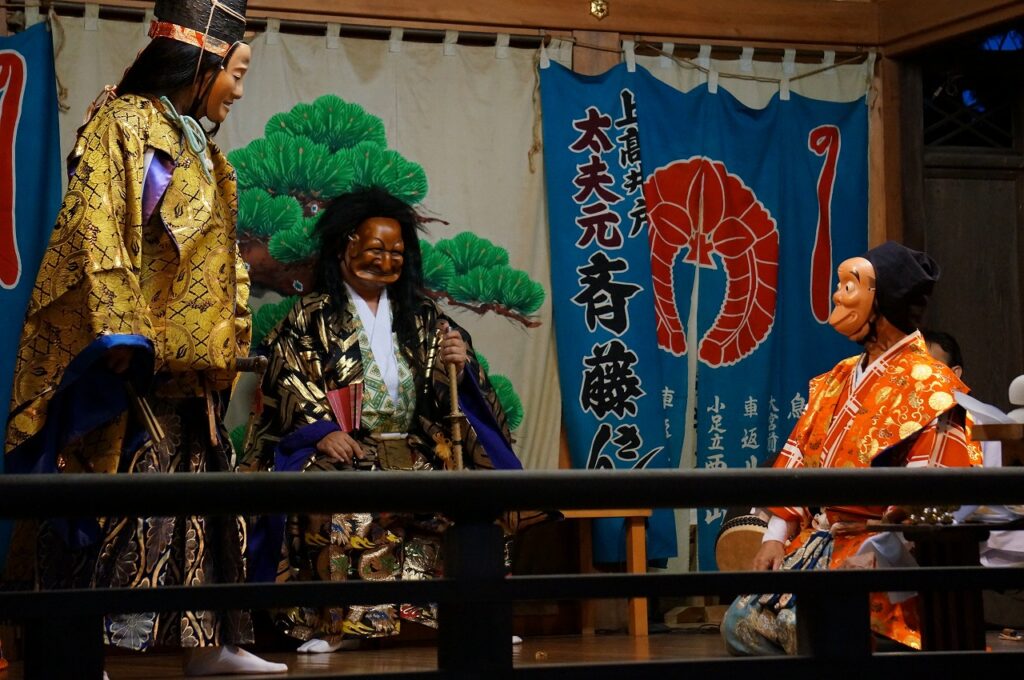
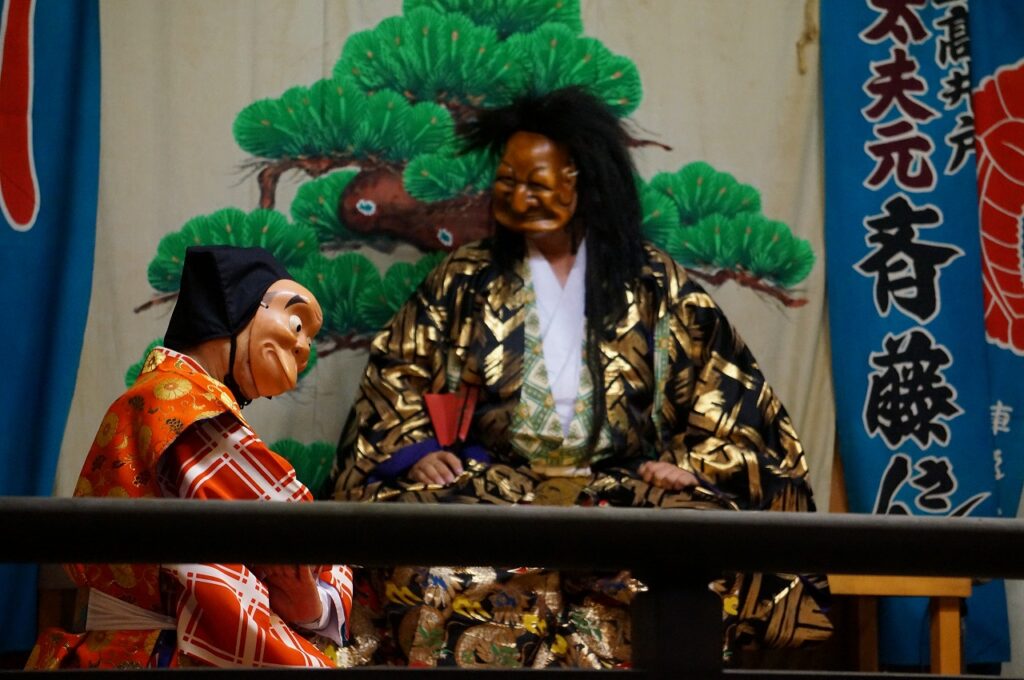
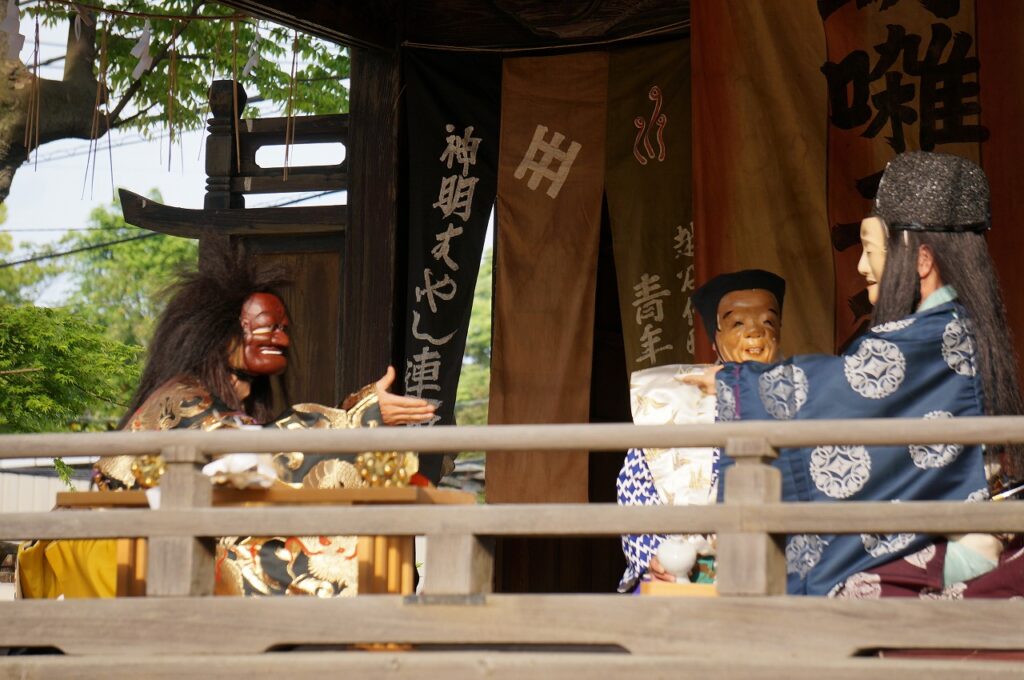
Next comes the servants, all of them are wearing masks with the comical role of ” Hyottoko” (modoki). However, only the Saito troupe has two people appear. The others just appear, but this is the only one which the two of them first have comic exchanges.
servant of Hisaizu shrine
servant of Wakayama groupe
two servants appear in Saito groupe
Ameno-bohi
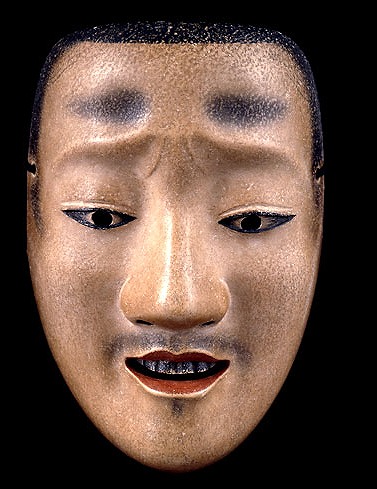
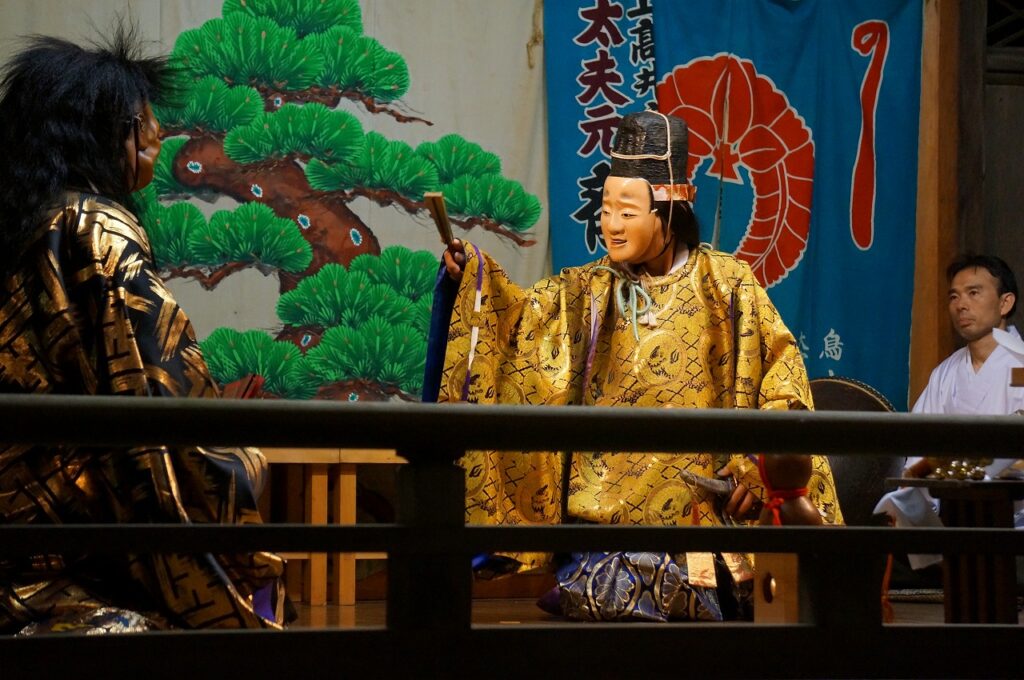
Then comes the third character, Amenobohi, who also appears in the title. All of the troupes use a mask based on a Noh play called “Chujo”. However, only Hagiwara’s troupe uses a different type of mask.
This mask was originally made for the role of a warlord who met a tragic end, and features a carving on the forehead that expresses melancholy. The use of this mask implies the tragic end of this person. In this way, Edo kagura often uses masks from Noh and Kyogen, which is one of the reasons why it is difficult to distinguish it from Noh. *One way to distinguish between Noh and Kagura is that Noh uses a musical instrument called a tsuzumi (hand drum) and includes a song called “utai (chanting)” as well as dialogues. In Kagura, except for a few cases, there are no dialogues. Basically, everything is performed in mute pantomime.
Musical accompaniment
Saito group
Wakayama group
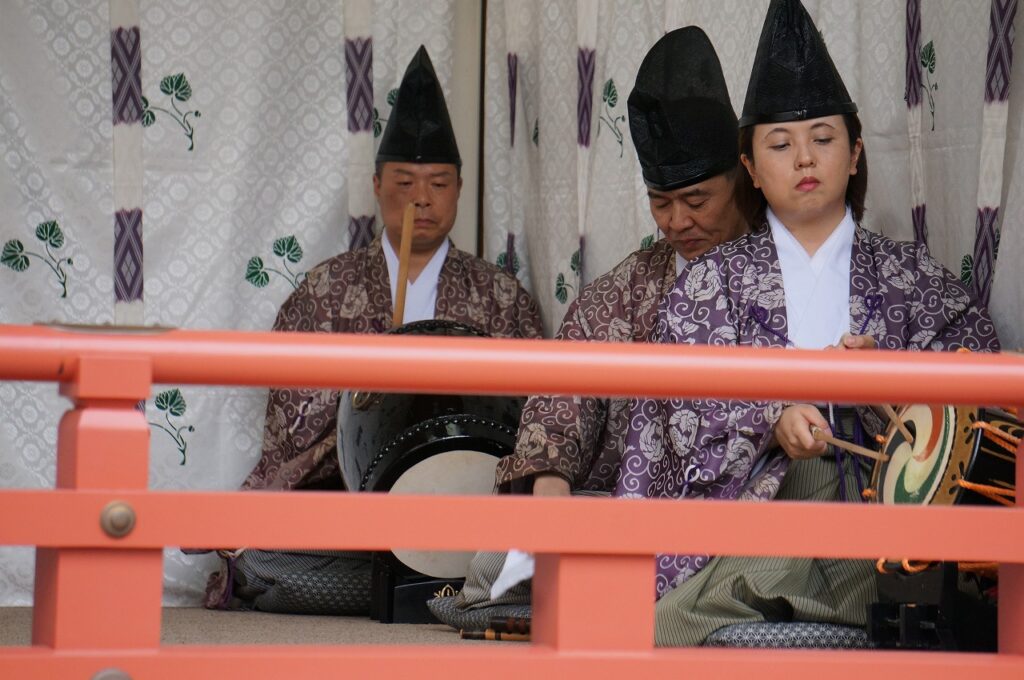
These three (four) people alone will proceed with the performance. They do all their acting in mime. The musical accompaniment conveys all the emotions and the mood of the scene. Most of them consist of two drummers and a flute player. There is no particular stage set, so it is difficult to understand without knowledge of the original mythology. Recently, some groups have begun to include a separate commentary.
Confronting
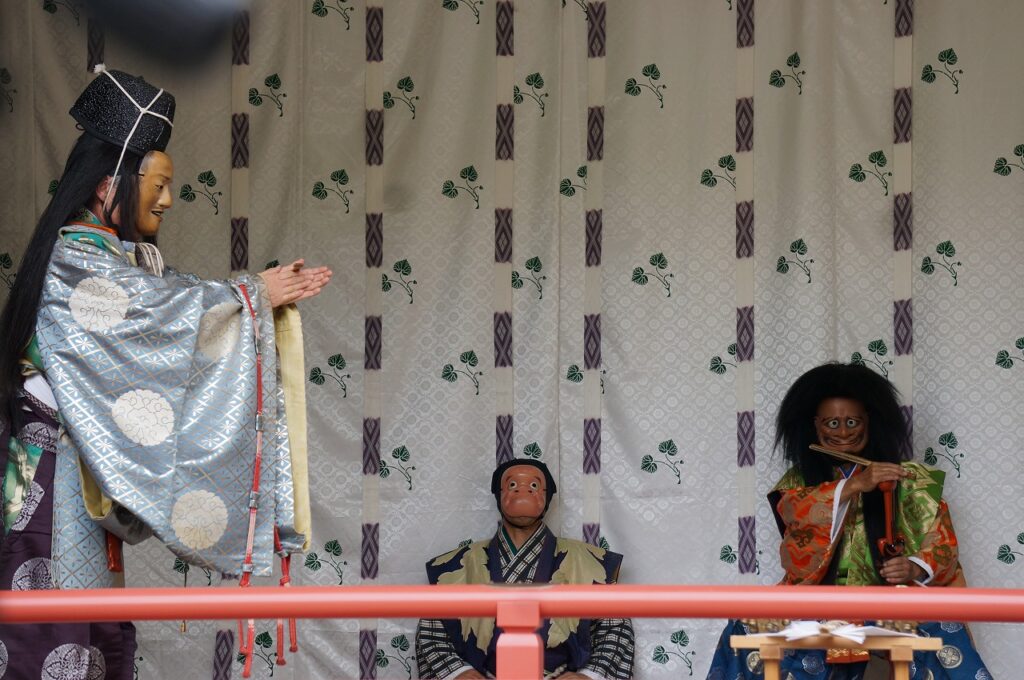
A scene in which a character (in this case, Amenobohi) claps his hands and calls out to people
Wakayama group
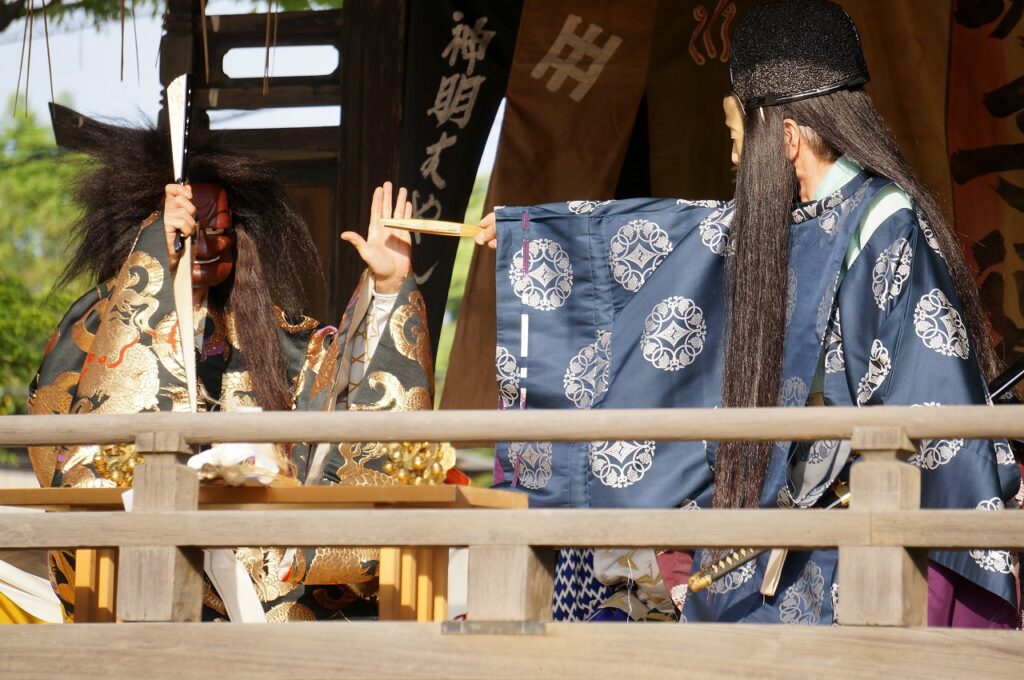
After the introduction of the characters, the story begins with a visit from “Amenobohi. The story begins with a visit from “Amenobohi”, and Takeminakata’s retainer, Modoki, welcomes him. Modoki opens the door and does some other things. There is one more thing that is customary in Edo Kagura, the clapping of hands to signal that someone is calling. This is a scene that is often seen. The Takeminakata is just standing there, but only the Wakayama troupe’s Takeminakata is holding up his fan as if in some kind of alarm. Their faces are more expressive than the others, so their movements are also more expressive.
And then they meet. The scene of the first meeting is filled with the feeling of tension, with both men bend their heads back slightly. Eventually, Takeminakata offers to sit next to him, and they finally sit down. Amenobohi then makes an offer to give up the kingdom. In addition, the stance of Amenobohi (and consequently, the Amatsu-kuni) make audience to feel their arrogance. Of course, there is no way Takeminakata will accept this offer. He interrupts the meeting, and Amenobohi leaves once.
Stratagem
The Takeminakata side ponders what to do about the proposal, which is not easy to accept. There is also a comical moment when Modoki as retainer falls asleep while thinking about it. If you look at it calmly, you may wonder why Takeminakata has continued to use such an unreliable-looking retainer, but he plays a very important role in the progress of the play. Originally, Kagura was performed as a form of entertainment for the common people. If it were only serious, it would not be appropriate for a festival. Takeminakata comes up with a ruse that is typical of him. He wanted to get him drunk and beat him to death with one fell swoop. The action here is easy to understand for both Takeminakata and Modoki.
I heard he loves drinking. So, just get him to drink more. And when he’ s drunk…
While he’ s drunk?
you just kill him with one fell swoop.
Heee!
Don’t panic. It’s not like you’re going to be killed. You’ll do it. Do you understand?
Hey, do I? Can I do it?
This is where the “carrying” scene comes in. It is a scene in which the attendant simply brings in sake, but the dance is accompanied by musical accompaniment. It is a kind of entertainment scene and has no deep meaning.
Banquet
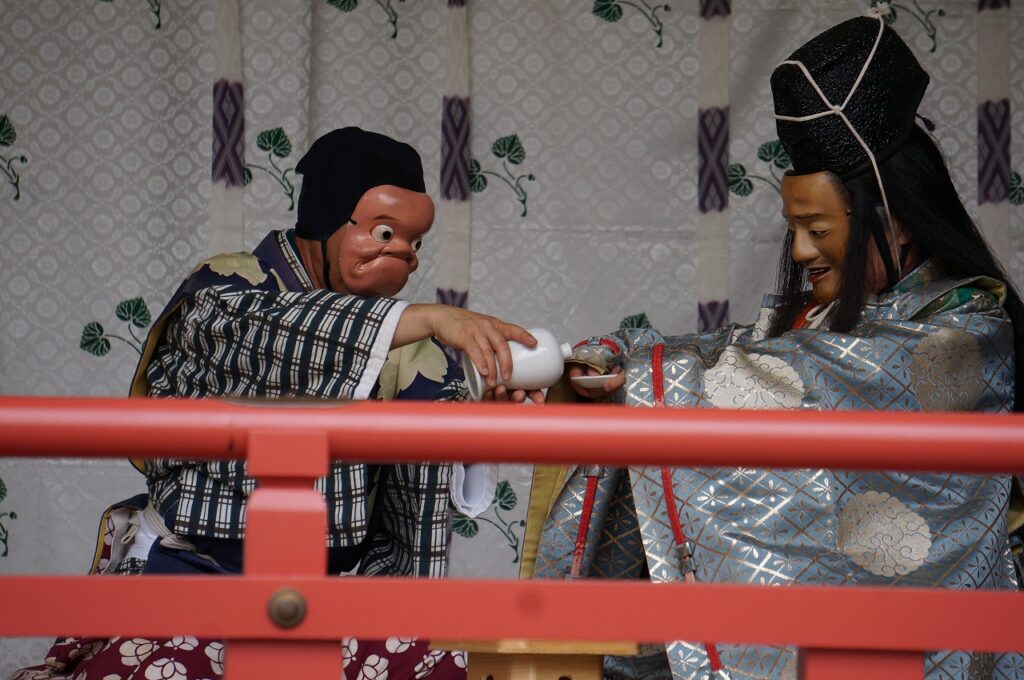
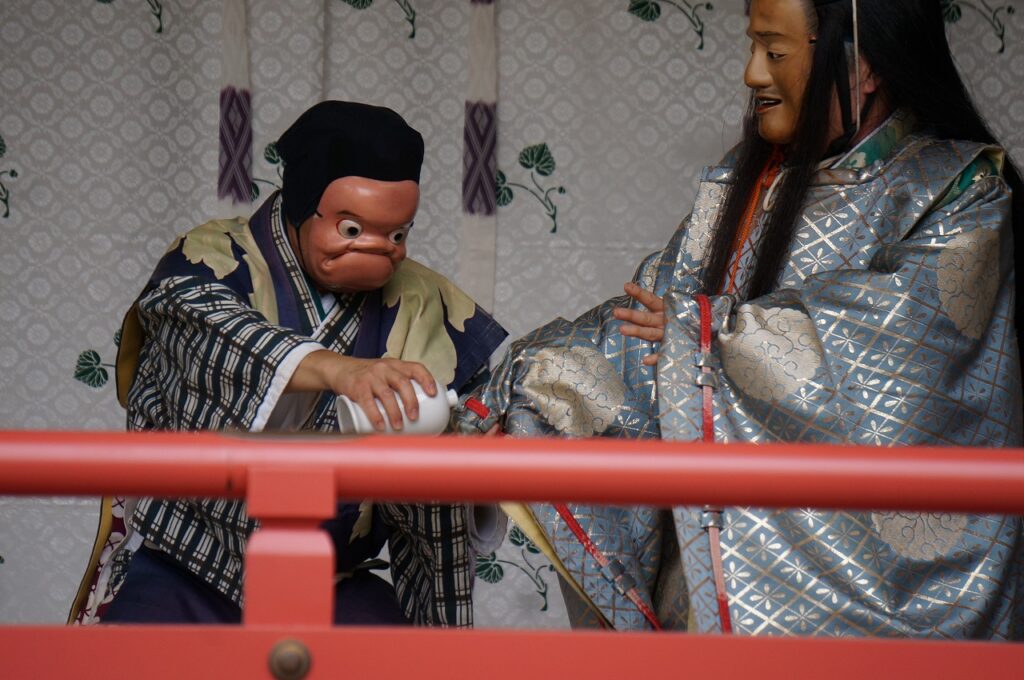
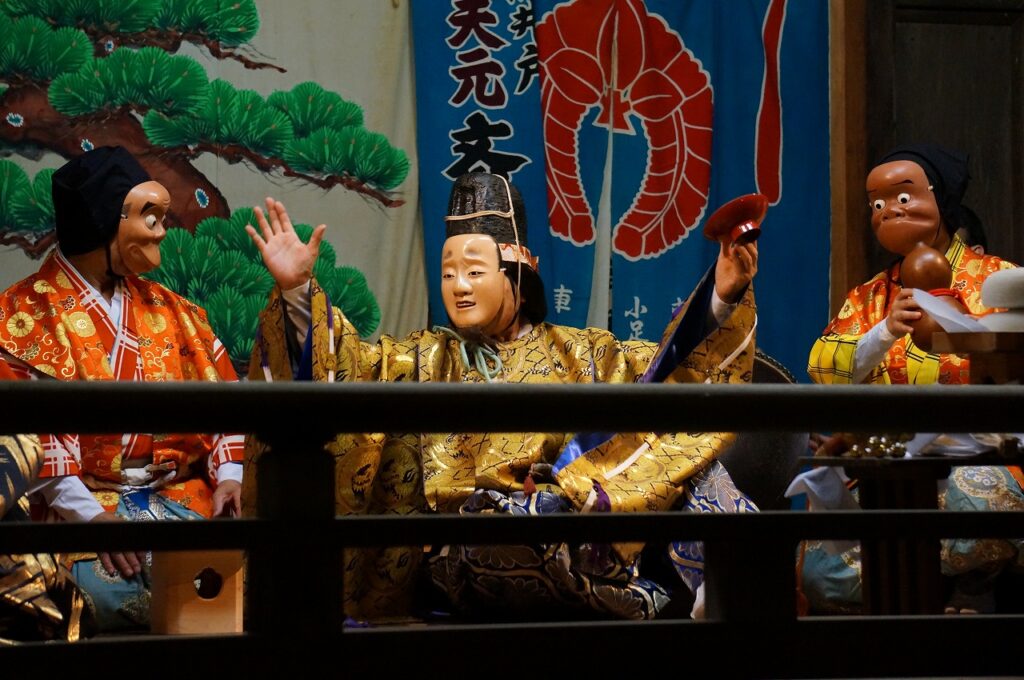
And finally, the banquet begins. Amenobohi, who had been holding fast to the suggestion, accepts the cup, saying, “Just one cup.” As soon as he drank all of it, Modoki pours him another cup. Bohee’s face shows his embarrassment. “Don’t hesitate,” Takeminakata said.
Even Bohi, who has a confused expression on his face, reveals his innate love of alcohol as the drinking continues. This is a great example of good acting and masks that make you feel the expressions on the face. At the end of the performance in the Saito group’s case, Bohi drinks out of a large bowl instead of a cup. In this kind of performance, you can feel the expression on the face even though it is a motionless mask. This is partly due to the quality of the masks and partly due to the skill of the performers. The key to enjoying Edo sato kagura is to be able to sense these small details.
Dance performance
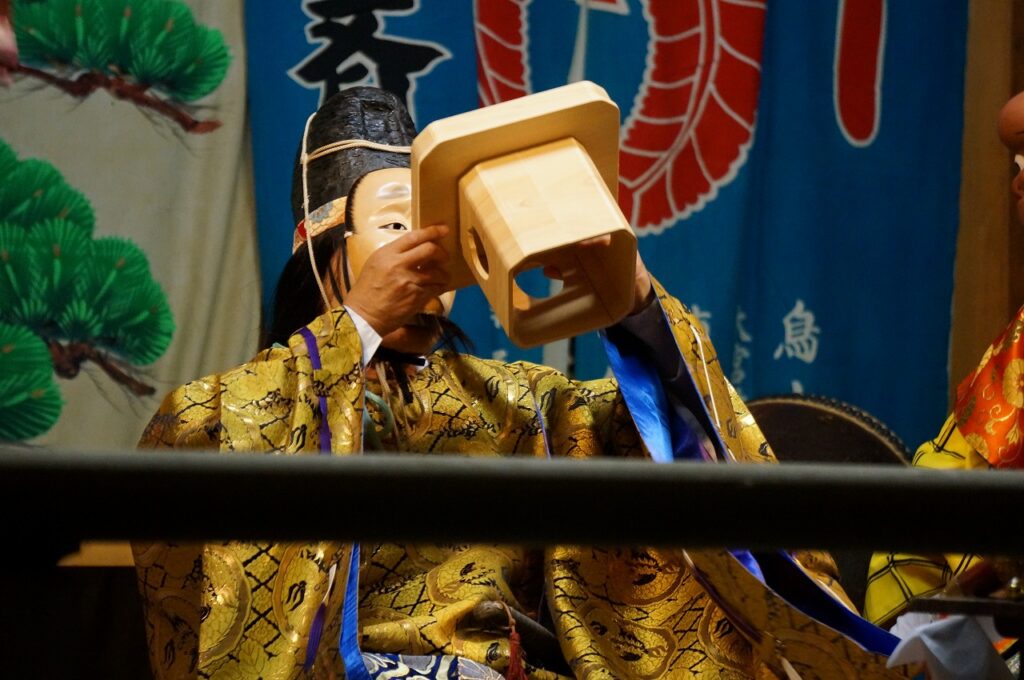
Finally, the drunken Bohi is in a good mood and begins to dance. Each group has a different performance of the drunkenness. In some troupes, Bohi stumbles when he stands up or when he starts to dance. In the other troupes he stumbles while he dances. Let’s enjoy another virtuoso performance here. Bohi then sat down and held a fan in front of his face. This is a rule for staging a kagura performance where the performer is said to have fallen asleep.
Takeminakata pulled out his sword to see whether he has been really asleep. Finally, he ordered his retainer to “go ahead and do it.” Bohi, as expected, sensed the presence and quickly took action. He is not just a drunkard.
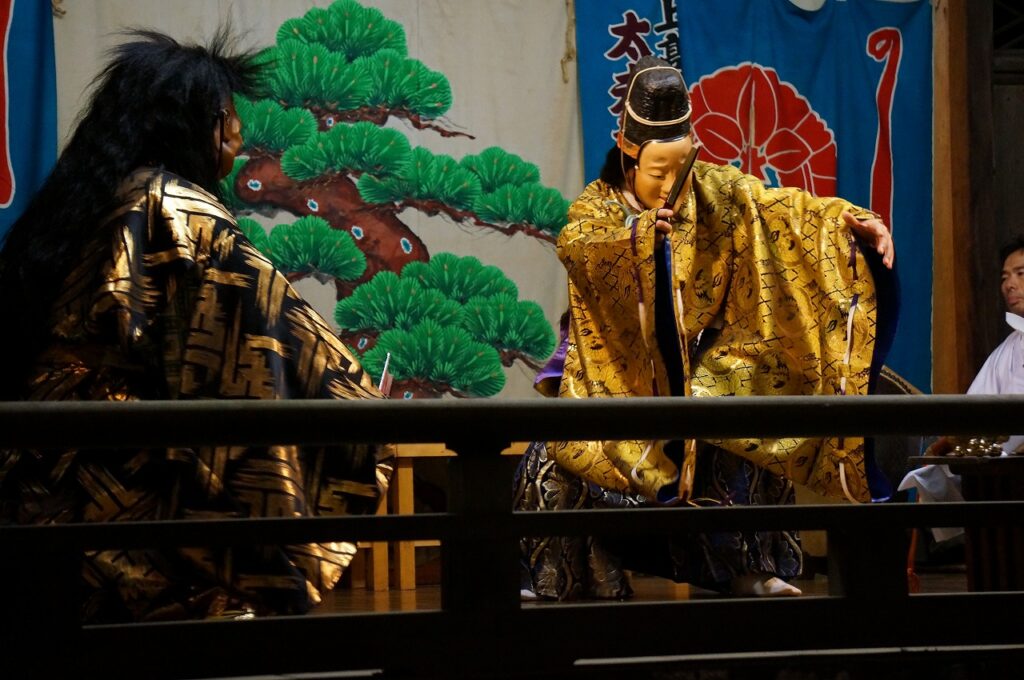
Takeminakata makes up his mind to accept that he has no choice without fighting now that his opponent is awake. He is not going to hand over their country so easily. Bohi pulls out his sword, and Takeminakata says, “Well, then. you should defeat my retainer first”. At this point, except for Saito troupe, Bohi gets ready by tucking up the sleeves of his kimono with a sash. The retainer makes a brave attempt to fight, but gets cold feet from the first. He is easily defeated, but it is admirable that he still makes a few attempts. But he’s no match for Bohi. This is a comical scene to ease the tension and entertain the audience. The retainer runs back saying “I’m not a match for him”. At last, the battle between the two is about to begin. The battle is different in each troupe. One side kneels down to receive the other’s sword, and now the other side. In such a way, an extremely stylized battle unfolds. Noh does not have such scenes, but rather is closer to the Kabuki style. Kabuki also has a large influence on Kagura such as strike swaggering pose. Finally, Takeminakata defeats Bohi. This is the same performance in every troupe. When Bohi swings his sword down, Takeminakata, a moment later, knocks it down from above.
Ending
After losing, Bohi gracefully admits defeat. The performing style of this scene varies depending on the performing troupe. One performer looks up at the heavens, while the other looks down at their sleeves and laments. This comes from a fineness of masks and performer’s acting. It is not a showy performance, but it is a scene where you can enjoy the virtuosity of the performers. Quietly enjoying these small parts is the peculiar feature of Edo Sato Kagura.
Sure, it’s not fancy. This is not like a spectacle of Iwami Kagura that uses fire and so on. Nor is it as groovy as Hayachine Kagura. But it’s not just a matter of spending a lot of money on a movie full of CG. There are many movies in which you can enjoy the virtuoso performance. If you have a chance, please take a look. A shrine festival makes you feel happy just by being there. It’s not too late to find out if Edo sato Kagura is boring or not after seeing it with your own eyes.
Report: The Lion dance (Shishimai) in Sawai, urban Tokyo
It is impossible to talk about folk performing arts in Japan without discussing “Shishimai”. Although Shishi means lion, this is not a real lion. The original source is said to have come from India, so it is said that a real lion had been an object of worship there. However, as it spread throughout the West, China, Korea and Nepal, it became an imaginary spiritual animal. Some say that Chinese emperors had lions, so it’s possible that they knew about the real lion up to that point.
Date: Sunday closest to July 25 (Most often the fourth Sunday of the month)
Place: Yagumo shrine, 2-902 Sawai, Okutama town, Tokyo
Access: A few minutes walk from Sawai Station on the JR Oume Line. It takes about one and a half hours to get to Sawai from either Tokyo or Shinjuku.
Shishimai (lion dance)’s history
It is said to have been introduced to Japan around the 6th century, at the same time as Buddhism. In 752, when the Great Buddha was built at Todaiji (東大寺) Temple as a national project, the lion dance was performed. It is said that half of the population of the time was involved in the construction of the Great Buddha, and about 10,000 people gathered for the unveiling of the statue. It is said that this is how the lion dance spread across the country.
However, there are various routes as to how it had been introduced to Japan, and thus a variety of lion dances have been born. It is said that there are now about 8,000 of them active. Shishimai can be divided into two main groups: Ise-Daikagura (伊勢太神楽) style and Furyu (風流) style. The Ise-style dance is performed by two people, while the Furyu-style dance is performed by one person holding a small drum called Kakko. However, it is so diverse that there is naturally a mix of these as well. The Ise-Daikagura-style is distributed in western Japan, while the Furyu-style is mostly distributed in eastern Japan.
Introduction of the Lion dance of Sawai
This time, this site is going to introduce Shishimai in Tokyo. The main style in Kanto region (including Tokyo) is three units of “one-man shishi dancers” comprising one group. Nevertheless, there is a variety of lion dances in Kanto, and even in Tokyo there is diversity. This time, I would like to take a look at one from the Okutama area first. The Okutama area may be the closest vacation spot for those living in Tokyo. It has ravines, waterfalls, mountains, and scenic beauty. It can be reached from the center of Tokyo in about an hour by train. An area that many people visit in summer to cool off. There are groups that practice canoeing on the river, and many groups enjoy hiking and camping. It is precisely because of such an area that the cohesion of the community is rather strong and there are many performing arts that have been passed down.
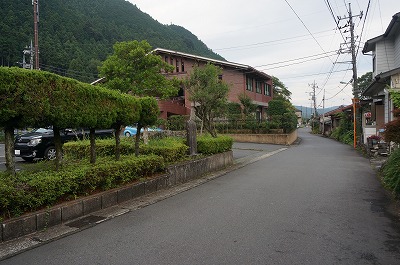
As we pass Ome (青梅), we start to see mountains around us, and the atmosphere starts to change. As most of the passengers are backpackers, the Okutama (奥多摩) area is just around the corner. There are reasonable hiking trails, mountain climbing trails, and ravines around the area, and the passengers get off at their desired destinations. When you get off the train, you find yourself in a quiet village surrounded by summer mountains, where the bustle of the city has disappeared. In the middle of the village, there is a small shrine. It looks just like an ordinary house. You would feel as if you are visiting a neighbor’s farmhouse. It’s Sawai Yagumo (沢井八雲) Shrine. This is the stage for today’s lion dance. As you walk up the stairs, you find a sandy stage about 10 meters square, surrounded by the shrine in front and audience seats on either side. The lion dance starts at 8:30 in the morning. But in the morning, the main activity is walking around the village. They walk around street by street performing their dance. This is not just to present themselves in public, but to celebrate the prosperity of the village and drive away the evil spirits.
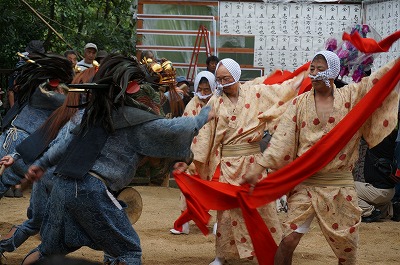
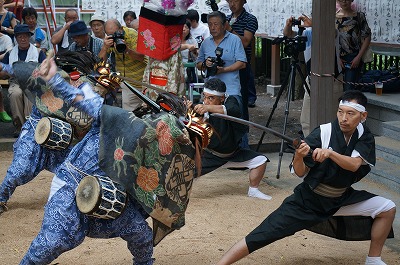
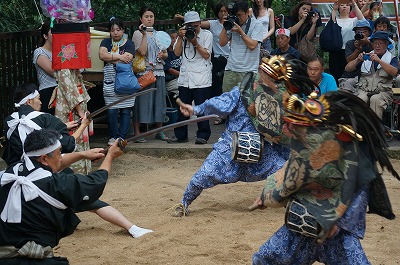
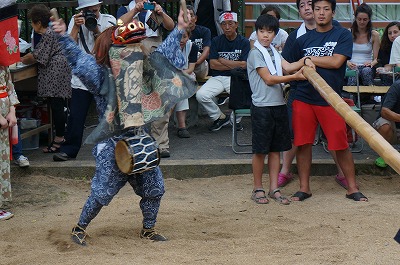
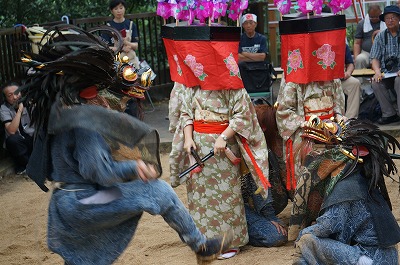
After lunch, they return to the shrine around 1:30 to perform a variety of acts. There are three lions. Two males and one female. The male lions are the elder and the younger. And four Hanagasa join them. This is the basic style. There are many theories as to why this style was adopted, but here in Sawai, it is said to represent the sun, moon, and stars. In Sawai, it is said to represent the sun, moon, and stars, and the four flower hats represent the four heavenly kings who protect the Buddha in Buddhism. The three lions are called ”Oh (elder)” lion, “Waka” (young) lion, and “Me (female)” lion.
the elder lion
the young lion
the female lioness
Hira-gurui 平狂い
The first performance is called “Hira-gurui”. In lion dance, a violent dance is often called “Kurui (mad dance)”. As the name suggests, this is also an intense dance. The age range of performers is wide, and this basic dance is usually performed by junior high to high school students. However, the ground below is soft sand. It’s like dancing on the beach, and we can imagine how exhausting it is.
It’s the height of summer. It’s hot. There is an electric fan running in front of the building, but it doesn’t help much for cooling. So, if there’s a pause in the middle or at the end of the dance, there are people who fan the dancers.
Kurenai-gakari 紅がかり
The next step is “Kurenai (deep red) gakari”. The lion dance often has a performance with this name. The word “kakari” seems to be used in the sense of relating to or showing interest in the subject. As the name implies, three rogues with deep red cloths come out and play with the lion. The lion’s interest in the red reminded me of a Spanish bullfight.
During the breaks, the famous local sake “Sawanoi” is served, and pickles are passed around. It was all very thoughtful. It doesn’t matter if you take it or not. In the plaza below the shrine, simple meals and beer are sold at a reasonable price, but if you want to eat well, it is best to bring your own food. There are no big stores or convenience stores nearby.
Tachi-gurui 太刀狂い
As the name suggests, a lion is entangled with a sword (Tachi means sword). Most of the swords are imitation, here they use imitation swords too. However, it was just barely enough to shave off 20%. They are almost serious about it. That’s why there is a sense of urgency in the air, as if a slight mistake could be made. It looks as if a lion and a man are engaged in a tense battle. As in any other performance, this one requires special training. The power of the lion dance can be seen in such a way.
Sao-gakari 竿掛かり
Let’s go !
I’m still afraid.
There’s no wall that we can’t cross.
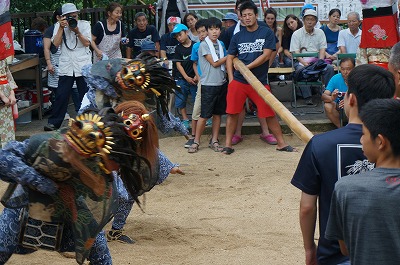
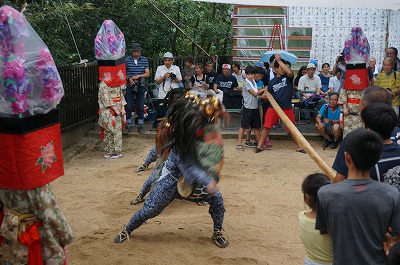
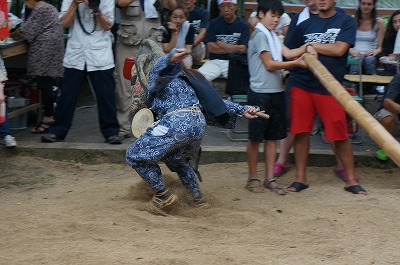
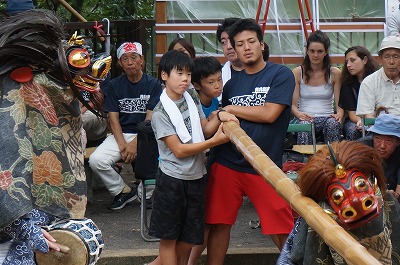
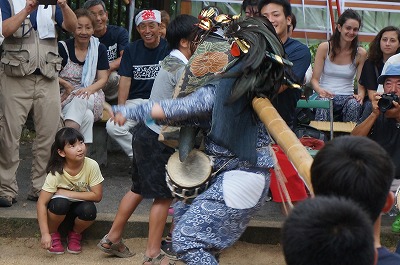
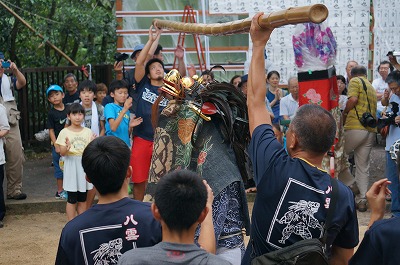
The lion dance sometimes has a representation of life. The same is true of this program. A pole (sao) is passed in the center. The lions are interested in the pole. But they are too scared to go over it. They try again and again, but each time they run back. They return with their hands behind their backs, as if they are expressing their fear with their whole body. And it is the female lion who is the first to cross the pole. The performance varies from each group of lion dance , but it is usually the female lion who is the first to cross the pole. And the elder lion is the one who hesitates until the end. It’s as if women are quicker to make decisions in life, and men who have too much stuff they don’t need are slower to adapt to change.
Mejishi-gura 雌獅子蔵
There is a performance in which a female lioness is hiding in every lion dance. I’m even wondering if that’s the reason why there are three lions two male lions and a female lioness. Simply put, it is a love triangle.
It starts out with the setting where the lions are on a journey. Eventually, the fog gets thicker and only the lionesses disappear. The two males panic and look around for her. They decide to split up and search for her. So far, there are no problems. After this, the young lion finds the female lioness first, but does not tell the elder lion. The elder lion is desperately searching for her. Eventually, he finds the two lions. He says, “Oh, I didn’t know they were here… Naturally, he was very angry. The young lion doesn’t even apologize, and a fierce battle ensues. This fight is one of the highlights of the story.
While they were fighting, the fog thickened again and the lioness disappeared. This is no time to fight. Once again, the two animals split up to look for her. This time, the elder lion finds the lioness first. If you get hit, hit back. The same thing happens again.
This fog thickening of fog is expressed by the densely packed Hanagasa hats on all sides. And finally the hanagasa return to their original positions, and the lions dance together as if nothing had happened. I always wonder. Why did the old people create this kind of performance? Is it a warning or an irony? In any case, the person who created the original must have been quite a connoisseur.
Gokito 御祈祷
The final performance is called “purification. At the end of the day, evil spirits are driven away, the place is cleansed, and the dance is concluded.
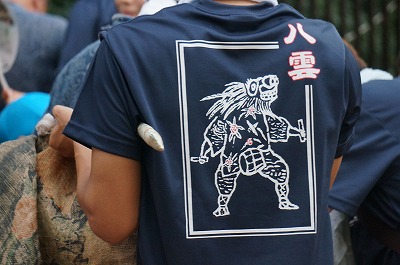
It ends at five in the evening. The Okutama area is a little cooler than the city center. The lion dance depicted on the back of stuff is dancing proudly. And so, one by one, summer comes to an end. You may look back at the road your came from, feeling as if the sound of lion dance drums and flutes are still echoing, but all you see is a quiet village that has regained its daily life. The fog in the mountains seemed to have lifted. The day is long. Let’s go home slowly.
Report: Let’s go to see the festival in Tokyo~Ome grand festival 青梅大祭
Date: 2nd & 3rd May Location: Ome city, Tokyo prefecture Access: It takes over 1 hour from Shinjuku by JR Chuo line
The feature of Japan Festival
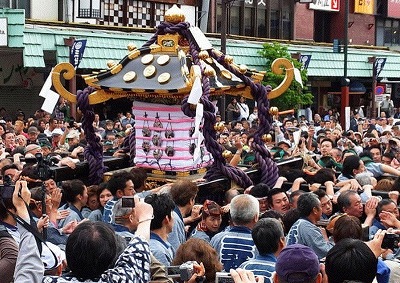
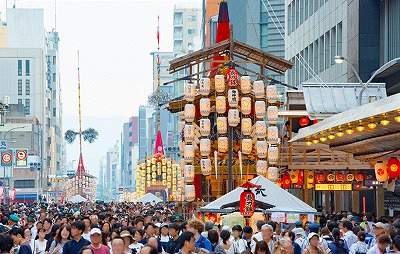
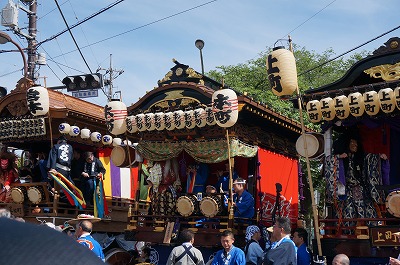
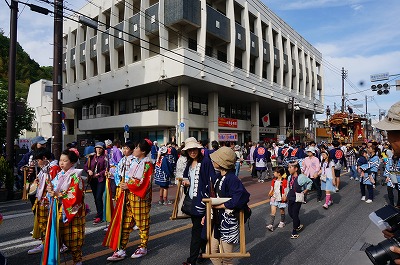
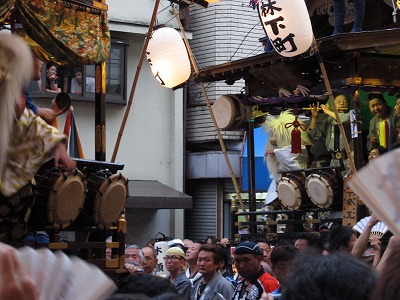
Do you know how many festivals there are in Japan? In one theory, it is said there are three hundred thousands. In Japan, if you ask a Japanese what is your image of festival, most people would answer “Mikoshi” or “Dashi (or Yatai). An exemplary “Mikoshi” festival is “the Sanja festival” at Asakusa or “the Kanda Myojin festival” at Kanda in Tokyo, and an exemplary “Dashi” festival is “the Gion festival” in Kyoto or “the Nebuta festival” in Aomori prefecture. *What is “Mikoshi” and “Dashi”? Both a means of transportation for a deity. Dashi is no different from Mikoshi in terms of being a vehicle. Mikoshi is a portable shrine and people carry it on their shoulders. Dashi is a float decorated with various objects for a festival.
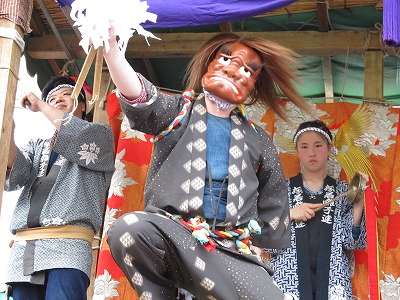
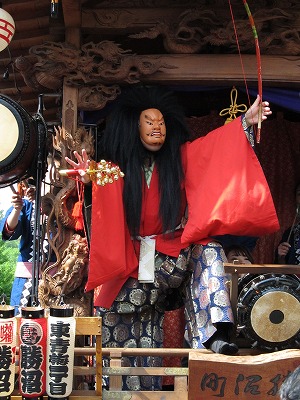
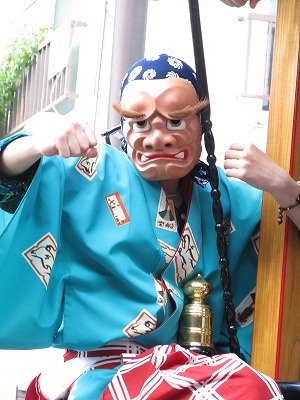
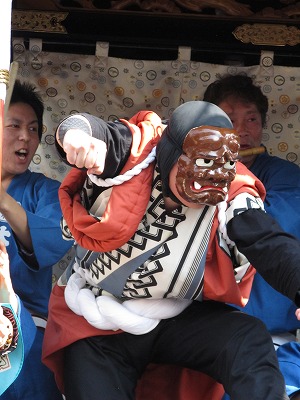
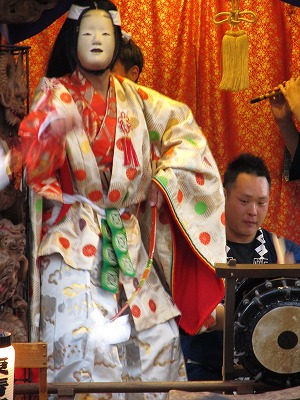
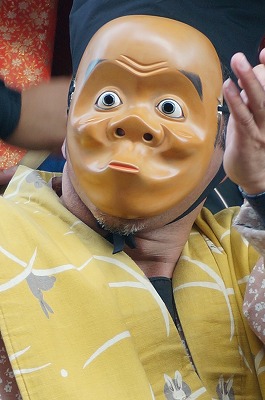
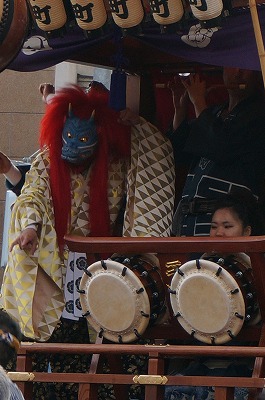
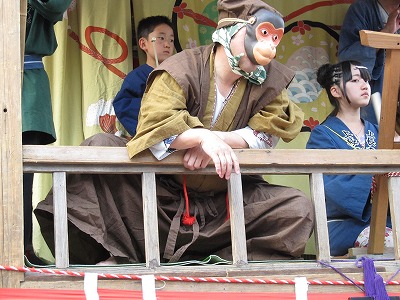
We can often see masked characters on Dashi in festivals. So, this time, we will go and see the Ome festival in Tokyo with our guides. Oh, where have they gone? Hey, it’s your turn!
What are you carrying?
We are going to Tokyo, aren’t we ? So, I wondered if I have to bring back gifts for our colleagues.
Stop being like a country bumpkin. We just get to Tokyo within 2 hours by train. (*They live in Gunma prefecture.)
What a surprise! There are so many people in Shinjuku station!
I can’t take it. Shinjuku is the busiest station in Tokyo (and the world) ahead of Shibuya station and Tokyo station. Tokyo Metropolitan Government office is in Shinjuku,too.
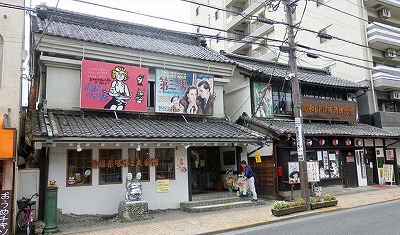
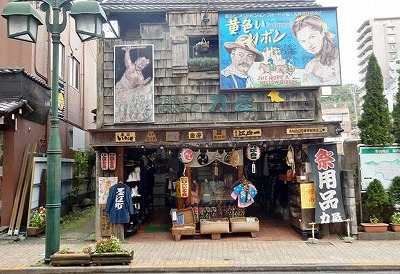
Ome is a town full of retro culture
Ome city is located in western Tokyo and is the major gateway of excursion into the Chichibu-Tama-Kai National park.
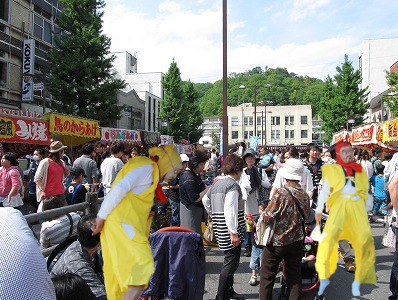
Ome is usually a calm town. There are still quite a number of vintage houses and many vintage film billboards. But only during the two days of the festival, this town changes.
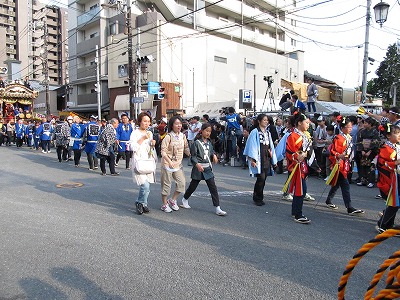
So many people!
You were right. It’s better not to carry a big bag.
It is said that this festival gathers about 150,000 people. There are too many people that we can hardly move.
Welcome to Festival
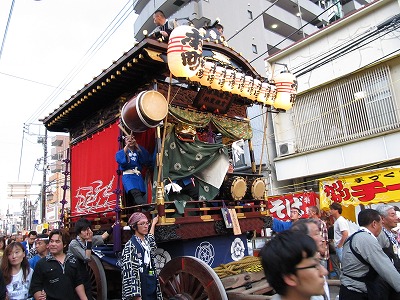
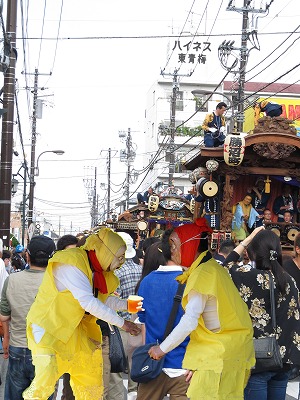
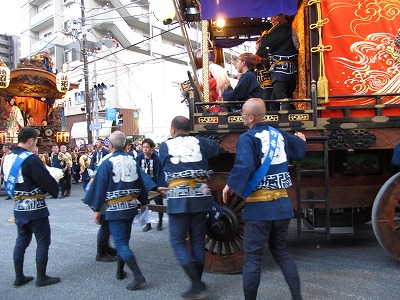
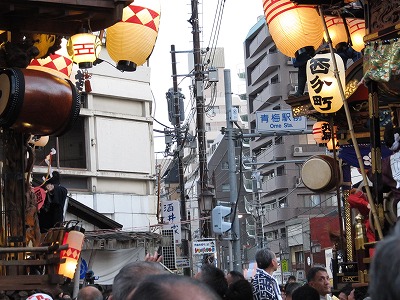
Oh, a big vehicle is moving.
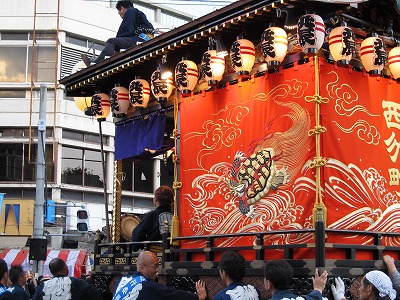
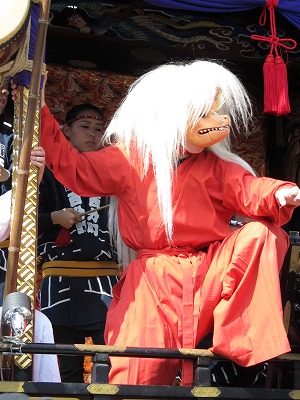
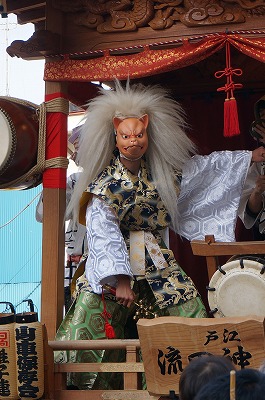
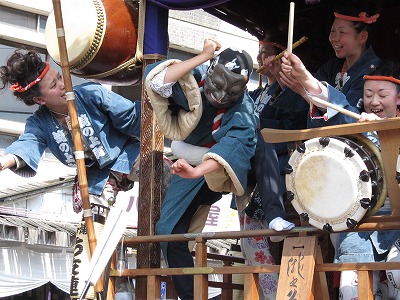
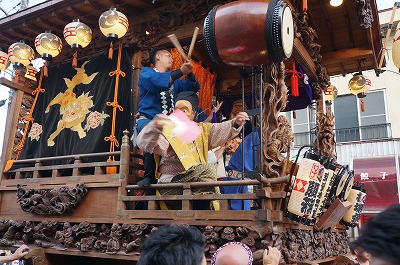
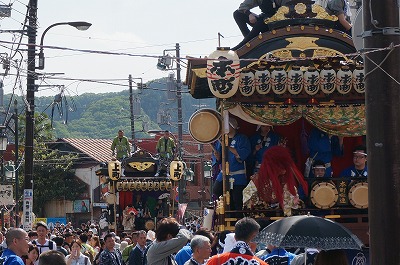
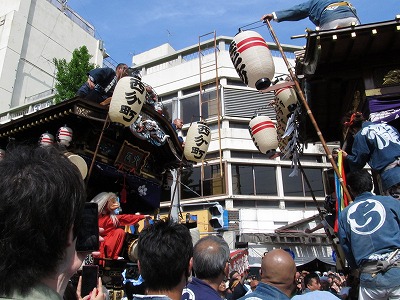
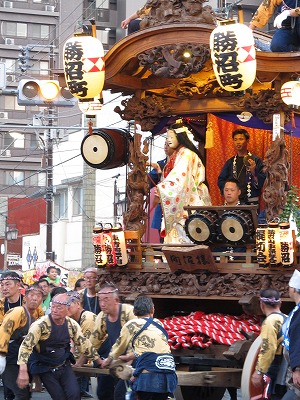
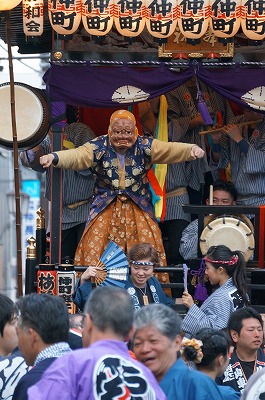
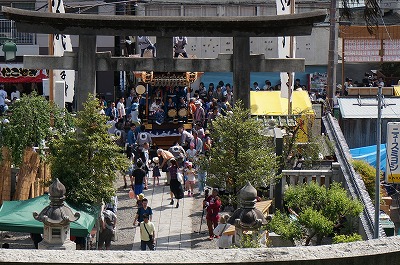
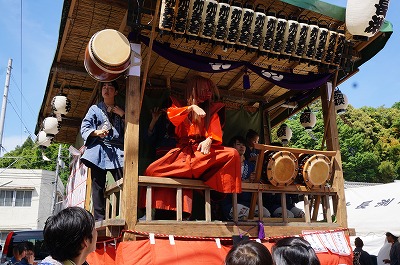
This is a “Dashi”. Each town in Ome city has a “Dashi”. There are 12 in all. There are various designs and decorations applied. These floats are so gorgeous that they are sometimes even described as a “mobile art museum”. To see each design of the Dashi is part of the attractions of enjoying this festival.
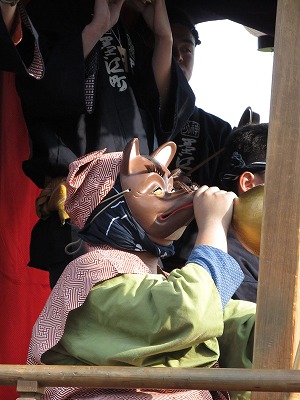
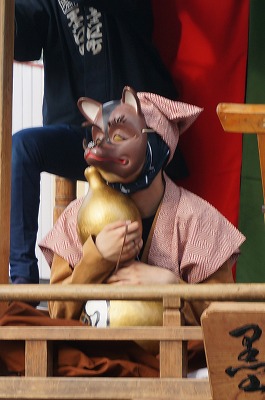
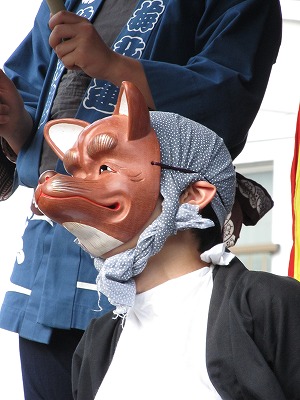
First, foxes greet us.
Even foxes come in various kinds.
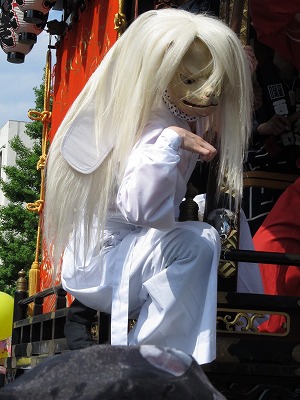
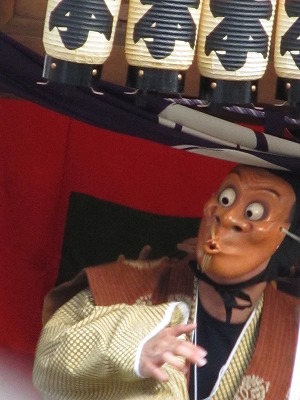
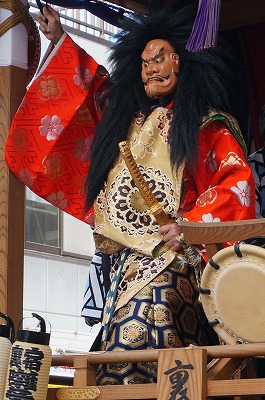
Yes. We will be able to find many masked characters on the Dashi.
Can we find other animals in addition to the fox?
Maybe. Not only animals, many various masked characters will be dancing on Dashi. This is not “Pokemon Go”, it’s “Maskman Go”. How many can we find them?
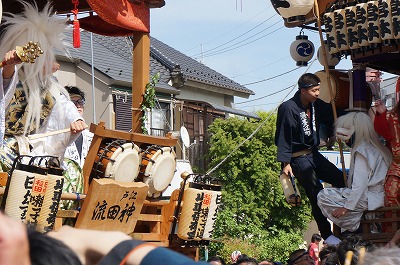
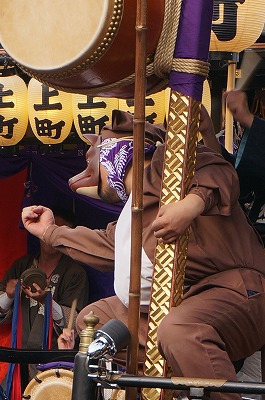
You OK? Oh, on the Dashi, several musicians are playing traditional flutes and drums.
They are playing music called “O-hayashi”. Especially O-hayashi played in festivals is called “Matsuri-bayashi”. It is designed to be performed with festival events and as such, the shape of performances and performer’s costumes can vary depending on the nature of the events. And an interesting point of this flute for festivals is that the musical scales don’t conform to either Japanese or Western music, because the finger holes are equally spaced to make it easier to make as well as to play.
With so many Dashi like this, I’m worried they might collide into each other. Oh, Dashi are coming from both sides.
People call the situation when two Dashi collide “hikkawase”. “Hikkawase”‘s “hiku” means to pull Dashi, and “awase” means to have them collide. It is the highlight of the festival. The time when more than two Dashi collide brings more excitement. This time is announced on the leaflet before hand or real-time on microphone. The leaflet is provided at the station free of charge. This leaflet tells the kind of each Dashi and where the Dashi will pass.
Battle of “Ohayashi” is worth seeing.
Let’s walk around a little.
Along the street
Many shop stalls are in a row along the road. What are they selling? Should we take a look?
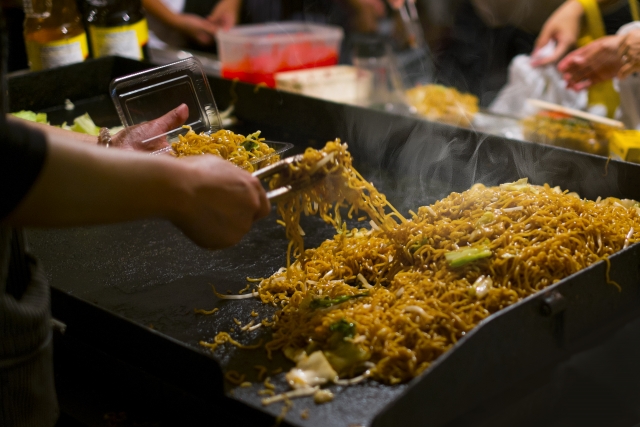
Foods, drinks, Japanese cheap sweets and toys are on the shop stands. “Yaki-soba“, “Tako-yaki“, “Okonomi-yaki” are traditional old-timers of all the stalls at the festival. In addition, there are grilled corn, “Yaki-tori” and so on. I guess Yaki-tori and Tako-yaki are some of the famous Japanese cheap foods. Yaki-tori is grilled chicken skewer, like kebab. Tako-yaki is a flour based snack baked in the shape of little round balls containing pieces of octopus. Okonomi-yaki is a dish of thinly sliced cabbage mixed with batter made of flour, eggs and water and cooked on an iron grill. Yaki-soba is stir-fried noodles. Yaki-soba, Okonomi-yaki and Tako-yaki are added with Japanese salty-sweet sauce. Each costs about \4~500.
Everything looks tasty and smells good. I want to eat all of them.
Me, too.
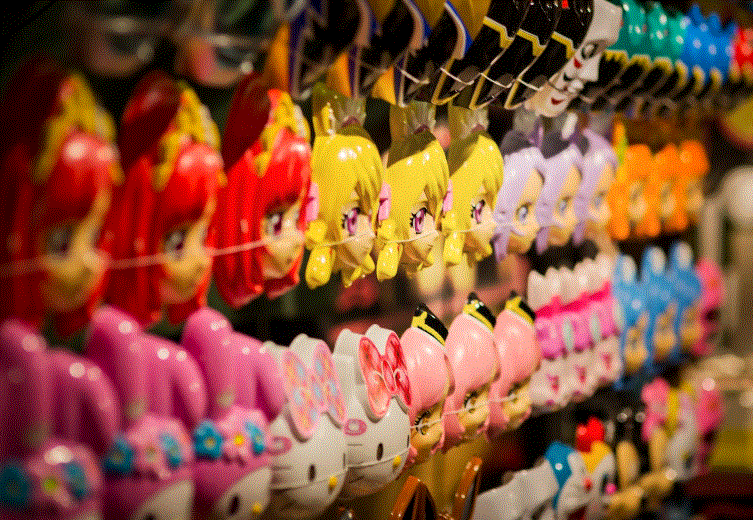
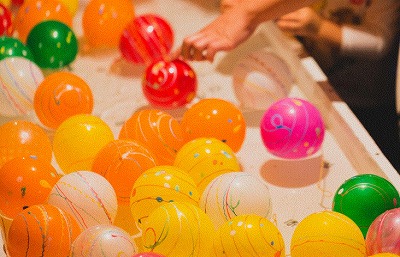
What? Have you heard a strange voice from heaven? …And, many toys are very colorful.
These are for children. But, most adults are excited to remember their childhood. These colors, smells, tastes and sounds. Every element enlivens people. I wonder if most festivals have such elements all over the world.
That hits the spot! Red pickled ginger goes with yakisoba and beer.
“Woo, sake tastes so good“
“It looks great”
You! Before I knew it. You are drinking alone.
Every “Dashi” is moved manually, isn’t it?
It is the greatest highlight scene to turn the Dashi. For example, “Kishiwada danjiri (it is held at Kishiwada in Osaka) ” is famous. At this festival, the highlight is to turn the Dashi around with breakneck speed.
Mask collection
By the way, what kind of masked characters are there?
Let’s go to look for them.
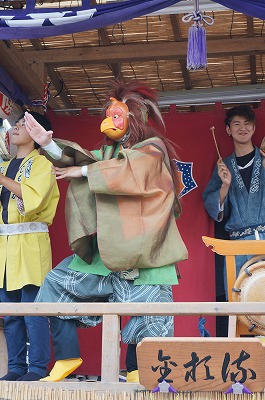
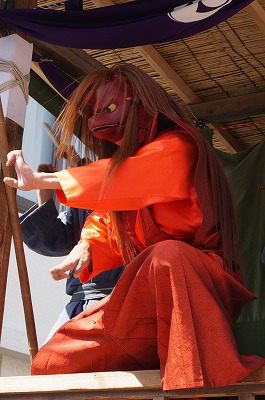
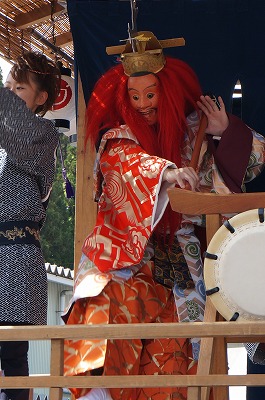
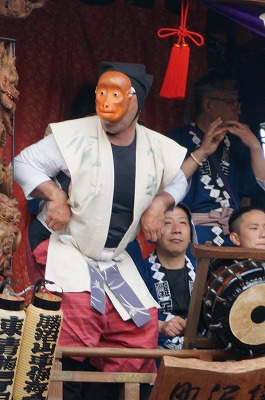
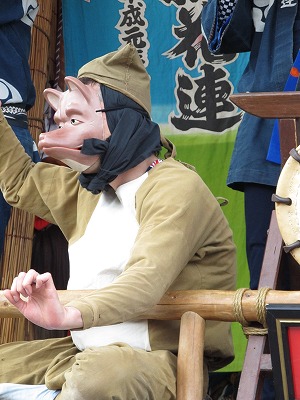
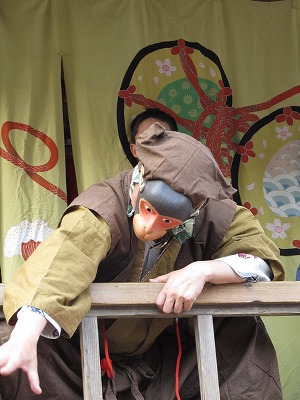
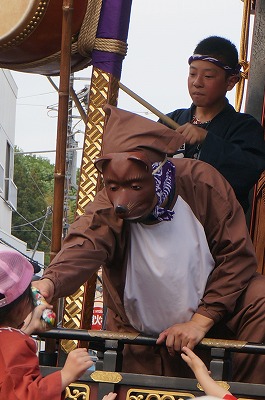
What a great variety of masks there are. There are not only a fox but a raccoon dog and a bird.
These variety of masks all derive from Noh, Kyogen and Kagura*,and so on. They represent a deity, people or animals. *Noh, Kyogen and Kagura are traditional performing arts since medieval times. Especially, Noh uses a lot of masks. Foxes, raccoon dogs, or monkeys are active characters in folk tale. In stories, foxes and raccoon dogs bewitch people. In addition, foxes are messengers of the deity of rice planting.
a monkey
a raccoon dog
a raccoon dog
Hey, raccoon dogs and monkeys are looking at us. I’m worried I might be bewitched.
Worship at shrine
This festival is for the deity of Sumiyoshi shrine. We go to shrines to worship.
Long steps….
How long the line is.
Hey! Don’t reach for sweets. It’s for children. Quit making a fool of yourself.
Sorry. I can’t resist sweet things. Anyway, what is this?
This is “Ibayashi”. It means they play “Ohayashi” without moving. In this period, they play and dance not only on the Dashi, but also on the stage like this. They are set along the road.
How long is the festival?
Until what time is this festival held?
On the 2nd of May, it is held from 3 pm to 10 pm. On the 3rd, it is held from 9 am to 10 pm. On the 2nd, the Dashi only moves in each town. So, I recommend to go on the 3rd.
The festival is still going on…
“Take care. Come back again anytime.”
I am a little tired. We are almost out of time. Let’s go home.
Yes. Let’s drop by Shinjuku to have a quick drink on our way home.