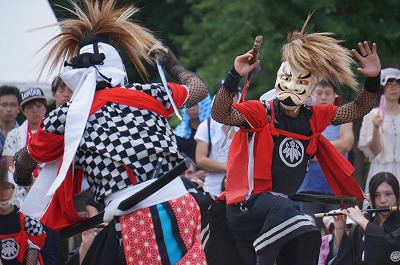
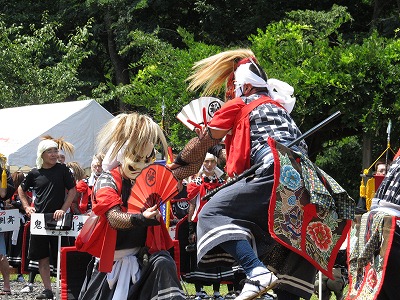
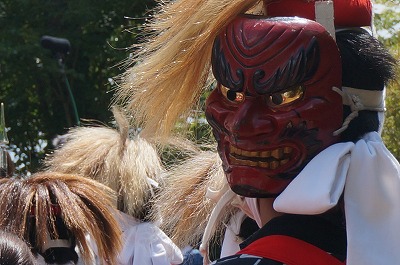
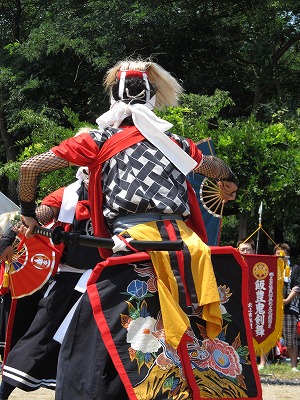
Report: Michinoku traditional folk performing Arts festival ~The Deer Dance

Shishi Odori (Deer dance) has 2 groups in Iwate prefecture
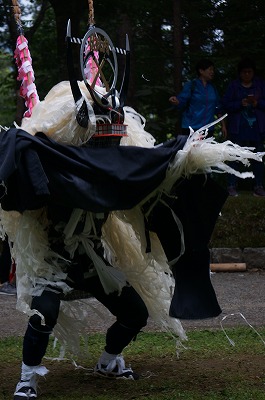
獅子踊り 幕系
using drape style

獅子踊り(太鼓系)
self drumming group

In Iwate Prefecture, the Deer Dance can be broadly divided into two groups.
One style involves the performer playing the drums and singing themselves; this is known as the “self drumming style.” The other style consists of a group in which the performer only dances, while others in the group take on various roles, including drumming; this is known as the “using drape group.”
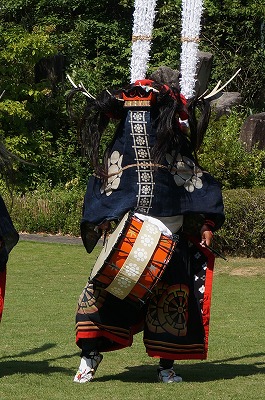
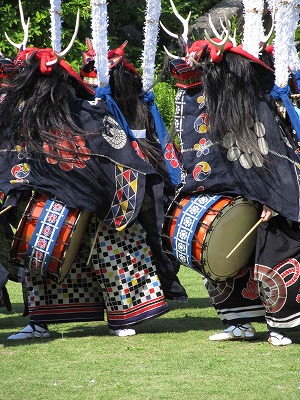
太鼓系鹿

踊る鹿たち

 The most unique aspect of the Deer Dance is its visuals. When transforming as an animal, Europeans often try to be the animal itself, wearing furs and such. In Africa or Papua New Guinea, they try to cover their bodies with leaves and other natural materials to appear as something other than this world. The Japanese tend to try to leave behind a human figure. They may use part of the animals, but only a little. More often than not, they don’t use them. Shishi odori (Deer dance) is one of the few exceptions to this rule.

The position of the deer dance in this festival

 The Deer dance is one of the most popular performance of this festival along with the Ogre Sword Dance. It can be seen at several venues, but the best place to see it is in the “Shiika no Mori Park*” on Saturday afternoon. “The Shiika no mori park” means “the poem park”. There is no doubt that it is a beautiful park, covered with lawn and lush with trees.
 The event starts at 1:00 p.m. Each group will perform every 20 minutes. In previous years, all of them have performed the Deer Dance. In fact, one of them includes a high school group. It is unique in this area that there is a Deer Dance club in the school, just like baseball and soccer. You just don’t see it anywhere else, especially in Tokyo. Let’s start with the Deer Dance, in which the deer beats the drum himself. (This style is called “self-drumming style.)

*Access to “Shiika no mori park” About 1.5 kilometers from Kitakami Station

The self-drumming style deer dance ~The song of the earth echoing from the depths of the earth
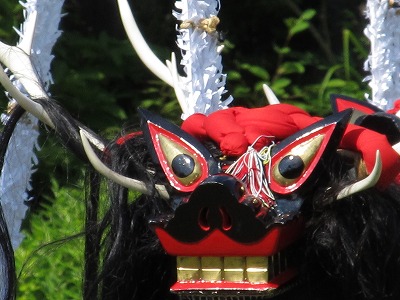
鹿踊り 顔

鹿踊り 背面
Ookuchi

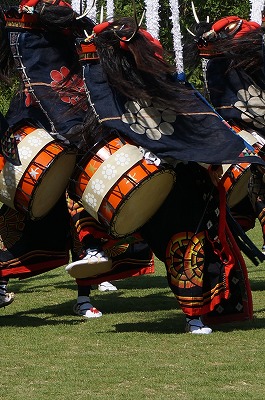
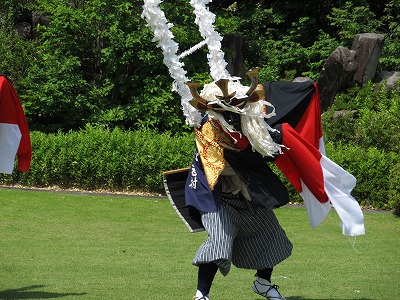
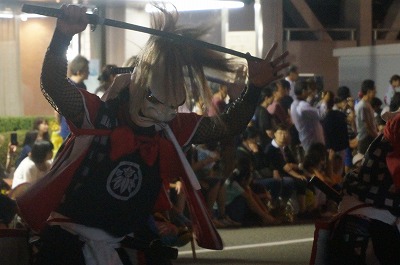
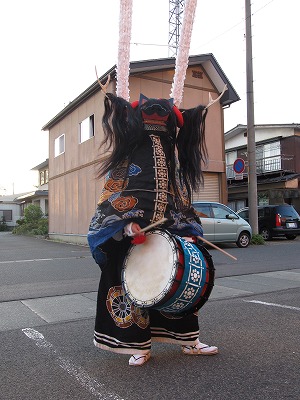
 This self-drumming style is characterized by the long antlers on its head. They are made from real deer antlers. If it is broken, they will be provided by the hunter. Originally, the antlers had to be split into four pieces, but nowadays it is difficult to get the right ones. And the raised eyes. He carries a long pole (called “Sasala) on his back. There is a piece of paper wrapped around it. It is said that this is the gohei, in which dwells the deity. A drum is tied around his belly, and behind it, just like in the ogre sword dance, hangs an “ookuchi”. Basically, it consists of a group of eight people. It is said that the dance is handed down to the next generation in a group of eight people. The weight of the entire costume is about 15kg. In summer, the temperature is said to be around 40 degrees Celsius. However, one can only admire their light and harmonious movements that do not make you feel that at all. There are also several schools of the art, but they are mostly the same in appearance.
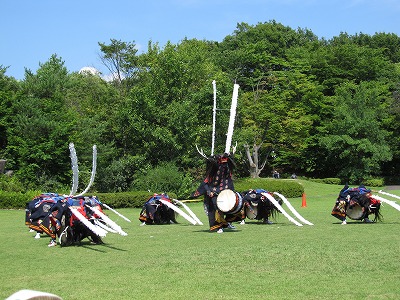
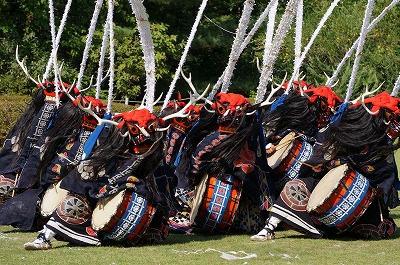
公園で舞う鹿踊り

鹿群舞

 Like the ogre sword dance, each performance lasts about 10 minutes, and there are several different types, but I won’t go into details here. However, one of the features of the dance is that at the beginning of the performance, there is always a program called “Niwa-home” which means “praise the place you visit.” When they visit a shrine or a mansion, that performance is performed first, and then the rest of the performances follow. The Sasara is bent at the back and slammed onto the ground with force. It is believed that this is meant to drive away evil spirits of the land. Here, the host introduces the name and the program before it begins, but people who have never seen it before do not understand it well. A deep bass of the drumming seems to echo from the depths of the earth. And the occasional singing voice enters, adding to the effects–a visual that overwhelms the viewer. It was as if the cries of the souls of the Tohoku region could be heard.

Drape-style deer dance ~inland areas
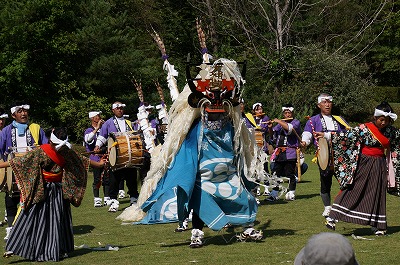
板沢鹿踊り

板沢鹿の面

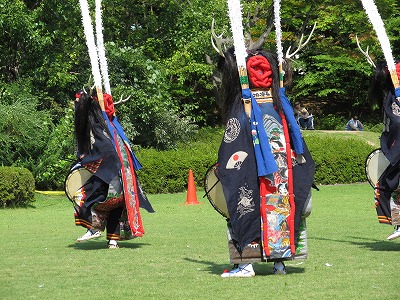
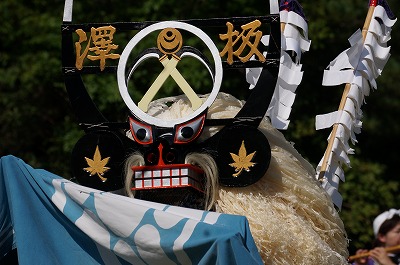
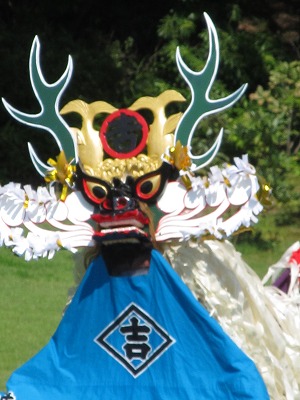
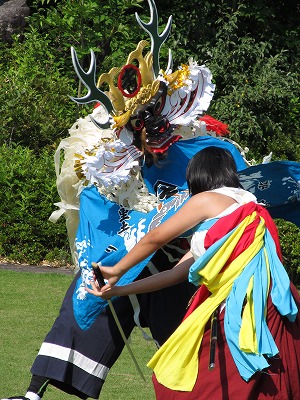
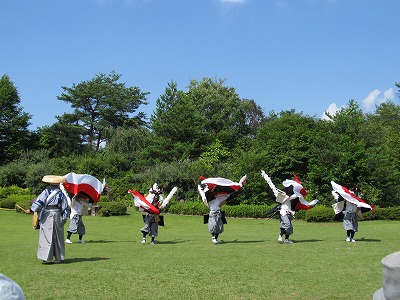
 For a change, this time there will be a deer dance performed by a large group of people. This dance is called “drape-style” because the whole body is covered with a kind of drape. The appearance of the dance is also very different from the “self-drumming style”. First of all, they do not use real antlers. It involves an extremely inspirational design. The design also differs from region to region. The most representative one is the one in Tono City, which is located east of Kitakami City. The design is quite different except for the fact that it has raised eyes and a stick-like object on its back. Its most distinctive features are that it has a large amount of wood shavings called “kannagara” on its back, and the dance that causes the drape to rise and fall violently. Moreover, each group has its own role after the leader. There are more than 60 people in total (officially). However, it is difficult for all the groups to get that many people together, so the number can be increased or decreased as needed. Unlike the “self-drumming style ,” there are separate drums and flutes, and the shishis focus on dancing. Men play the role of the deer, and many women play the role of “Nakataiko” or “Katanakake”. However, in the olden days, all the roles were performed only by men and none were taught to women because women might eventually leave to other areas. This was because they were afraid that other communities would copy their methods.
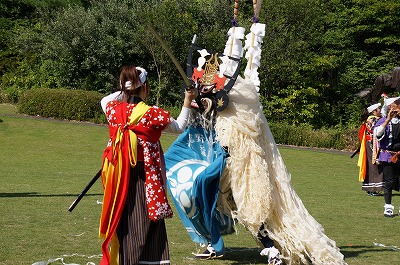
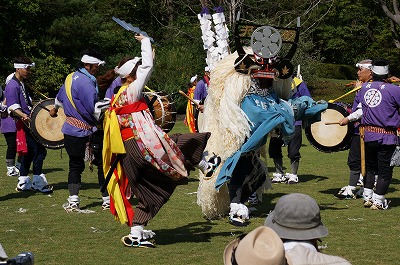
刀かけと鹿
Katanakake and Shishi

中たいこと鹿
Nakataiko and Shishi

Drape-style deer dance ~coastal area

 The dance is done in such a plaza with the whole thing going around in a circle. Basically, drums and flutes are often set aside. And the shishis raise the drape violently and shake their heads from side to side while squatting down. Those who are good at it have a keen sense of how to handle the drape. In the role called “Katanakake”, the actor dances holding his sword in the air while facing the shishi. It looks as if they are confronting the shishi.
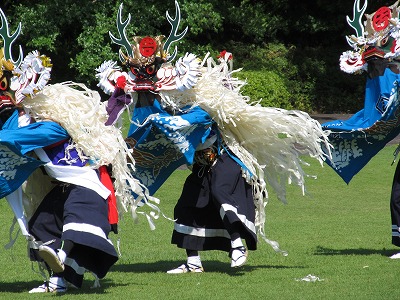
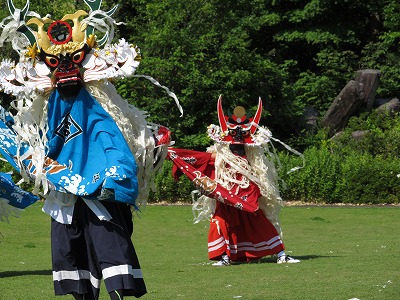
釜石鹿踊り

釜石鹿踊り 雌鹿

雄鹿

刀かけと鹿

 Drape-style Deer dance outside of Tono also makes an appearance. Unlike the taiko style, the drape style has many variations. For example, the shishi in Kamaishi City, on the coast, use really flamboyant colors. Their bodies are bright blue and their heads are more ornamental. There are also doe that are clearly recognizable by different colors, like the lion dance in Kanto. There is also a performance called “Tsunagakari,” in which the performers go over a single tight rope through trial and error, which is also in the Kanto style. If you ask the origin, you’ll find out that it was learned from fishermen who finally arrived after drifting from Chiba (Kanto) in the olden days.

Others
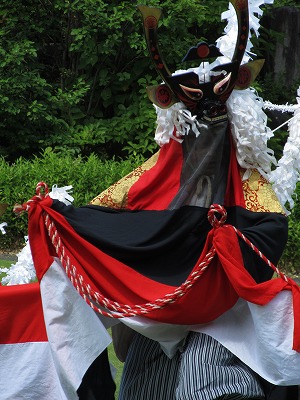
箱石鹿踊り

箱石鹿踊り 全体
箱石鹿踊り 舞

 There are also other much performed deer dances. On the other hand, there are also more designed and impressive and slender deer dances like the ”Hakoishi” deer dance (Miyako city). A slender figure and a bright contrast of red and black costumes. It’s really unique.

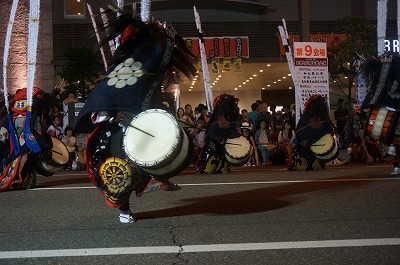
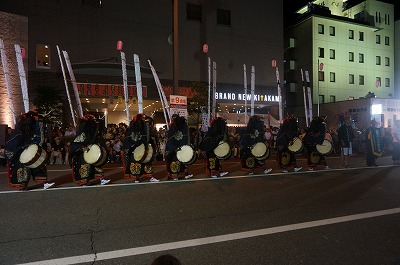
 Thus, the drape style can be enjoyed in a variety of designs. On the other hand, the self-druming style is not as interesting, but its dignity cannot be imitated. You can feel its awesomeness on the main street on Saturday night. If the finale of the festival is the ogre Sword Dance group dance, what should be called the “Deer Dance Group Dance” will take place shortly before that.

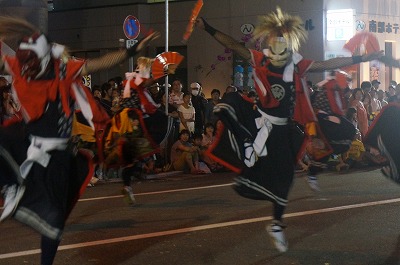
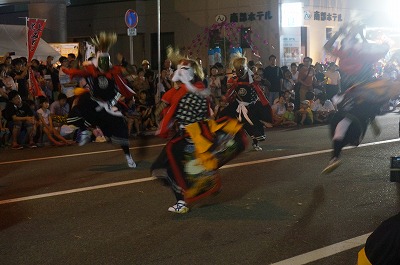
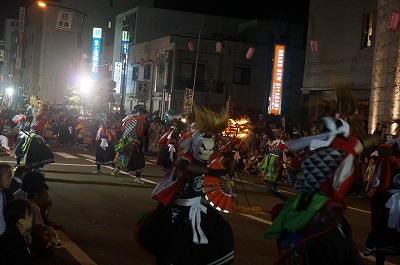
Corps de deer dance ~Night part
大通りに並ぶ太鼓系鹿

跳ねる鹿

Although it is not like the demon sword dance where everyone dances the same program at the same time, it is very powerful to see as many as 10 deer dancing groups performing at the same time. Especially it is overwhelming to watch the drummers. Of course, the Maku-kei is nothing less impressive than those performances. The sound of the drums shaking the earth and the singing voice echoing in the depths of the stomach. The power to make the earth tremble. In reality, though, the earth doesn’t shake because it’s on concrete.
It is possible to move around to see several groups, but the 20 minutes go by very quickly. I recommend you to take your time and focus on just one or two, if possible.

For those who want to learn more

 The Shishi Odori (the deer dance) is a performance unique to the Tohoku region. There are many theories about its origin but it is not well known. Some scholars (mainly around Kyoto) say that it was modified by the propagation of some of the performing arts from the capital , while others from the northeast claim that it developed on its own. The word “shishi” is often compared to “shishi-mai” (lion dance), but in this region the “lion dance” is called “Gongen-mai” and exists separately. The word “shishi” generally refers to an imaginary animal of Chinese origin, but it also meant animals themselves in general (although it is rarely used today). In Kanto, the “wild boar” is called “shishi”, while in the Tohoku region, the word “shishi” came to mean “deer”, because the deer was the most accessible prey in the Tohoku region (this is also confirmed by relics). Legend has said that this dance was started to make offerings to the prey. It can be said that this kind of thinking was not common in the capital because the division of labor was well developed in the city. The people who ate did not think about the people who caught and dressed it. It was different in Tohoku. Animals were closer to them. It can be said that this is why people had a strong sense to make offerings.
ホテルの鹿

ホテル裏庭で舞う鹿

A Miraculous Experience of the Deer Dance

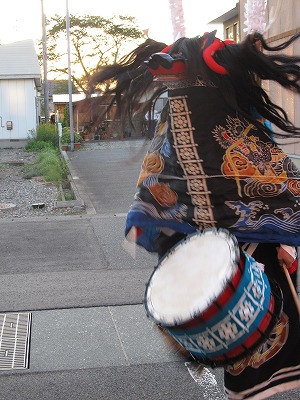
 Finally, I would like to share two interesting experiences I had. When I was about to leave the hotel to watch the night session, I found a self-drumming style deer dancing man standing in the backyard. Apparently, he had just finished getting dressed there and was about to go to the venue. I was so surprised that I was allowed to take a picture of him up close. When he asked ”where did you come from?”, I replied, “From Tokyo area”. He was delighted and said, “Good to see you from afar. I am grateful to you for visiting me from such a distance. Then I said, “Well, let’s have a dance,” and he beat the drum in front of me and danced lightly. It is impossible to describe the power of this performance in words. I remember that the surprised hotel staff came out of the hotel to see what was going on. And then the deer dancer walked away leisurely. I remember it as vividly as if it was yesterday.
 And here is one more episode. I was watching the Deer Dance in the daytime, not wanting to miss a second of it. I had taken a camera and videotaped it. Halfway through, my batteries ran out. But the dance wasn’t over yet at all. I hurriedly took out my cellphone and filmed the remaining part. When I was relieved that I could record till the end, I remembered something. Probably from the impact of dropping it, I remembered that the smartphone’s camera function had been disabled for a while now. But I was able to take a picture safely. And ye after this one moment my camera hadn’t recovered until I changed it to a new one.

 You have to actually visit the place to see it. Miracles don’t happen just by looking at images and photos. I highly recommend you to visit the place and experience it for yourself.

https://discoverdeeperjapan.com/2020/10/18/michinoku-traditional-performing-art-festivaloni-kenbai/
https://discoverdeeperjapan.com/2020/12/13/michinoku-folk-performing-arts-festivalkagura/

Report: Michinoku traditional folk performing art festival~Oni-kenbai


鬼剣舞 太鼓系鹿 幕系鹿


Date; The first Friday, Saturday, and Sunday of August every year (3 days)
Location; Main Street in front of Kitakami Station and other locations
Access; It takes between two and a half and three hours to get to Kitakami Station from Tokyo by Shinkansen. By air, fly to Hanamaki Airport from any airport. The shuttle bus from Iwate Hanamaki Airport to JR Kitakami Station covers a distance of about 20 km (about 50 minutes).

Tohoku Region is a Treasure Trove of Festivals

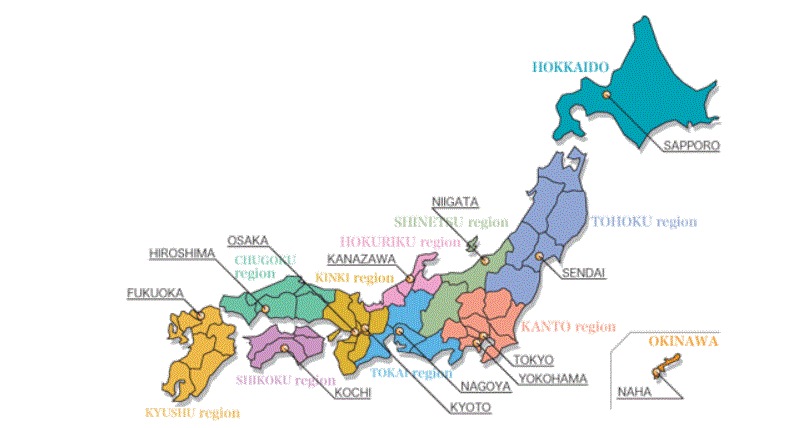
 When we say “Tohoku” (the Northeast) region of Japan, there is a kind of plaintive image. Japan has developed mainly around the western part of the country. Since ancient times, the capital was located near Nara and Kyoto, and the Kyushu region continued to have a large influence as a point of contact with the continent. The Kanto region, where the current capital city of Tokyo is located, did not appear on the historical stage until the 10th century, and it was not until the 18th century that Tokyo became the center of the country. Tohoku, on the other hand, had long been considered a land to be conquered. When Tohoku region had come on the historical stage several times, each had ended with a pathetic story. But on the other hand, it was also a land that produced a lot of rice and, above all, gold, which the central government wanted to acquire at all costs. The Tohoku region was seen as just a gold mine. At the time of the Great East Japan Earthquake, it was the Tohoku region that was far more affected than the Kanto region.
 At the same time, the supply of agricultural products is abundant and plentiful, making it a fertile region, which many people think of when they think of rice and sake. It is also a place where a lot of folklore has been handed down from generation to generation.

各地方


 Summer in the Northeast is short. Long winters come earlier than in other parts of Japan. For this reason, summer in the Northeast is the season when people are passionate about their momentary emotion. Especially in the first week of August, several of Japan’s most iconic festivals are held. These include the Nebuta Festival in Aomori, the Kanto Festival in Akita, the Tanabata Festival in Sendai, and the Hanagasa Festival in Yamagata

What is the Michinoku traditional folk performing arts festival ?

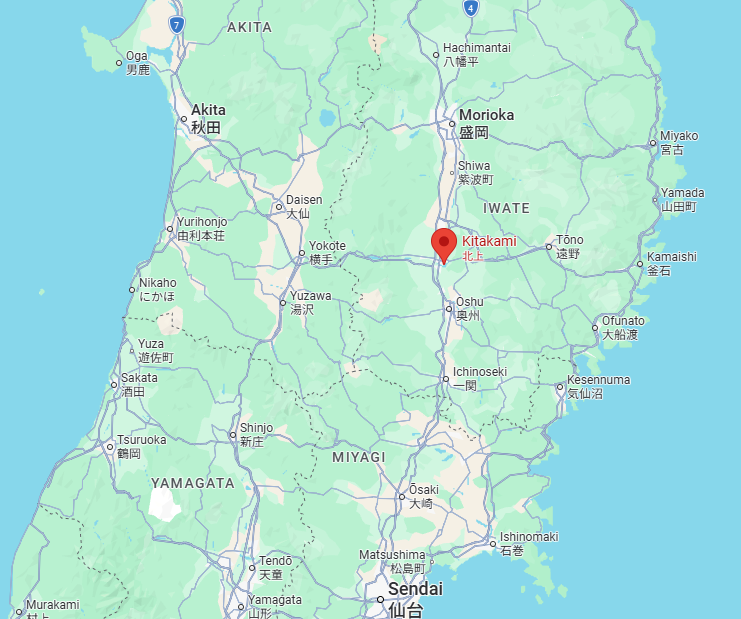
 At the same time, the Michinoku Performing Arts Festival is being held in Kitakami City, Iwate Prefecture. Iwate Prefecture is the largest prefecture in Japan and is said to have the largest number of traditional performing arts in Japan. The Ohshu 奥州 Kaido (a highway road), the most important road from ancient times, runs through the center of the city, leading north to Morioka, the capital of the prefecture, east to the Pacific Ocean, south to Hiraizumi, famous for its Golden Temple, and west to Akita.
 During the three days from Friday evening to Sunday, various traditional performances, said to be more than 100, will be held throughout the city. In this article, I would like to focus on the performing arts using masks.
Official site https://geinoumatsuri.com/

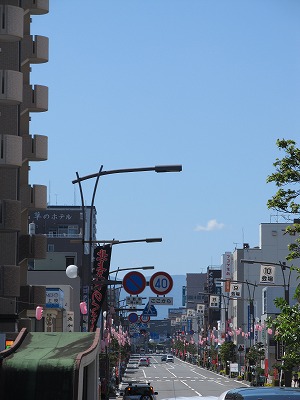
北上市駅前大通
front of Kitakami station

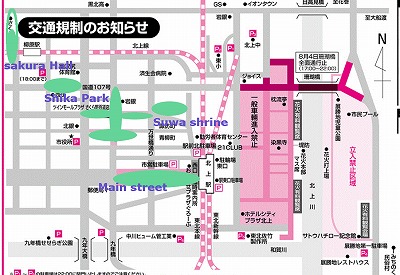
各会場地図
venues

 The area is divided into several locations and varies by time of day. On Friday, the first day of the festival, there is a parade on the main street in front of the station and a dance troupe called “Onikenbai,” which is the most popular form of entertainment in the city. On the next day, in the morning, there are performances at the site of Iwasaki Castle and Nyoirin-ji Temple. In the afternoon, various places such as squares, parks and shrines are used for the performances. At night, The festival reaches its first highlight. More than 50 performing arts will be performed in a little over two hours on the main street in front of the train station. On Sunday, most of the performances end in the morning. In the afternoon, the Oni-kenbai (ogre sword dance) is performed in the hall. And on the last night, a fireworks display finishes the whole schedule.
 As for transportation, there is a city bus service (500 yen per day), which is the most convenient. However, the Iwasaki Castle, Oni no Yakata and Nyoirinji-temple are not included in the route, so you have to take another city bus (about 30 minutes from the station). There are several rental bicycles in Kitakami City, so it may be easier to use them. By the way, it took us about 30-40 minutes by bicycle. As for the other venues, they are well within walking distance.
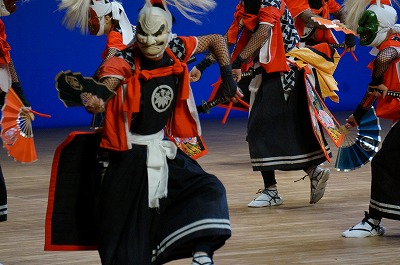
 Despite this it is certainly limited to the performing arts of the Tohoku region, especially around Kitakami City, it is perhaps the festival that provides the most direct insight into Japanese folk arts. There are two main performing arts, “ogre sword dance (Oni-kenbai 鬼剣舞) and “dear dance (Shishi-odori 鹿踊). But I’ll focus on the former this time, and at last, I’d introduce the rest.

Oni-kenbai (Ogre sword dance) 鬼剣舞

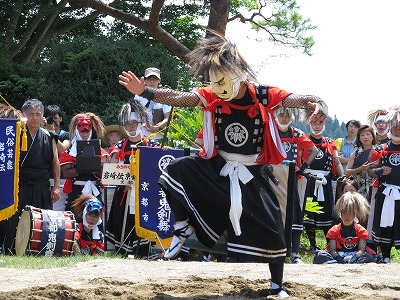
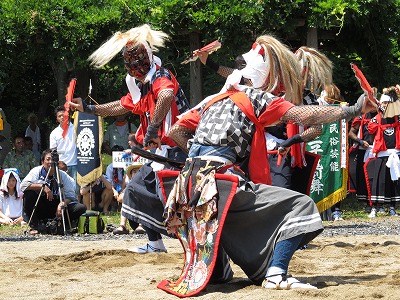
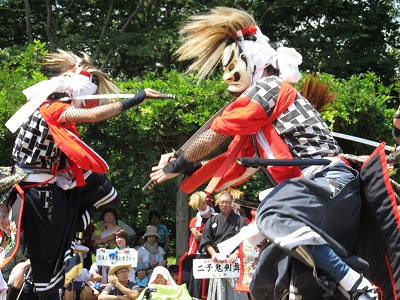
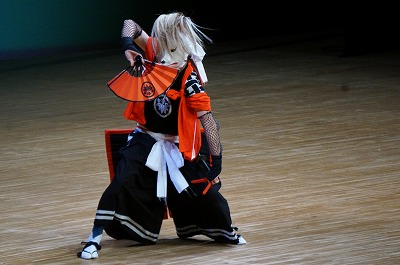
 It is impossible to see this festival without mentioning “Oni-kenbai” 鬼剣舞 (the ogre sword dance). Sophisticated movements and elaborate figures. The dance is a seamless, well-trained dance. The most impressive feature of the dance is the masks. Although the mask is called an ogre mask, it is said to be an incarnation of a Buddha. The evidence of this is that it has no horns, which a ogre should have. Oni Kenbai is one of the sword dances. It is just one of the forms of sword dance that incorporates elements of various predecessors and refines the dance and design. This may be due to the fact that this dance had been performed in front of the lords of the time. In other words, at that moment, it was transformed from a mere folk art to an official art form.

鬼剣舞 岩崎城址

滑田系鬼剣舞

 The Waga 和賀 clan reigned as the lords of this area until about the 17th century. After that, the Nambu 南部 clan replaced them, but the dance is still loved by the lords, and it has remained so to this day. Although Iwate Prefecture is a large area, each region has its own performing arts that are representative of the region. Morioka City has the “Sansa”, Tohno City has the “Deer Dance with a large group”, and Hanamaki City has the “Hayachine Kagura” and “Deer Dance with its own drum”. And most of all, Kitakami City is famous for its “鬼剣舞 ogre sword dance”. That’s why the people of Kitakami City are so passionate about this dance, that they have become connoisseurs. Children learn it the same way they learn to play soccer or baseball (which are the two most popular sports in Japan). Motifs related to the ogre sword dance can be found throughout the city. Currently, there are 12 organizations active in the city. Therefore, this dance is very much a part of this festival.

Oni-kenbai ~feature~


 As I mentioned earlier, the feature of this dance is the use of masks. There are four types of masks. They are white, red, blue, and black, and each one has its own meaning. And a pair of eight masks is the basis of the form. White is a special color, and only one person who is skilled in the art is allowed to wear it.
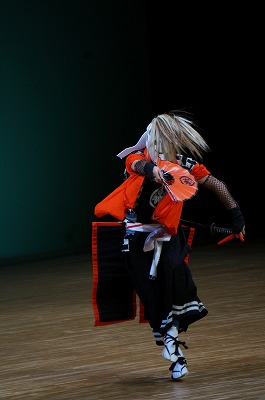
 On the head, they wear hairs called “zai”. This is made of horse hair. It is considered good to have this “zai” standing during the dance. They also wear a sword at the waist. Now a fake sword is used, but it is said that in the past a real sword was used.
 In addition, the “Ohguchi 大口” draped from the waist in the back, and a small jacket draped over it. This is remnant of the past where it was taken off and draped over the waist. The “Ohguchi” is decorated with pictures of heroes who once ruled the land and fought fiercely against the central government. On the chest is drawn the crest of a Chinese bellflower, the crest of the Waga family, who once ruled this area. When the lord of the castle in this land invited the Waga family to his castle, he showed them a performance of the ogre sword dance. It is said that the lord of the Waga was so pleased with the dance that he allowed the dance group to use this crest. In addition to this, there are people who are in charge of the accompaniment. They support the dance with drums, bells and flutes under a leader called “Dotori 胴取り”.

座る鬼面

鬼剣舞背面 大口
Oguchi 大口

  Watch “Oni-kenbai”1 ~The Iwaski castle ground and the museum of Ogre

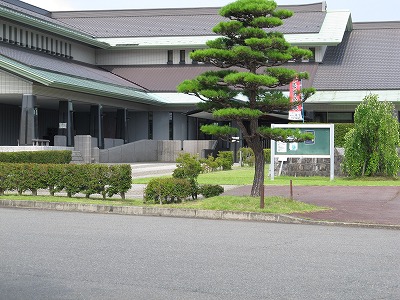
 You can enjoy the ogre sword dance in several venues. The main venues are the main street throughout the city, the site of Iwasaki Castle grounds, Oni no Yakata (the museum of ogre), and Sakura Hall. On the first night, if you want to learn the charm of the ogre sword dance, you should wait for it on the main street. You will see a big group dance of the junior group (junior high school students and under) ogre sword dance. They are only a select few who are allowed to dance here. You may underestimate them as juniors, but they will surely show you breathless and impressive dancing. Every year, after the opening parade, the dance starts at 8:00 pm and lasts for about 30 minutes.
 Next morning, you should go to the Iwasaki castle ground. This place is near “Oni no Yakata (the museum of ogre). The museum opens at 9:00 a.m., so you’ll have an hour or so to visit before the sword dance starts at 11:00 a.m. The museum has a display of goods related to demons (ogre) not only from the ogre sword dance, but also from all over the country and even abroad.(500 yen for adults, as of October 2020)

*Access to Oni no Ykata Since it’s just under 5 kilometers from the nearest station, you can either take the shuttle bus that runs during the festival, rent a bike at the station, or take a taxi.


鬼の館
Oni-no-Yakata (Demon museum)

鬼剣舞 一人加護

鬼剣舞

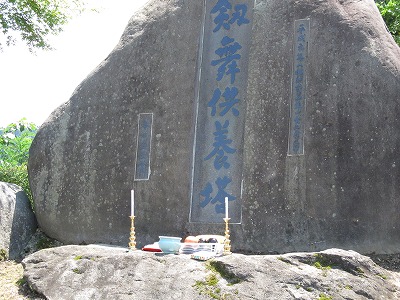
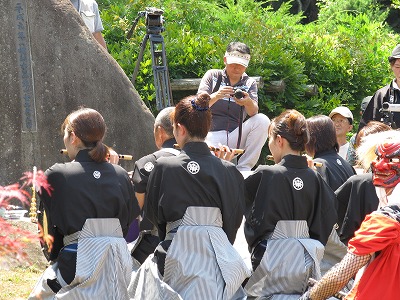
 The site of Iwasaki Castle is located on top of a small hill a short distance up from the museum. For about an hour, several groups will perform a ogre sword dance here. This is said to be a memorial service. The first thing to do is to pray in front of a stone monument in honor of the Waga clan.

供養碑

供養碑の前でお囃子

 There are about 15 to 18 different kinds of ogre sword dances being handed down, depending on the group. One of the most noteworthy performances is the one in which dancers dance alone. This is a special dance that only those wearing a white mask are allowed to dance. Since the basic performance of “Oni-kenbai” is a group dance, there are not many opportunities to see this dance in detail. There are many groups in the venue, but only a few of them dance, partly because of time constraints. It is not difficult to imagine the honor and pressure of dancing alone in the midst of all that attention. It will all be over by 12:00. If you want to get back to the city after this, you’ll have to hurry. Most of the events will start at 1:00 in the afternoon. If you want to enjoy the Oni-kenbai more, there will be another one hour performance in front of the “Oni-no-Yakata (ogre’s museum). However, there are some opportunities to see the Oni-kenbai in other parts of the city.

鬼剣舞

舞う鬼たち

  Watch the Oni-kenbai 2 ~on the street

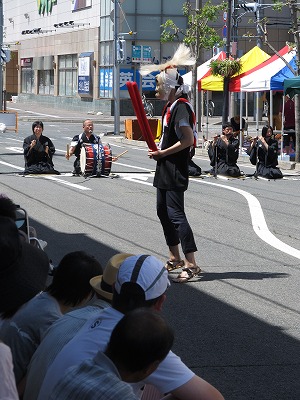
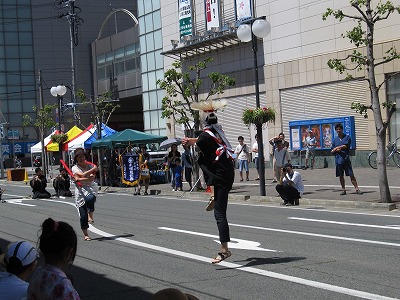
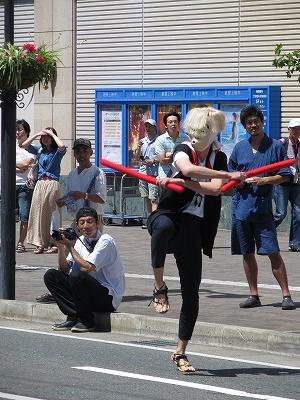
When the dance takes place on a street corner, there is another way to enjoy it compared to a genuine performance. The proximity between the performers and the audience adds a kind of street performance element. Some of the performances are acrobatic and others are very exciting, such as the use of many swords. One of the most noteworthy is the program called “Kakkata”. I have already mentioned that there are four basic types of masks used in “Oni-kenbai”. Each of them represents the north, east, west and south, but this “Kakkata” represents the center. The expression on the mask is also much different. The expression on the mask is rather droll. Unlike other performers who use fans or swords, this Kakkata uses a long stick. He put it between his legs and swings it up and down. This suspicious performance the audience laugh. He also invitees one from the audience out onto the stage and makes them laugh even more with his joking motions, as he lies down to watch. His role is like that of a circus clown. But that doesn’t mean he should be underestimated. This is a special role that can only be played by someone who knows it all. If you see him on a street corner, I would like you to enjoy his performance.

カッカタ

カッカタ

踊るカッカタ

Watch the Oni-kenbai 3~Saturday night

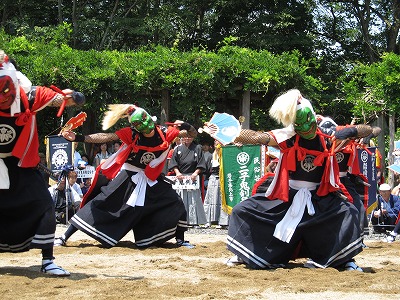
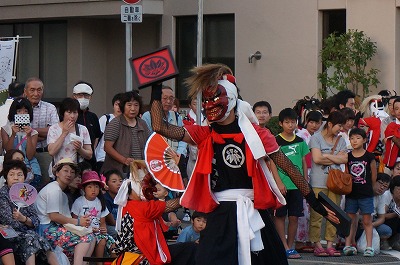
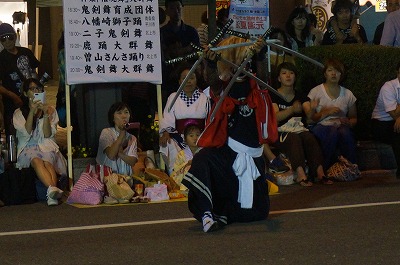
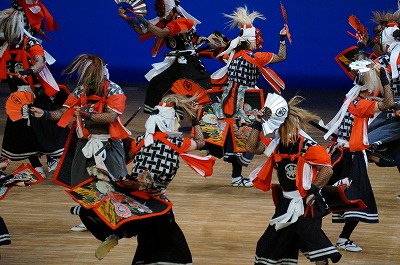
 Saturday night is when the performances are at their best; every 20 minutes starting at 6:00 p.m., The main Street will be filled with local entertainment. Among them, you can see the “Oni-kenbai”. The sideshow-like performances are especially performed. Many of them are fun to watch, such as the one in which the dancer dances so as not to drop the flat tray in his hands, and the one in which the number of swords in his hand is increased one after the other. And at the end of the day, the time is usually 8:00 a.m. The biggest highlight of the festival comes at 8:00 a.m., when about 20 groups of eight people perform a dance in unison. A bonfire is lit at regular intervals, and the performers begin to dance in unison as the musical accompaniment set up on the stage in the center of the street begins to sound.

鬼剣舞 膳舞

鬼剣舞 刀狂い


 Local audiences will stay in front of their favorite (often local town) groups before them. There’s hardly any moment breathing during the “Oni-kenbai”. It just resembles an intense aerobic dance. It is done with masks on and swords in hand. It’s not hard to imagine the intensity of the dance. In the darkness of the night, the figures that emerge from the bonfire, filling the main street, is sure to leave a strong impression.
When it’s over, they become temporary heroes. Children begin to dance with pamphlets in their hands as if they were swords. People are so excited and they want to shake hands and take pictures with them. Of course, anyone who asks them to do so will do so. The town of Kitakami is filled with the “Oni-kenbai” fever. On the way home, the melody of the dance echoes in our heads forever.

大通りでの鬼剣舞

舞い狂う鬼たち

一番庭大群舞

タイトル写真

踊る子供

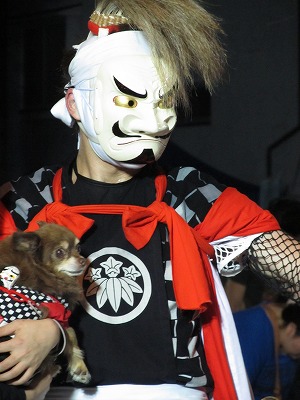
撮影に応じる鬼

白面

  Watch the Oni-kenbai 4 ~Sakura Hall

 More performing arts exhibits will continue until the final day, Sunday morning. If you walk around the city, you can expect to see “Oni-kenbai” at every corner. In the afternoon, the Oni-kenbai will be performed at Sakura Hall. This is where all the groups will perform and all the acts will be performed. If you are interested in “Onikenbai”, you can’t miss it. There is a fee of 1,000 yen for advance purchase and 1,500 yen at the door, but it is worth it. Advance tickets are available at all time until the show starts, so you can buy them if you arrive at the hall a little earlier.
 

鬼剣舞(さくらホール)

鬼剣舞(さくらホール)

There are thirteen to eighteen different types of “Oni-kenbai”, depending on the group. The basic group is made up of eight performers and is called the “Niwa”. There are also other forms that alter the basic form.

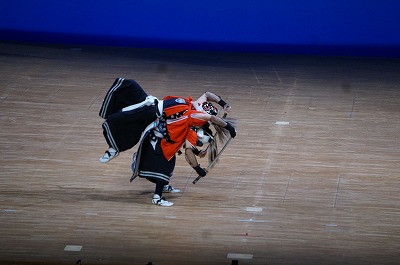
The number of people in the dance is not limited, so the number of dancers can be as small as one or two. I’ve already mentioned the one in which the dancer dances without dropping holding trays, and the one in which the dancer rotates his body while increasing the number of swords which he holds. There are also other movements that look like gymnastics.
 Lastly, I would like to introduce the “Kitsune-kenbai (Fox Sword Dance)”. It is a part of the “Oni Kenbai” and uses a fox’s mask and moves in a slightly different way. Once upon a time, there was a man who could not come to the dance due to illness. This is based on a mysterious legend that a god disguised himself as a fox and joined the dance. The performance lasts about three hours, and then all the performances are finished.
 Next time I would like to introduce the dances other than the Oni-kenbai.

狐剣舞

狐剣舞

カニムクリ

Access to Sakura Hall About a 10-minute drive from the West Exit of Kitakami Station (approximate travel time by taxi)
About a 7-minute walk from Yanagihara Station on the JR Kitakami Line

To be continued in the next article.