Report: 1/35 of the most important of the folk performing art Haji Ichiryu Saibara Kagura 土師一流催馬楽神楽

Date:   1st January, 14th February, 10th April, 10th October, and day of “Tori” in December, every year
Location: Washinomiya shrine Washinomiya, Kuki city, Saitama prefecture
How to get there: It takes 10 minutes from Washinomiya station (Tobu Isezaki line)

 ※This kagura is consisted of 12 programs.

 ※This kagura is one of 35 an important Intangible Folk Cultural Heritage by Japanese national government.
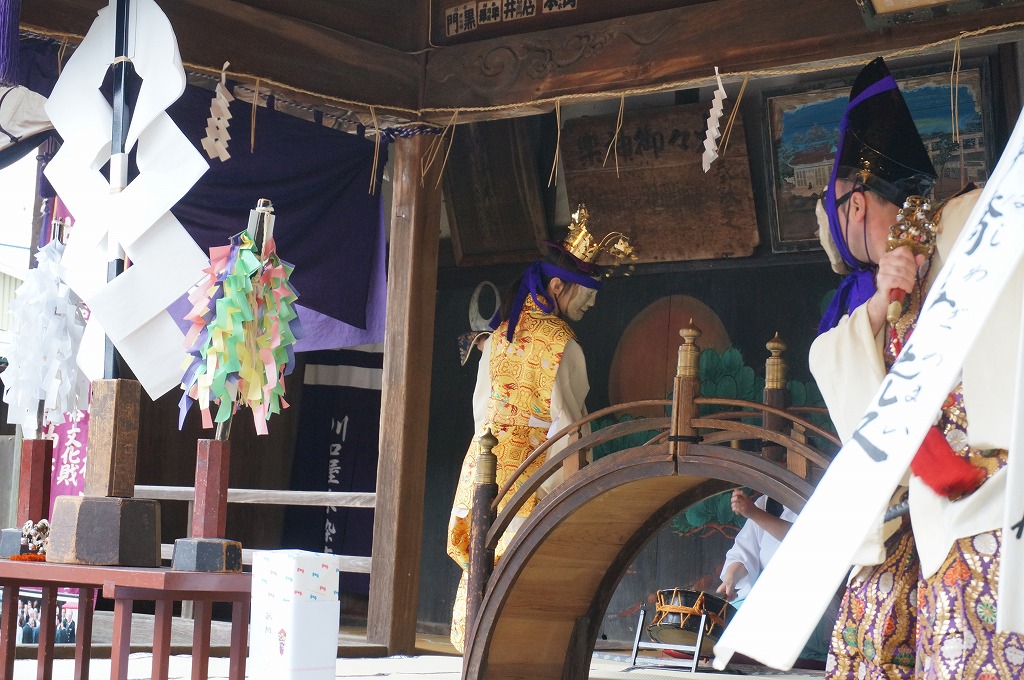
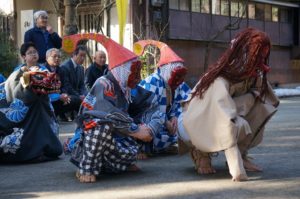
two maked dancers

Introduction

 This kagura is called “the source of Kanto kagura” (Kanto is located in center of Honshu which is main island of Japan, and is the generic name of seven prefectures). In addition, this is one of the country designation important intangible cultural asset which there is 35.
 ”Sada shinno” originally started in Shimane prefecture. A Shinto priest of Sada shrine learned Noh in Kyoto about the beginning of 17th Century, and made a new kagura (so called Sada Shinno) baced on the Noh style. This kagura is known for a distinctive element. That’s the dancer is holding thing (bell, sacred staff with cut paper (heisoku 幣束), or a sakaki leaf and so on). This style of kagura started to be called “Izumo style ” and spread out in the whole country before long. This shrine is where Izumo style was accepted first. So it is called “the source of Kanto kagura”.
 But the first document of the kagura in this shrine was recorded in about the middle of 13th century. We don’t know whether this kagura is the same kagura of today.
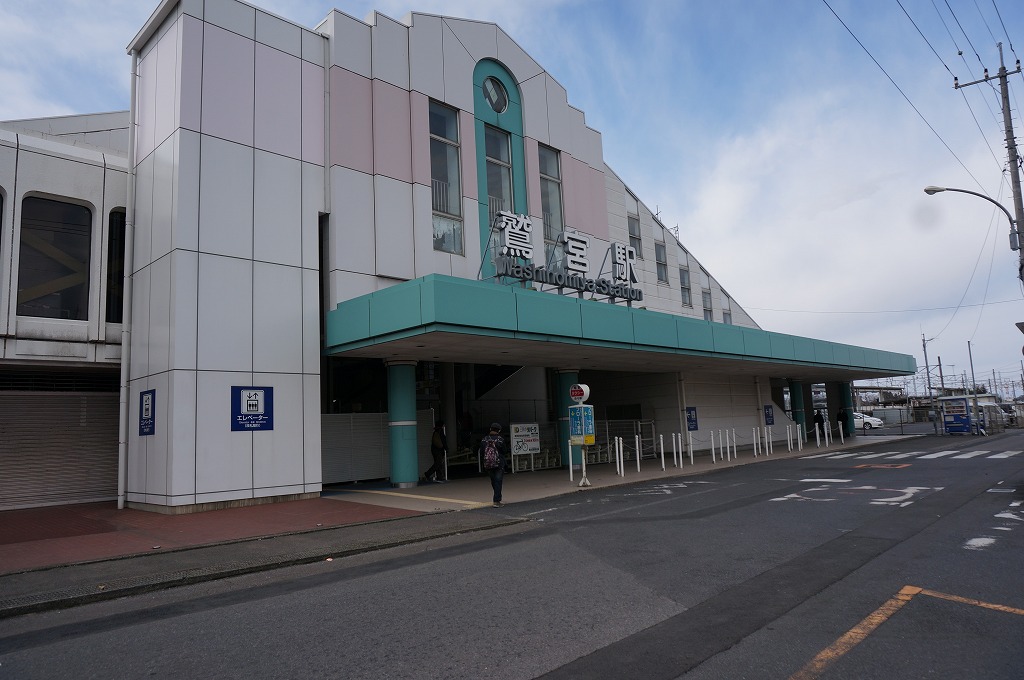
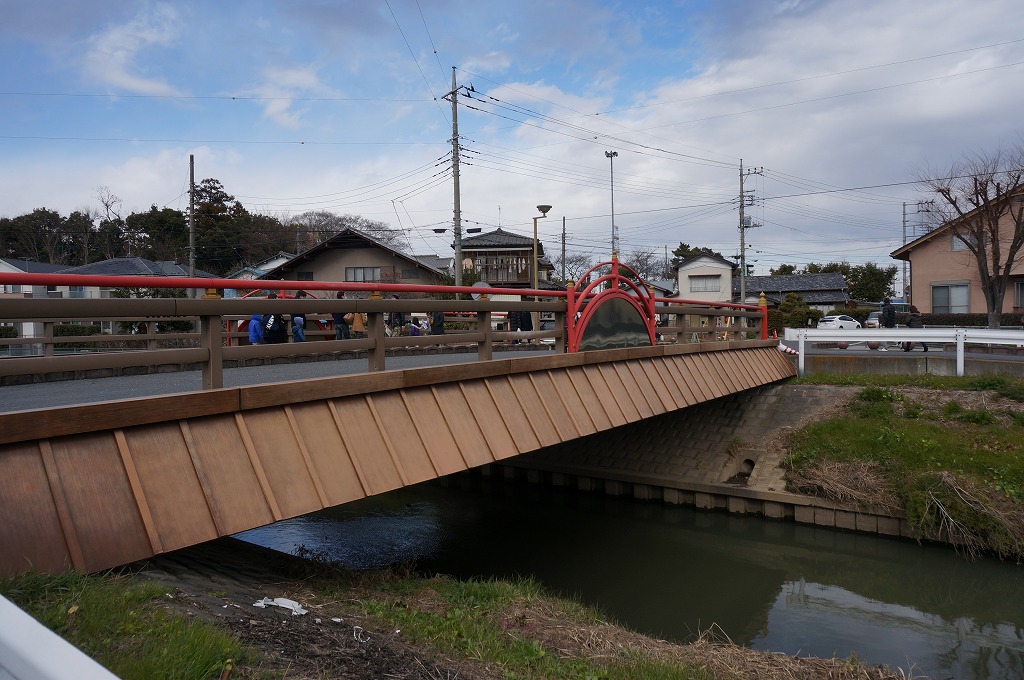
washinomiya station
Washinomiya station

around the shrine

 I went to Washinomiya shrine on 1st January, 2015.
 Kuki city is located in Saitama orefecture, population of about 150,000. It is not very big town. It takes about 1 hour from Tokyo by Ueno-Tokyo lune (JR), changing at Kuki to Tobu line, next station being Washinomiya station.
 Washinomiya shrine is about a 10 minute-walk from Washinomiya station. We cross a red bridge on the way to the shrine. It like a cnnection between the sacred place and the regular world.
animation costume player

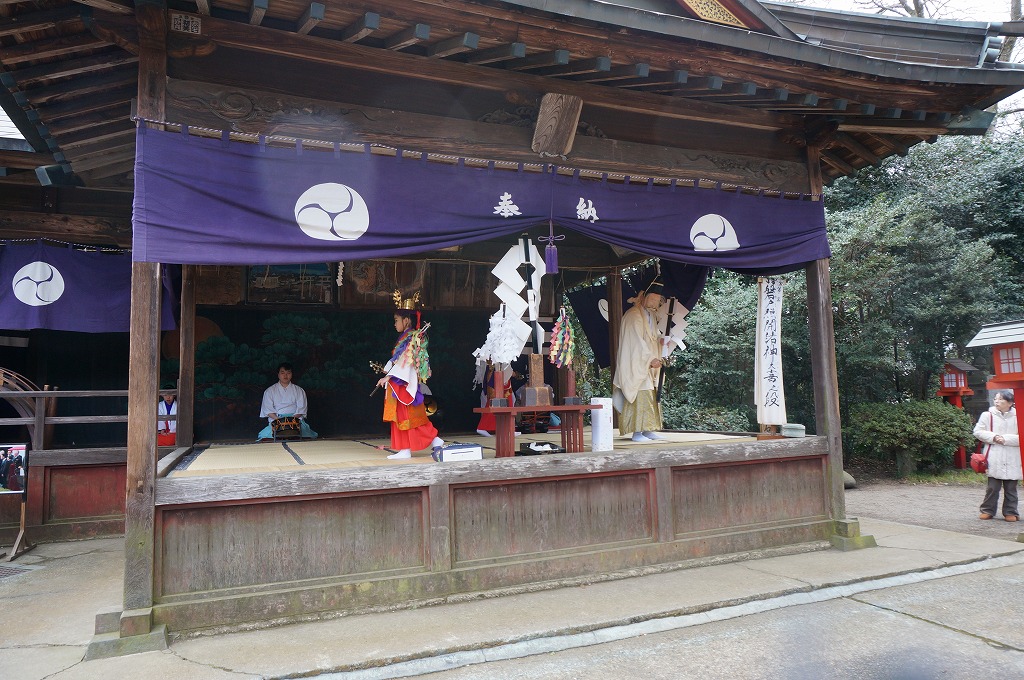
the stage

 The shrine became a holy ground of animation films in these days. so we can see many persons who wear costumes of animation characters. We can find a middle-aged man who puts on a blond wig wearing sailor uniform (high school girls style ) and skirt among them. You guess that it is quite a surreal scene. Even if it is not so, this shrine is the core of faith in this area. The number of people that gathered exceeded 400,000 in there days. The shrine is quiet in usual times, but only for three days, it becomes really crowded.

First half

 On those days, people make a long lines to pray, I passed by them and ran to the hall (kagura-den) where kagura was being performed.
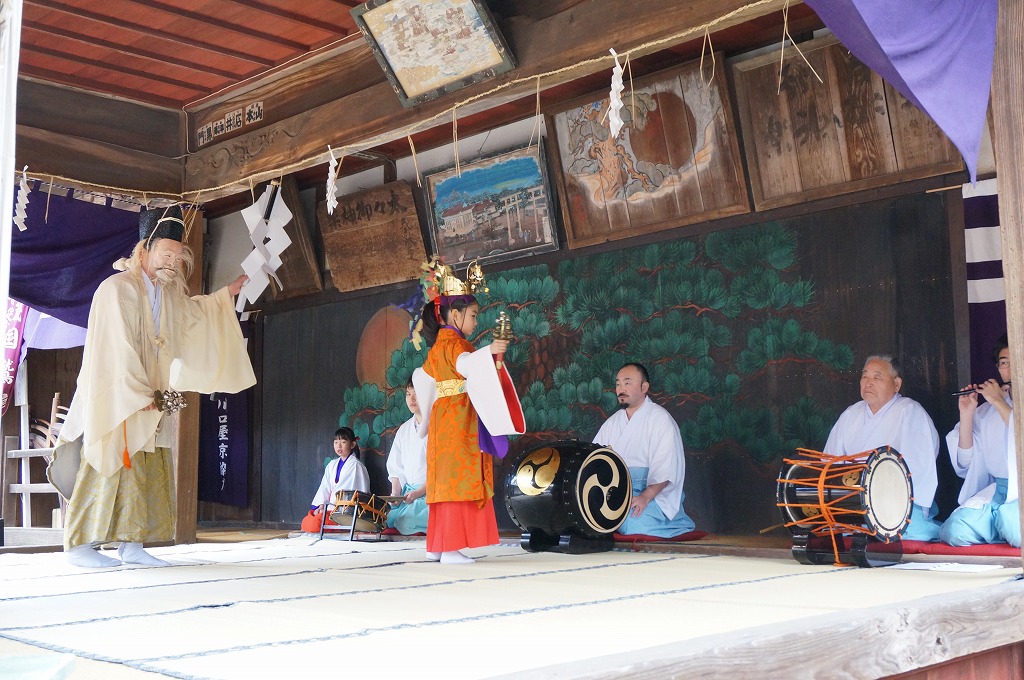
first program on the stage (Japanese traditional performing art, kagura

 the kagura was going to start about 10 or 10:30. When I arrived at about 11:00. The kagura had already started. The kagura-den is front of the Hon-den (main hall). So many people were there, but nobody was looking at the kagura. The audience seemed to be no more than 20 persons.
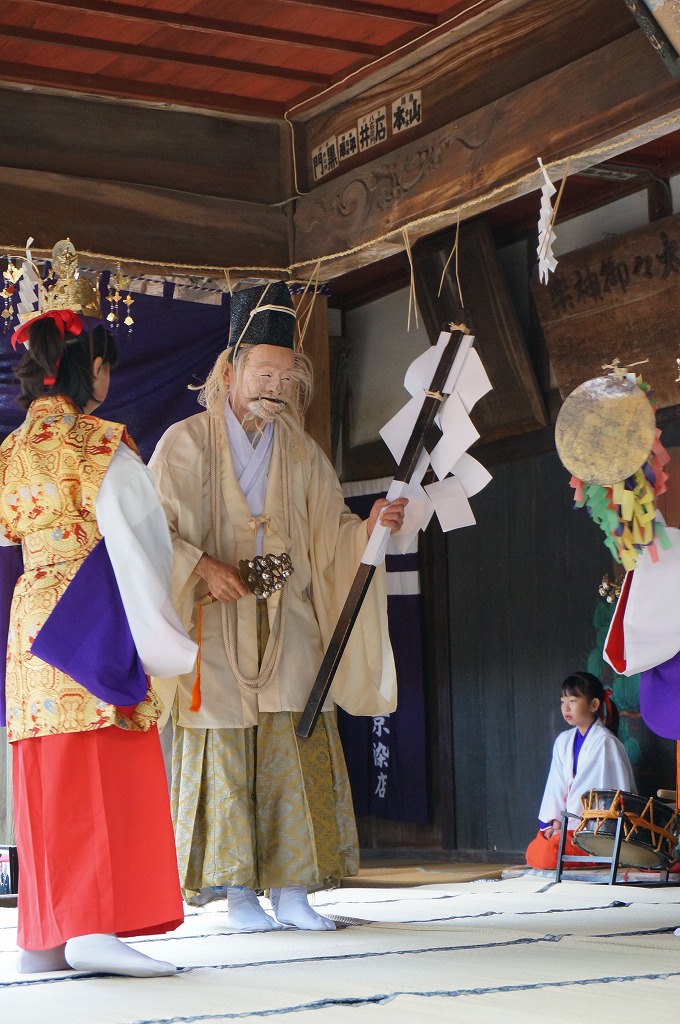
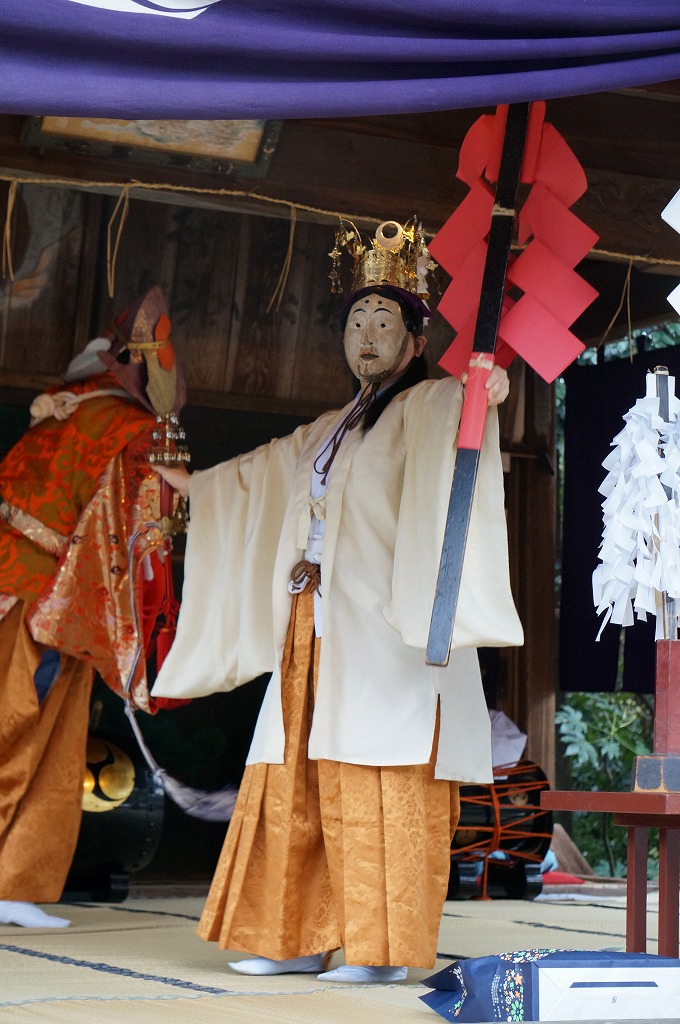
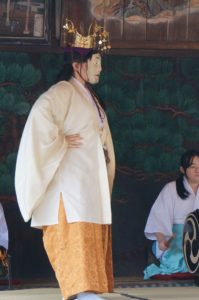
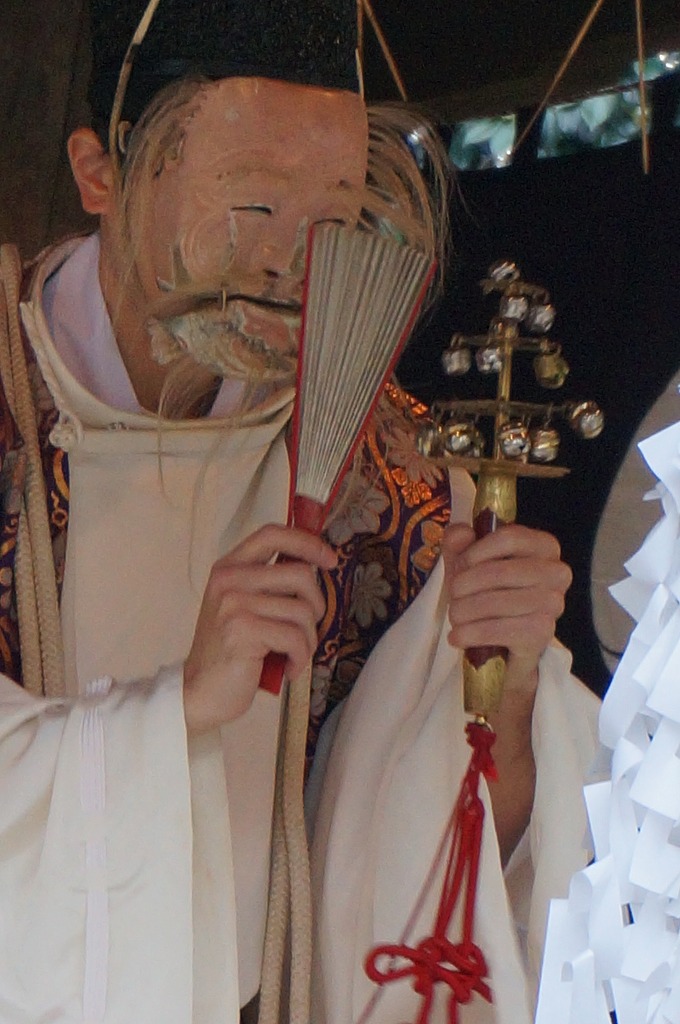
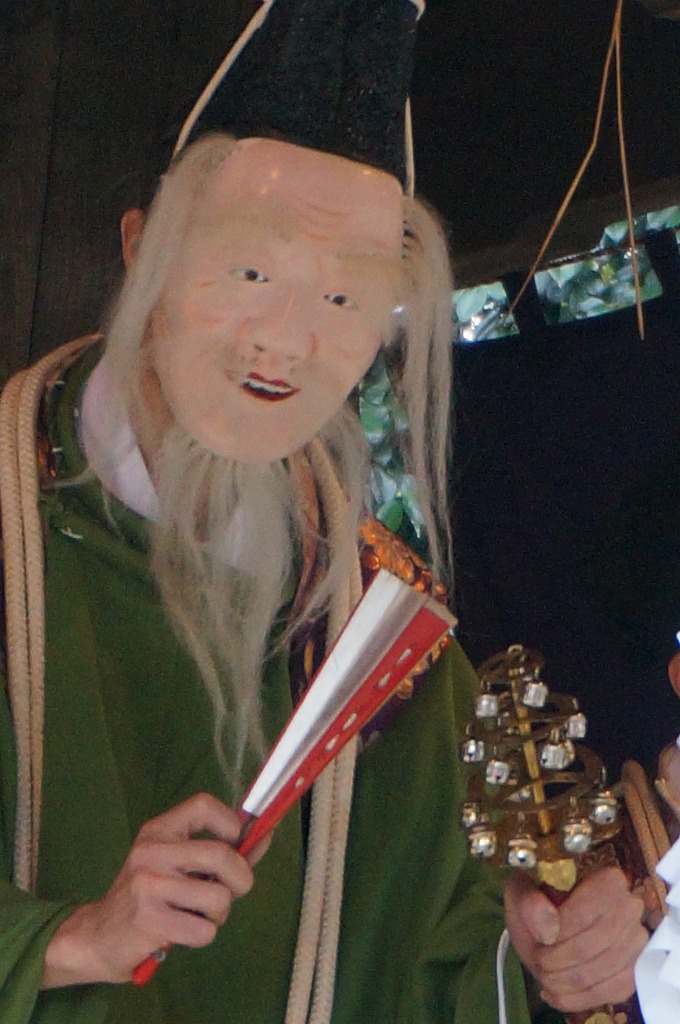
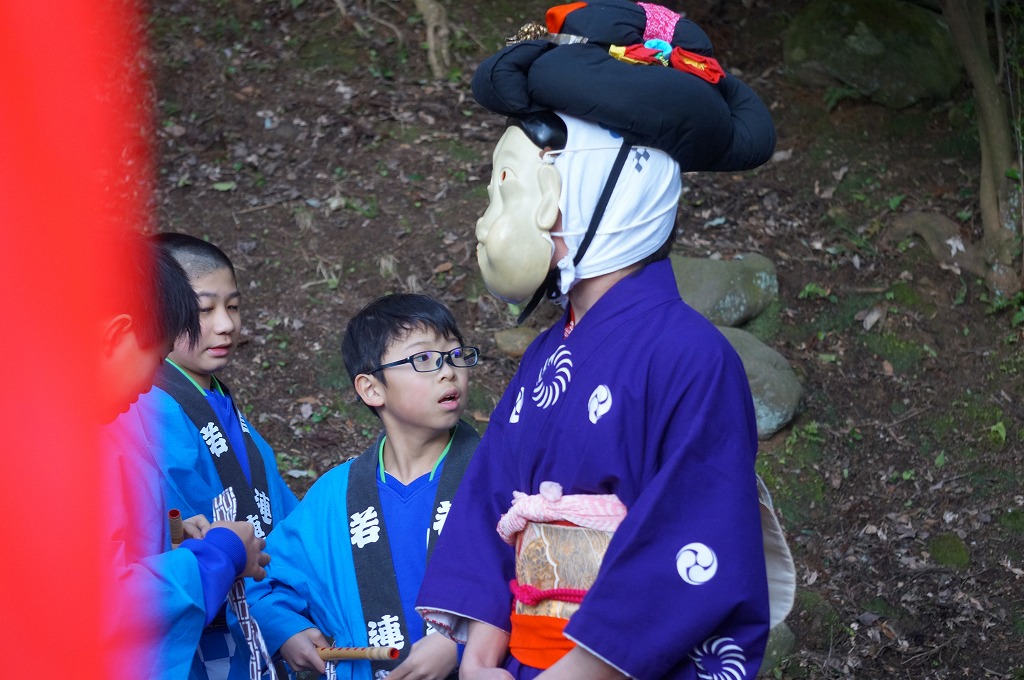
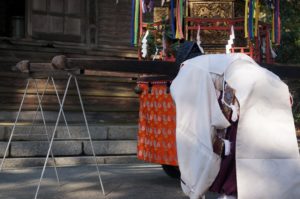
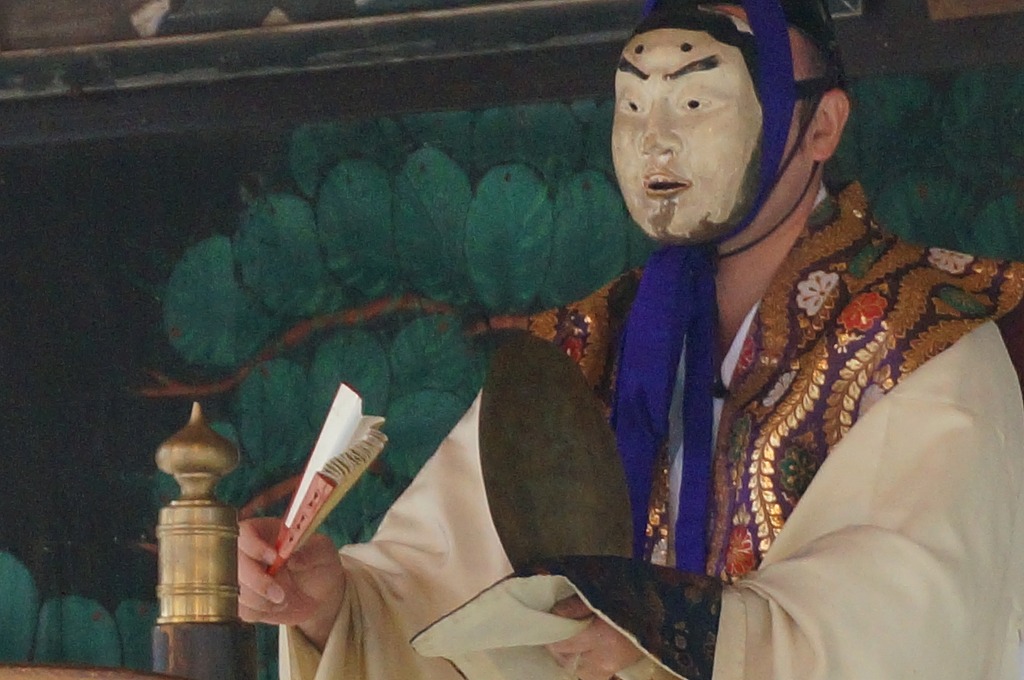
 On the stage, there were one masked man and two girls. The mask showed an old man smiling gently. He dance slowly holding a bell and sacred staff with cut paper (heisoku 幣束). This kagura’s feature was in a ceremonial manner with hardly any dramatic representation.
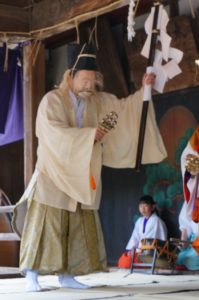
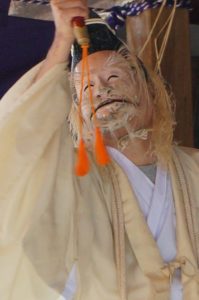
a masked chracter

a masked character

on the stage

a girl on the stage

 I guessed from the title that this program represented at the famous scene of Japanese mythology, “Amano iwato biraki” (see to “Reference/Japan mythology). In “Amano iwato biraki” all deities are pleased when “Amaterasu” (she is a deity of sun) comes out from where she was hidden in a big door of rock. But, it is difficult to understand such a state only by seeing it. It is significant to appease the Earth in every direction by the swinging the bell. This program took about 30 minutes.
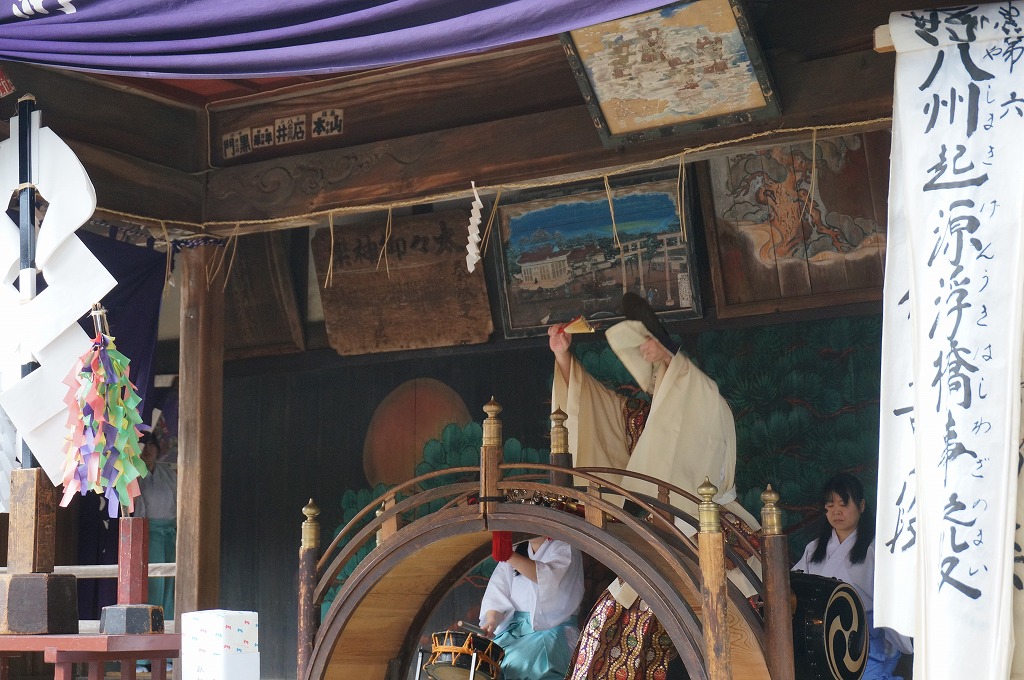
a masked character in front of a bridge

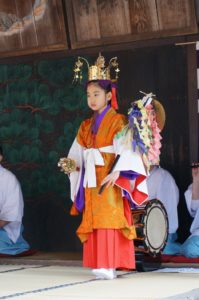
 Next program is “Hakagura“. This program is where two girls dance swinging a bell. When this program is played, people sitting on the stage play music “Saibara”.”Saibara” is a popular music in Heian period (9~10 C). When we listen to these music, we don’t feel such elements. The oldest music is called “Gagaku”. I feel this music like “Gagaku”faster in tempo. I don’t know if these music remain completely at the time, but I am filled with deep emotion. I think it worth listening to once at least because you would feel the life of ancient Japanese.
two masked players

Izanagi
Izanagi

Izanami
Izanami

two people are playing kagura(Japanese traditional folk performing art)

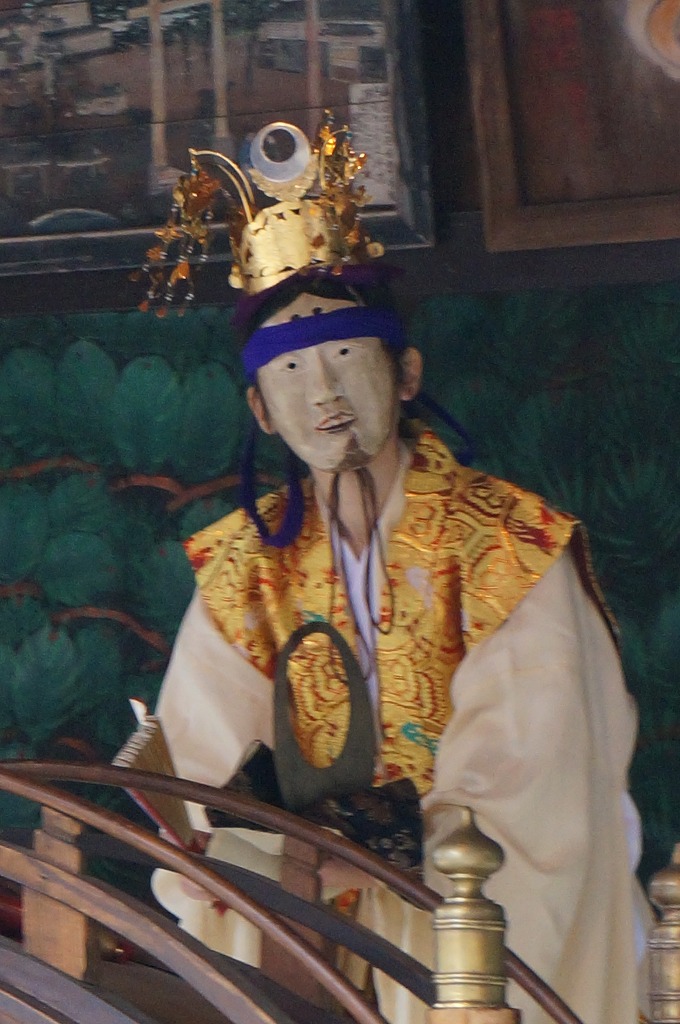
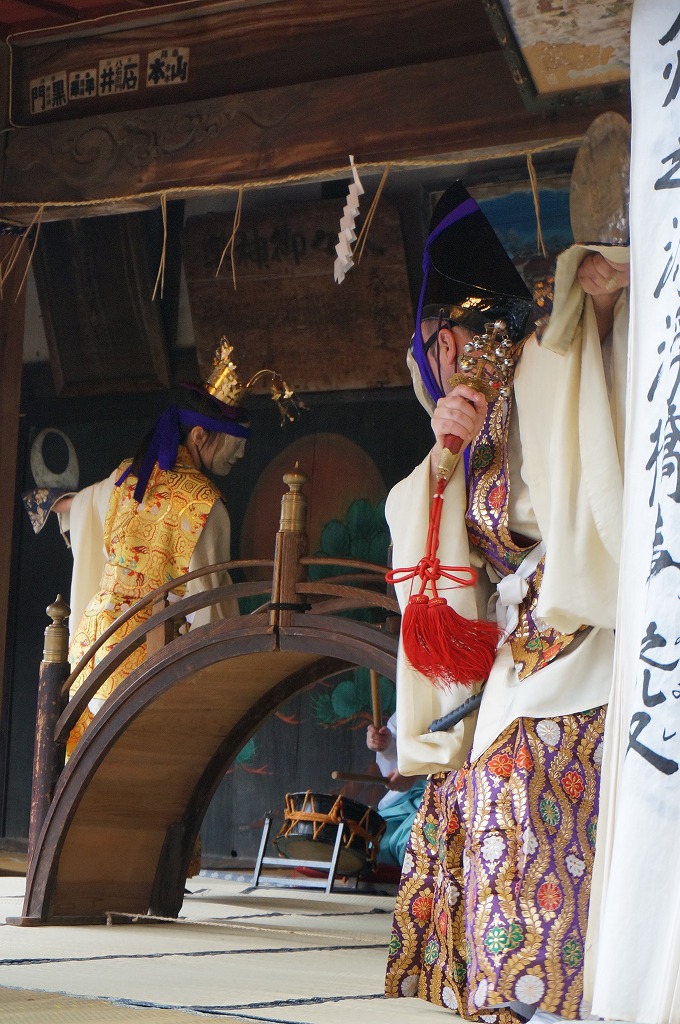
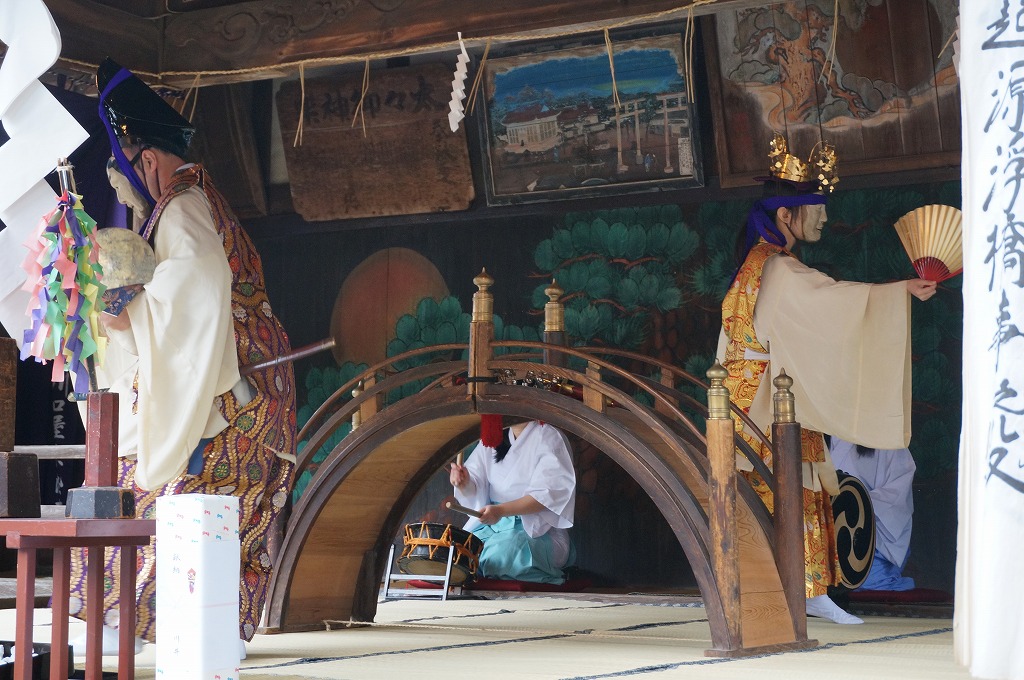
 Next program is based on Japanese mythology, too. This mythology says in the beginning of time, two deities, named “Izanagi” and “Izanami” gave birth this country. So, a mobile bridge is set on a stage and two players dance across the bridge. The male deity dances powerfully, the female deity dances with grace.While changing their positions they dance around a stage. This program ended at about half past 12. Then there was an intermission.

Intermission
the shrine

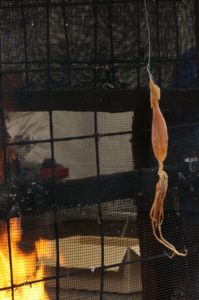
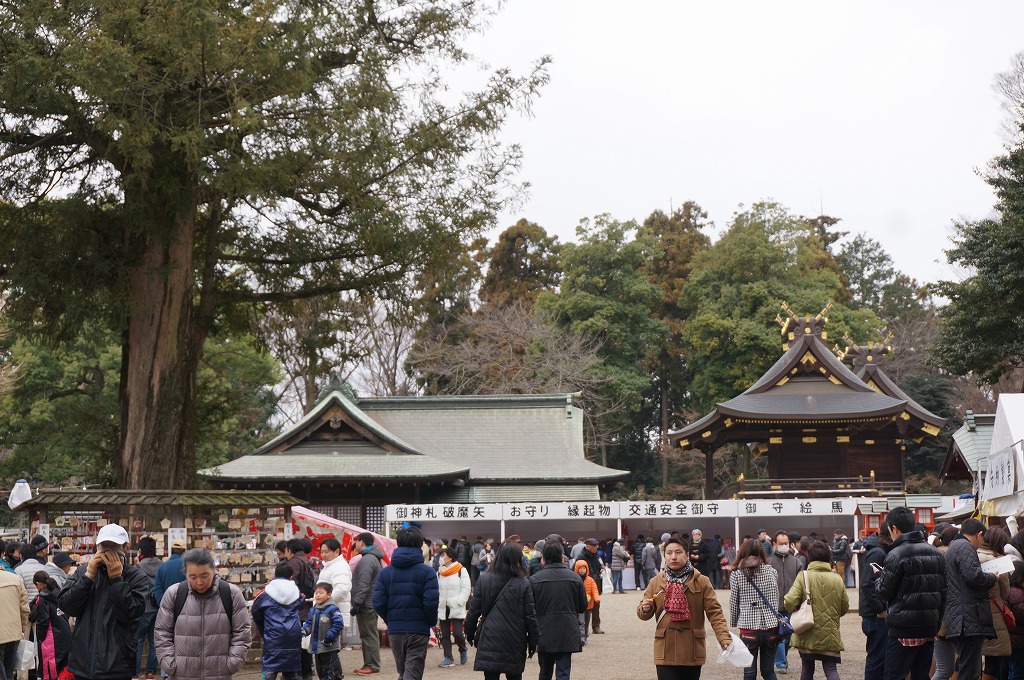
 There were many food stalls in the shrine precinct. After I ate lunch, I found a place where people were being fire using metal barrel. This area was surrounded by a double fence, and some people were direct cuttlefish. I thought it was a good system. Only people who bought, direct dried cuttlefish could enter in front of the fire. I saw quite a lot of people buying cuttlefish.

Second half

 Meanwhile the kagura started again at 2 o’clock.
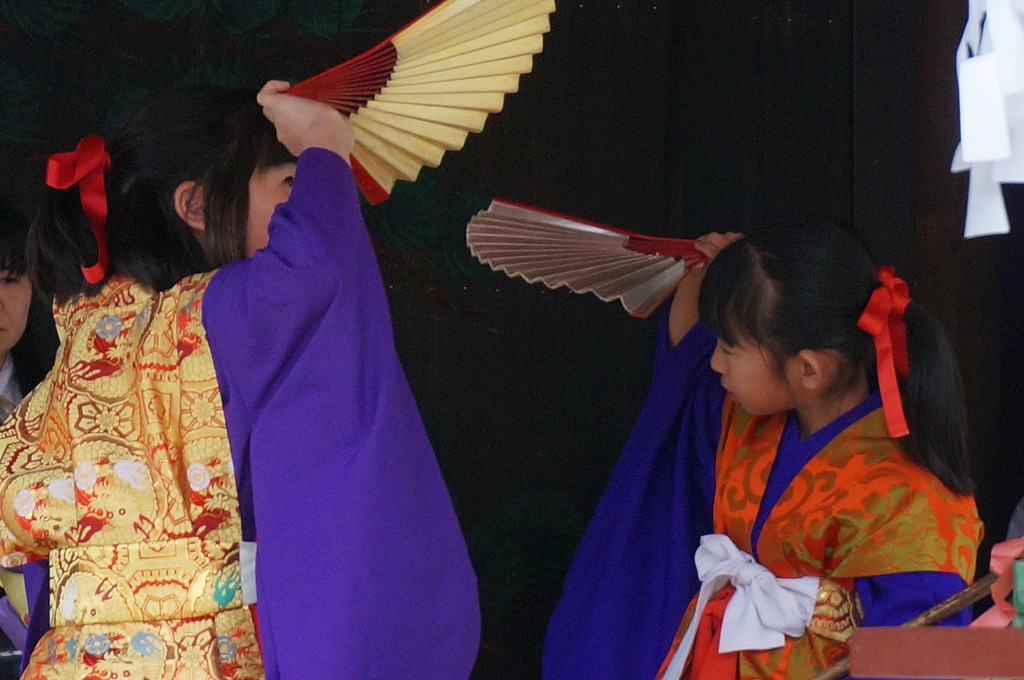
 First program, two little girls were dancing hoiding a bell. It was short.
two girls are dnacing

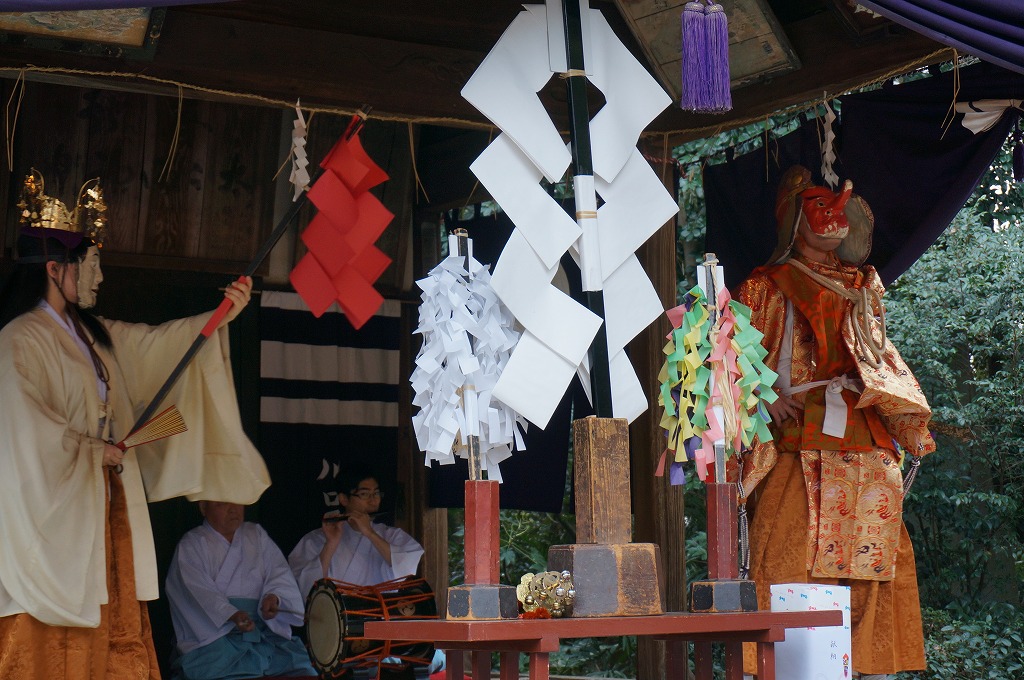
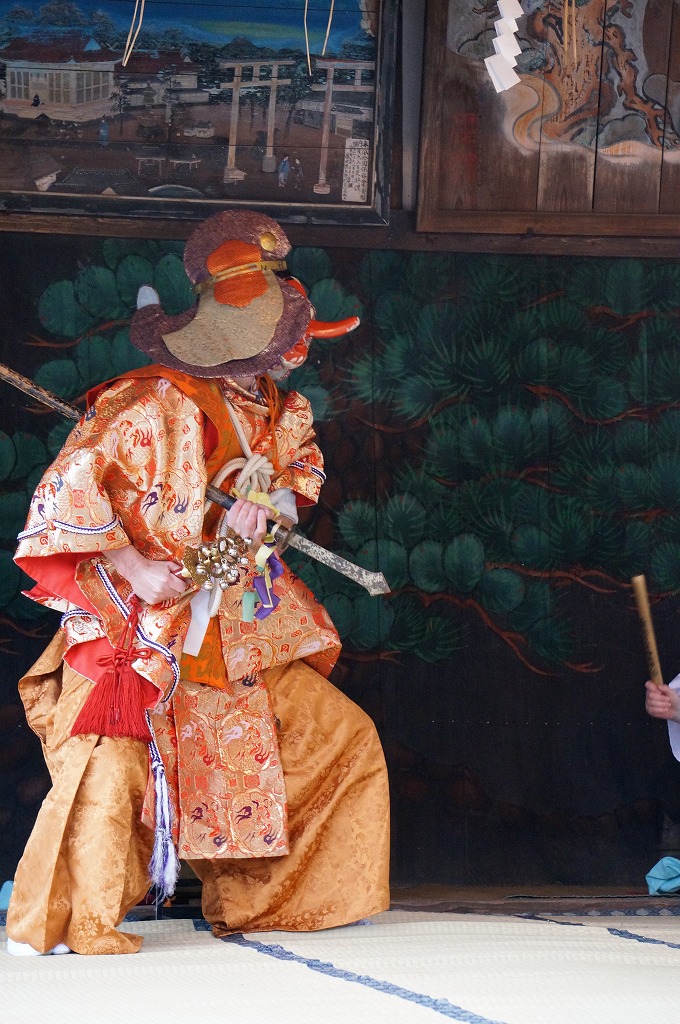
 Next program was based on mythology,too. When the grandson of “Amaterasu (a deity of sun)”, “Ninigi” goes down from his country “Amatsu kuni” to this earth, two deities got married with the meditation of “Ninigi”. One is a chaperon of Ninigi, named “Ameno Uzume“, and is a deity who had waited Ninigi’s group and led this coutry to safty, mnamed “Sarutahiko“.
two players are on the stage of kagura (Japanese traditional folk performing art)

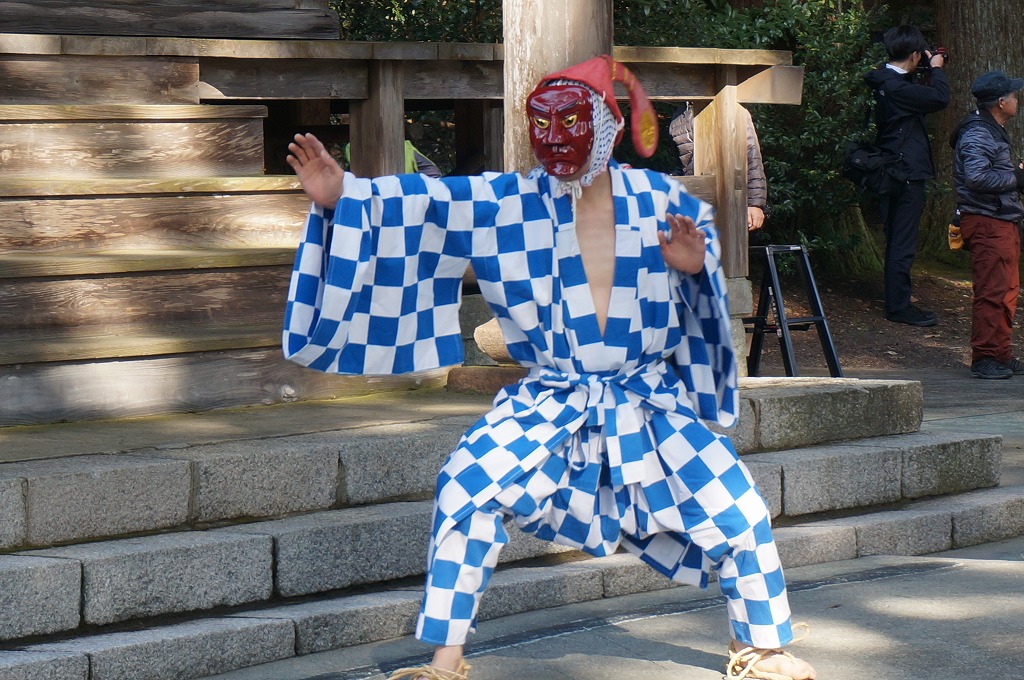
masked player of Kagura
Sarutahiko

masked player of kagura (Japanese traditional folk performing art)
Ameno Uzume

ameno uzume

sarutahiko

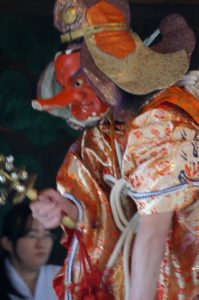
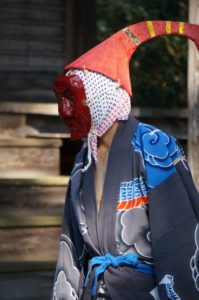
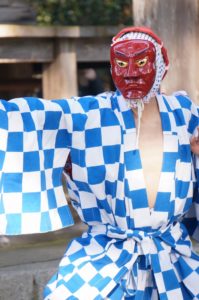
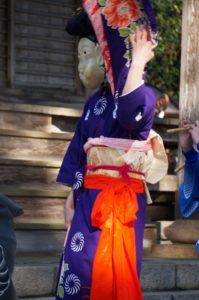
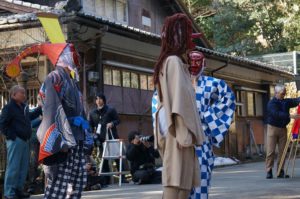
 So, two dancers enter the stage. One wore a red face mask with long -high nose, and another wore a female mask. The dancer with the red mask is “Sarutahiko”, and the other is “Ameno Uzume”. Sarutahiko held a pike, and Ameno Uzume held a big staff which red pieace of paper. Two dancers faced each other across the bridge, changing their position like the program of “Izanagi and Izanami”. This kagura basically consists of such dancing.
 It ended at 2:20.
3 players onthe stage of kagura (Japanese traditional performing art)

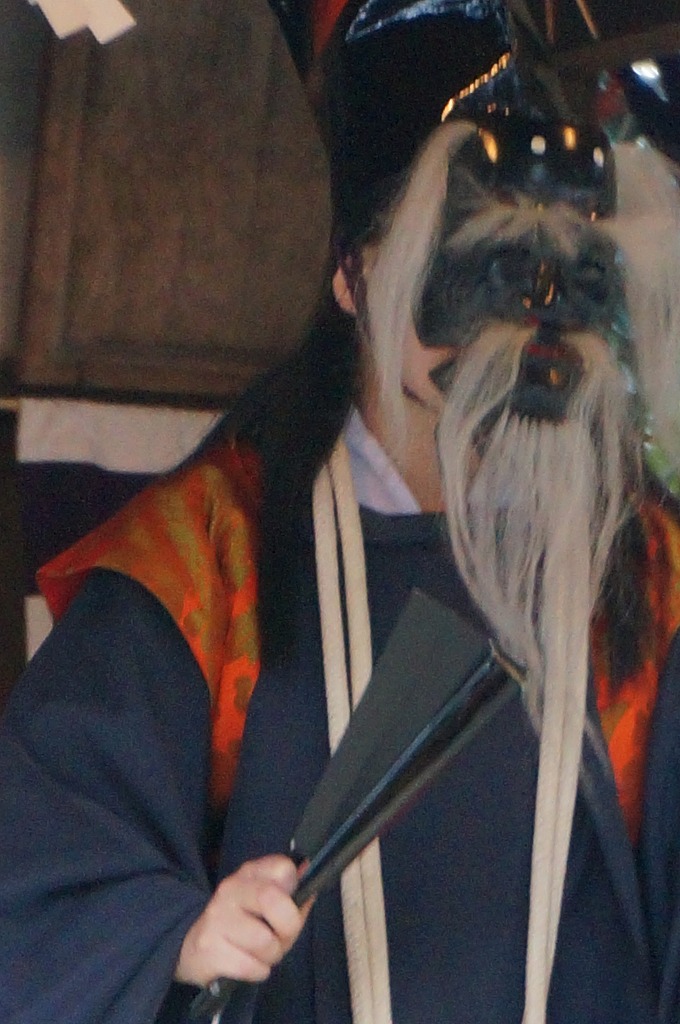
a maske player

a maske player

a masked player

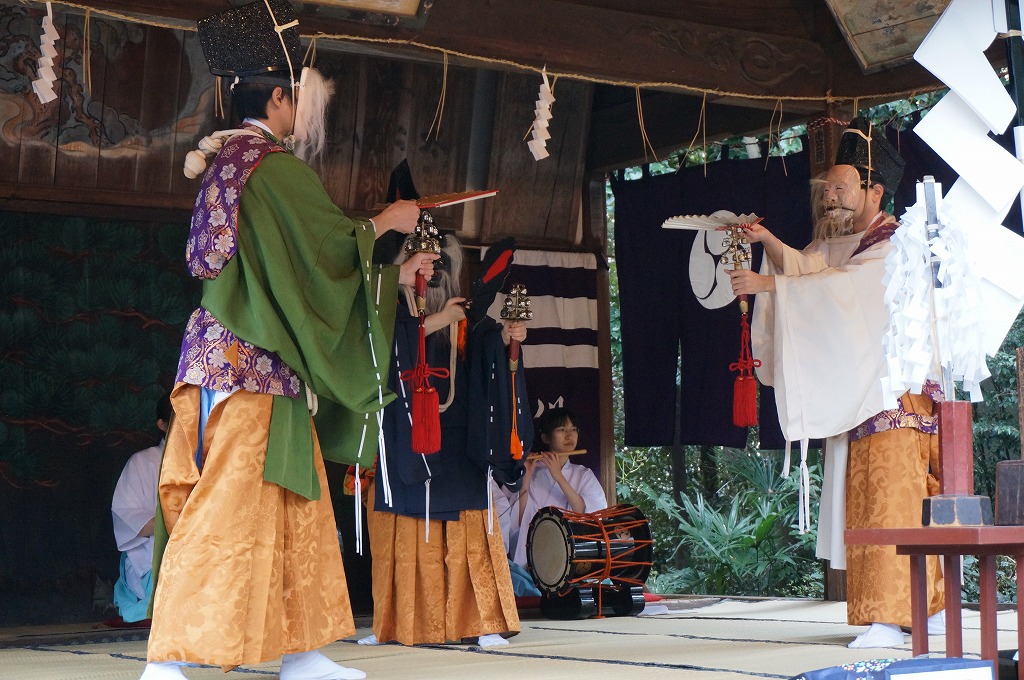
 After short break, next program started. Three dancers each wore a mask of “okina” (old man) with long mustache and beard. They each held fans, and danced slowly making a circle. It is said that it is to express a prayer for a peace of the world.

 After 30 minutes, the whole program for today ended.
 If you are interested in old style kagura, I recommended to watch this “Saibara kagura”. You can definitely see a noble and elegant dance program.

     For more information
 This kagura is held at “Washinomiya shrine (branch shrine)”, 15th April. It is at “Hachiho, Washinomiya town”.
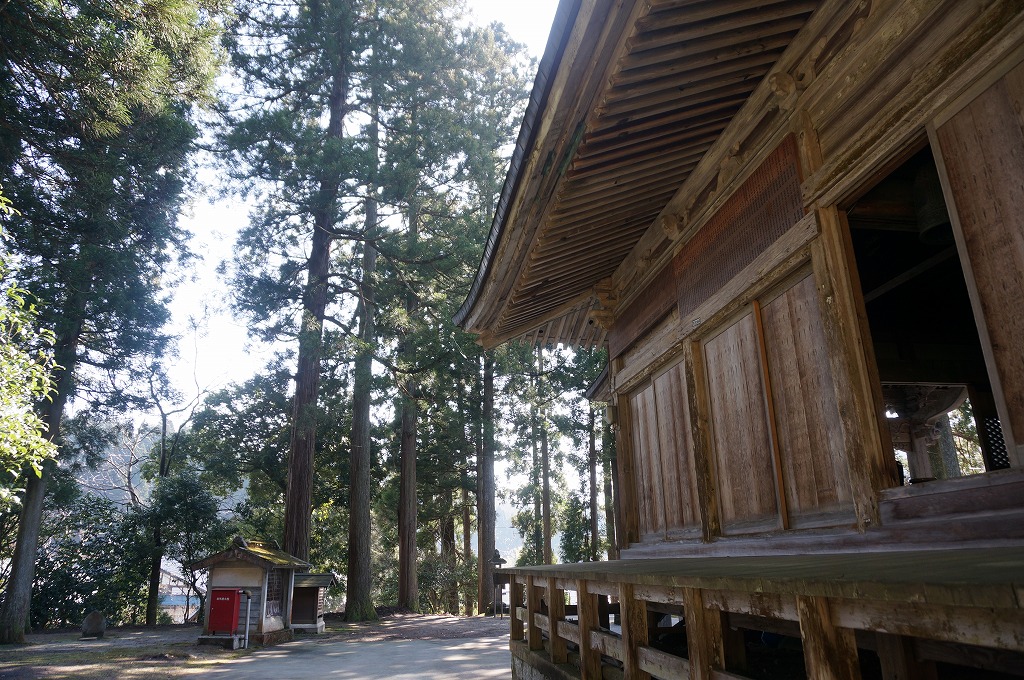
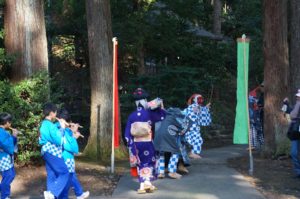
Report: Strange parade – Lion Dance in Ogawaji 小川寺の獅子舞

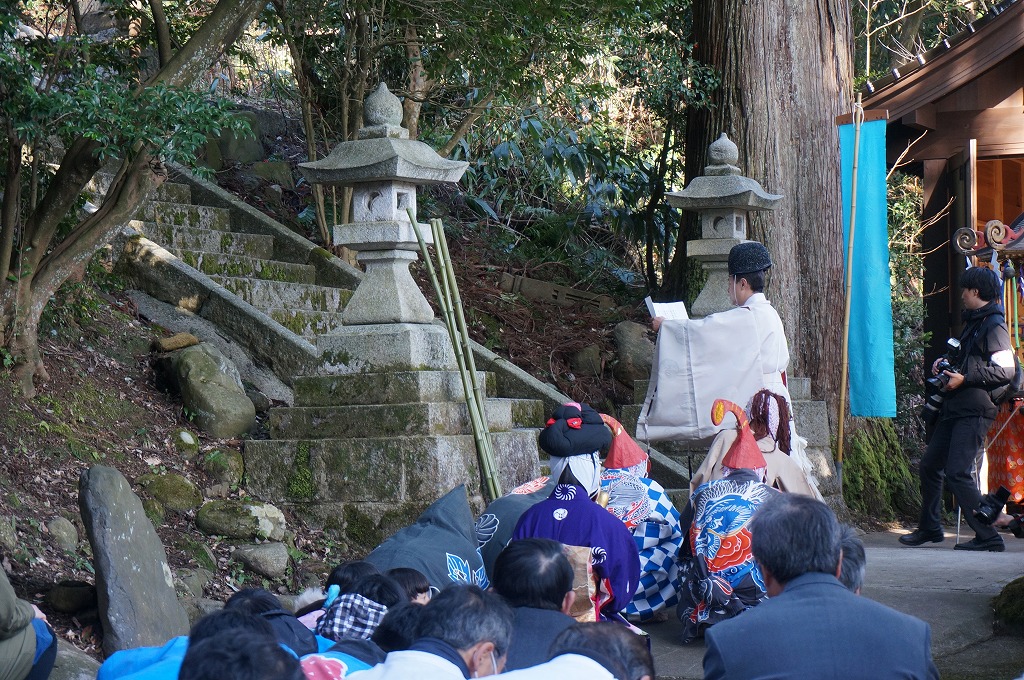
the parade of Japanese traditional folk performing art
strange parade of variants in Ogawaji, Uozu cuty

Date 4th January, 12th March, and 12th October pm 2:00~
Location Senkoji-temple, Ogawaji, Uozu city , Toyama prefecture
How to get there It takes 20 minutes from Toyama station or Unazuki-kurobe station

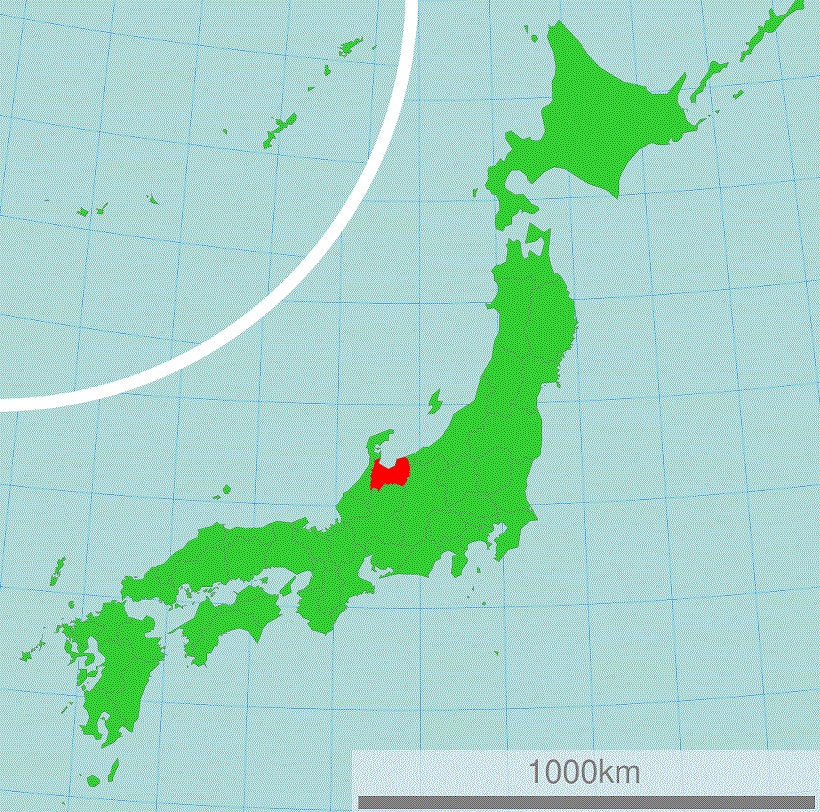
Toyam prefecture
Toyama prefecture 富山県

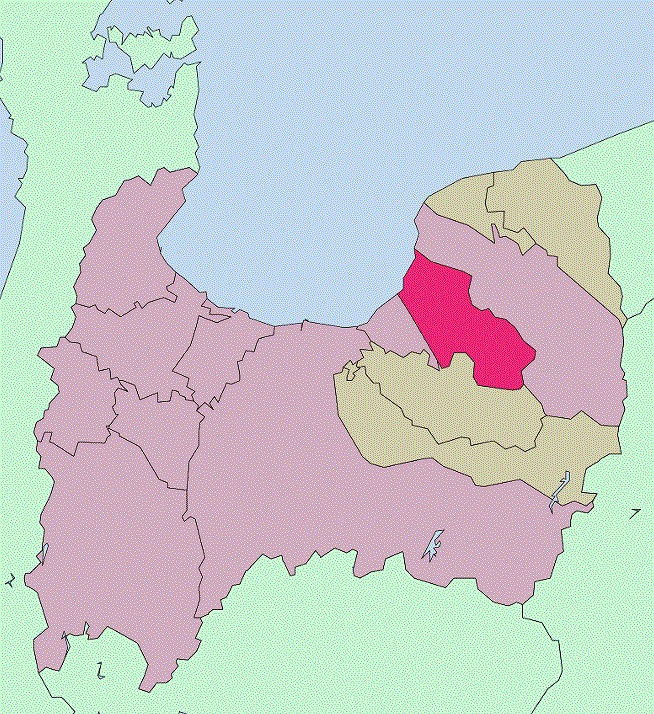
Uozu city
Uozu city 魚津市

Introduction

 An event we’ll look at this time is “Lion Dance in Ogawaji”.
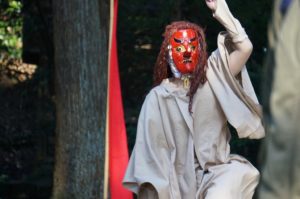
 This event is held on March 12th (and other days) in Uozu city in Toyama prefecture. Toyama prefecture is very prosperous region of Lion Dance, the performed number is over 850 now. There are a significant number of various kinds, and there are 10 main kinds we can break down into 3 categories. In that, the Ogawaji Lion Dance is classified as “Gyoudo Shishi” (Lion guiding the way), it follws the traditionl style.
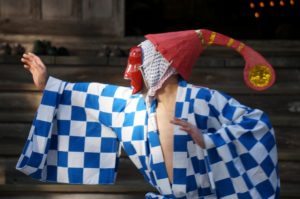
 I went to see this event in 2018. The following is from then.

 If you want to go to Uozu ciity, you have two options, Shinkanswen or express bus.
*in all of the above routes, the starting point is from Tokyo
 In the case of a train, from Tokyo you will take the Shinkansen to KUrobe Unzuki-onsen (黒部宇奈月温泉), transfer Toyama local line (Dentetsu Toyama; bound for Dentetsu Toyama (電鉄富山) station , for Shin Uozu(新魚津) station.
It takes about 2~3 hours and costs about \ 14,000. If you take a bus, from Tokyo to Toyama station, and transfer to the local line (Ai no Kaze Toyama あいの風富山) line; bound for Tomari 泊) and stop at Uozu station. The Uozu station is in front of Shin-Uozu station. It takes 8 hours and costs about \ 8,000). After arriving in Uozu city, you can take local bus (Kurosawa 黒沢 line) and get off at Ogawaji bus stop. But, there is only one bus every 2 hours, if you take a bus, you must get on a bus at 11:50, Kurosawa line (as of January 2020).

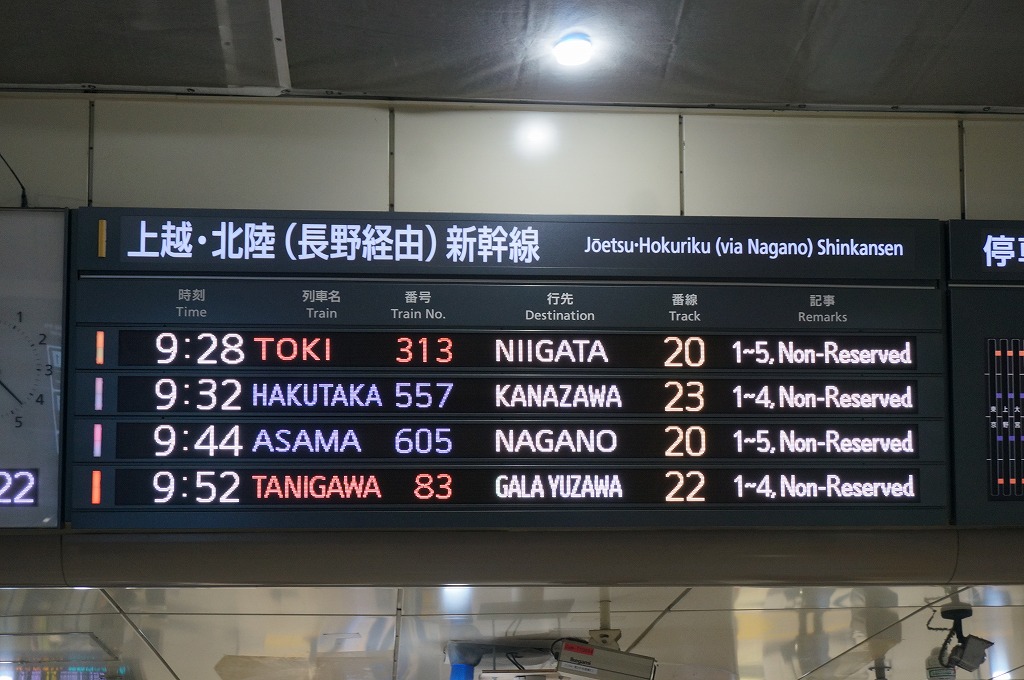
Tokyo station
Tokyo station 東京駅

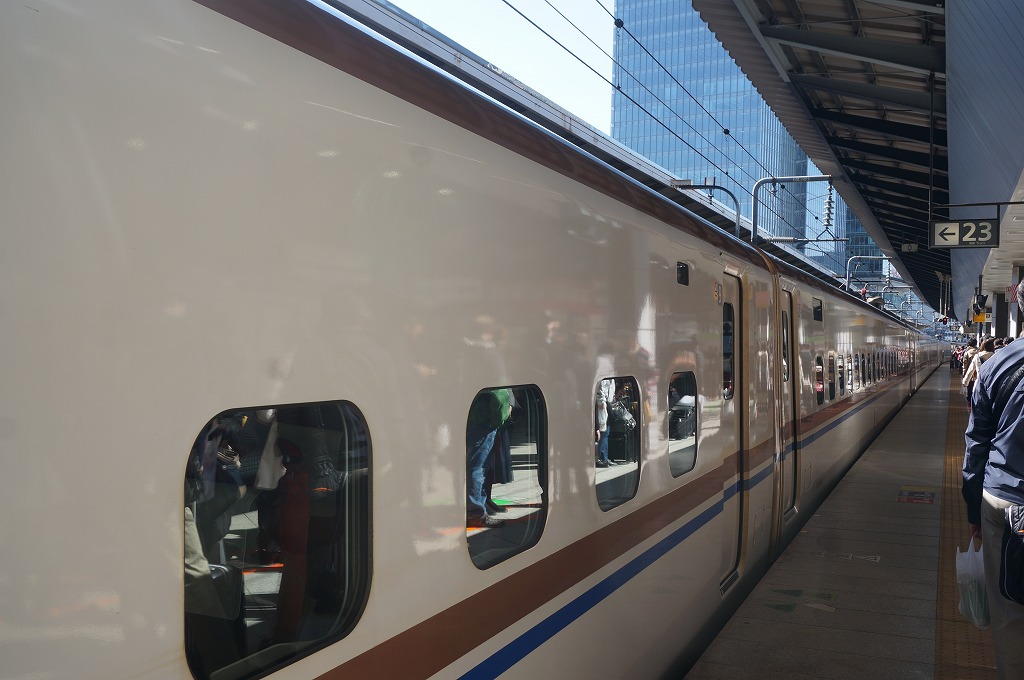
a Shinkansen
Shinkansen  新幹線

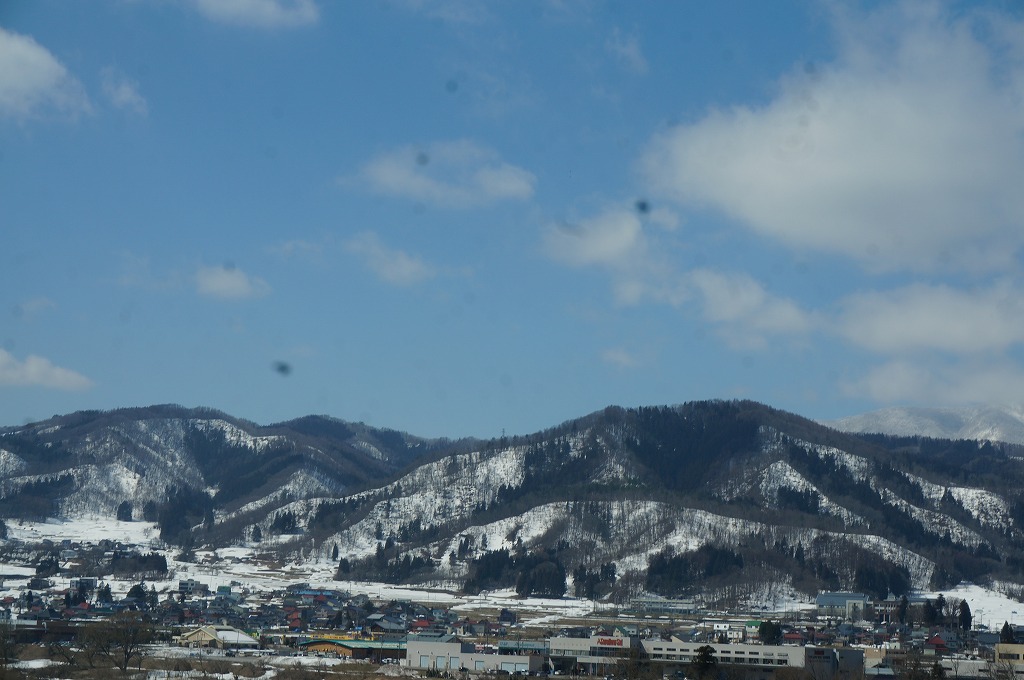
 When I went to this event, I took a Shinkansen at 9:38 (from Tokyo). the Shinknasen crossed Honshu, by way of the still snowy Nagano prefecture, after a little over 2 hours, I arrived at about 12 o’clock.

a iew of Nagano

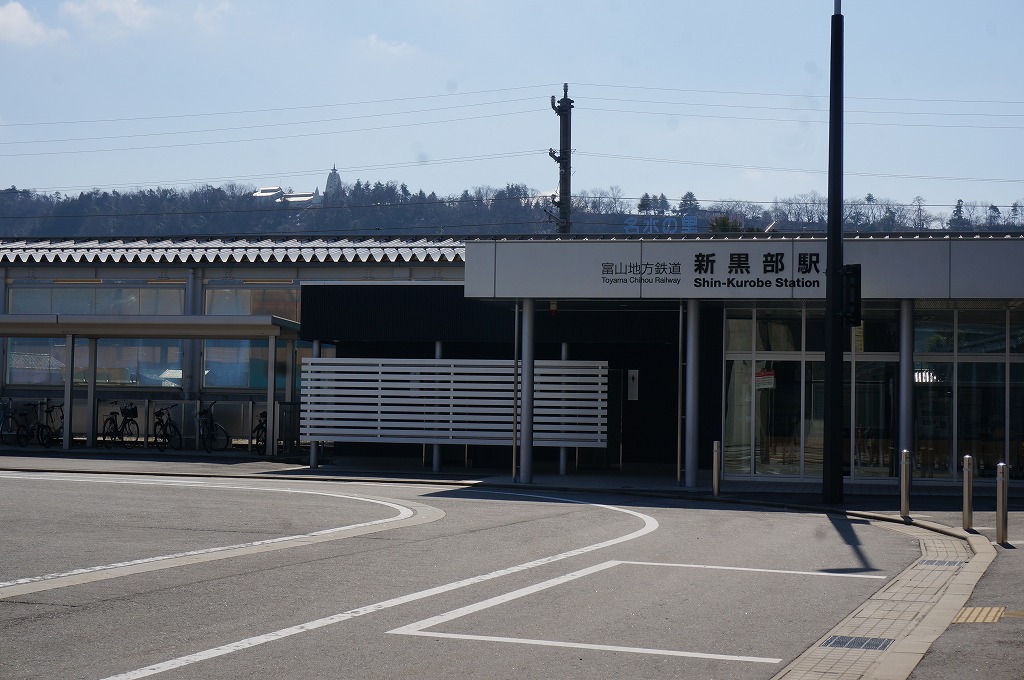
Shin Kurobe station
Shin Kurobe station 新黒部駅
is front of Kurobe Unzauki Onsen

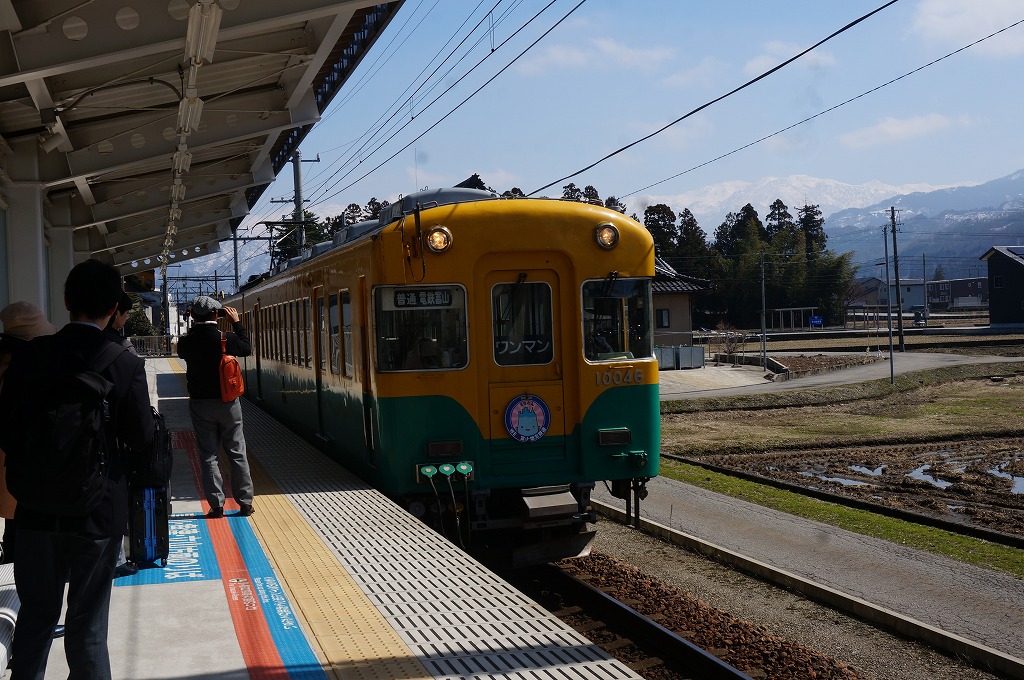
Dentetsu Toyama line
Dentetsu Toyama line 電鉄富山線

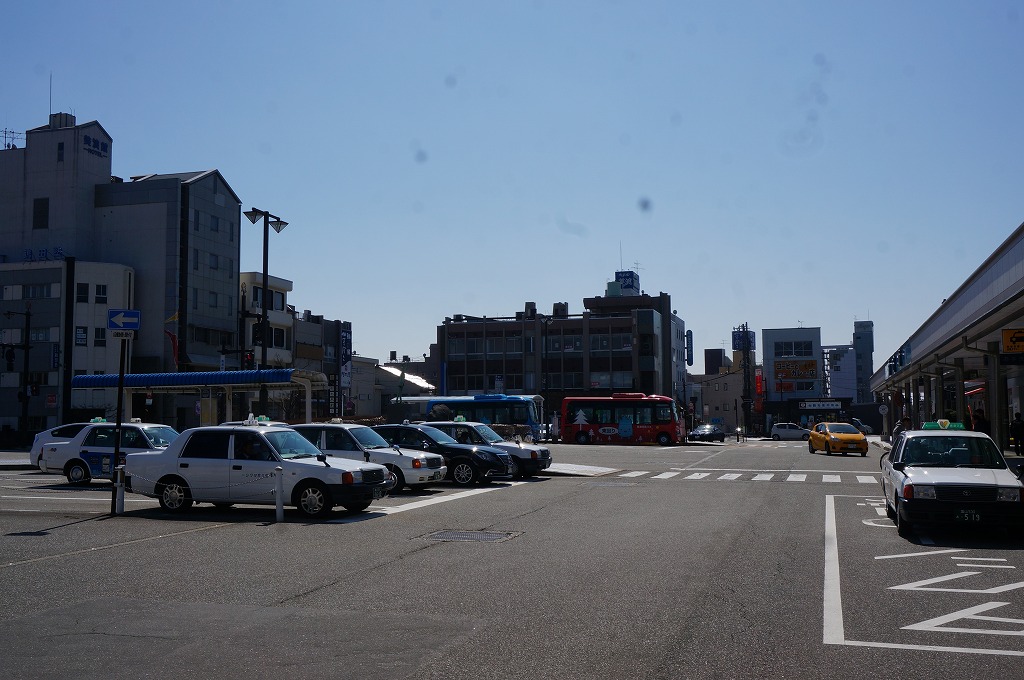
front of Uozu station

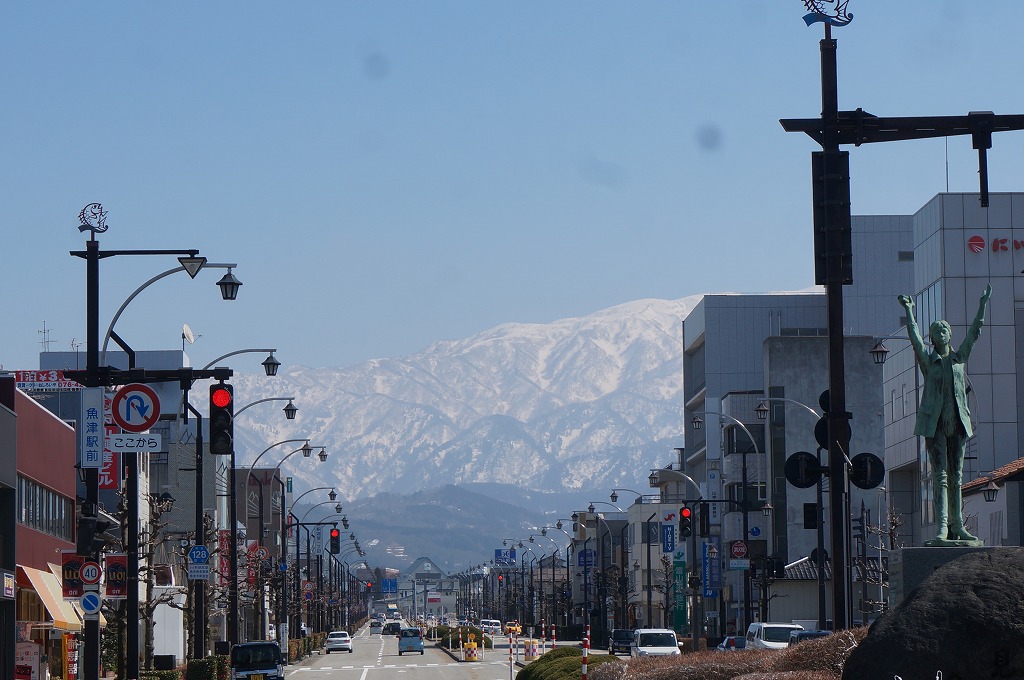
In Uozu city

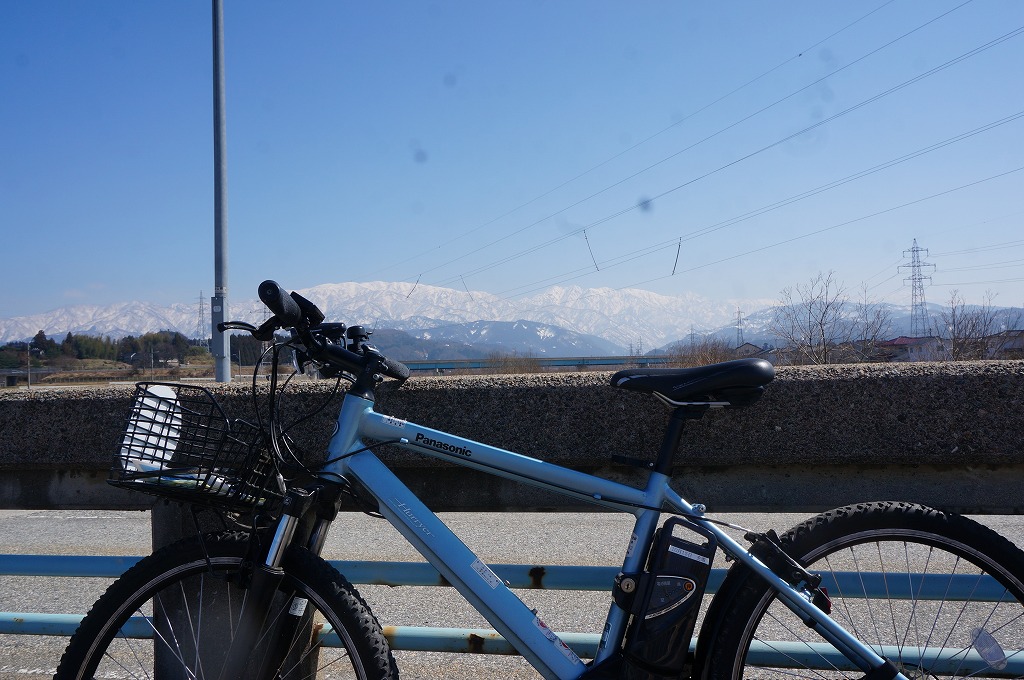
 The event starts at 2:00. The next bus will leaves at 12:38 (as in 2018). I had a little time, so I stopped by the tourist information center. A person working there was very kind and loved the city. I got a lot of information and many booklets. I heard that it’s about 4 kilometers from here to Ogawaji and road is flat. I decided to rent a bicycle. All are electric assist bicycle which are available from the information center, it costs \ 100~300.

Uozu city and Tateyama mountain range

a rant bicycle

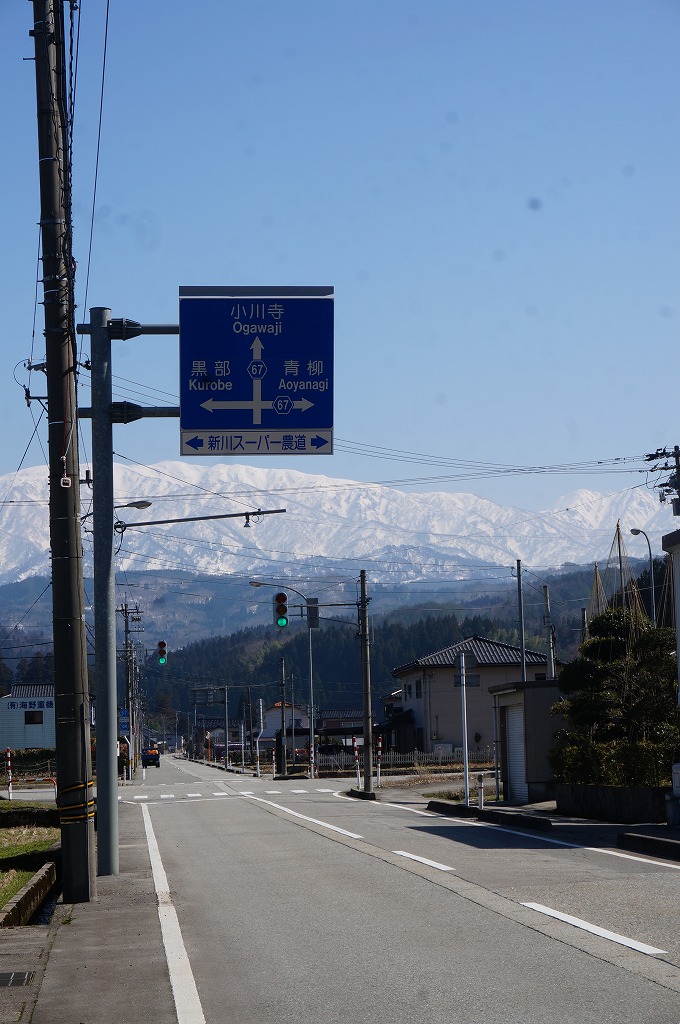
 It’s very fine, but the air is cold and feel chilly. Is this because it was still March or because this was Toyama? I was comfortable cycling, while seeing the snowy Tateyama mountain range. The city is very calm.

a road to Ogawaji
a road to Ogawaji

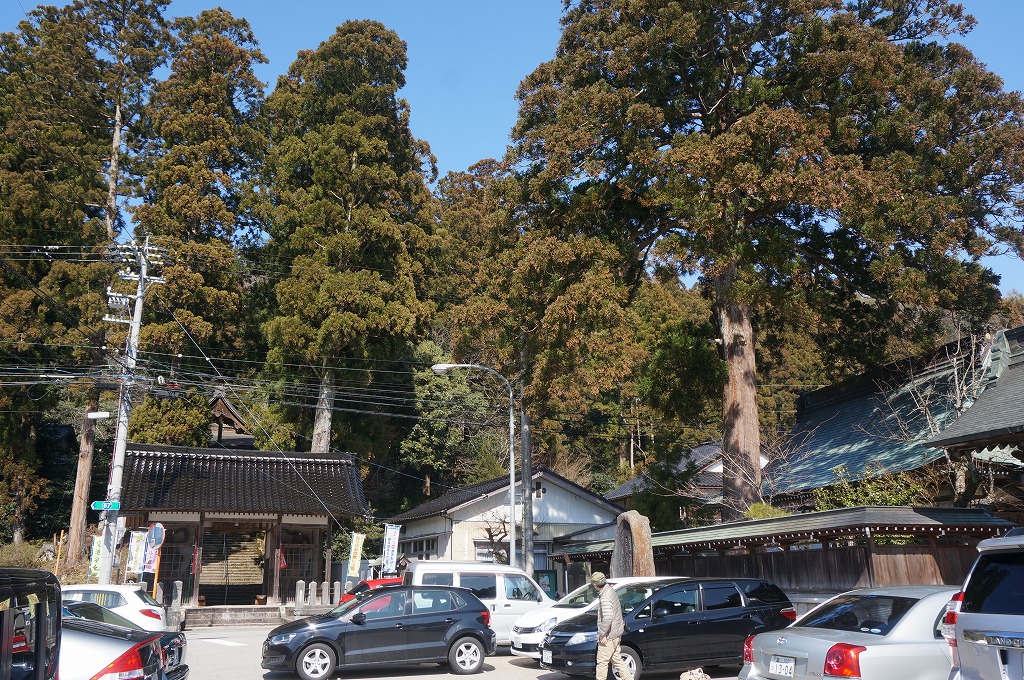
Senkoji-temple
Senkoji temple 千光寺

Senkoji-temple

The Kannon-do
The Kannondo 観音堂

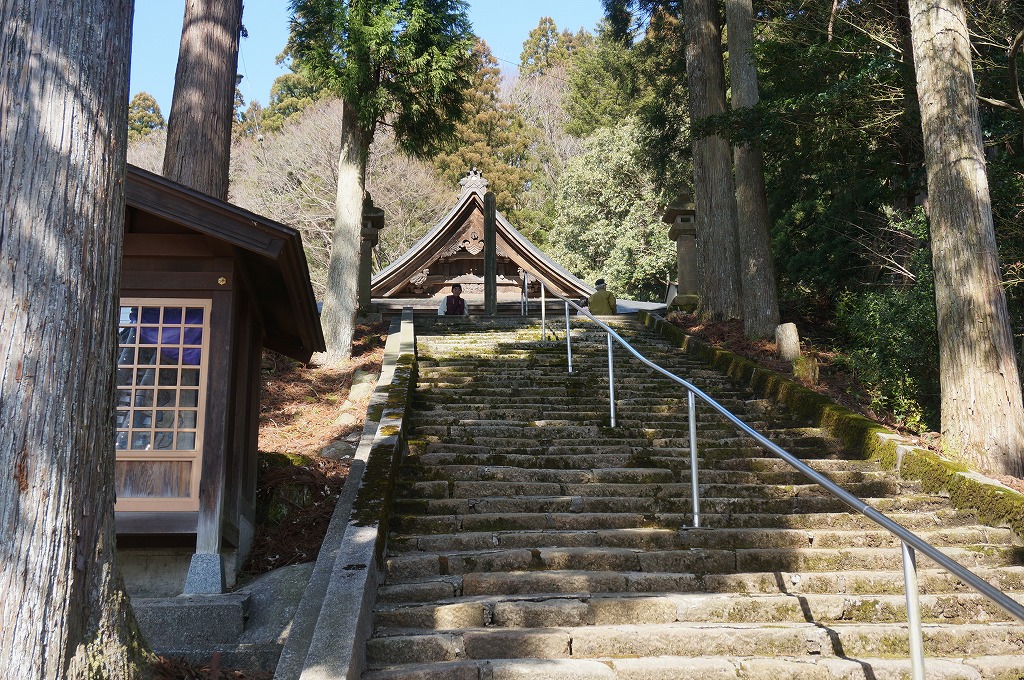
 I wonder, if I run some 2~30 minutes, I might finally arrive at the destination. It is the “Senko-ji temple”. There are steps for the “Kannon-do hall” right next to the building.

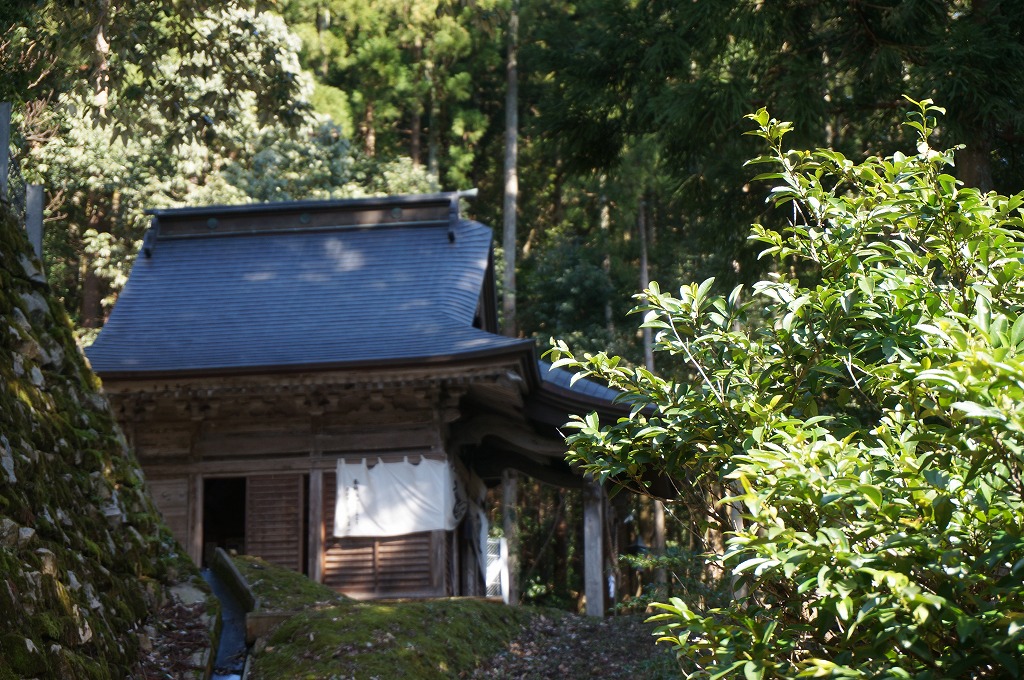
the Hakusan shrine
The Hakusan shrine 白山社

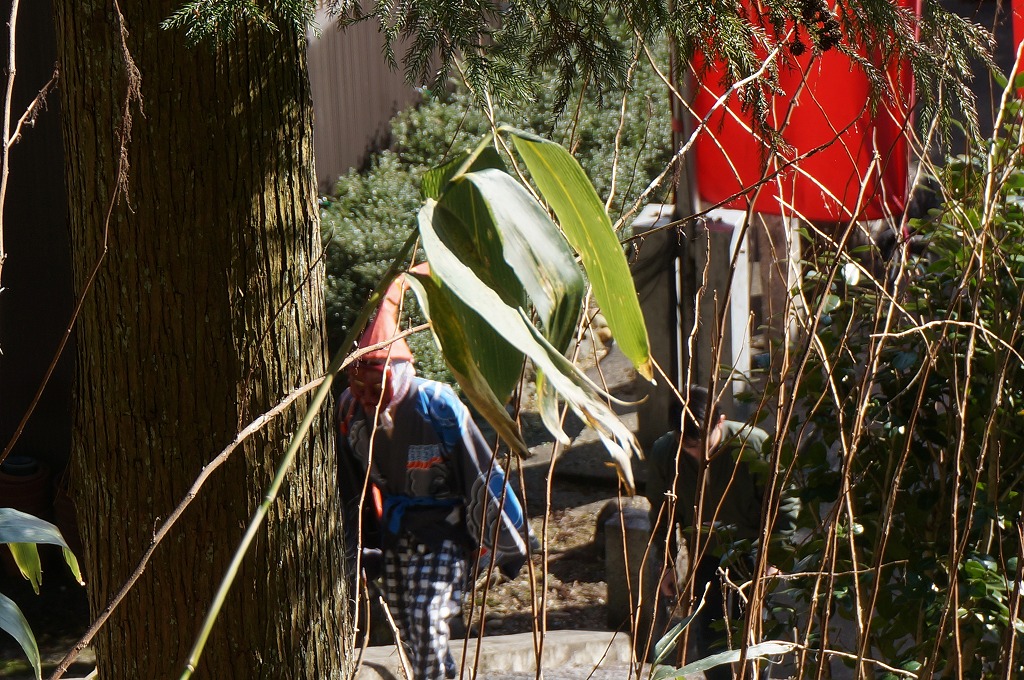
a strange man

 The precincts of the Kannon-do hall are unexpectedly large. About 2~30 people already were as if surrounding the Kannon-do hall. The neighboring building is the Hakusa shrine. As for the men, while the women gather in the Hakusan shrine, the men gather in Kannondo hall. In the Kannon-do hall a priest gives sutra-chanting, and Shinto priesthood gives a congratulatory address in the Hakusan shrine. This is a rare event, mixing Buddhism and Shintoism. In Japan, originally, the syncretism of Shinto and Buddhism was widely seen from the Heian period (9~10 C) until the Meiji restoration (1968), and Shinto and Buddhism were not distinguished from each other as a general rule. Therefore a trace is sometimes still seen in this way.

 A group is going to do seven laps here. On that day, the event was going to begin at 2:00 pm, but it was half past 2 and it started at 3:00 after all. A Buddhist priest seemed to be late for a funeral.

strange men at the shrine

before parade

 I looked at some strange people who come up the stairs between some trees. It may be finally beginning. First, they stopped at the Hakusan shrine 白山社 and gathered at the foot of the steps, they then received purification of the Shinto priesthood. Several children who hold the flags stood up. With them in the lead, a parade begin.

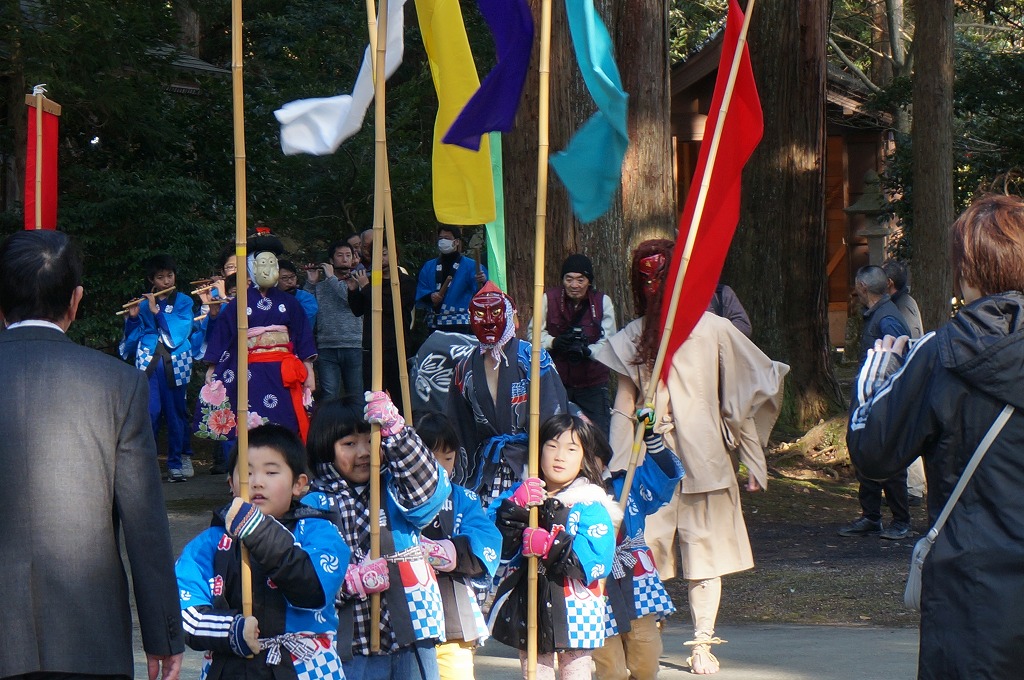
The parade has began

the parade has started

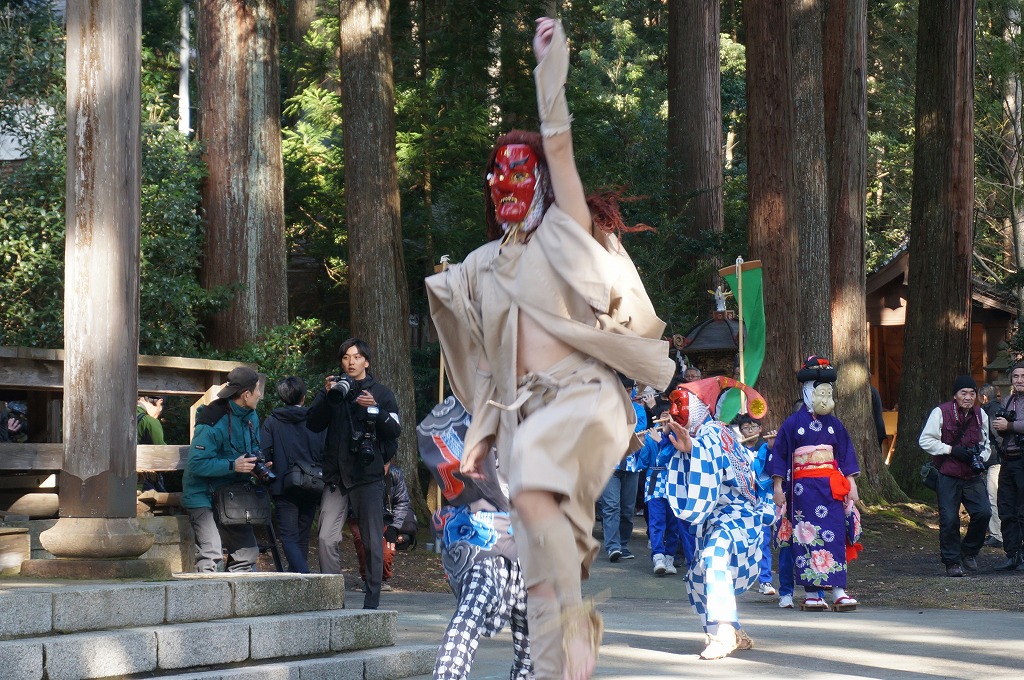
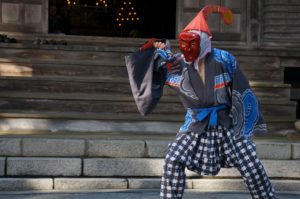
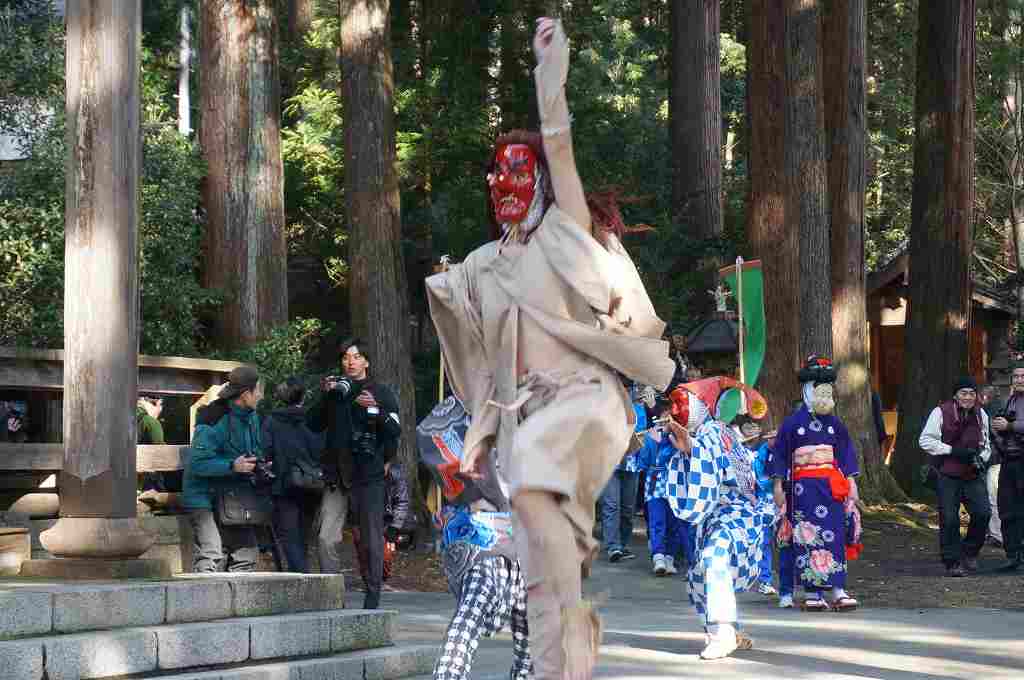
Tengu,a lead of the parade
Tengu 天狗

 Strange people appeared with flute and drums before us who were wating. At first, it is Tengu 天狗. The kind look that some mind seems to be weak here through Tengu is severe or it is a scary image. He come while jump up and down lightly.

many strange men

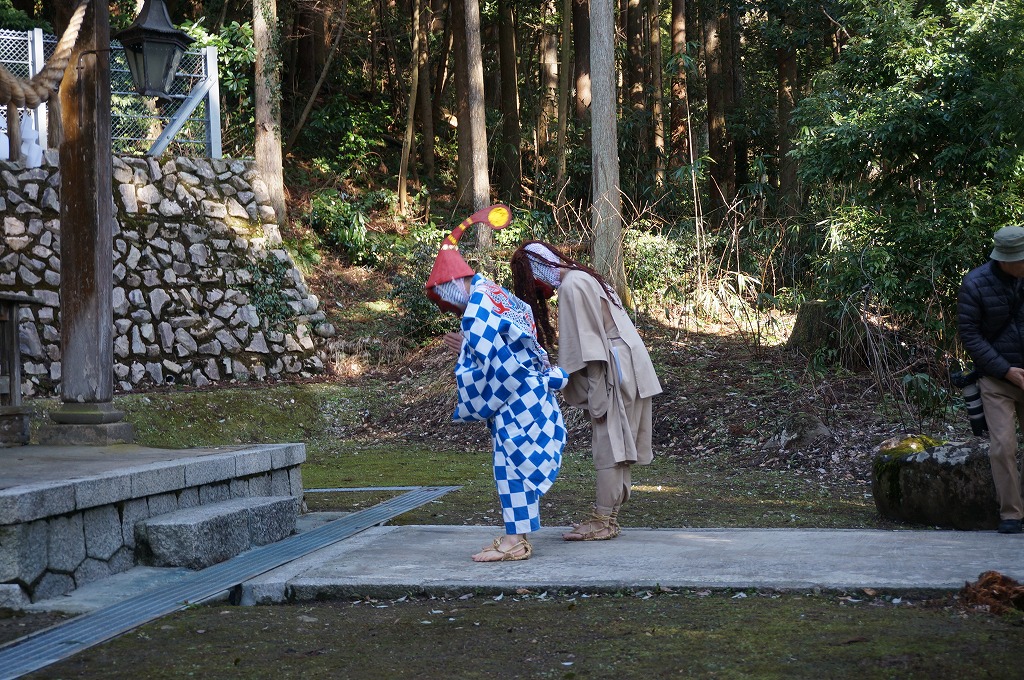
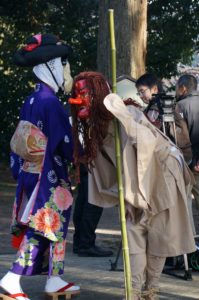
baba-men (masked character)
baba-men ばば面

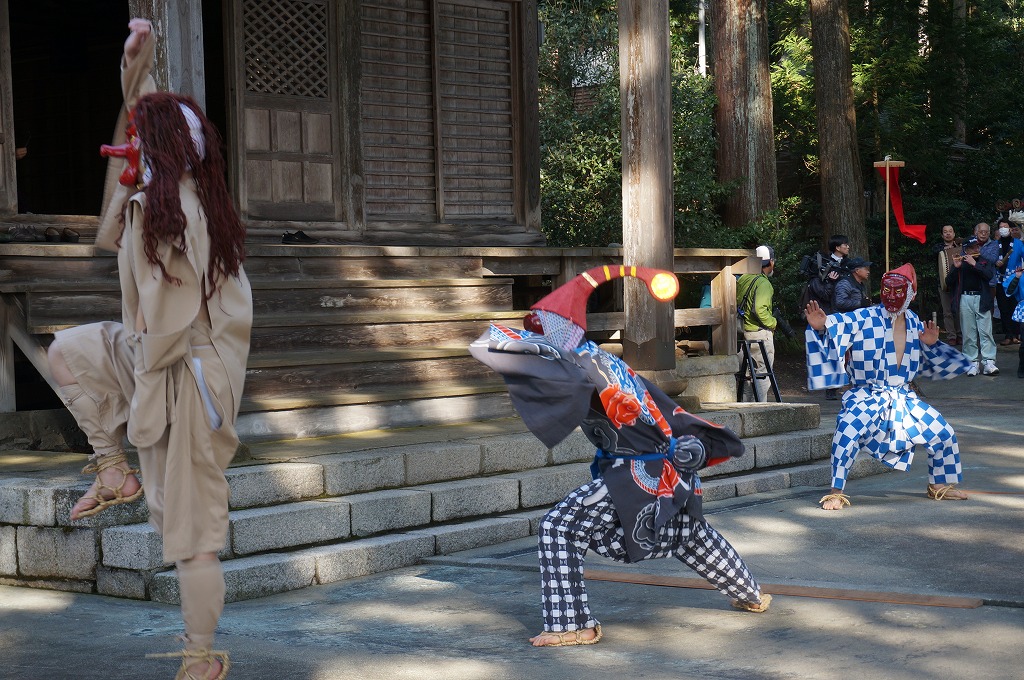
 They walk with their hands and feet at same time. Next, two people following Tengu walk towards the same direction. They don’t jump, instead of push their hand up front powerfully with one step forward while glaring at front. They are called “baba-men(mask)”. Further more, they wear distinctive clothes characteristic. One is the pants of the striped pattern on showy clothes, and another is all striped. And after all, to catch the eyes is a strange headpiece. It seems like a crown. I have never seen anything like that. It is not Japanese -style at all. Where did this design come from?

the lion

the lion
Chinese Lion (Shishi) 獅子

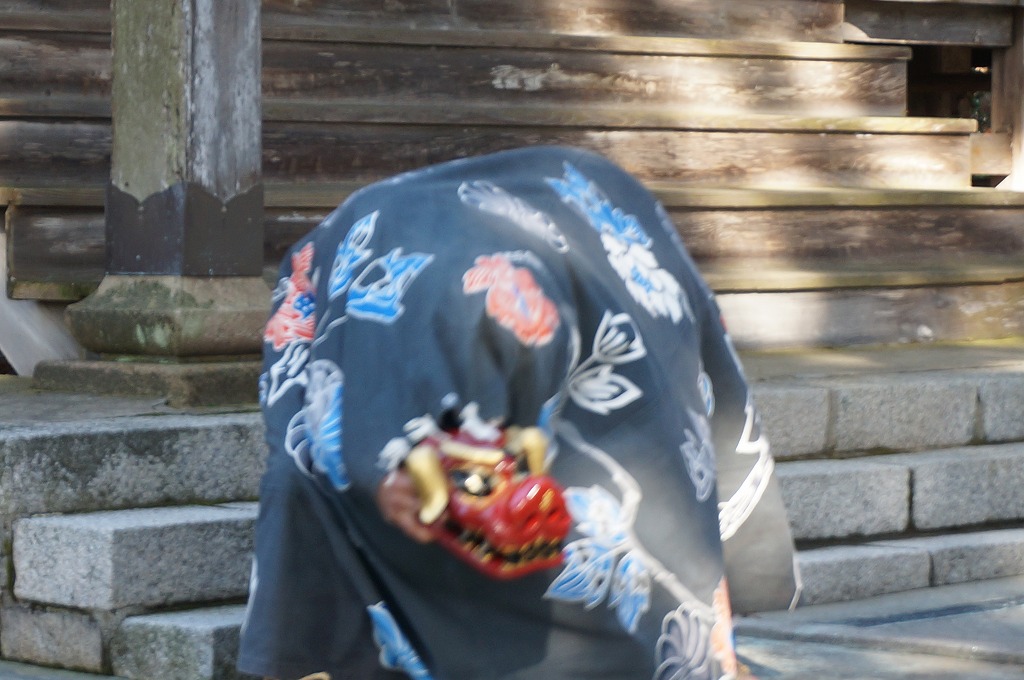
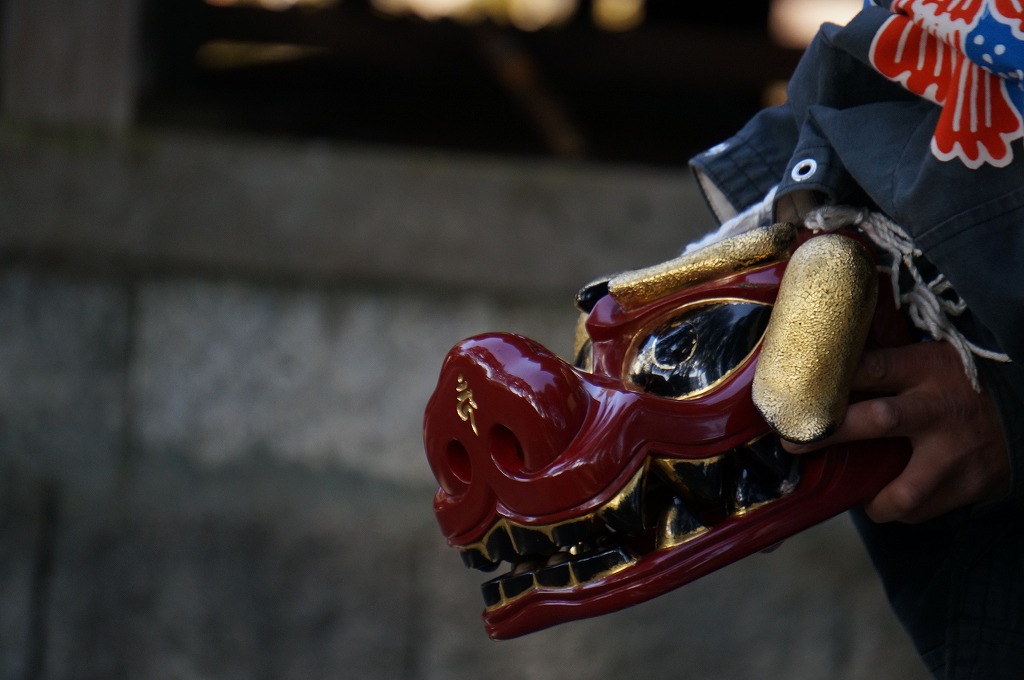
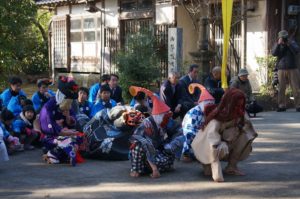
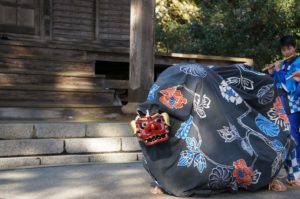
 Next comes a lion. Even though I call a lion, this is a Chinese legendary creature, it is totally different from the real animal. Japanese call them Kara-jishi (Chinese Lion). In Japan, there are many folk performing art about this Chinese lion. They are called Lion Dance. Lion Dance has various kinds. In this Ogawaji, it is the oldest style. They are only walking. Though, it’s very tough to walk while lowering the body. Older men say that they cannot walk for a muscular.

anema-mask

an anema mask
anema-men (mask) あねま面

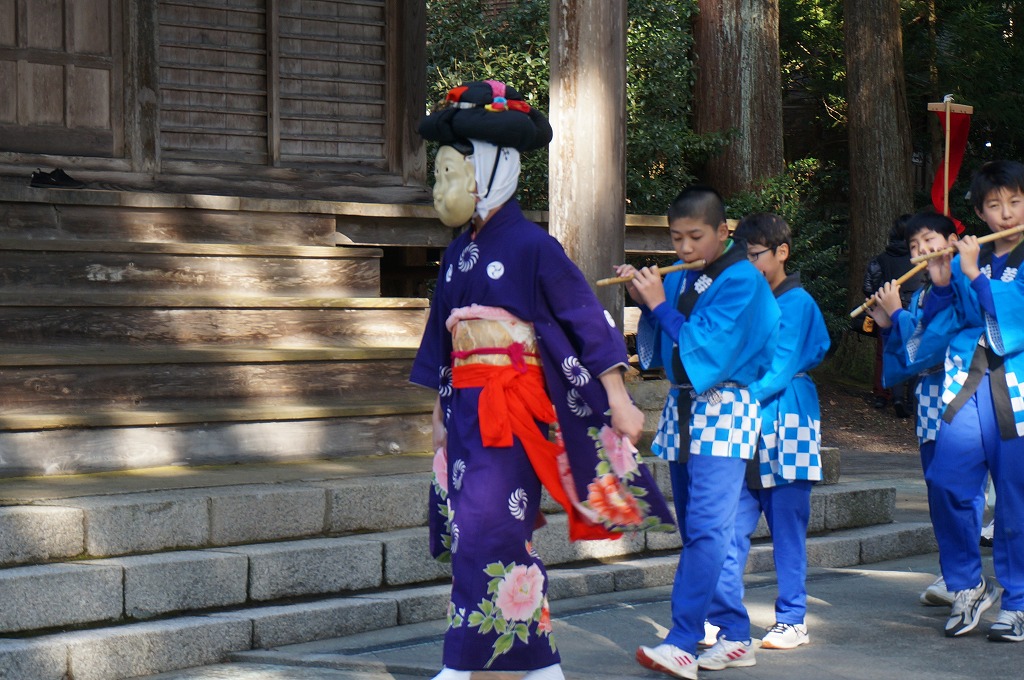
 And the lion following is a woman called “Anema”. She is coiffured old style and mouth bends for some reason and is walking while raising a sleeve by one step. And flute players, drum players and portable shrine. Though they say portable shrine (mikoshi 神輿), they pull it on a carriage. It is difficult for a few people to carry it on shoulder, so it become today’s style. They decided to concider it to walk around 7 laps for walk around all town.

mikoshi
mikoshi 神輿

a tale of the parade

 This event is only they repeat this 7 times. It seems very strange.


Tengu

baba-men

baba-men

anema

 Legend saya that both “baba-men” and “anema” was old heros and heroine. Name was Morimoto Sanemon, Joudou Rokubei and Omatsu. They fight with next village or avaricious feudallord. But now, we do not know the merely true meaning. Only this strange event has remained today.

parade is braaking

wating

a Shinto priest

many starange people

 A break time enters once on the way. They sit in front of Kannon-do, Shinto priest read a long address to the deities. After this, they walk aronud again.

Tengu

baba-men

the lion

 After they finished laps, they came back to the starting place, under the Hakusan shrine. The event is finished.

a parade
a strange man (masked character)

tengu and anema

 At the event, they accept taking a ceremonial photograph.
 Totally about 30 minutes, this event had finished.

 If you want to video, please click here.↓

   for your information
http://go-centraljapan.jp/lsc/lsc-upfile/pamphlet/01/33/133_1_file.pdf Pocket Guide Uozu

 If you have some time, I recommend sightseeing around Toyama. The place where there are old cityscapes, hot springs and natural. There are many places for sightseeing.

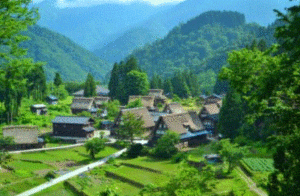
world heritage “Gokayama”

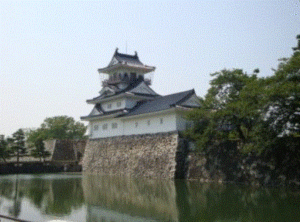
castle and park

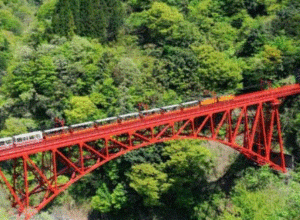
natural “Kurobe”

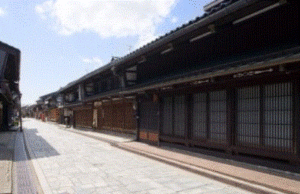
old town “Kanaya”

evry pictures from https://www.info-toyama.com/spot/21100/ Toyama prefecture とやま観光ナビ 

  Reference
https://foreign.info-toyama.com/en/ Tourism information in Toyama